
- Collection type
- Object
- Description
- Iron hoe blade with socketed base, used as a form of currency [RTS 15/6/2004].
- Long description
- Iron hoe blade, made from two pieces of iron joined together. The body consists of an almost circular blade with flat upper and lower surfaces, the edges of which curve in at the base to meet a round sectioned socket, almost as long as the blade itself. This socket is open along the length on one side, with the opening gradually widening towards the end. Where the socket overlaps the blade, it has been hammered flat and then welded into place. This has left a slightly raised, triangular ridge that tapers towards the centre of the blade on one side. The object is complete and intact, with hammering marks visible on most surfaces, and is currently a dark metallic gray colour (Pantone 425C). It has a length of 226 mm; the blade is 130 mm long, 122 mm wide and 1 mm thick; the socket is 23.6 mm wide and 21.6 mm thick. The object has a weight of 344.2 grams [RTS 15/6/2004].
- Geographical reference
- Person
- Maker Unknown Maker
- Field collector John Petherick
- PRM source Augustus Henry Lane Fox Pitt Rivers founding collection
- Date / Period
- Date made: Possibly before 1858
- Date collected
- 1858
- Acquisition information
- Donated: 1884
- Materials and processes
- Material Iron Metal, Process Forged (Metal), Process Hammered, Process Welded
- Dimensions
- Diameter: max 23.6 mm socket, Width 122 mm blade, Length 226 mm, Length 130 mm blade, Weight 344.2 g
- Object numbers
- Accession number: 1884.99.3
- Research and responses
This object is said to have been collected in 1858; in that year Petherick led a trading expedition south from Khartoum, down the Bahr el Abiad, Bahr el Ghazal, Jur and part of the Bahr el Jebel rivers. This route took him through Shilluk territory (the villages of Kaka and Gova), Raik Dinka territory (the villages of Coq-quel-a-ken, Moi Chin, Agoig, Affoock), and Jur territory, among others. This material was shipped back to England in 1859. An account of this expedition is given in his 1861 volume, Egypt, The Sudan and Central Africa. A similar object, used as a hoe and mounted onto a wooden handle, was illustrated in his 1869 volume, Travels in Central Africa and Explorations of the Western Nile Tributaries, on p. 249, where it is attributed to the Jur. He also describes how the Jur manufacture such items and trade them on to the Dinka (See J. Petherick 1861, pp 395-6). The implication of this is that this even although this object may have been used by Dinka or Shilluk individuals, it was probably manufactured by the Jur. However the same type of object appears to be more widespread. Schweinfurth illustrates an almost identical blade, collected from the Bongo, which he calls 'loggoh' and says functions as currency; and from the Jur, where it is described as a hand spade for weeding (G. Schwienfurth, 1875, Artes Africanae, pl. IV figure 14; pl. II figure 20; see also 1873, The Heart of Africa Vol. 1, p. 279). J.G. Wood also talks about the use of hoe blades, or 'molotes' amongst the Latuka for both agriculture and as currency (J.G. Wood, The Natural History of Man Volume I, 1868, p. 508, and figure on p. 475). [RTS 15/6/2004].
This object was subsequently acquired by Pitt Rivers, presumably at auction, as the accession book entry bears the note 'lot 42' [RTS 15/6/2004].
Search terms: Tool, Agriculture and Horticulture, Currency, Trade, Hoe, Agricultural Tool, Token
Further items to explore
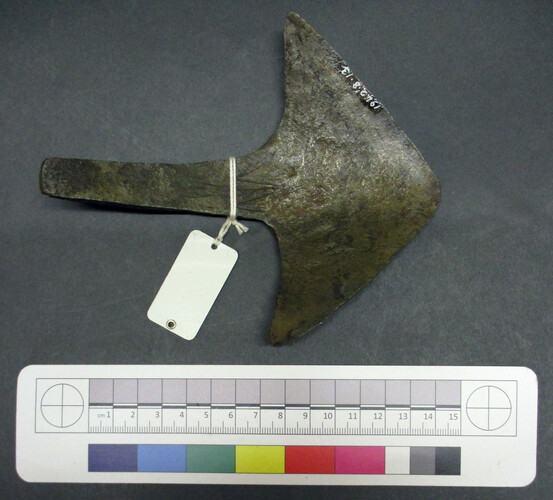 1942.8.13Iron hoe blade. [JC [OPS Move] 14/12/2016]1942.8.13
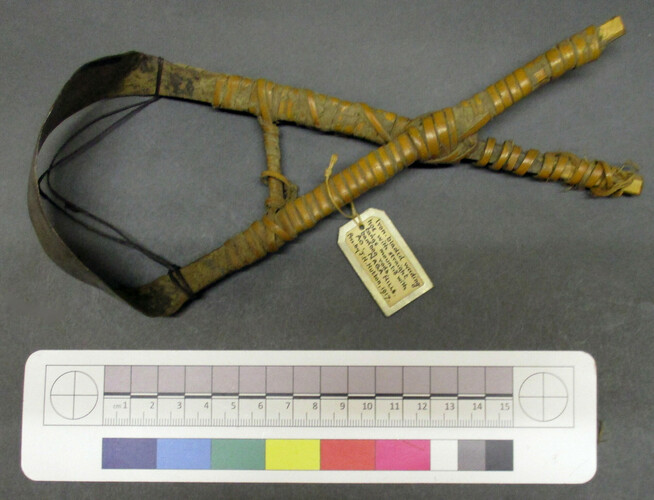 1923.84.333Weeding hoe. [JC [OPS Move] 14/12/2016]1923.84.333
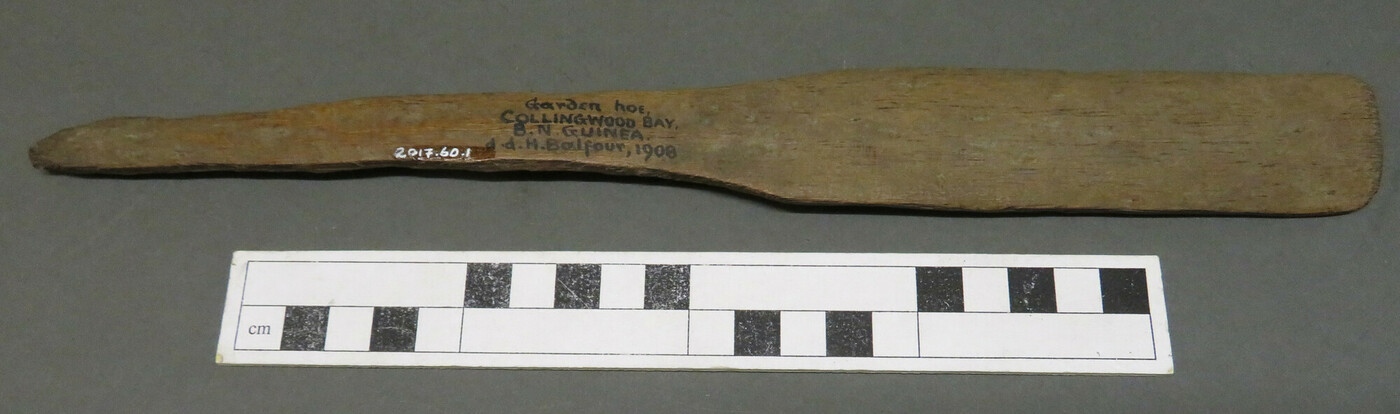 2017.60.1Wooden garden hoe. The hoe consists of a rectangular section with a narrower handle extending from one side. [SB [OPS Move] 12/6/2017]2017.60.1
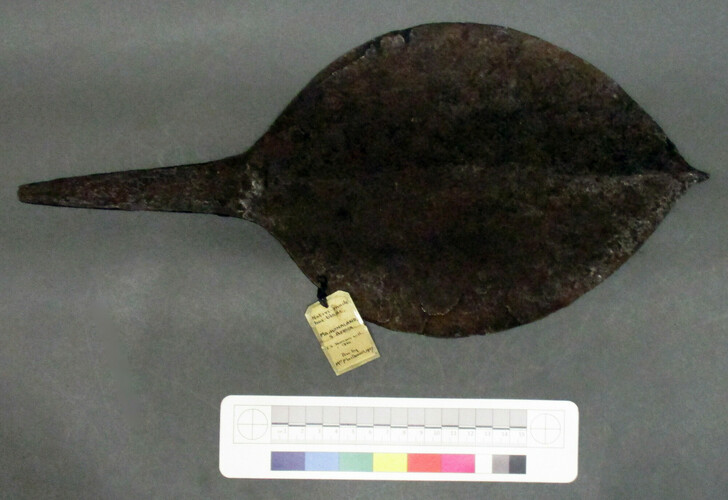 1927.54.36Hoe-blade, made from iron. Leaf-shaped with a pointed tip. The tang is tapered. [AB [OPS Move] 20/12/2016]1927.54.36
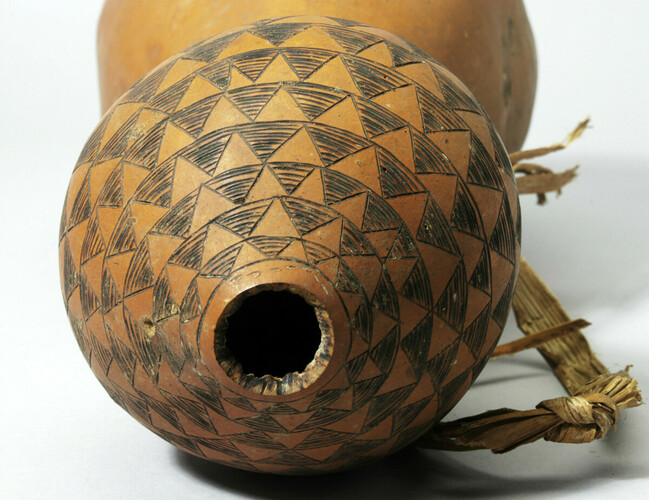 1948.2.158Tall bilobed gourd container with pyroengraved hatched triangles decorating upper part, and a fibre carrying strap [RTS 16/8/2005].1948.2.158
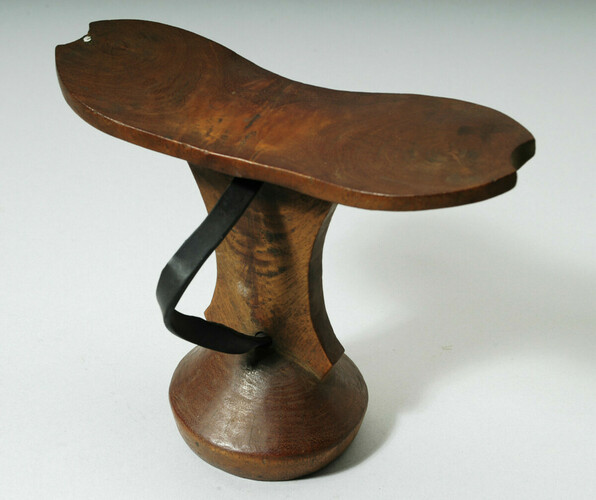 1979.20.172Wooden headrest with notched, bilobed seat on a flat pedestal with hollow conical foot and rubber carrying loop, used by men for sitting and sleeping [RTS 1/6/2005].1979.20.172
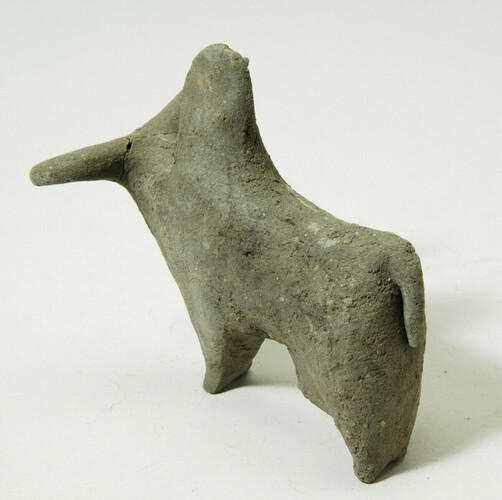 1936.10.88Hand modelled clay ox with humped back and trained horns, used as a toy [RTS 5/10/2004].1936.10.88
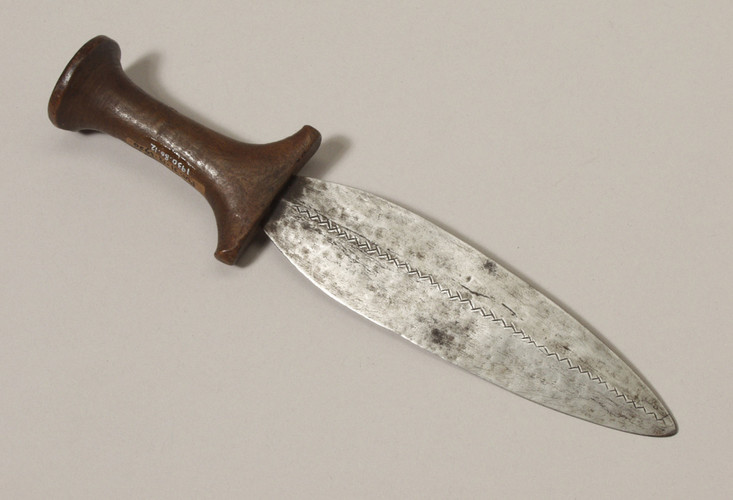 1930.86.12Knife with two edged iron blade decorated with incised zigzags, and wooden handle with flared cross guard. [SM 15/06/2007]1930.86.12