
- Collection type
- Object
- Description
- Knife with two edged iron blade decorated with incised zigzags, and wooden handle with flared cross guard. [SM 15/06/2007]
- Long description
- Small knife with carved wooden handle, consisting of a flat end, slightly concave in places and roughly oval in plan view, with a narrow flat outer edge, then concave sides flaring in and then sharply out to form the handle guard. The body of the handle is round in section, but this flattens out as the handle splays out, becoming sub rectangular at its widest point. The guard end is cut flat, with a slot cut into it to receive the blade tang; this slot has been widened at the centre on either side to accommodate the thicker midrib of the blade. The other end of this tang can be seen projecting from the flat handle end, where it has been bent over and hammered back into the wood to fix it in place. The blade is made of silvery gray coloured iron (Pantone 423C), with a narrow, leaf-shaped form consisting of a slightly angular midrib running down the centre of the length on either side, representing the thickest part, thinning out towards each of the two cutting edges; this gives the blade a flattened, lozenge-shaped section. The edges curve in to a slightly blunt or rounded point. The blade is decorated along the centre of its length on both upper and lower surfaces, with an incised zigzag motif formed from a series of short oblique lines in alternating directions; occasionally these overlap at the ends. Probably hammering marks may be seen on the surface of the blade. Complete; there is no damage along either cutting edge of the blade, but the projecting handle guard has been damaged on one side. This looks to have been subsequently polished over, as it is stained the same glossy mid brown colour of the rest of the handle (Pantone 463C). Total length of object 204 mm, length of 69.5 mm, length of blade to hilt 134.5 mm; width of flat handle end 32.5 x 30 mm, diameter of handle body 15.6 mm, width of handle guard 48 mm, thickness of handle guard 12.3 mm; maximum width of blade 33 mm, maximum thickness of blade 2.3 mm, thickness of blade edge 0.2 mm [RTS 17/2/2004].
- Geographical reference
- Northern Bahr el Ghazal Western Bahr el Ghazal Warab Lakes Western Equatoria
- Cultural groups
- Rumbek Jur
- Date / Period
- Date made: Before 1930
- Date collected
- By 1930
- Acquisition information
- Purchased: 31/12/1930
- Materials and processes
- Material Iron Metal, Material Wood Plant, Process Hammered, Process Incised, Process Punched, Process Carved, Process Stained
- Dimensions
- Width: max 33 mm blade, Length: max 204 mm
- Object numbers
- Accession number: 1930.86.12
- Research and responses
It is assumed here that 'Bahr el Ghazal' refers to the province, rather than to the river. At the time this object was collected, the Bahr el Ghazal province was much larger than it is today, extending from roughly the Bahr el Arab all the way to the border with the Belgian Congo; this area is now divided into the districts of Western Bahr el Ghazal, Northern Bahr el Ghazal, and parts of Warab, El Buheyrat and Western Equatoria.
The group this object belonged to are probably Rumbek Jur (Beli, Sofi, Gberi, Mittu, Lori) [RTS 16/1/2004 after comment from CM/JC].
For the other two dagger knives mentioned in the accession book, see 1930.86.11 and 1930.86.13.
RDF 1930.86 contains a letter from Evans-Pritchard to Mr. Malcolm dated 12 December 1930, offering him some 81 Zande and Nuer objects. As Malcolm was curator of the Wellcome Historical Medical Museum, it seems unlikely that these objects were ever sent to the Pitt Rivers Museum and this letter is only useful as background for Evans-Pritchard's attitudes to the intended future use of his material, and as evidence for the temporary storage of these objects in Professor Seligman's office in the London School of Economics at the time. The file also contains an undated list of 48 objects, which does not seem to match accessioned material and could be the list of rejected items that Balfour mentions in his letter [RTS 17/5/2004].
- Associated publications
- Illustrated in colour as figure e on page 56 of A Shared Struggle: The People & Cultures of South Sudan, edited by Tim McKulka (no place [Juba]: Ministry of Culture, Youth and Sports, Government of the Republic of South Sudan and the United Nations Mission in South Sudan, 2013). Caption (same page): 'Jur (Beli or Modo) iron and wood knife'. [JC 28 2 2014]
Further items to explore
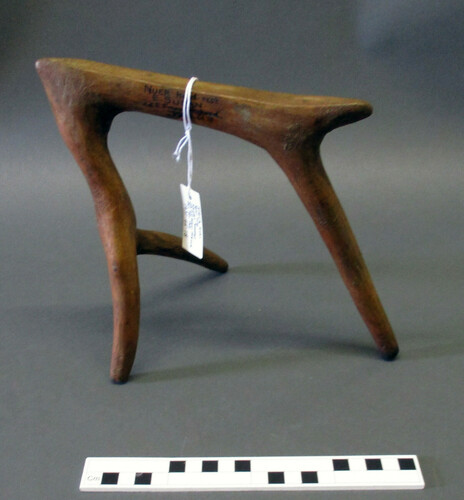 1931.66.18Headrest carved from a tree branch, with narrow rectangular seat and 2 legs, one of which forks at its base [RTS 3/6/2005].1931.66.18
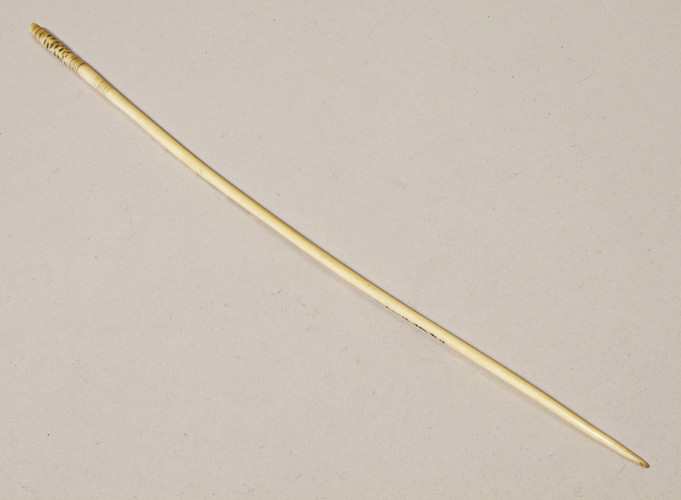 1884.71.12Slightly curved ivory hair pin with groups of incised lines and dashes just below the head. [EC 'DCF 2004-2006 What's Upstairs?' 3/2/2006]1884.71.12
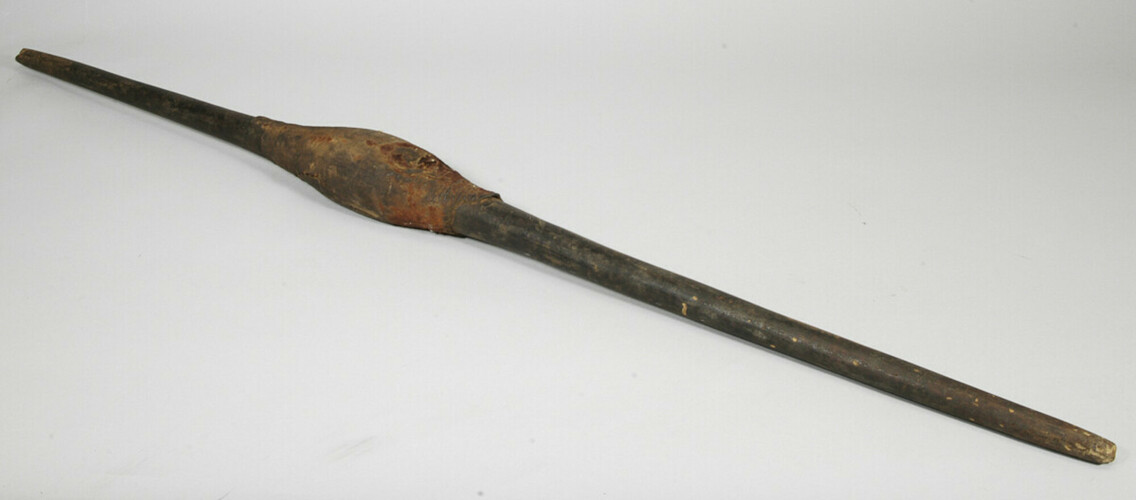 1979.20.75Wooden parrying shield with hollowed out hand grip at centre, covered in hide, and tapering ends [RTS 1/8/2005].1979.20.75
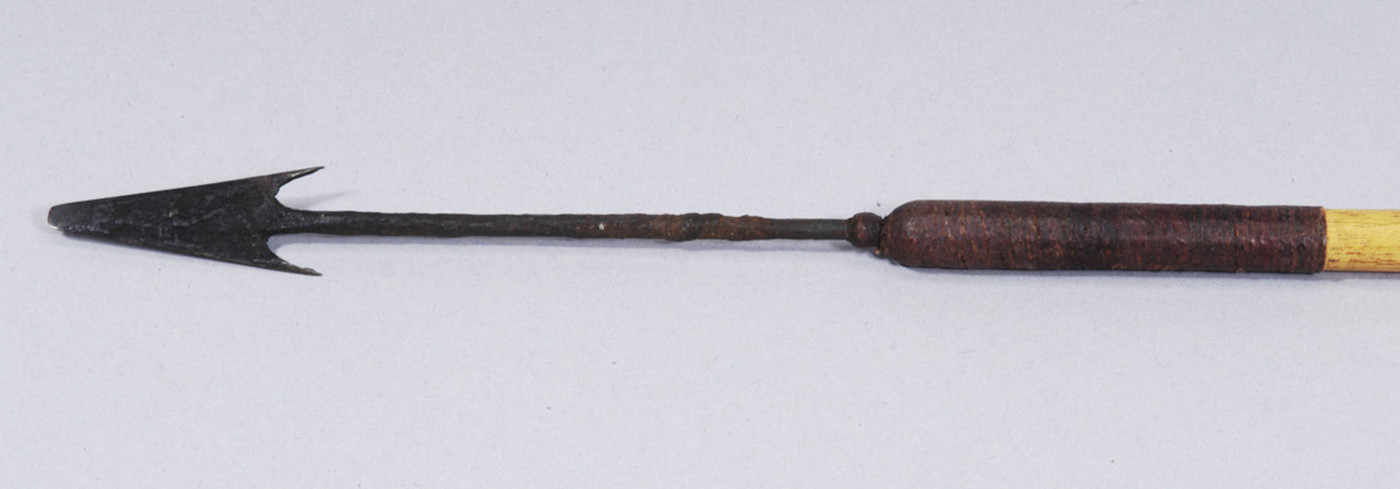 1934.8.108Poisoned arrow with triangular iron head, long circular sectioned tang and cane shaft with bound and nocked end [RTS 6/6/2005].1934.8.108