
- Collection type
- Object
- Description
- Headrest carved from a tree branch, with narrow rectangular seat and 2 legs, one of which forks at its base [RTS 3/6/2005].
- Long description
- Headrest carved from a single piece of wood, stained a reddish brown colour (Pantone 469C). This is an example of 'found form', with a naturally grown branch specifically chosen because its shape, with subsidiary branches coming off the main stem to form the three feet, was suitable for making a headrest. It consists of a narrow seat that runs horizontally across the top and that is concave along its length, and almost flat across its width. This tapers to a point at either end. The underside of the seat is curved, except for the front area, which has an angular ridge running down from the seat tip to the top of the leg, and the back where a similar ridge runs from the end down the upper part of the back leg. 2 branches extend from the seat underside to form these legs, with a single leg at the front angled forwards and in line with the seat itself, and a thicker back leg, that extends almost vertically downwards before dividing into 2 parts, in the shape of an inverted 'Y'. These legs have rounded undersides, one of which has been burnt. The headrest is complete and intact, but has one minor crack running along the grain of the seat. It has a weight of 227.9 grams and is 212 mm high; the seat is 204 mm long, 17 mm wide and 24.4 mm thick, while the legs have a diameter of from 17.8 to 20 mm [RTS 3/6/2005].
- Geographical reference
- Cultural groups
- Nuer
- Date / Period
- Date made: Before 1931
- Date collected
- 1930 - 1931
- Acquisition information
- Donated: 1931
- Materials and processes
- Material Wood Plant, Process Carved, Process Stained, Process Polished
- Dimensions
- Length x Width: max 173 x 203 mm seat, Width: max 21 mm seat, Length: max 233 mm, Height: max 215 mm, Weight 227.9 g
- Object numbers
- Accession number: 1931.66.18
- Research and responses
This object was collected by Edward Evan Evans-Pritchard, probably during his first or second season of fieldwork amongst the Nuer, e.g.: in 1930 or 'the dry season' of 1931. In the former, he spent around three and a half months in Leek territory at Yahnyang and Pakur on the Bahr el Ghazal, in Lou territory at Muot Dit, and at Adok, amongst the Dok Nuer. In the latter, he spent five and a half months at Nasir, on the Nyanding River, and at Yakwat on the Sobat River (see E.E. Evans-Pritchard, 1940, The Nuer, and the map of Evans-Pritchard's fieldwork in D.H. Johnson, "Evans-Pritchard, the Nuer, and the Sudan Political Service", African Affairs 81 no. 323, p. 233).
Objects like these were used by men to protect their elaborate hairstyles. Willis described the Nuer practice of covering their hair with a paste made of clay, cow dung and urine, and then shaping it into the desired style, such as a cock's comb, or a peak at front or back. This treatment gradually wears off, staining the hair a reddish colour, and then the hair needs to be redone. Domville-Fife describes a similar process for the Shilluk in some detail, although amongst that group hair is dressed by a specialist barber, and is a costly process (C.W. Domville Fife, 1927, Savage Life in the Black Sudan, pp 71-76).
While Evans-Pritchard did not record the local name for this particular example, a similar but undecorated headrest, 1937.34.49, is called köm, although he also uses this term for Anuak examples (see 1936.10.55-6). This type of lightweight headrest, made from a tree branch, is produced by a number of Nilotic groups; for further Nuer examples, see 1917.25.39-40, 1931.66.17, 1932.30.1, 1936.10.56, 1937.34.49 and 1948.2.128; for Dinka examples, see 1934.8.17, and for examples from the Anuak, see 1936.10.55 [RTS 22/08/2005].
Search terms: Furniture Dwelling, Headrest, Furniture
Further items to explore
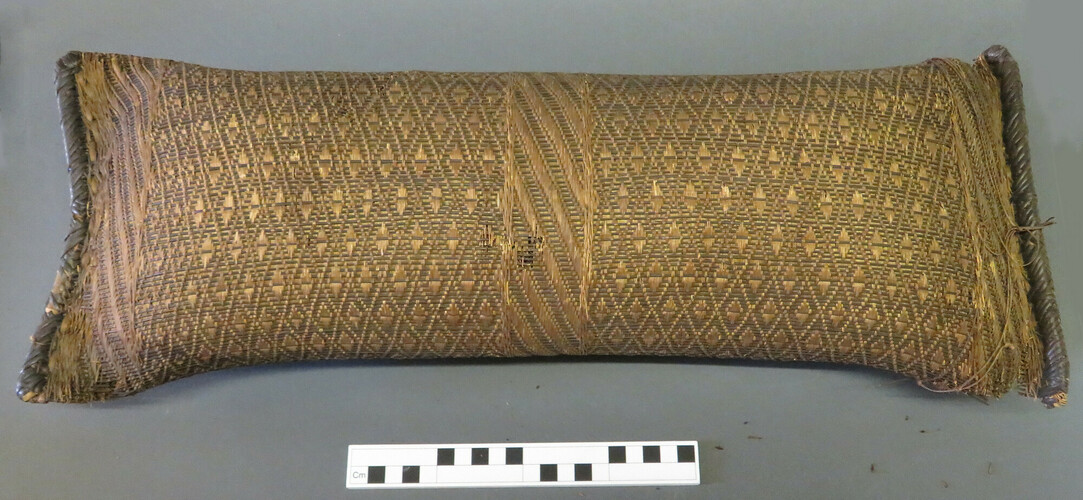 1891.50.18Woven grass work pillow or headrest. Long rectangular, stuffed pillow. Woven of fine grass work in gold and black in a predominantly lozenge shaped pattern with diagonal bands down the short sides. The short edges are closed using plaited grass. [MOBB [OPS move] 21/3/2017]1891.50.18
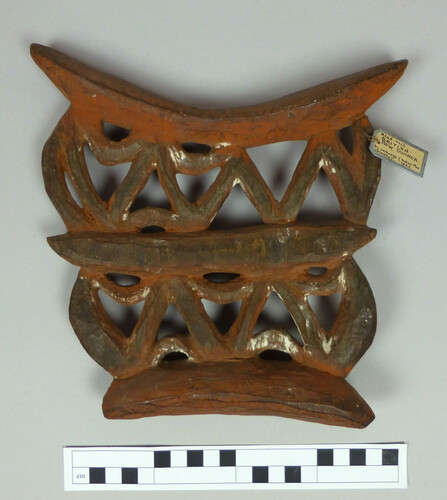 1923.69.2Carved wooden headrest with perforations forming a zig-zag design. With traces of red and white pigment. [SM (Verve) 08/01/2014]1923.69.2
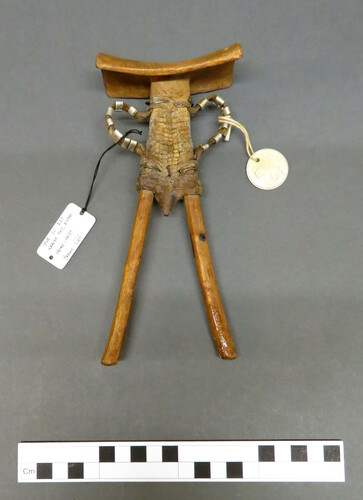 1968.20.221Wooden headrest with curved rectangular seat and two splayed legs both bound with leather and with two leather loops decorated with strips of aluminium. [JC [OPS Move] 22/3/2017]1968.20.221
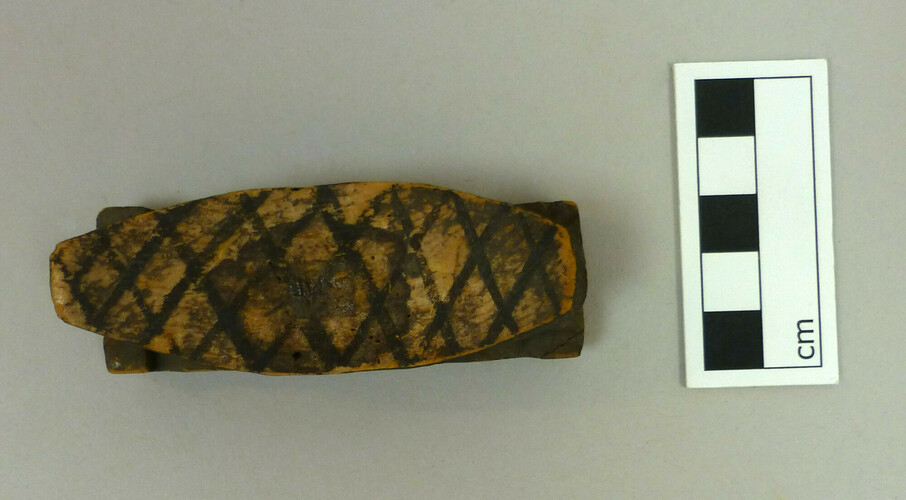 1886.1.929Seat model.1886.1.929
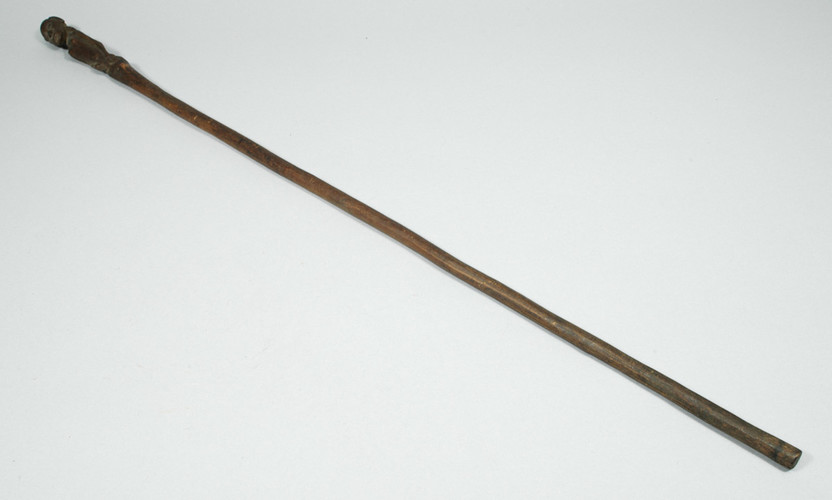 1928.67.4Wooden walking stick with the head and torso of a woman carved at the top, showing cicatrization marks and braided hair [RTS 22/9/2004].1928.67.4
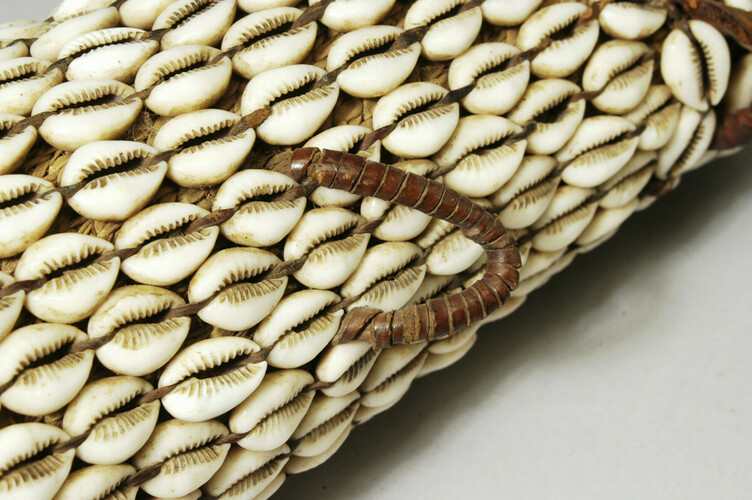 2005.40.1Hollow basketry cylinder with long leather straps, covered with cowrie shells and with small bell attached [RTS 26/7/2005]2005.40.1
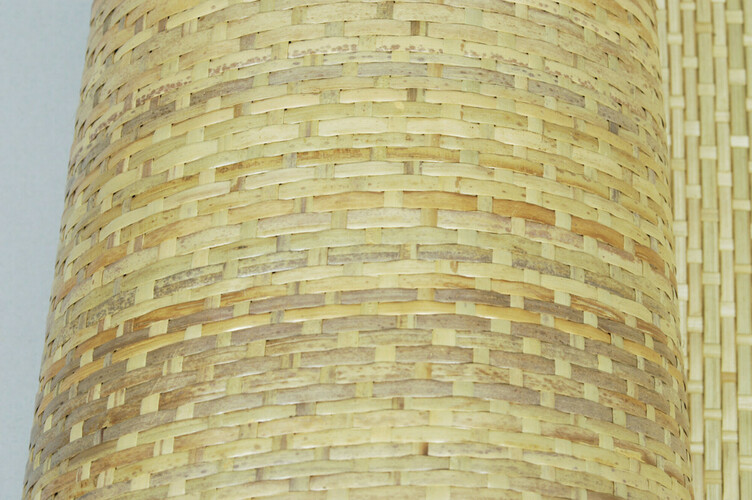 1948.2.159.5Rectangular mat made of chequerwoven strips of yellow palm fibre with fringed inner edges [RTS 8/8/2005].1948.2.159.5
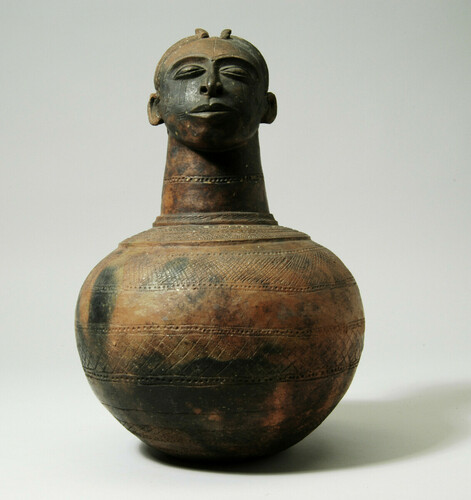 1950.12.117Human-headed pottery jar with narrow oval opening at back of head, on a globular body with incised, impressed and painted decoration [RTS 17/9/2004].1950.12.117