
- Collection type
- Object
- Description
- Hand modelled clay ox with humped back and trained horns, used as a toy [RTS 5/10/2004].
- Long description
- Toy figure of an ox, hand made from a well levigated gray clay with tiny mica and some white inclusions (Pantone 403C), dried in the sun and possibly painted with white and black pigment. This consists of a cylindrical body, pinched together at the front to form a sharp ridge that runs down in a vertical line from the head to just above the feet. The head itself is poorly defined, and dominated by the horns, one of which curls away from the face, the other curving forwards towards it, suggestive of artificially trained horns. Behind the head, the back rises to an elongated hump with curved top, then slopes down concavely to form the back beyond. A thin piece of clay has been rolled and applied to the back as a tail, hanging down between the legs; the end of this has broken off and is missing. The underside of the body has been pulled out to form front and back legs; these are in the shape of a single pillar of clay until just above the base, where they divide into two parts with uneven undersides. Unlike most of the other figures in this group, this figure has some trouble standing unaided and can only do so on a perfectly flat surface. Another piece of clay has been applied to the underside of the body, between the legs, to represent the testes. The surface has faint traces of white pigment, largely in the form of splotches on the back and what may have been stripes down the front flanks, while there is a darker black patch on the centre of the body on one side. This is probably the remnants of pigment painted on to imitate different hide patterns. The figure is nearly complete, but the end of the tail is missing and both horns have been reattached to the body. It has a weight of 209.7 grams, is 101 mm high, 112 mm long and measures 35.2 mm across the hind quarters [RTS 13/10/2004].
- Geographical reference
- Cultural groups
- Nuer
- Date / Period
- Date made: Before 1936
- Date collected
- 1935 - 1936
- Acquisition information
- Donated: 1936
- Materials and processes
- Material Clay, Material Pigment, Process Modelled, Process Pinched, Process Dried, Process Painted
- Dimensions
- Length: max 112 mm, Height: max 101 mm, Width: max 35.2 mm, Weight 209.7 g
- Object numbers
- Accession number: 1936.10.88
- Research and responses
Evans-Pritchard did his fieldwork amongst the Nuer in four expeditions, which took place in 1930, 1931, 1935 and 1936. This object was probably collected in 1935 or 1936, when he held a research fellowship from the Leverhulme Trust (see E.E. Evans-Pritchard, 1940, The Nuer) [RTS 2/3/2004].
Evans-Pritchard discusses the use of mud figures by the Nuer: “The games of rather older children of both sexes centre round cattle. They build byres of sand in camps and of moistened ashes or mud in villages, and fill the toy kraals with fine mud cows and oxen ... with which they play at herding and marriage” (E.E. Evans-Pritchard, 1940, The Nuer, p. 38). The material used seems to be a naturally occurring clayey soil, and 'clay' has been chosen here as a better descriptive term than 'mud' [RTS 27/2/2004].
This figure is probably an ox, rather than a bull, as the Nuer generally only train and decorate the horns of their castrated male cattle (ox being a term that is often applied to castrated bovine quadrupeds, whereas bull used more generically for the male of the species) [RTS 12/11/2004, pers. comm. J. Coote].
For clay figures made by neighbouring groups, such as the Dinka, see S.L. Cummins 1904, "Sub-tribes of the Bahr-el-Ghazal Dinkas", JRAI 34, 160-161, and H.A. Bernatzik, 1929, Zwischen Weissem Nil und Belgisch-Kongo, fig. 137 (for a photograph of Shilluk children playing with a large group of such figures) [RTS 15/8/2005].
Search terms: Toy and Game, Figure, Model, Pottery, Animal Figure, Toy
Further items to explore
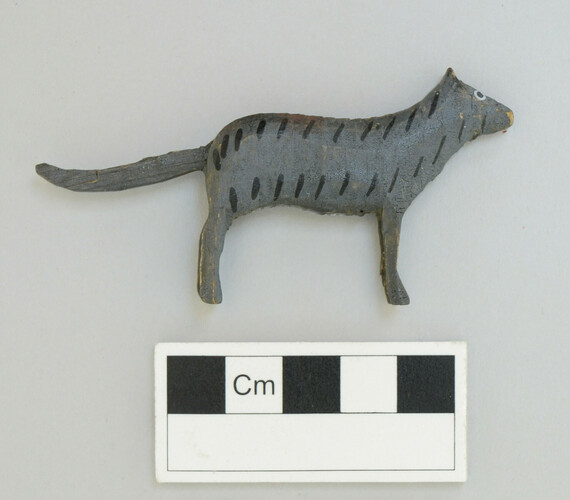 1956.9.70.182Dark grey cat figure with black stripes. Part of a Noah’s Ark set. One of a pair. [See 1956.9.70.183 for other figure]. [SM (Verve) 16/04/2015]1956.9.70.182
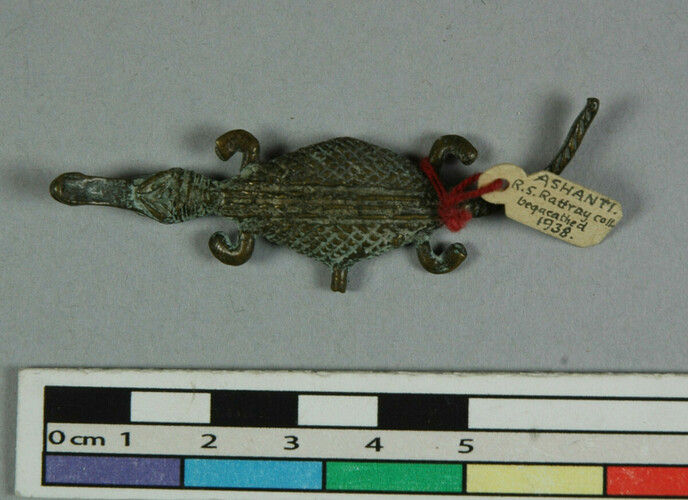 1938.18.780Copper alloy weight for weighing gold, in the shape of a crocodile. [MJD DDF Body Arts Project 2010/2011 13/12/2010]1938.18.780
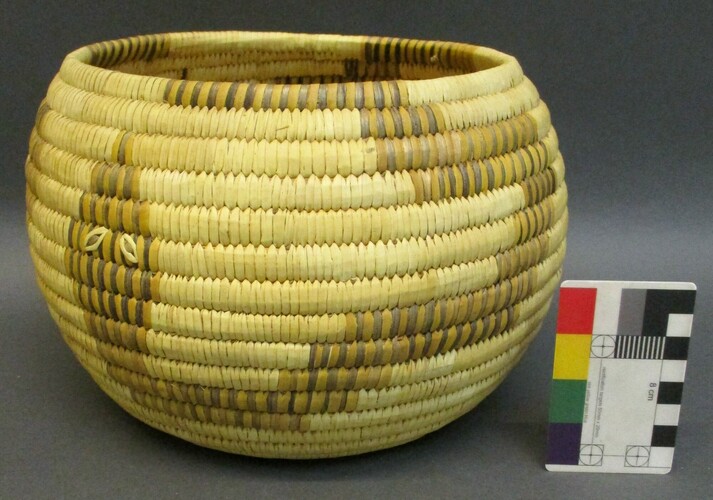 1927.1.3Basket with designs of snakes worked into the fabric. [BH [OPS Move] 3/11/2016]1927.1.3
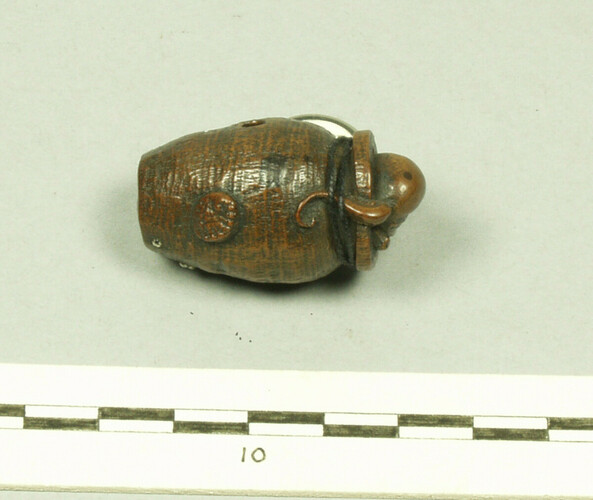 1980.34.144Netsuke toggle of an octopus emerging from a jar. [El.B 'DCF 2004-2006 What's Upstairs?' 12/5/2005]1980.34.144