
- Collection type
- Object
- Description
- Wooden headrest with notched, bilobed seat on a flat pedestal with hollow conical foot and rubber carrying loop, used by men for sitting and sleeping [RTS 1/6/2005].
- Long description
- Headrest carved from a single piece of reddish brown wood (Pantone 4625C), with an oiled surface that has darkened in places, particularly the seat. This consists of a narrow seat at the top with a bilobed plan view - strongly concave down the long sides, but swelling out to convex ends, each with a shallow concave section cut out of their centre. The seat is concave along the length, and slightly convex across its width. The underside has 2 angular ribs carved along its length, with a tall pedestal foot extending from the centre. This has a narrow body with rectangular section, with concave sides that make a convenient hand-sized grip, before turning sharply in again just above the base. The foot has a conical upper part that slopes down to a thick, bevelled edge, and has a hollow underside that could be used to store fat for greasing the surface of the wood. The pedestal has been pierced through the centre of its top and bottom, and a carrying loop fitted through the holes. The loop itself has been made from a narrow strip of black rubber (Pantone black 7C), secured by a knot at its base. The upper end may have originally been fixed in a similar way, but looks to have broken, with a length of twisted plant fibre cord tied around the end to form a small loop that now extends from the other side of the hole. Another possible repair may be found on the edge of the seat, which has split on the underside at one end. Two holes have been bored on either side of the crack, and a thin strip of white metal, possibly tin or aluminium, fitted through like a small staple. One end of this strip continues up to the upper surface of the seat, where it lies flush with the surface. The seat is complete, and otherwise intact. It has a weight of 264.3 grams, and is 166 mm high; the seat is 185 mm long, 65 mm wide and 18.7 mm thick; the pedestal has a maximum width of 63 mm and is 13 mm thick, with a hole diameter of 8 mm; the base is 84.6 mm long and 83 mm wide, the white metal mend is 2 mm wide, and the carrying loop is 85 mm long, 10.5 mm wide and 2.5 mm thick [RTS 1/6/2005].
- Cultural groups
- Southern Laarim
- Date / Period
- Date made: Before 03/1979
- Date collected
- 20 - 25 March 1979
- Acquisition information
- Purchased: 1979
- Materials and processes
- Material Wood Plant, Material Rubber Plant, Material Plant Fibre, Material String, Material Aluminium Metal, Material Tin Metal, Process Carved, Process Perforated, Process Twisted, Process Knotted, Process Polished, Process Repaired (local), Process Decorated
- Dimensions
- Height 166 mm, Length 185 mm, Width 65 mm seat, Height: max 18.7 mm seat, Diameter: max 84.6 mm base, Weight 264.3 g
- Object numbers
- Accession number: 1979.20.172 Other numbers: ∆22
- Research and responses
Note that the height of this object varies across its length, hence the lower measurement provided by Langton for this object.
1979.20.173 is of identical form, but with a handle made of plaited hide strips, while 1979.20.174 shares the basic design but varies in minor details of form. All 3 Larim examples collected by Langton have a greasy surface that suggests they had been oiled. A similar style of headrest is also used by the Toposa; see 1979.20.201.
John Mack discusses South Sudanese headrests, commenting that in recent times they are found amongst transhumant groups who use them to protect elaborate hairstyles, and that this particular type of headrest is used by the Toposa, Didinga and Larim in Sudan, and also across a wide area of northern Uganda, Kenya and in adjacent areas of Ethiopia. The variety with semicircular cutouts of the seat edges, as seen here, is more restricted in distribution to the Toposa and Larim. Personal items such as knives and tobacco containers are sometimes attached to the central pedestal (J. Mack, 1982, "Material Culture and Ethnic Identity in Southeastern Sudan", p. 117) [RTS 23/8/2005].
In May 2015 a digital photograph of this object was supplied to Ellen Lekka (Culture Specialist / UNESCO Juba – South Sudan) for use in 'South Sudan Traveling Exhibition: Pilot Phase', a project being carried out by UNESCO Juba in collaboration with the Ministry of Culture, Youth and Sports of South Sudan, as part of the establishment of a public culture sector through the development of key institutions and as a step towards the creation of a National Museum. [JC 22 5 2014]
Search terms: Furniture Dwelling, Status, Headrest, Stool, Furniture
Further items to explore
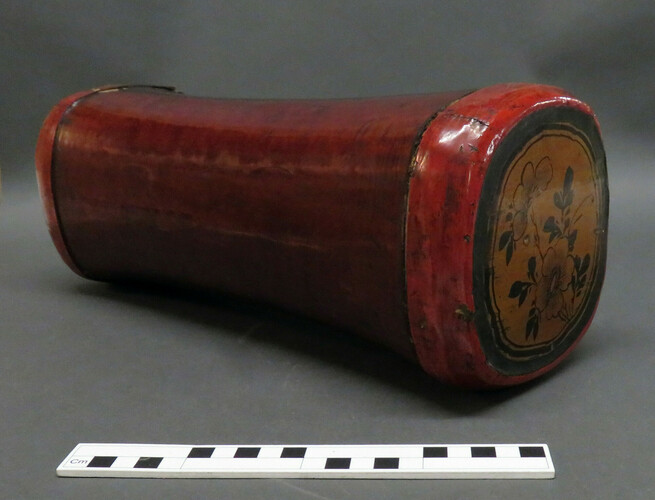 1983.2.1Rectangular reddish lacquered pillow with basketry framework and slightly concave sides. The ends of the pillow have been attached to the main body, and both have a panel of lacquered floral decoration. [EH [OPS Move] 24/3/2017]1983.2.1
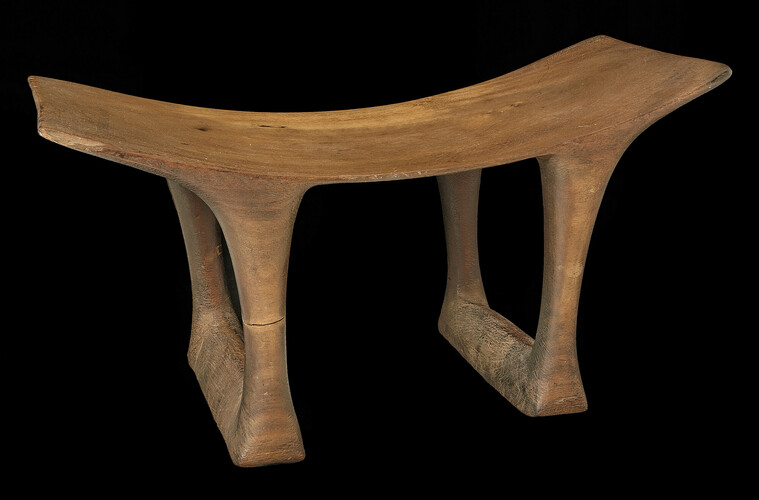 1886.1.1417Headrest. Carved from a single piece of wood.1886.1.1417
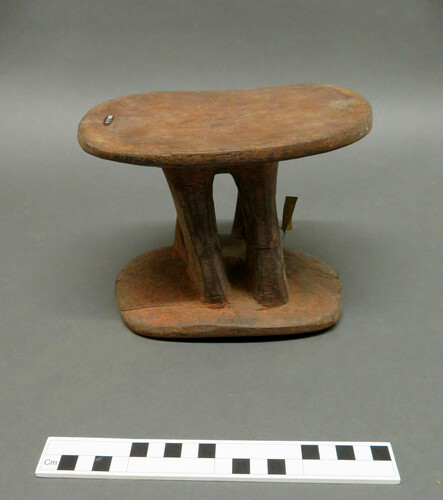 1884.3.14Stool or headrest carved from a single piece of wood. [JC [OPS Move] 11/4/2017]1884.3.14
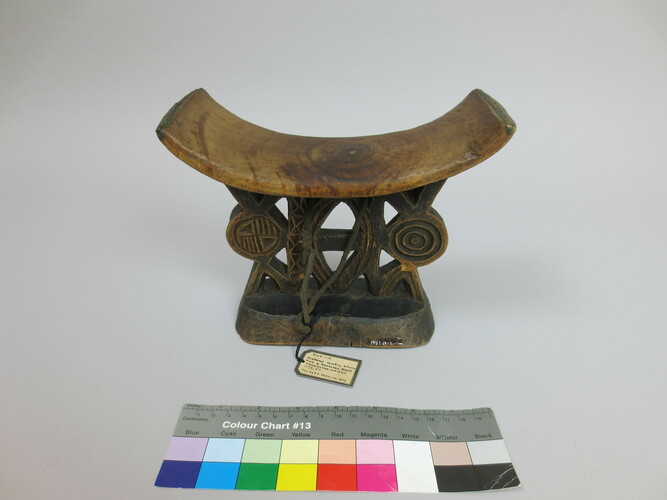 1907.19.1Wooden headrest with curved head support, carved and decorated stem and base with local repairs using wire. [SM (Verve) 12/02/2014]1907.19.1
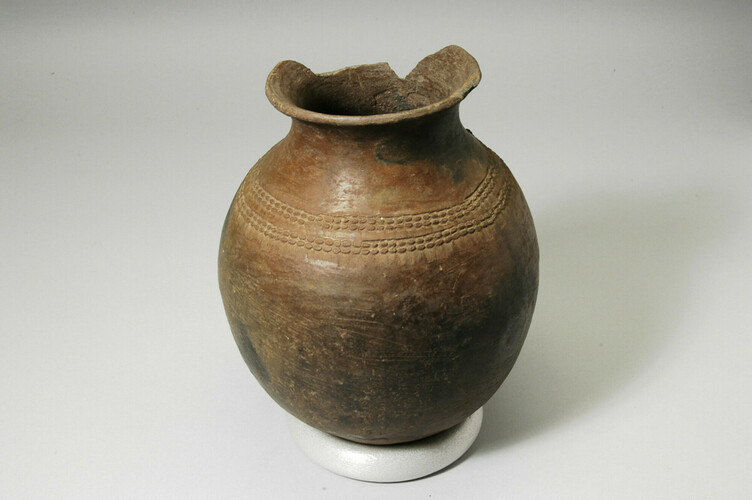 1979.20.139Pottery jar with everted rim, ovoid body and convex base; burnished with 2 bands of roulette decoration on shoulder [RTS 3/8/2005].1979.20.139
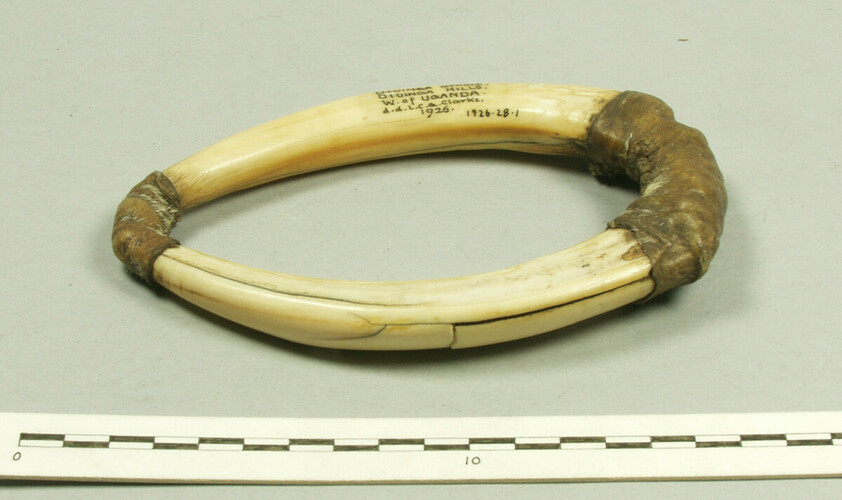 1926.28.1Armlet made from two warthog tusks joined together with two pieces of hide.1926.28.1
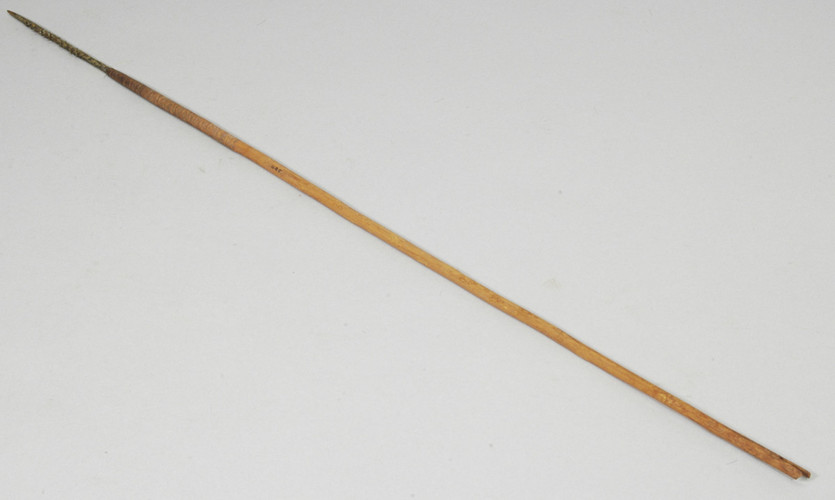 1884.140.826Arrow with narrow multibarbed iron arrowhead fitted into a wooden shaft, damaged at the butt [RTS 7/7/2005].1884.140.826
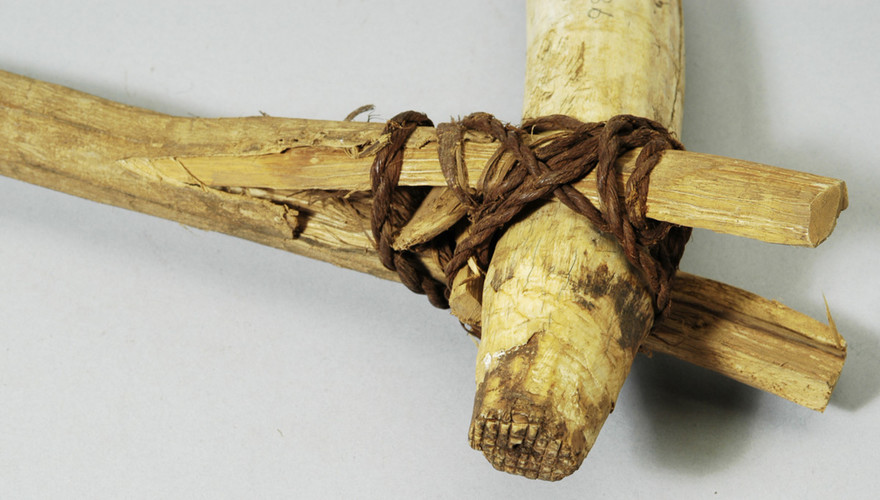 1934.8.125.1Ivory barkcloth beater with crosshatched end. Oval in section, and largely hollowed out. Curves slightly from the broader top end to its solid, flat-cut base. Hafted onto wooden handle [1934.8.125 .2] [EH [OPS Move] 30/3/2017]1934.8.125.1