
- Collection type
- Object
- Description
- Headrest. Carved from a single piece of wood.
- Long description
- Headrest carved from a single piece of wood. The rectangular top is concave, and the legs have a oval profile. The legs at each end are connected by a crossbar. [JU 29/01/2013]
- Geographical reference
- Society Islands Tahiti
- Person
- Field collector Johann Reinhold Forster
- Field collector Georg Forster
- PRM source Ashmolean Museum, University of Oxford
- Date / Period
- Date made: Before 04/06/1774?, uncertain
- Date collected
- Between 17 August and 18 September 1773, or between 22 April and 4 June 1774?
- Acquisition information
- Transferred: 10/02/1886
- Materials and processes
- Material Wood Plant, Process Carved
- Dimensions
- Width: max 130 mm, Length: max 250 mm
- Object numbers
- Accession number: 1886.1.1417 Other numbers: Forster 30
- Research and responses
Reidentified as Tahitian and collected by the Forsters by P. W. Gathercole, 1970. [unsigned, undated]
- Associated publications
- Listed according to the 'Forster list' numbering system in 'From the Islands of the South Seas 1773-4: An Exhibition of a Collection Made on Capn. Cook's Second Voyage of Discovery by J.R. Forster- -A Short Guide (Oxford: Pitt Rivers Museum, no date[1970]). The text from the 'Forster' manuscript is followed by the following notes: '30. an Otaheitee stool. A headrest, long assumed to be part of the Bloxam Collection (1825), but Bloxam never went to Tahiti. Made from the solid wood. Height: 15cm.' Listed as number 5 under ‘Tahiti...Neck Rests’ on page 145 of 'Artificial Curiosities': Being an Exposition of Native Manufactures Collected on the Three Pacific Voyages of Captain James Cook, R.N. at the Bernice Pauahi Bishop Museum, January 18, 1978 - August 31, 1978 on the Occasion of the Bicentennial of the European Discovery of the Hawaiian Islands by Captain Cook - January 18, 1778 (Bernice P. Bishop Museum Special Publication 65), by Adrienne L. Kaeppler (Honolulu: Bishop Museum Press, 1978): '5. Neck rest, Oxford (30). Height 15 cm. Evidence: Forster collection. Second voyage. Literature: Gathercole, n.d. (1970) [see above]'. [JP 24/7/2002] Listed on page 520 of 'Appendix A: Catalogue of Society Island Objects with Secure Eighteenth-Century Provenance' in 'Shaping the Body Politic: Gender, Status, and Power in the Art of Eighteenth-Century Tahiti and the Society Islands', by Anne Elizabeth D'Alleva (New York: Columbia University, Ph.D. thesis, 1997). She describes it as follows: 'Concave rectangular platform with two loop feet.' [JP 31/7/2002] Illustrated in black and white on page 30 of The Captain Cook Encyclopaedia, edited by John Robson (London: Chatham Publishing / Mechanicsburg, Penn.: Stackpole Books, 2004). Caption (same page) reads: 'A wooden headrest collected in Tahiti on the second voyage. (Forster Collection Pitt Rivers Museum, Oxford)'. [JC 25 11 2004] Published as part of the Forster Collection on a dedicated website at www.prm.ox.ac.uk/forster (from February 2001). [JC 7 7 2005] Illustrated in colour as Fig. 229 on page 380 of 'Africa, Oceania and the Americas', by Jeremy Coote, in Arthur MacGregor (ed.), The Cobbe Cabinet of Curiosities: An Anglo-Irish Country House Museum (New Haven and London: Yale University Press, for the Paul Mellon Centre for Studies in British Art, 2015), pp. 374–403. Caption (same page): 'Tahitian headrest, collected on Cook's second Pacific voyage of 1772–5 by Johann Reinhold and/or George Forster, and given by them to the University of Oxford in 1766; Pitt Rivers Museum, inv. no. 1887.1.382 [sic; 1886.1.1417].' [JC 22 4 2015] For an account of the history of the collection of which this is part, see 'The Cook-Voyage Collections at Oxford, 1772–1775', by Jeremy Coote, in Jeremy Coote (ed.), Cook-Voyage Collections of 'Artificial Curiosities' in Britain and Ireland, 1771–2015 (MEG Occasional Paper No. 5), Oxford: Museum Ethnographers Group (2015), pp. 74–122. (Copy in RDF: Researchers: Jeremy Coote (Cook-Voyage Collections).) [JC 9 6 2016]
Search terms: Furniture Dwelling, Headrest
Further items to explore
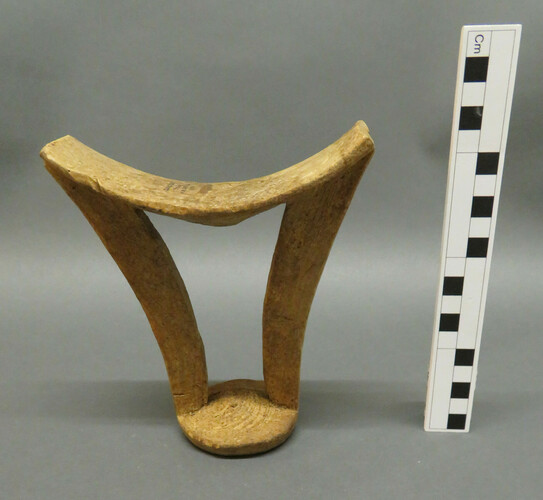 1900.30.2Light coloured wooden headrest carved from a single piece of wood. Rectangular, concavely curved seat, with wider middle section. The supports are narrow and curved and attached to a round foot with flat bottom and raised centre on top. [MOBB [OPS move] 21/3/2017]1900.30.2
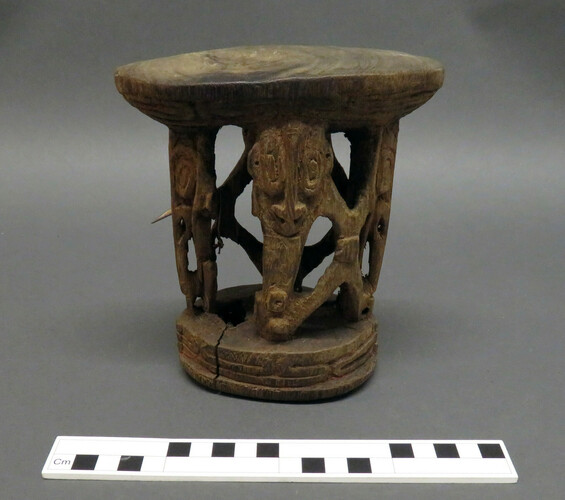 1922.60.2Carved wooden headrest. On the seat and the base there are carved patterns in relief. The centre support of the headrest is hollowed out, with two bird and two human figures carved into the wood. [EH [OPS Move] 24/3/2017]1922.60.2
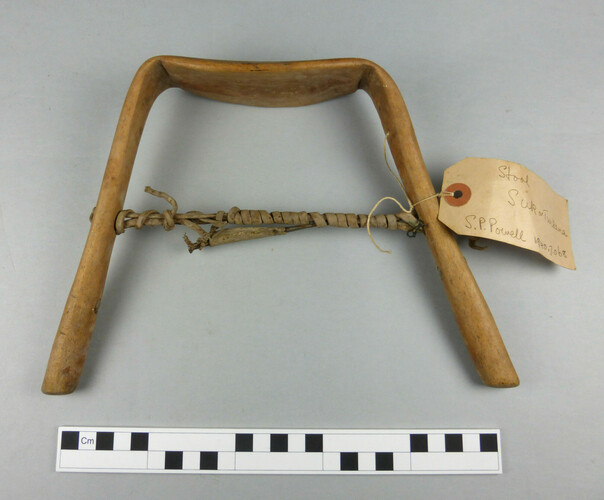 1940.7.068Wooden stool or headrest with rectangular, concavely curved seat. Two splayed legs, both of which are perforated and connected with a strap made of a strip of twisted leather, bound with leather. There is a nail in a stitched leather pouch attached to the strap. [EH [OPS Move] 27/3/2017]1940.7.068
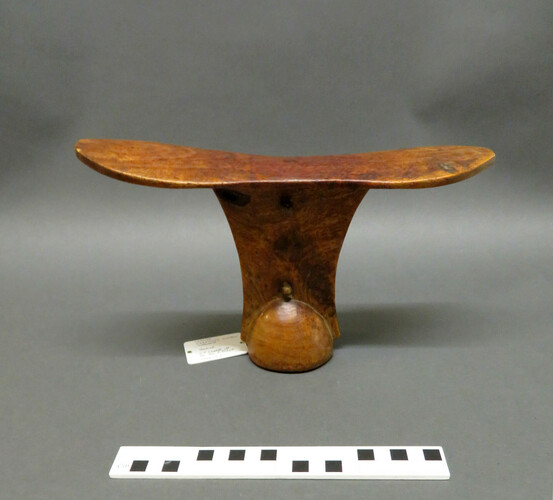 1992.19.2Headrest carved from a single piece of wood, comprising a flat, bi-lobed seat, circular base, shaped like an inverted cup, and a thin wooden sheet support connecting the two. The support is perforated in two places and a carrying strip of leather is threaded through the holes and tied. [JC [OPS Move] 22/3/2017]1992.19.2
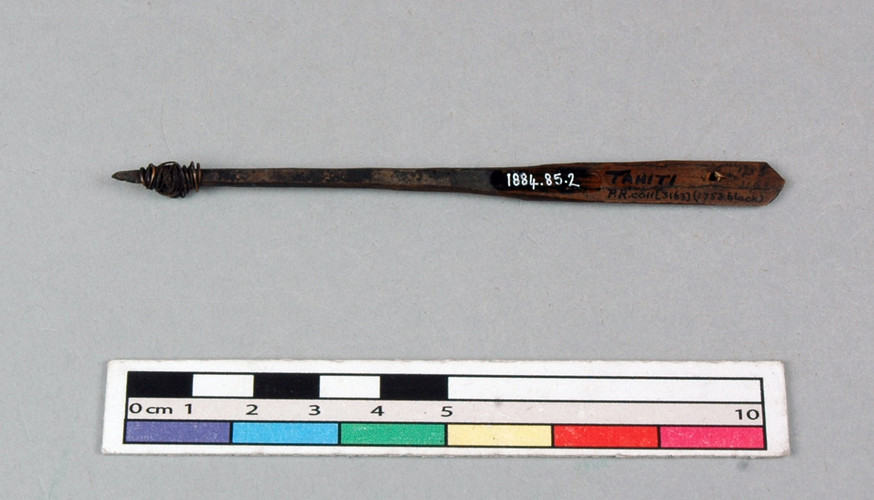 1884.85.2Wooden handle of tattooing tool, paddle-shaped and perforated at one end. [El.B DDF Body Arts Project 2010/2011 02/09/2010]1884.85.2
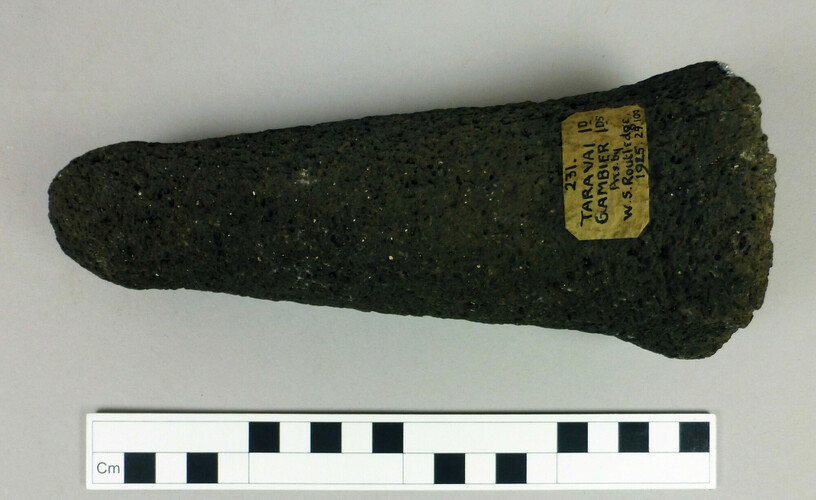 1925.29.100Stone pounder made from volcanic stone. It is dark grey in colour and conical in shape with a flattened base. [JC [OPS Move] 31/10/2016]1925.29.100
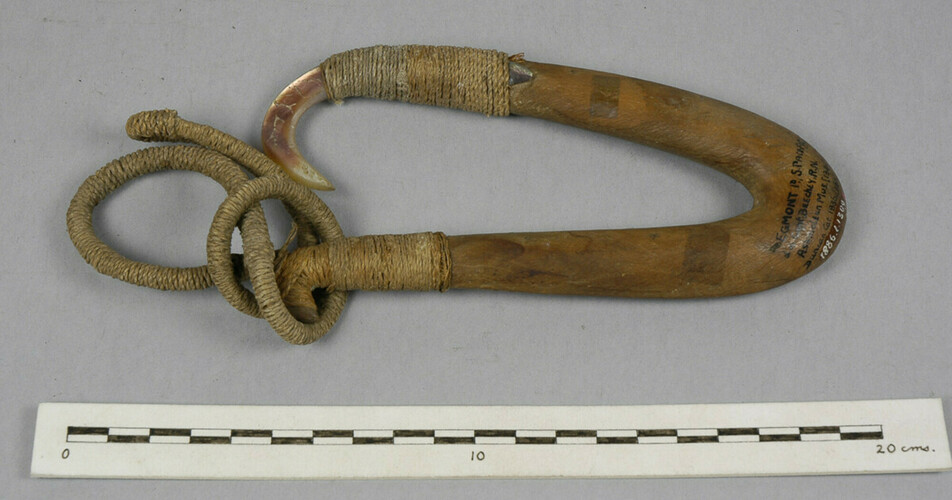 1886.1.1309Wooden shark hook with pearl shell point bound on with plant fibre twine. A looped length of stout twisted twine is tied to the top of the hook. [LM 20/06/2007]1886.1.1309
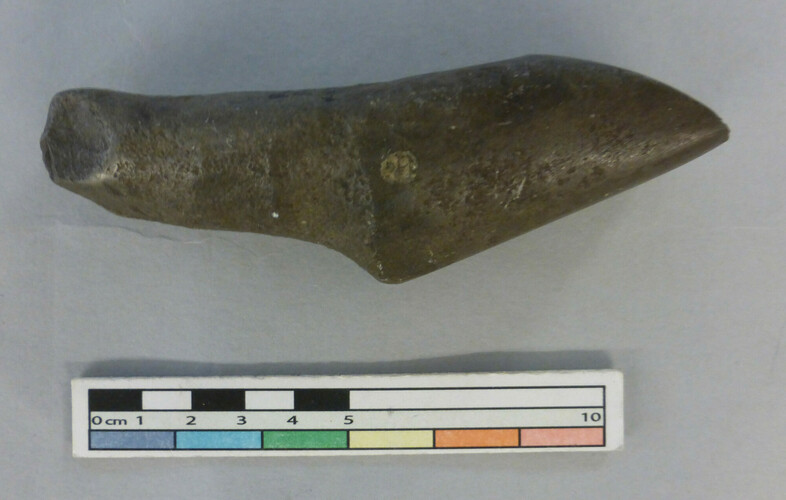 1925.29.71Stone adze blade; identified by Figueroa and Sánchez as an Eastern Polynesian Adze Type 4 (finished). [Dan Hicks 06/06/2012]1925.29.71