
- Collection type
- Object
- Description
- Wooden throwing club with spherical head and tapering shaft and handle [SM 21/03/2007]
- Long description
- Club carved from a single piece of light yellowish brown wood (Pantone 1395C), consisting of a spherical head, oval in plan view, almost pointed at the top, with slightly irregular, convex sides turning in to the underside where the surface has been cut flat, and slopes slightly in to where it joins the handle. The handle is oval in section, and tapers in towards a narrow, flat end. The surface of the club has been well polished, with only a few tool marks visible around the top of the handle, and a single line, made up of several short, shallow cuts, around its upper body. Complete and intact. Total length 674 mm; length of head 74 mm, width of head 106.3 mm, thickness of head 101.6 mm; length of handle 600 mm; width and thickness at top of handle 36.6 x 34.8 mm; width and thickness at base of handle 8 x 6.3 mm [RTS 8/3/2004].
- Geographical reference
- Cultural groups
- Shilluk
- Person
- Field collector William Ernest Taylor
- Field collector Church Missionary Society
- PRM source Catherine Taylor
- Date / Period
- Date made: Before 1890
- Date collected
- 1882 - 1890?
- Acquisition information
- Purchased: 1927
- Materials and processes
- Material Wood Plant, Process Carved, Process Polished
- Dimensions
- Width: max 106 mm head, Length: max 674 mm
- Object numbers
- Accession number: 1927.84.1
- Research and responses
Shilluk clubs of this type often have a socketed iron spike fitted to the end of the handle, to serve as an additional weapon, or to allow the club to be pushed into the ground and used as a stool (C. Spring, 1993, African Arms and Armour, p. 119; see also the photograph of Shilluk men with these clubs tucked under one arm on p. 111). There was no indication that this object had ever been fitted with such a spike [RTS 8/3/2004].
Taylor died in October 1927, and this object was purchased 2 months later from his widow Catherine Taylor, who survived him. Although the dates given for the collection of this object in the accession book entry are from 1882 to 1890, it should be noted that this was before Taylor married Catherine, so the collection dates cannot have come from her direct personal knowledge. In addition, his activities for the Church Missionary Society did not seem to take him to East Equatorial Africa until after this period; he was examining chaplain to the Bishop of that region in 1895, he was working in Cairo from 1896, is recorded as visiting Omdurman in 1900, and was a missionary for the society in Khartoum for a brief period in 1903. It seems more likely that this item was collected during this later part of his career.
For similar Shilluk clubs, see 1903.16.114-115, and also R. Boccassino, 1960, "Contributo allo studio della ergologia delle popolazioni nilotiche e nilo-camitiche, Annali Lateranensi XXIV, figs 45-46, 60-61 and 69. Clubs of this form often had a socketed iron spike fixed to the butt, which could be used as a weapon in its own right or pushed in the ground to let the club stand upright by itself (C. Spring 1993, African Arms and Armour, p. 119). Domville Fife describes this type of club as follows: "when at war with their neighbours the Dinkas [carry]… a special club, which is an ingenious affair, combining in one article, made of exceedingly hard wood, a spear, knobkerry and seat ... The point can be used for stabbing or for sticking in the ground" (C.W. Domville Fife, 1927, Savage Life in the Black Sudan, p. 69) [RTS 15/8/2005].
Further items to explore
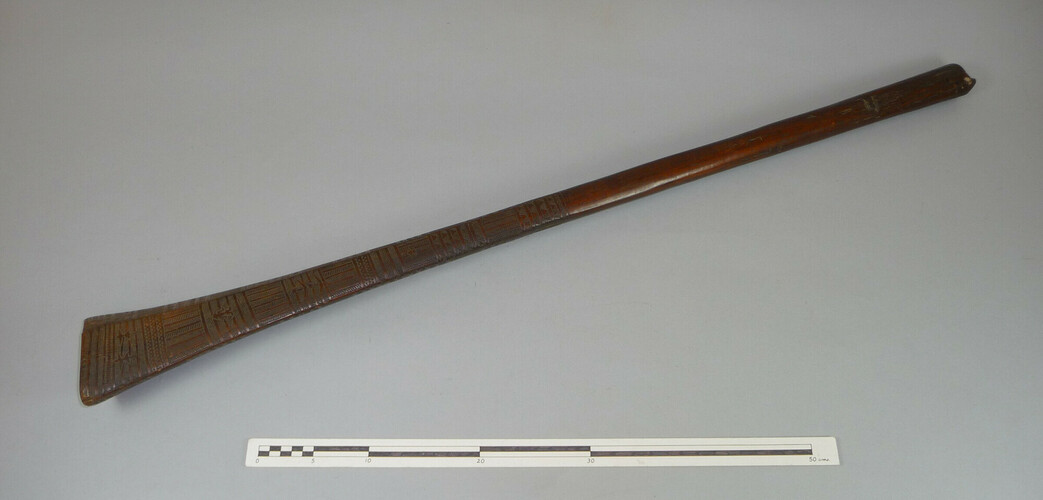 1933.92.1Club with elaborately carved head. [FB 19/10/2011]1933.92.1
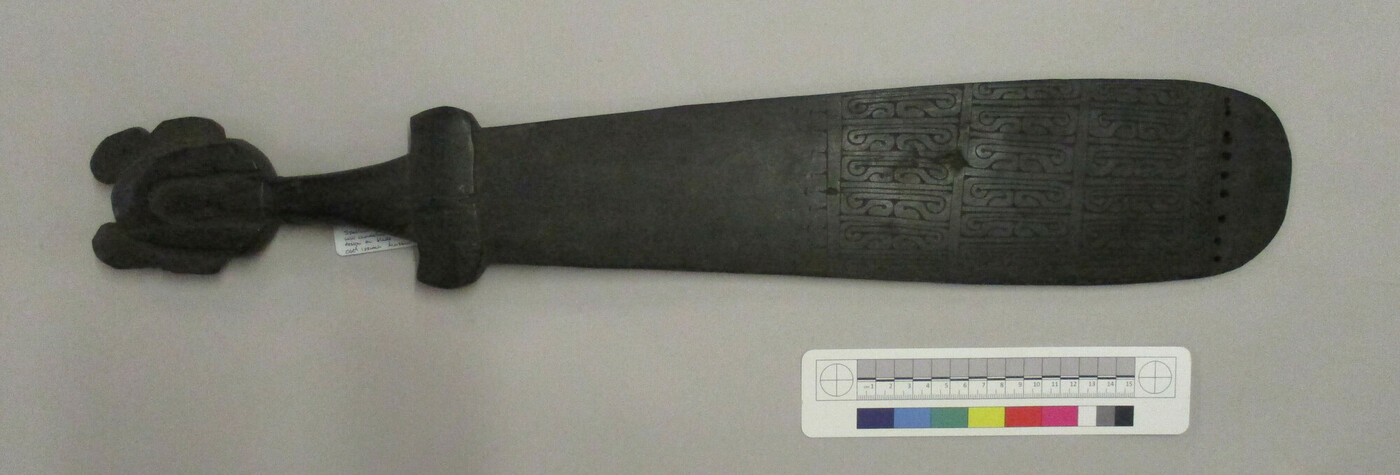 1966.1.234Spatulate wooden club incised on the blade with characteristic scroll design. The plain semi-circular tip has multiple perforations. The handle has an elaborately carved terminal. [JC [OPS Move] 01/08/2016]1966.1.234
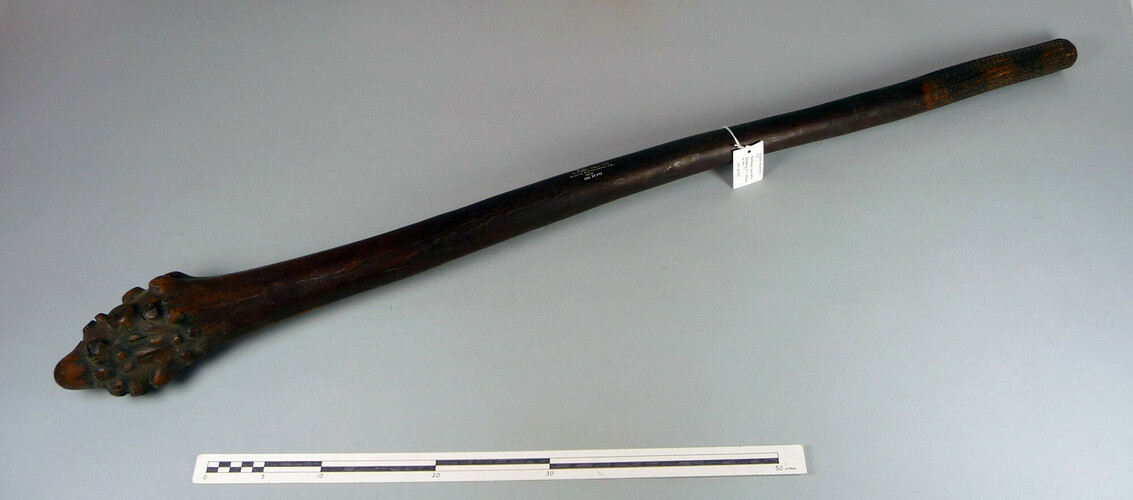 1900.55.643Rootstock club (Waka) [FC 05/09/2011]1900.55.643
 1943.6.81A weapon made from a long stick of solid bamboo, the upper part of which is bound with twelve large iron rings. [JC [OPS Move] 24/10/2016]1943.6.81
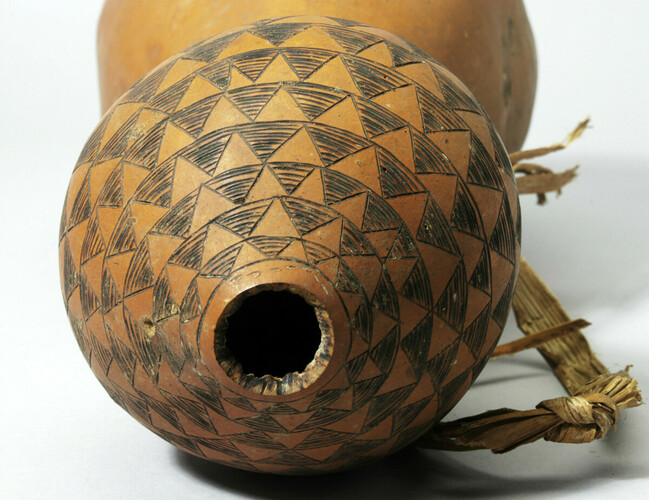 1948.2.158Tall bilobed gourd container with pyroengraved hatched triangles decorating upper part, and a fibre carrying strap [RTS 16/8/2005].1948.2.158
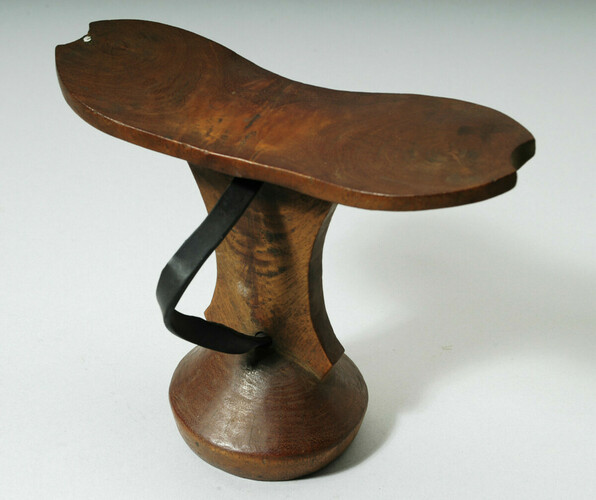 1979.20.172Wooden headrest with notched, bilobed seat on a flat pedestal with hollow conical foot and rubber carrying loop, used by men for sitting and sleeping [RTS 1/6/2005].1979.20.172
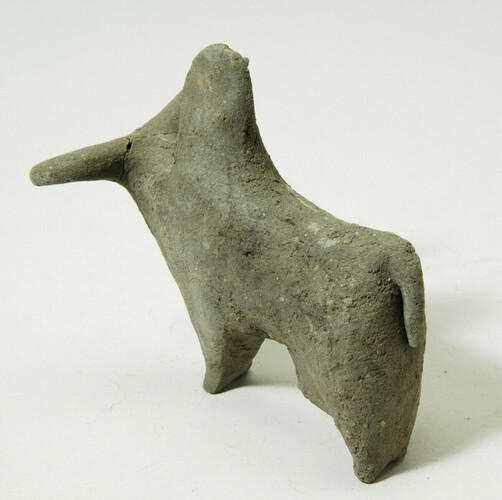 1936.10.88Hand modelled clay ox with humped back and trained horns, used as a toy [RTS 5/10/2004].1936.10.88
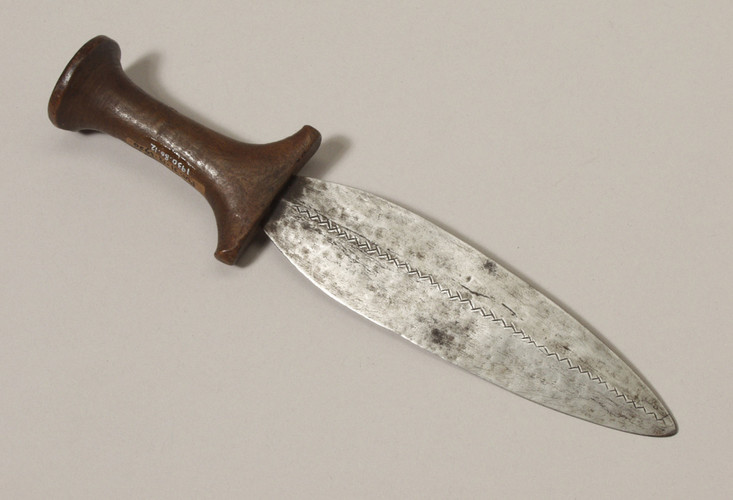 1930.86.12Knife with two edged iron blade decorated with incised zigzags, and wooden handle with flared cross guard. [SM 15/06/2007]1930.86.12