
- Collection type
- Object
- Description
- Sheep skin back apron, worn by men for dancing [RTS 22/6/2004].
- Long description
- Piece of lamb skin with yellow hide on the inside face (Pantone 7407C), and largely white to buff coloured hair on the outer face (Pantone 7506C), with a few patches of black hair along the edges of the legs and down the spine/tail (Pantone black 6C). The hair has worn away in patches. The skin has been cut, using the original tapering shape of one front and one hind leg to form the two long arms of the apron. The ends of each arm have been pinched together, causing the hide to form folds, and have cords made of twisted plant fibre tied around them; these cords would then have been used to fasten the apron in place around the waist. The body of the apron has been cut to a roughly trapezoidal shape, with two short taps of skin left at the centre of either side representing the neck and tail of the original animal; two longer tapering flaps of skin continue from the base of the apron, which runs in a straight line between them. The object is complete and intact, although the ends of the cords are frayed and some surface hair has been lost. The apron measures 635 from arm to arm, not including the cords, and is 357 mm long, including the base flaps; the apron body is 212 mm long and 235 mm wide at its centre, while the cord has a diameter of 1 mm [RTS 22/6/2004].
- Cultural groups
- Lango
- Person
- Field collector Percy Horace Gordon Powell-Cotton
- Field collector Hannah Powell-Cotton
- PRM source Percy Horace Gordon Powell-Cotton
- Date / Period
- Date made: Before 1933
- Date collected
- 16th February 1933
- Acquisition information
- Donated: 1934
- Materials and processes
- Material Sheep Skin Animal, Material Plant Fibre, Process Twisted, Process Tied
- Dimensions
- Length 357 mm, Width 635 mm across top
- Object numbers
- Accession number: 1934.8.90 Other numbers: 310
- Research and responses
According to “African ethnonyms: index to art-producing peoples of Africa” by Daniel P. Biebuyck, Susan Kelliher and Linda McRae (G.K. Hall & Co.: New York, 1996), there are two different groups known as Lango, one from Sudan who speak an Eastern Nilotic language, and one from Kenya and Uganda who speak a Western Nilotic language. According to the catalogue cards, it is the Sudanese (Eastern Nilotic speaking) group which is referred to here [CW 23/3/2000]. Powell-Cotton made ethnographic films during his 1932-3 shooting expedition to southern Sudan; footage included Lango men cutting and making spear shafts, and a Lango potter at work (see the description in Mrs Powell Cotton, "Village Handicrafts in the Sudan", Man 34 (112), pp 90-91) [RTS 12/12/2003].
Search terms: Clothing, Dance, Ornament, Cordage, Apron, Dance Accessory, Waist Ornament, Groin-cover
Further items to explore
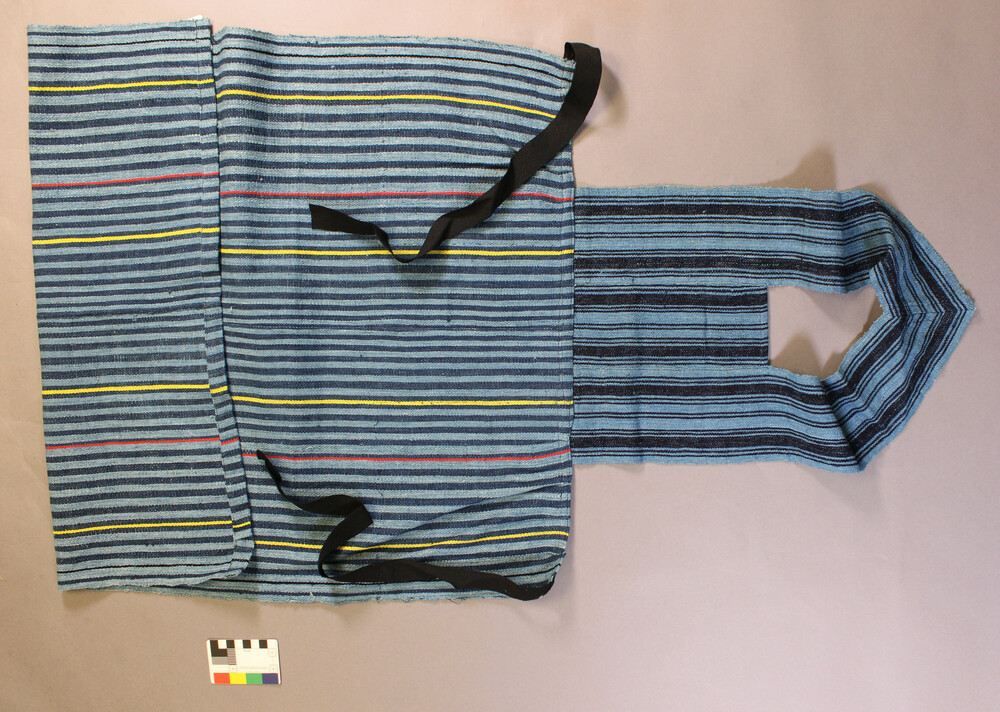 1972.24.9Apron1972.24.9
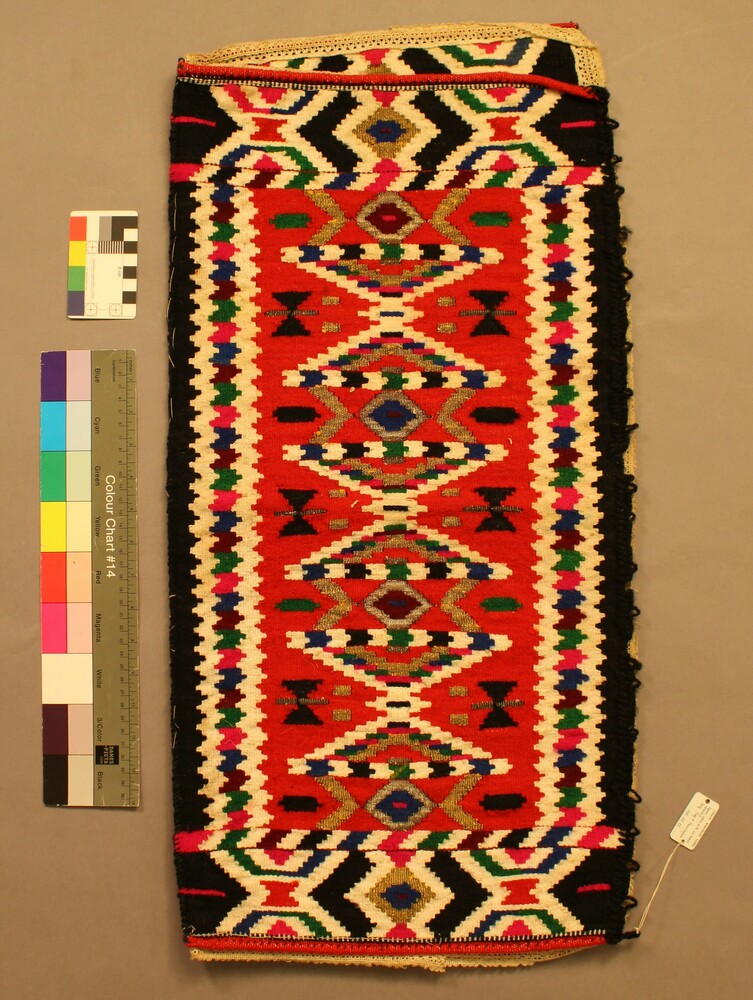 1981.35.15Apron. Two panels of elaborately woven coloured wools in geometric patterns are joined together horizontally across centre. Influenced by Albanian designs. Predominant colours are red & black, with green, white, blue, magenta, maroon & gold & silver. The apron ties at the waist; drawstrings missing. Machine-made lace around edges. Possibly part of woman's dance costume 1981.35.11-221981.35.15
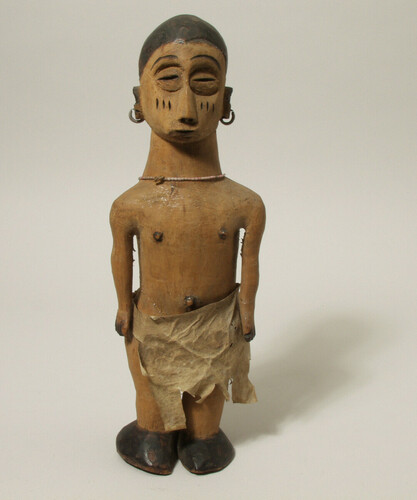 1939.7.123Wooden figure of a man.1939.7.123
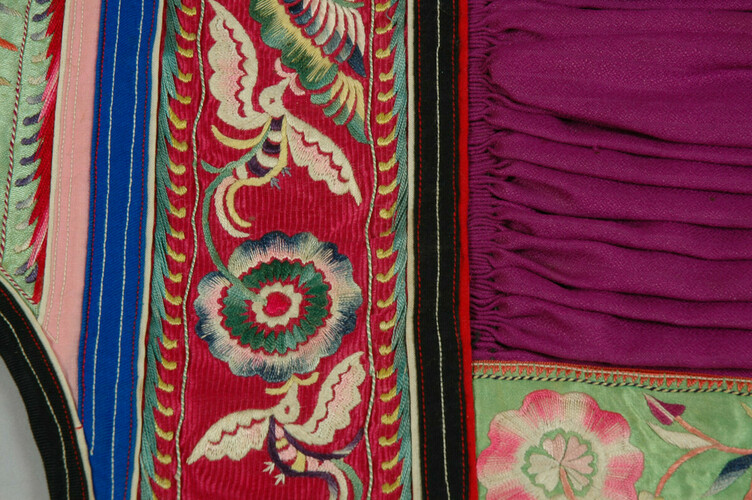 2010.3.22Embroidered Apron, decorated on the back with batik. [FC 02/08/2010]2010.3.22
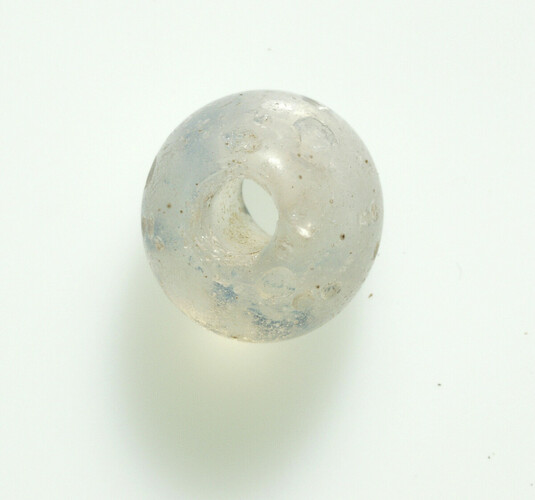 1946.8.105Spherical bead of translucent slightly bluish white glass with medium thread hole [RTS 19/4/2004].1946.8.105
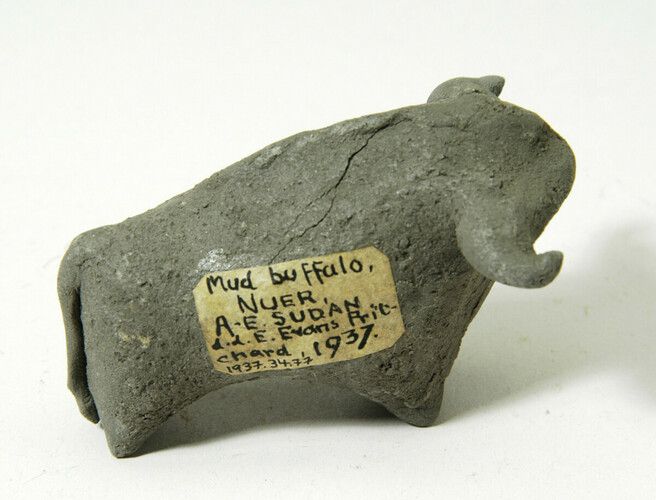 1937.34.77Hand modelled clay figure of a buffalo with long tail, used as a toy.1937.34.77
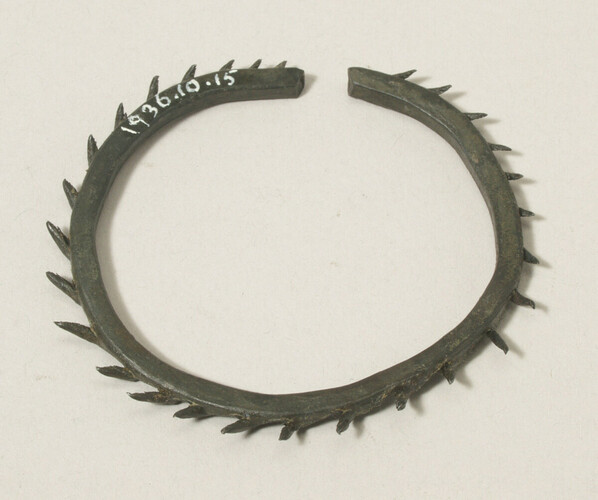 1936.10.15Iron armlet with sharp spikes around the edge, used for wrestling fights [RTS 23/3/2004].1936.10.15
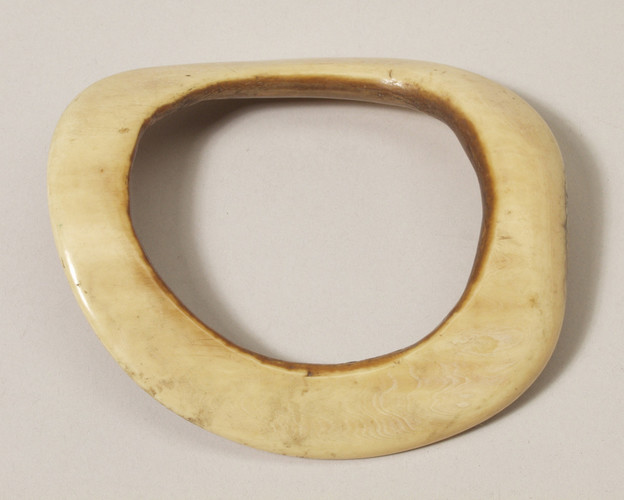 1917.25.82Annular ivory arm ornament with convex upper surface [RTS 25/3/2004].1917.25.82