
- Collection type
- Object
- Description
- Hand modelled clay figure of a buffalo with long tail, used as a toy.
- Long description
- Toy figure of a wild buffalo, hand modelled out of well levigated gray clay with tiny mica flecks and occasional small white inclusions and dried in the sun (Pantone 404C). It consists of a cylindrical body, with a thickened ridge running along the top of the back then curving over the top of the head, giving the animal a stocky profile. The head itself is poorly defined, with the horns being its most prominent feature, curving out on either side of the face in a horizontal plane, with the line of the horns running across the front in a pinched, convex ridge. Another pinched ridge runs vertically down the front of the chest. The figure has four short legs, pulled out from the underside of the body, and poorly defined. Although these have pointed bases, the figure is able to stand upright. The underside of the belly is concave, following in a smooth line from front to back legs. A narrow strip of clay has been applied to the rump of the animal, and hangs down between the back legs to form a long tail. The surface of the figure has been smoothed, but some fingerprints are visible. It is complete and intact, with a weight of 79.8 grams, being 48.2 mm high, 68.3 mm long and 26.3 mm wide across the shoulders.
- Geographical reference
- Cultural groups
- Nuer
- Date / Period
- Date made: Before 1936
- Date collected
- October to November 1936
- Acquisition information
- Donated: 1937 Found unentered: 05/10/2004
- Dimensions
- Height 48.2 mm, Width 26.3 mm shoulders, Length 68.3 mm, Weight 79.8 g
- Object numbers
- Accession number: 1937.34.77
- Research and responses
Evans-Pritchard did his fieldwork amongst the Nuer in four expeditions, which took place in 1930, 1931, 1935 and 1936. This object appears to have come into the museum as part of a group of figurines, collected during Evans-Pritchard's last expedition in 1936, when he held a research fellowship from the Leverhulme Trust (see E.E. Evans-Pritchard, 1940, The Nuer). He discusses the use of mud figures by the Nuer: “The games of rather older children of both sexes centre round cattle. They build byres of sand in camps and of moistened ashes or mud in villages, and fill the toy kraals with fine mud cows and oxen ... with which they play at herding and marriage” (E.E. Evans-Pritchard, 1940, The Nuer, p. 38). The material used seems to be a naturally occurring clayey soil, and 'clay' has been chosen here as a better descriptive term than 'mud'.
This object was found amongst material in storage at Osney and assigned an accession number on 5th October 2004; the paper label stuck to the surface of the object matches the style and handwriting of the label for 1937.34.75 and 1937.34.78, and it seems likely that all were brought in at the same time (see group 1937.34.70-75). This is the one of the smallest of the figurines in that group. See also the other Nuer figurines collected by Evans-Pritchard, and accessioned in the previous year, 1936.10.82-91.
Similar figures are described in their accession book entries as made by boys, and played with by children of both sexes (e.g.: 1936.10.90) [RTS 12/10/2004].
For clay figures made by neighbouring groups, such as the Dinka, see S.L. Cummins 1904, "Sub-tribes of the Bahr-el-Ghazal Dinkas", JRAI 34, 160-161, and H.A. Bernatzik, 1929, Zwischen Weissem Nil und Belgisch-Kongo, fig. 137 (for a photograph of Shilluk children playing with a large group of such figures) [RTS 15/8/2005].
Search terms: Toy and Game, Figure, Model, Pottery, Animal Figure, Toy
Further items to explore
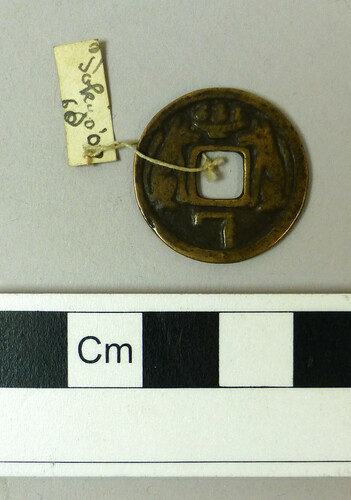 1985.53.936Amulet, metal coin with square perforation, with two foxes, a bowl with something on it and a ?key. The foxes are associated with Inari. [El.B 09/12/2013]1985.53.936
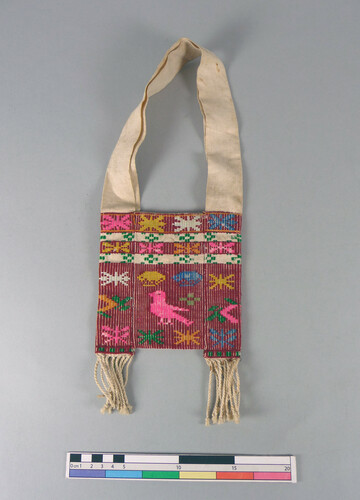 2011.126.3Embroidered bag with animal and geometric embroidered decoration. [FB 11/01/2012]2011.126.3
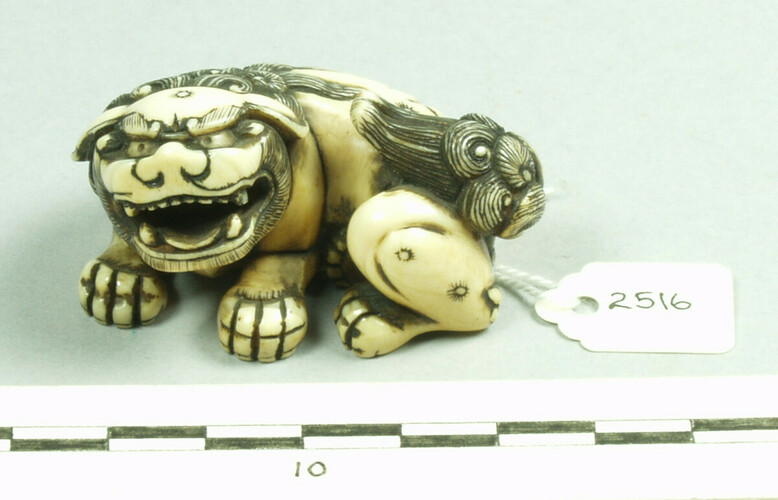 1980.34.2516Ivory netsuke toggle representing a lion with a ball in his mouth. [N.B. 'DCF 2004-2006 What's Upstairs?' 17/5/2005]1980.34.2516
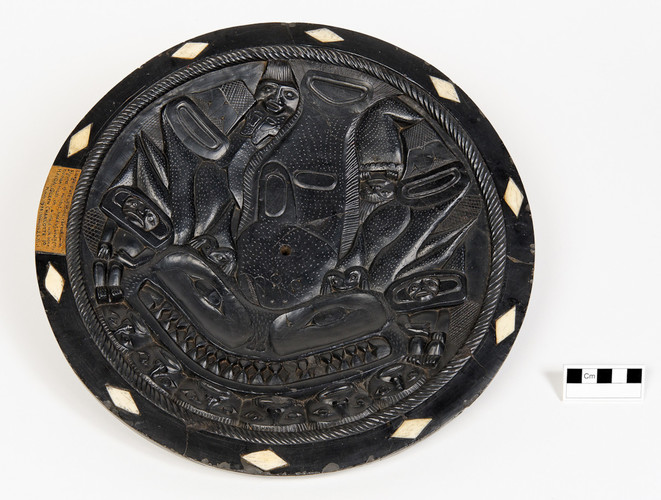 1926.71.1Large circular argillite plate carved with figures of halibut, sculpin, humans and frogs and inlaid with bone.1926.71.1
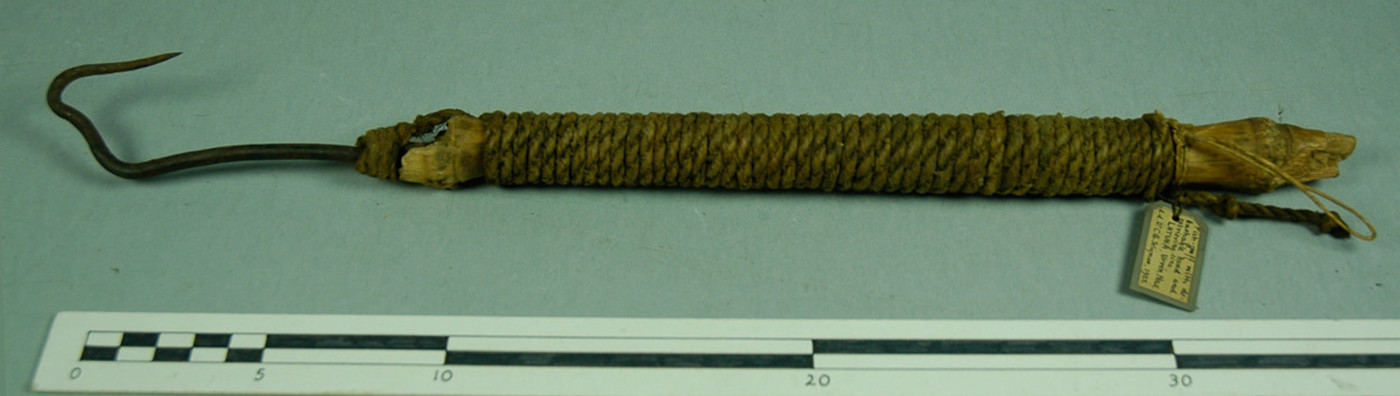 1922.25.2Fish-gaff with detachable iron hook bound to wooden stick with twisted line. [MJD 09/11/2009]1922.25.2
 1934.8.132.5Short narrow wooden spatula, pointed at both ends, used as potter's tool [RTS 15/10/2004].1934.8.132.5
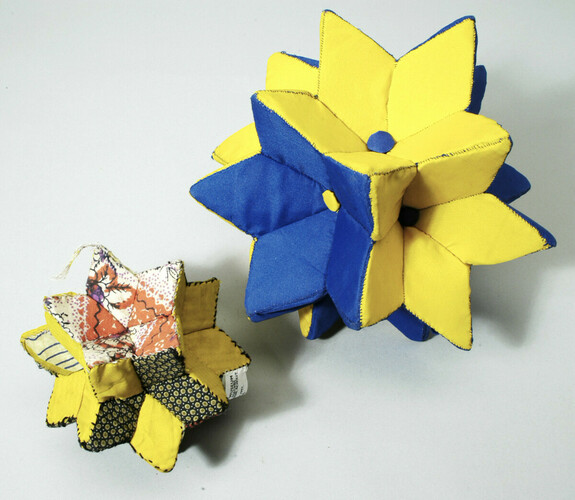 1998.9.16Dodecahedron-shaped mobile with each face in the form of a 5-pointed star, made from cardboard covered with recycled cloth [RTS 16/2/2005].1998.9.16
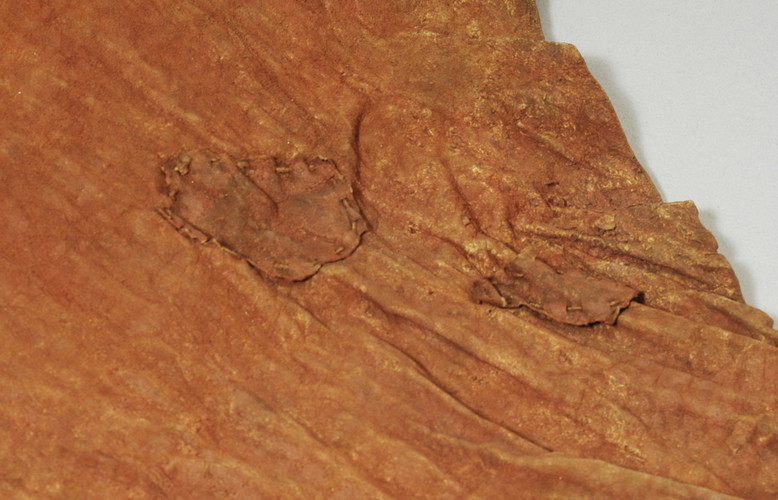 1903.2.6.2Hide back apron with several mended patches, worn by a woman [RTS 16/9/2005].1903.2.6.2