
- Collection type
- Object
- Description
- Dodecahedron-shaped mobile with each face in the form of a 5-pointed star, made from cardboard covered with recycled cloth [RTS 16/2/2005].
- Long description
- Mobile made from diamond-shaped pieces of cardboard, covered in recycled scraps of school uniforms and other textiles and then stitched together. The body is hollow and shaped like a dodecahedron, with each of the 12 sides composed of 5 diamond-shaped segments arranged into a star, then stitched to one another and adjacent sides along their edges. This stitching has been done using a combination of white, yellow and black yarn, some of which may be wool; the colours do not always co-ordinate with the colour of the fabric being used. All the cloth used has been made with a simple checkweave (over 1, under 1). Some pieces are cut from a yellow polyester fabric (Pantone 7505C) that is said to be reused from ECF school uniforms; 2 sides have been filled entirely with diamonds in this design. Others have been cut from fabric with a navy blue background (Pantone 539C) covered with 2-coloured olive green dots (Pantone 449C). This has been used for 1 whole side and parts of 2 other sides. A third fabric has a pale pink background with a floral pattern in red (Pantone 173C), purple (Pantone 258C) and navy blue, including heart shaped motifs; this appears on one full side and part of a second. The final fabric is a mix of a pale off white background with thin blue stripes (Pantone 2766C), red background with thicker blue stripes (Pantone 484C), and yellow background with thin blue stripes (Pantone 110C); this makes up 2 full sides and parts of several others. At the top of the mobile, a multi-stranded loop has been sewn onto one corner to allow it to be hung up. The mobile is complete and in good condition, and the fabric colours are still quite bright. It has a weight of 75.6 grams, and is 138 mm high, and 180 by 170 mm wide. Each diamond shaped segment is around 60 mm long, and the suspension loop is 45 mm long [RTS 16/2/2005].
- Geographical reference
- Cultural groups
- Acholi
- Date / Period
- Date made: Before 1997
- Date collected
- 1997
- Acquisition information
- Purchased: 19/01/1998
- Materials and processes
- Material Cardboard Paper Plant, Material Textile, Material Polyester Textile Synthetic, Material Wool Yarn Animal, Process Chequer Woven, Process Covered, Process Stitched, Process Recycled
- Dimensions
- Length x Width x Height 180 x 170 x 138 mm, Length 60 mm diamond shaped segments, approx, Length 45 mm suspension loop, Weight 75.6 g
- Object numbers
- Accession number: 1998.9.16 Other numbers: Kaiser no. 17 Other numbers: PRM invoice item 16 (see RDF)
- Research and responses
This object is one of a collection made by Tania Kaiser, a D.Phil. student of Linacre College, during her fieldwork in the Kiryandongo Refugee Settlement. She conducted fieldwork in the camp from October 1996 to March 1997, and between June and November 1997. The population of the camp had originally come from Parajok in the Torit district of Southern Sudan, and was a mix of Acholi from that area and previously displaced Sudanese refugees (For details of her work, see: T. Kaiser, 1999, Living in Limbo: Insecurity and the Settlement of Sudanese Refugees in Northern Uganda (Unpublished PhD); T. Kaiser, "Making Do and Making Beautiful: Recycling in an African Refugee Settlement", in: J. Coote, C. Morton and J. Nicholson (eds), Transformations, the Art of Recycling, 44-47; T. Kaiser, 2000, UNHCR's Withdrawal from Kiryandongo: Anatomy of a Handover, New Issues in Refugee Research Working Paper No. 32, 1, 3).
Although not specified for this particular object, the yellow material used here is the same as that seen on 1998.9.16, where it is described as 'Blue and yellow polyester - leftover scraps from the ECF school uniforms'; ECF is the 'Equatoria Civic Fund' [RTS 16/2/2005].
Search terms: Furniture Dwelling, Ornament, Toy and Game, House-ornament, Toy
Further items to explore
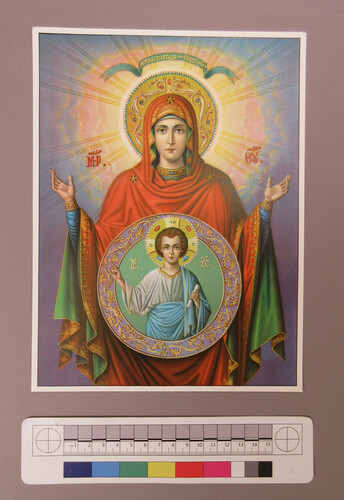 1978.16.76Paper print of Virgin and Child inset in circular floral icon.1978.16.76
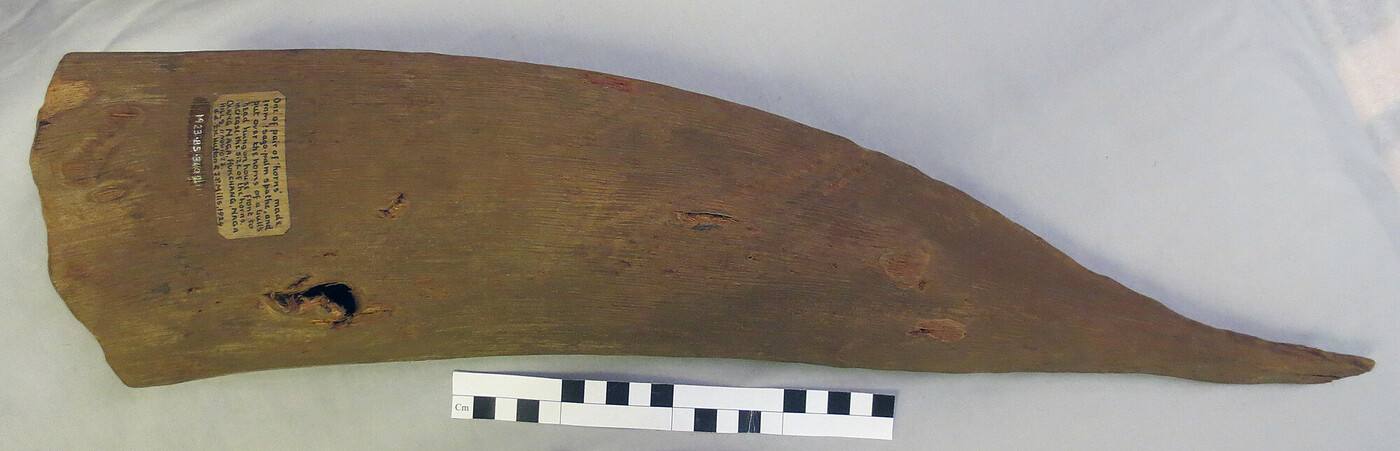 1923.85.340.2Palm or bark in the form of a horn. [ZM 5/1/2006]1923.85.340.2
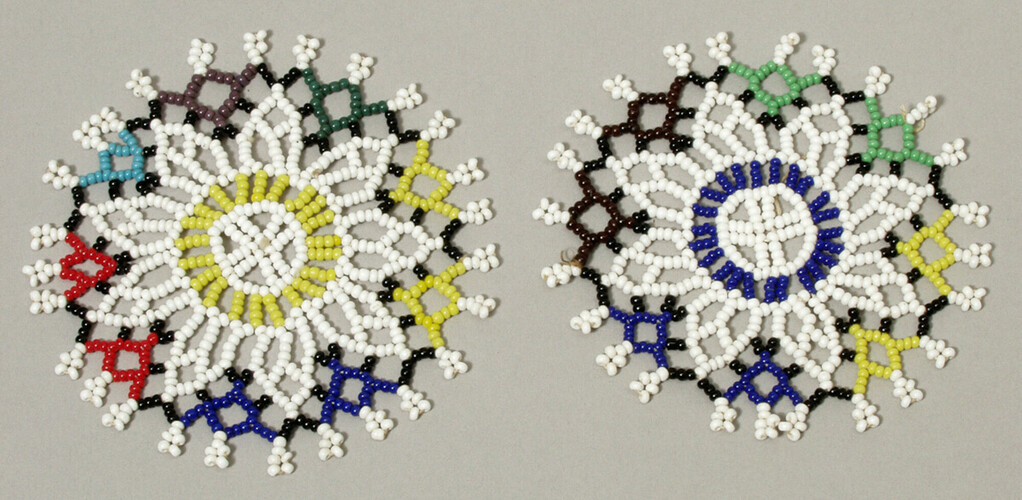 2000.21.10One of two circular pieces of beadwork. The main colours used are white, blue, yellow, black and red. The use of the piece is unknown but is most likely a coaster to be placed under a drink to prevent marks on a table. [MdeA 24/11/2000]2000.21.10
 1939.12.44Carved house panel painted with in red black and white. Carved with a central face and decorative curvilinear designs. [LKG 24/06/2010]1939.12.44