
- Collection type
- Object
- Description
- Wooden figure of a man.
- Long description
- Anthropomorphic figure carved from a single piece of wood in the form of a standing man, facing forward with arms held straight by sides, legs positioned slightly apart and feet flat on the ground, facing forwards. Most of the body is a warm orangey brown colour (Pantone 730C), with areas burnt black to show details of the hair, face, torso, hands and legs (Pantone black 7C). The figure has a slightly pointed head, with the edges of the hair delineated by incised arcs over the brow, curving above the ears and down to a point at the nape of the neck. This area has been burnt black but has no further detailing. Facial details have been marked using the technique of pyroengraved pokerwork. This includes two curving eyebrows burnt into the surface, above sunken oval eyes, defined by grooves around their edges and narrow, burnt, deep slots running horizontally across the middle. Below these there is a long triangular nose with two neat circular nostrils burnt into its underside, a pouting mouth with a short straight line burnt across the surface, and a small protruding chin. Cicatrization marks have been added as a group of three vertical lines on each cheek. The ears stound proud from either side of the head, and are notched on the inside edge. Their interiors are deep, blackened hollows. A small hole has been burnt through the base of each ear, and fitted with two small white metal earrings that are probably made from either aluminium or tin (Pantone Cool Gray 1C). The appear to have been made from sheet metal, rolled into a rod and then bent into loops with the ends touching. The figure has a thick neck, defined by a faint groove at its base. A short necklet has been hung around this and tied in a knot at the back. This has been made from twisted cotton yarn, strung with a series of 76 small cylindrical glass beads. Some of these are translucent and colourless; a few appear to have a colourless surface with a dark gray or black core (possibly from dirt along the thread hole); the remaining beads which are in the majority are a bright pink that has faded in patches to white (Pantone 190C). The torso of the figure is cylindrical and only slightly modelled, with two nipples and a navel protruding from the surface and blackened around their bases, and male genitals carved below. The bottom is indicated by a narrow curving surface; the buttocks are not distinguished. The shoulders and arms are rounded, swelling out slightly at the elbows and with splaying hands that have flattened surfaces. Four long v-shaped grooves have been burnt into each hand to indicate the fingers. The legs are fairly plump, swelling out at the hips then tapering in towards two broad oval feet that slope down on all sides to a flat base. The tops of these have been burnt black. Around its waist, the figure wears a buff coloured hide loincloth or apron (Pantone 7506C). This has been cut to imitate the shape of a full hide, with outstretched leg sections; the top two corners have been tied to a two narrow strips of hide that are knotted together at the centre of the back. The figure is complete and intact, although there are a few small holes in the apron. The surface of the wood seems to be covered with tiny flecks of either mica or salt. Carving marks are visible across much of the surface, which has been largely smoothed, except for inaccessible areas under the arms and between the legs. It has a weight of 750.5 grams, is 331 mm high, and measures 72.2 mm across the width of the head, 114 mm across the shoulders and 90.5 mm across the hips; the maximum thickness of the head is 73 mm. The earrings have diameters of 11.5 mm, and are 2.4 mm wide and 2.3 mm thick. A typical bead is 2 mm long and has a diameter of 1.1 mm, while the apron is 96 mm long at the front [RTS 17/9/2004].
- Geographical reference
- Cultural groups
- Acholi
- Person
- Maker Ajala
- Field collector Armine Charles Almroth Wright
- PRM source Armine Charles Almroth Wright
- Date / Period
- Date made: Before 1939
- Date collected
- By 1939
- Acquisition information
- Donated: 07/1939
- Materials and processes
- Material Wood Plant, Material Animal Hide Skin, Material Glass, Material Cotton Seed Fibre Yarn Plant, Material Aluminium Metal, Material Tin Metal, Process Carved, Process Perforated, Process Burnt, Process Pyroengraved Pokerwork, Process Hammered, Process Bent, Process Strung
- Dimensions
- Height: max 335 mm, Weight 750.5 g
- Object numbers
- Accession number: 1939.7.123
- Research and responses
Gulu is located in the Gulu District in the northern part of Uganda [RTS 10/6/2004].
This figure has been carved in a similar style to 1939.7.122, and was made by the same craftsman. They wear similar earrings, and have almost identical bodies, except for the genitalia; there are differences in the cicatrization marks and the types of necklace they wear [RTS 17/9/2004].
Search terms: Figure, Bead, Clothing, Ornament, Trade, Ear Ornament, Apron
Further items to explore
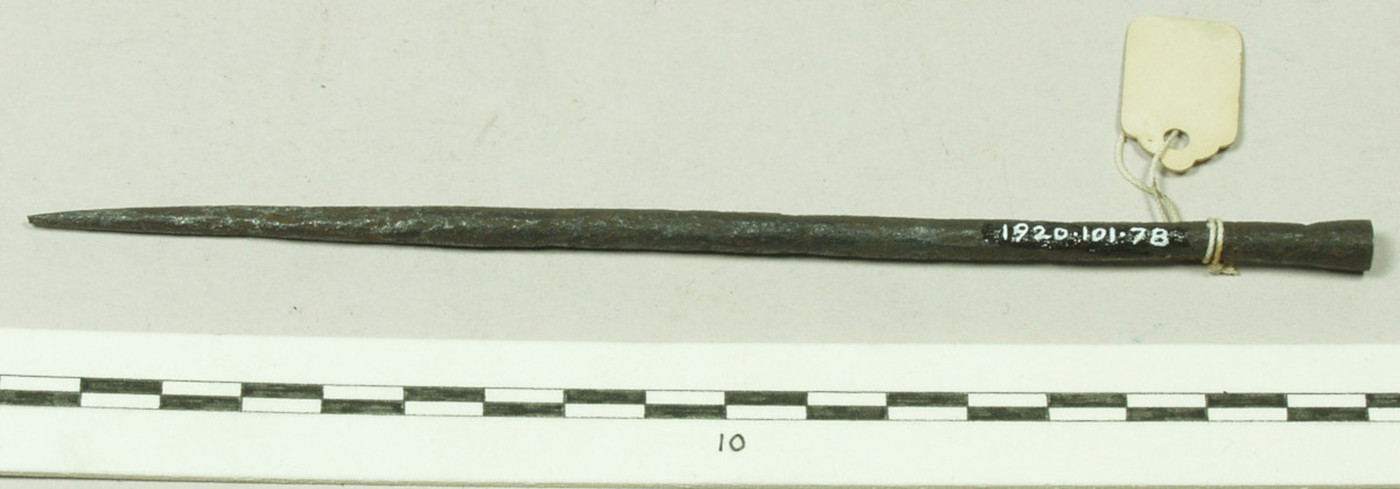 1920.101.78Cautery-iron, for blistering to cure headache.1920.101.78
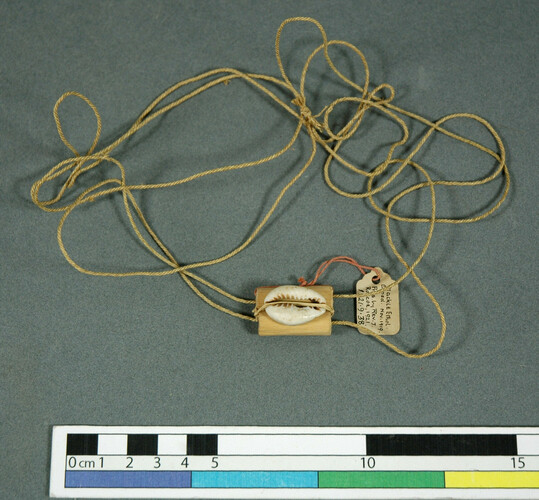 1921.9.38Amulet worn by pregnant women.1921.9.38
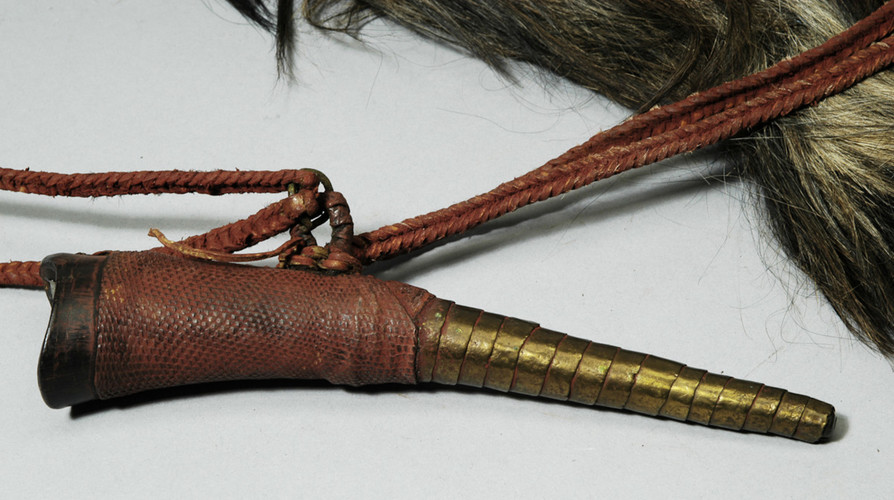 1925.14.15Notched end-blown war flute carved from horn, with added resin narrowing the embouchure and a single fingerhole at distal end. Bound in reptile skin and brass strips, with plaited hide carrying loop and 2 long animal tail tassels [RTS 27/1/2005].1925.14.15
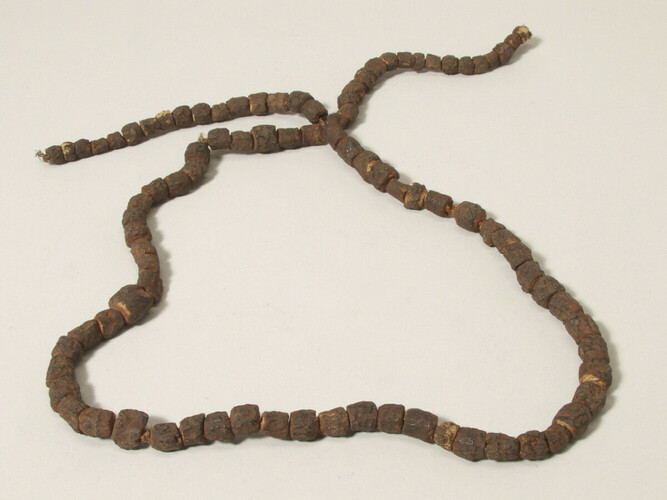 1942.1.447Scented wooden beads strung on a plaited grass string, worn around the neck [RTS 13/5/2004].1942.1.447