
- Collection type
- Object
- Description
- Mask used in dances performed for curing, with large carved pointed teeth and holes under the eyes to enable the wearer to see. [JN 15/07/2008]
- Long description
- Mask used in dances performed for curing, with large carved pointed teeth and holes under the eyes to enable the wearer to see. The mask is painted a yellow/brown colour with black lines to accentuate the eyes and mouth. The mouth has six very pointed and large teeth and is painted red. Both eyes are open. [SM 11/07/2008]
- Geographical reference
- Cultural groups
- Sinhalese
- Person
- Field collector Frederic(k) W. de Silva
- PRM source Frederic(k) W. de Silva
- PRM source Henry Luttrell Moysey
- Date / Period
- Date made: Before 1895
- Date collected
- By 1895
- Acquisition information
- Donated: 1895
- Materials and processes
- Material Wood Plant, Material Pigment, Process Carved, Process Painted, Process Perforated
- Dimensions
- Length: max 155 mm, Width: max 120 mm
- Object numbers
- Accession number: 1895.36.2 Other numbers: 1 [on list in RDF]
- Research and responses
The following notes were taken during a visit on the 9th July 2008 by Mohan Daniel, a mask specialist from Sri Lanka. He noted that the masks were not always correctly identified with the relevant demon on the list in the RDF or the writing on the objects that was presumably written by Frederick De Silva before the objects were donated to the museum. It is unclear whether this was done deliberately to prevent the masks being used, or whether it was accidental. Mohan Daniel believes that this mask is not Maru Sanniya. However, further research will be necessary to determine which demon it does represent. He mentioned that masks like this were usually rubbed with an oil made from a now rare tree in Sri Lanka to act as an insect repellent. This oil leaves a shiny surface on the mask. Mohan Daniel believes that none of the masks in this collection [1895.36.1-18] were used, as they show no discolouration on the back of the mask and there are no holes to use to tie the mask onto the face. [JN 15/07/2008]
- Associated publications
- Illustrated in colour on page 332-333 of Les Maîtres du Désordres, edited by Josephine Chambonnière (Paris: Musée du quai Branly / Réunion des Musées Nationaux Grand Palais, 2012). Caption (same page): 'Dix-huit masques représentant les dix-huit maladies (Sri Lanka, avant 1895, 18 x 11,7 cm)'. (The eighteen masks in this collection are illustrated in accession number order, from left to right and from top to bottom of each page; the first nine on page 332 and the rest on page 333.) (Photocopy in RDF.) [FB 22/05/2013, JC 30 5 2013]
Search terms: Mask, Dance, Medicine, Religion, Medical Accessory
Further items to explore
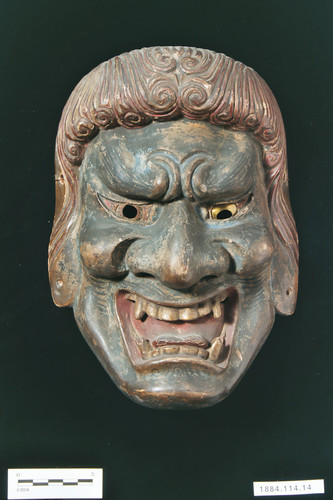 1884.114.14Carved wooden Noh mask depicting a fierce Buddhist deity. The mask has a menacing expression with narrowed eyes and furrowed brow. The mouth of the mask is open revealing pointed teeth and wide red tongue. [CW [OPS move] 31/8/2016]1884.114.14
 1938.27.17Carved wooden figure/ mask.1938.27.17
 1938.15.36Forehead mask with human and animal features.1938.15.36
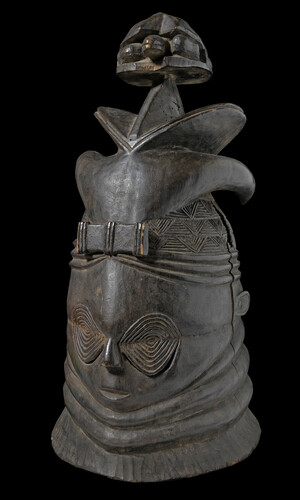 1984.28.1Headpiece or helmet mask of the type associated with Sande or Bundu women's society of West Africa.1984.28.1
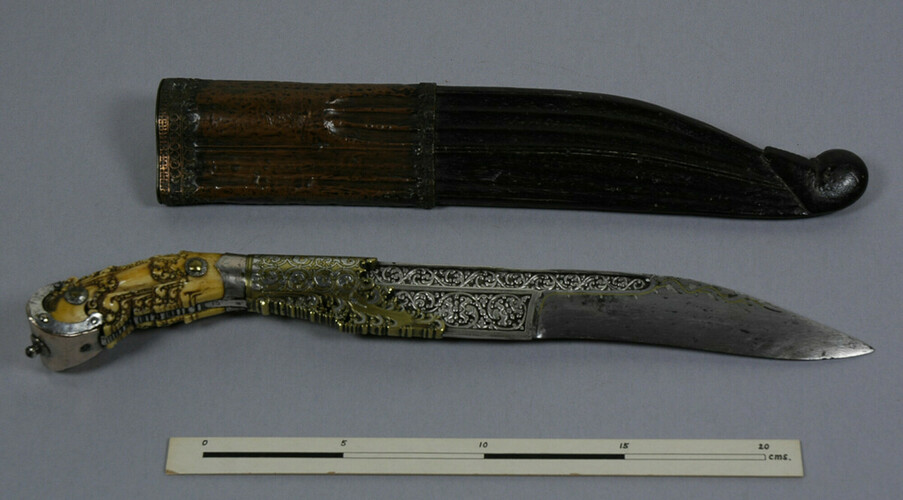 1935.75.30.1Richly chased and mounted dagger [.1] with carved ivory hilt and wooden sheath [.2] [SM 19/03/2007]1935.75.30.1
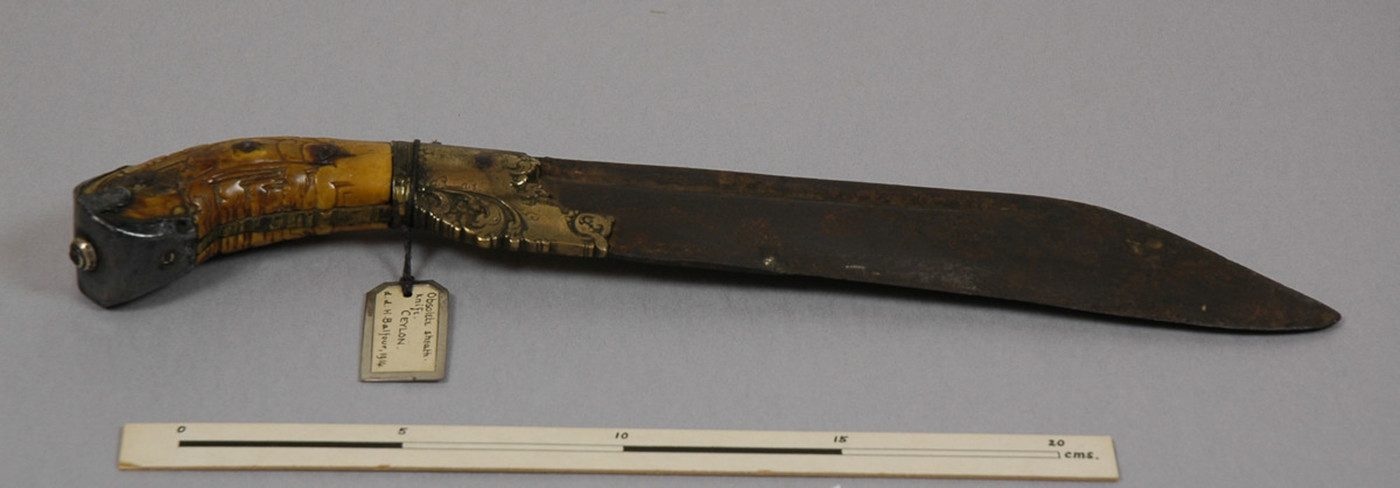 1914.11.12Sheath knife with silver mounted bone grip. [SM 15/03/2007]1914.11.12
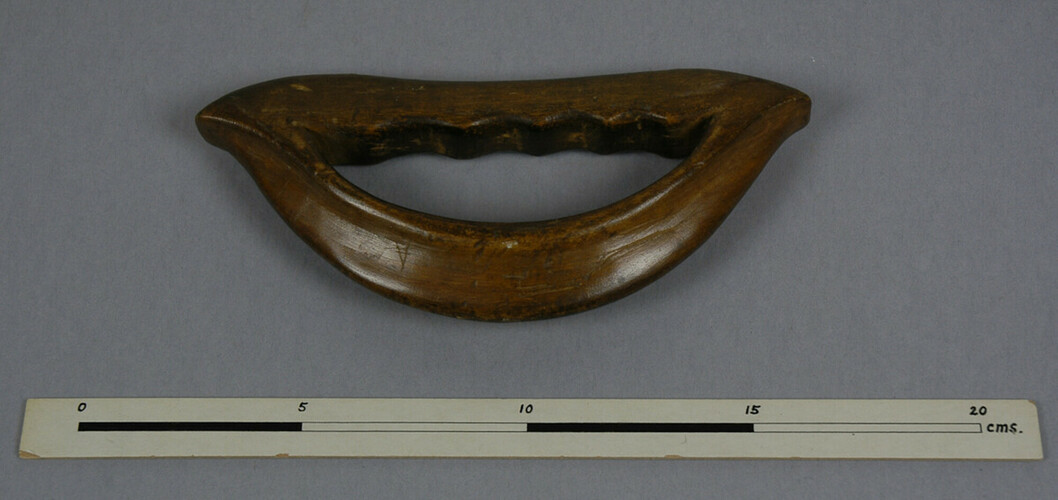 1913.68.4Knuckleduster made of wood with a central ridge running along the outside and scalloped grip. [SM 23/04/2007]1913.68.4
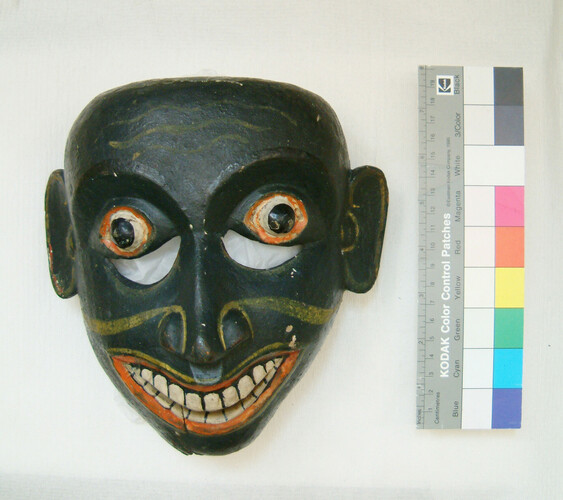 1893.77.1Wooden mask painted blue.1893.77.1