
- Collection type
- Object
- Description
- Headdress of blue and red macaw feathers and small green feathers on a cotton band, tied around a basketry framework in open hexagonal plaiting. Beaded cotton pendants with feathered ends on some of the long feathers.
- Geographical reference
- Person
- Field collector William John Burchell
- Other owner Anna Burchell
- PRM source Ashmolean Museum, University of Oxford
- Date / Period
- Date made: Before 1829, uncertain Date made: 1829, uncertain
- Date collected
- 1826 - 1829
- Acquisition information
- Transferred: 17/02/1886
- Materials and processes
- Material Bird Feather, Material Bead, Material Glass, Material Cotton Seed Fibre Yarn Plant, Material String, Material Plant Fibre, Process Strung, Process Basketry, Process Plaited, Process Beadwork
- Dimensions
- Height: max 360 mm, Width: max 500 mm
- Object numbers
- Accession number: 1886.1.907 Other numbers: 911
- Research and responses
Célia (Glicéria) Tupinambá is an artist, activist, teacher and researcher from the Serra do Padeiro village, located in the Tupinambá Indigenous Land of Olivença, in the south of the state of Bahia, Brazil. Célia and her niece Jéssica viewed this object during a research visit in June 2023 and were certain that it comes from Brazil rather than Guyana as previously documented. This is based on Célia's ability to listen to the object itself and corroborated by comparative research of other collections undertaken by Rosa Dyer and Dr Andreas Schlothauer. A copy of the report written by Célia and Rosa regarding the Brazilian featherwork collections can be found in RDF under 1886.1.908.
For notes on the Amazonian featherwork and related material on display in the Museum in April 2016, including this object, with suggestions regarding provenance and species identification, see the untitled report by Andreas Schlothauer and related correspondence in the RDF: Researchers: Andreas Schlothauer. [JC 8 7 2016]
Andrew Gosler and Juan Gonzalez, during a research visit, thought that the red and blue feathers were from the scarlet macaw, the blue feathers were from the blue and gold macaw, and the green feathers were from a parrot. [ROH 07/03/2012]
William John Burchell was collecting in southern Africa between 1810 - 1815 and in South America between 1826 - 1830, see Biographies file for further information [AP 20/1/99]
According to Peter Riviére none of the sources that he has checked mention that Burchell visited Guyana and it may therefore be that he was not the field collector of these items. PR confirmed that there is a detailed report of his itinerary in Phytologia 14 (1967) [AP 24/06/2009]
- Associated publications
- Illustrated with a line drawing in the leaflet 'Basketry in The Pitt Rivers Museum', devised by Felicity Wood with the Oxfordshire Basketmakers, 2001. It is also featured on the website www.basket.prm.ox.ac.uk [JN 14/11/2001] This object was featured in the Museum's on-line fact sheet ‘South American Feather Headdresses’ produced during the DCF-funded 'What's Upstairs?' project, 2004–2006. [BR 'DCF 2004-2006 What's Upstairs?' 8/11/2005] This object was featured in the Museum’s ‘web gallery’ (‘Selected Objects from the Lower Gallery’) produced during the DCF-funded ‘What’s Upstairs?’ project, 2004–2006, with the following caption: ‘In South America the brightly coloured feathers of parrots, toucans, and macaws have been used to make headdresses since before the Spanish conquest in the sixteenth century. Macaws are large and brightly coloured. This bright blue headdress is decorated with macaw feathers. It belonged to a chief and was collected between 1826 and 1829.
Search terms: Clothing Headgear, Ritual and Ceremonial, Ornament, Basketry, Status, Headdress, Head Ornament, Ceremonial Object, Status Object
Further items to explore
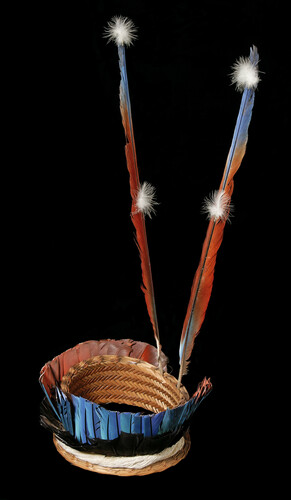 1954.2.105Ceremonial feather hat: a crown of twill plaited basketry surrounded with cut macaw feathers, black powis feathers and a thick band of cotton yarn. At the back are two long macaw feathers decorated with duck down. [LM 'DCF 2004-2006 What's Upstairs?' 6/12/2005]1954.2.105
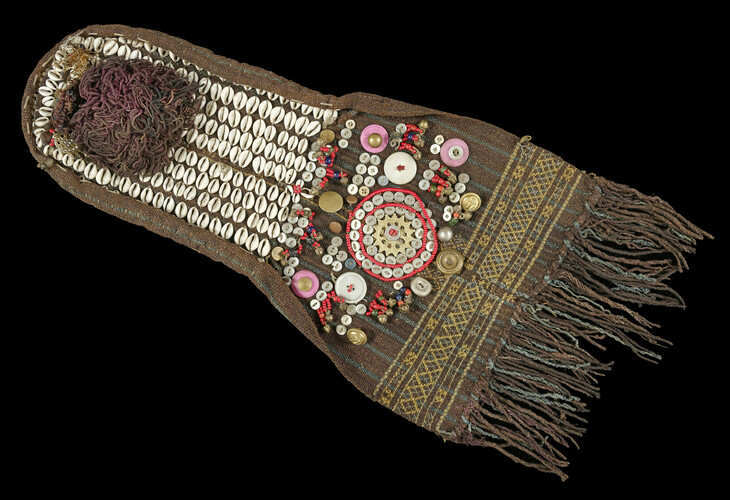 1983.20.5Headdress. [El.B 22/04/2008]1983.20.5
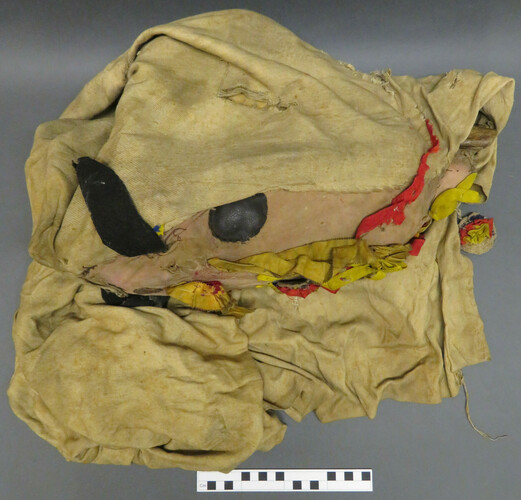 1941.4.59Decorated horse skull, part of mumming costume.1941.4.59
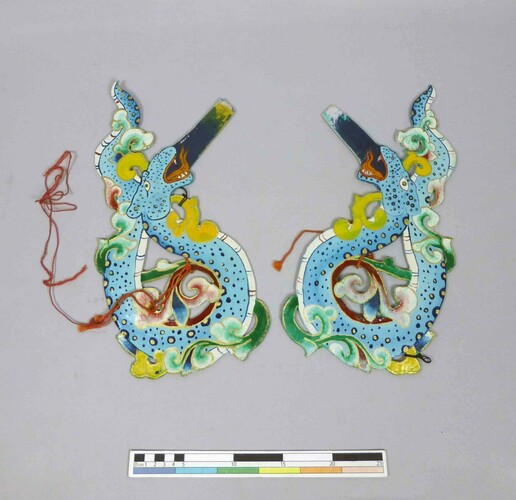 1996.3.1.3.1Two decorative superstructures which attach to the sides of Black Hat Dancer's hat [1996.3.1 .1]. [FB 02/12/2014]1996.3.1.3.1
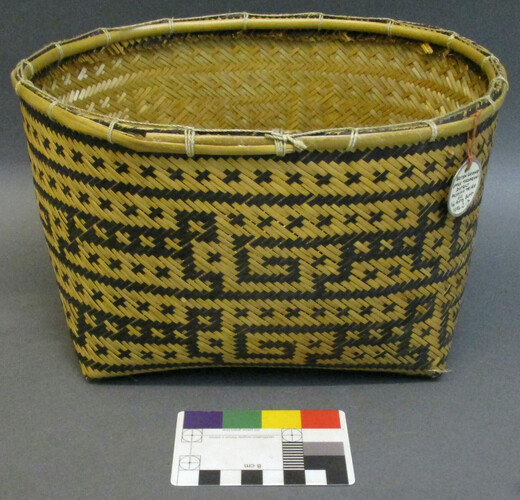 1954.2.17Basket. Rounded rectangle or oval basket with flat, rectangular bottom and straight sides. [MOBB [OPS move] 17/11/2016]1954.2.17
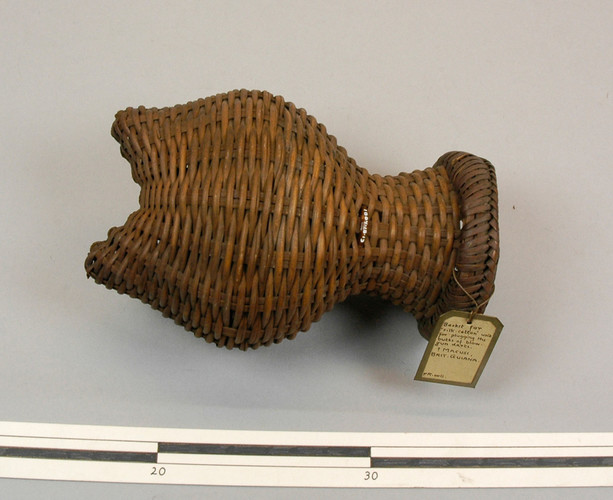 1884.18.13Blowgun accessory, globular basket with small 'legs' on the bottom. [El.B 14/01/2008]1884.18.13
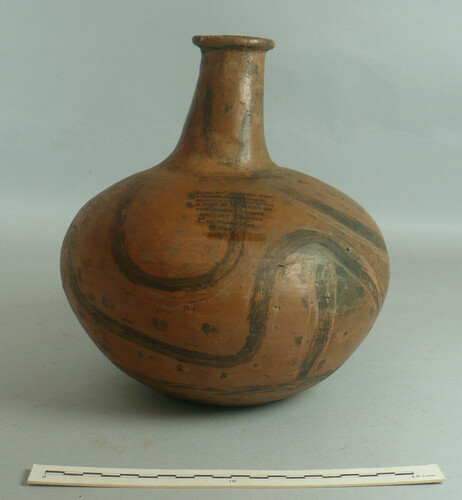 1885.9.5Ceramic water pot1885.9.5
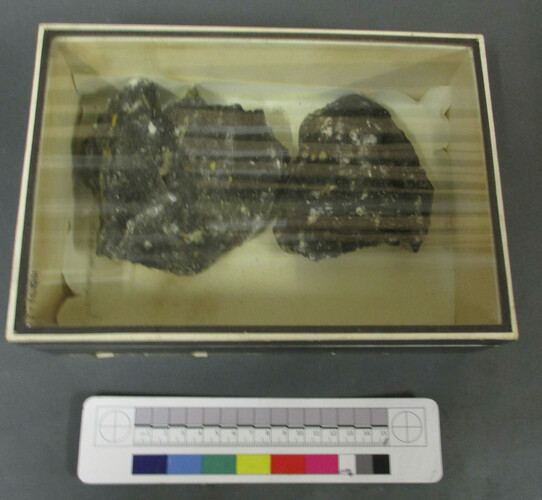 1958.3.2.1Specimen of tree resin used in torches and when lighting fires. The resin is predominately black in colour with spots of white and yellow. One of a pair in a glass-topped box, for the other see 1958.3.2 .2. [AB [OPS Move] 12/5/2017]1958.3.2.1