
- Collection type
- Object
- Description
- Women's fringe apron made from strands of twisted opossum fur, black and brown in colour. [FB 12/02/2015]
- Geographical reference
- Northern Territory Gulf of Carpentaria Mcarthur River Borroloola
- Cultural groups
- Marra
- Person
- Field collector Francis James Gillen
- Field collector Walter Baldwin Spencer
- PRM source Walter Baldwin Spencer
- Date / Period
- Date made: Before 1902
- Date collected
- 1901 - 1902
- Acquisition information
- Donated: 1903
- Materials and processes
- Material Animal Fur Skin, Material String, Process Twisted, Process Tied
- Dimensions
- Width: max 880 mm, Length: max 230 mm
- Object numbers
- Accession number: 1903.39.23 Other numbers: Spencer number 17
- Research and responses
Borroloola is where the Spencer and Gillen expedition was 'marooned' during the 'Wet'. Originally the expedition had planned either to go overland to Queensland or to Darwin but a decision was taken to go to Borroloola but the expected boat to take them to Darwin did not arrive and Spencer and Gillen stayed there for some time before they were 'rescued' by a boat sent at the request of Mrs Spencer. see Mulvaney 'So much that is New' 1985: 212-213. During their stay in Borroloola they carried out some fieldwork (and collecting). See also 'Camp Jottings .. ' by FJ Gillen 1968 South Australian Libraries Board [AP]
This object was collected during an expedition of Central Australia led by Walter Baldwin Spencer and Francis Gillen between 1901 and 1902. However, it should be noted that accompanying them was an Aboriginal man called Erlikilyika. He was 'hired' (receiving no monetary payment) to run their campsites, but actually undertook some of the ethnographic work himself. He could speak Arrernte (his native language), Kaytej (another Aboriginal language), and English. In their personal field-diaries, Spencer and Gillen note that they took days off work, leaving Erlikilyika with "entire charge of the ethnological branch", where he spoke with and recorded the complex beliefs and customs of Aboriginal communities that were not his own (the Kaytetye group in particular). Unfortunately, there is no way of knowing if Erlikilyika collected any of these objects himself but we know that he played a vital role in documenting their meaning and significance, and should therefore be credited for his valuable contributions to the expedition. This information was provided by Fionnuala Bradbury, a Master's student in Archaeology at Newcastle University, as part of her thesis entitled "Erlikilyika and Walter Baldwin Spencer: Indigenous Informants, Ethnographic Analogy, and Archaeological Interpretation". There is an abridged version of the thesis in RDF.
- Associated publications
- S&G 1904: 686 'Like the pubic tassels the women's aprons vary much in size, being larger and more constantly worn in the northern than in the southern tribes. A girl is not allowed to wear one until such time as she has passed through the ceremony of atna-ariltha-kuma (an initiation ceremony). Most often the apron is made out of opossum fur-string. There is a strand which passes round the waist, and from this a number of strands hang pendant side by side (Fig 253). Occasionally, but only very rarely, aprons made of human hair string are met with (fig 254). In all cases, except the latter, they are covered with red ochre. [AP 13/1/2000]
Search terms: Clothing, Ornament, Apron, Skirt, Waist Ornament, Groin-cover
Further items to explore
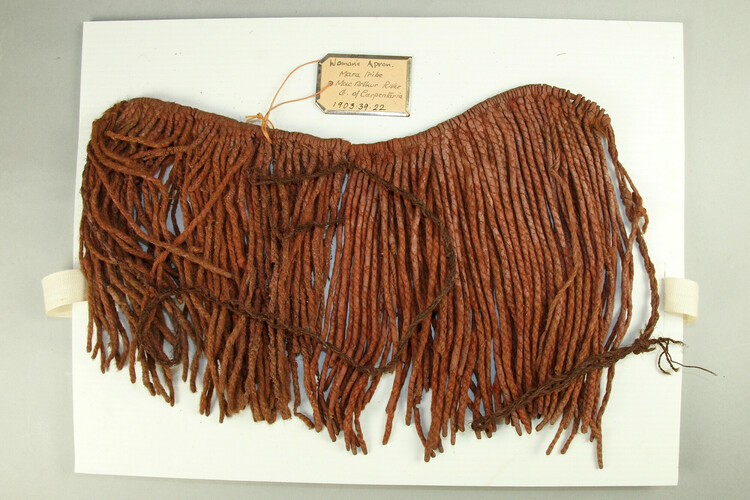 1903.39.22Women's apron made from ochre coated ?plant fibre cord which has been twisted and bound around a waist band strip. [LKG 06/07/2010]1903.39.22
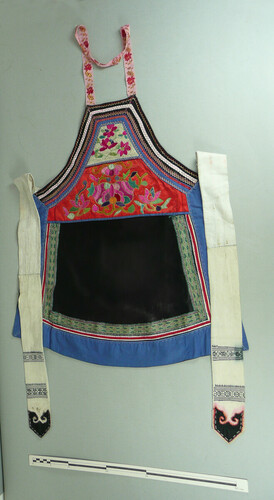 2010.3.8.2Festival appliqué apron [part of a festival costume comprising head-dress [.1], apron [.2] and skirt [.3]]. [FC 14/06/2010]2010.3.8.2
 1994.10.4.2Beadwork apron in dark blue, white and red designs. [N.B. 'DCF 2004-2006 What's Upstairs?' 26/7/2005]1994.10.4.2
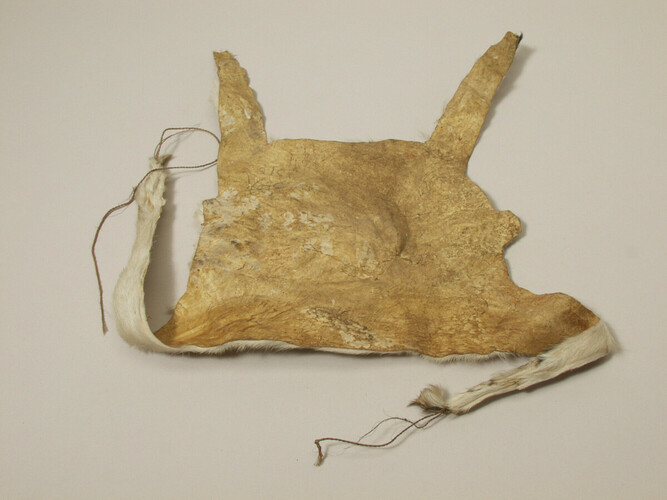 1934.8.90Sheep skin back apron, worn by men for dancing [RTS 22/6/2004].1934.8.90
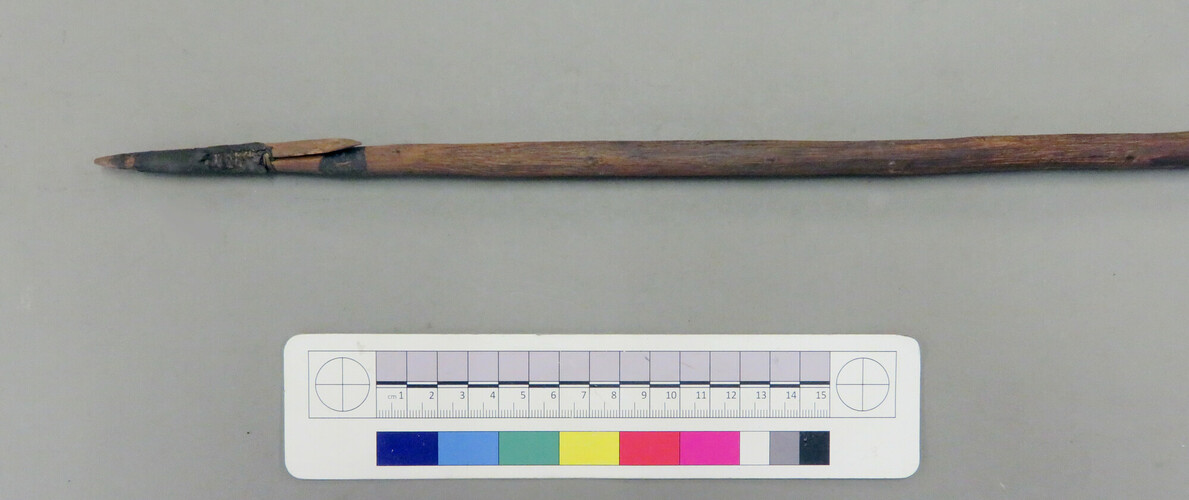 1900.55.7Spear of naturally shaped length of wood, cupped at the butt and pointed at the tip with a flat wooden barb tied to the tip, and a band of black below the barb. [MOBB [OPS move] 13/8/2018]1900.55.7
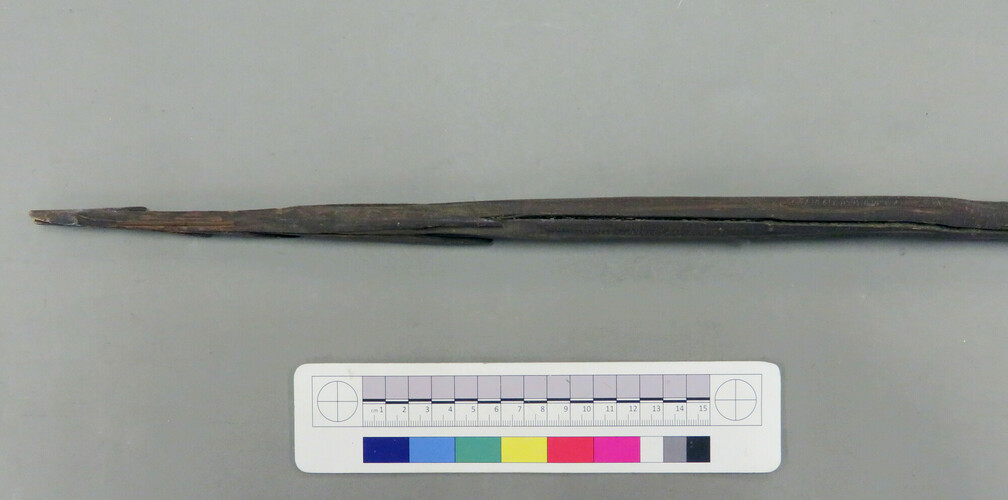 1966.1.61Wooden spear with carved barbs.1966.1.61
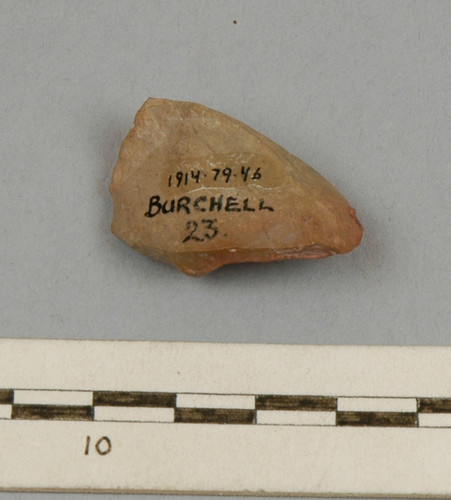 1914.79.46Small core. [El.B 06/08/2007]1914.79.46
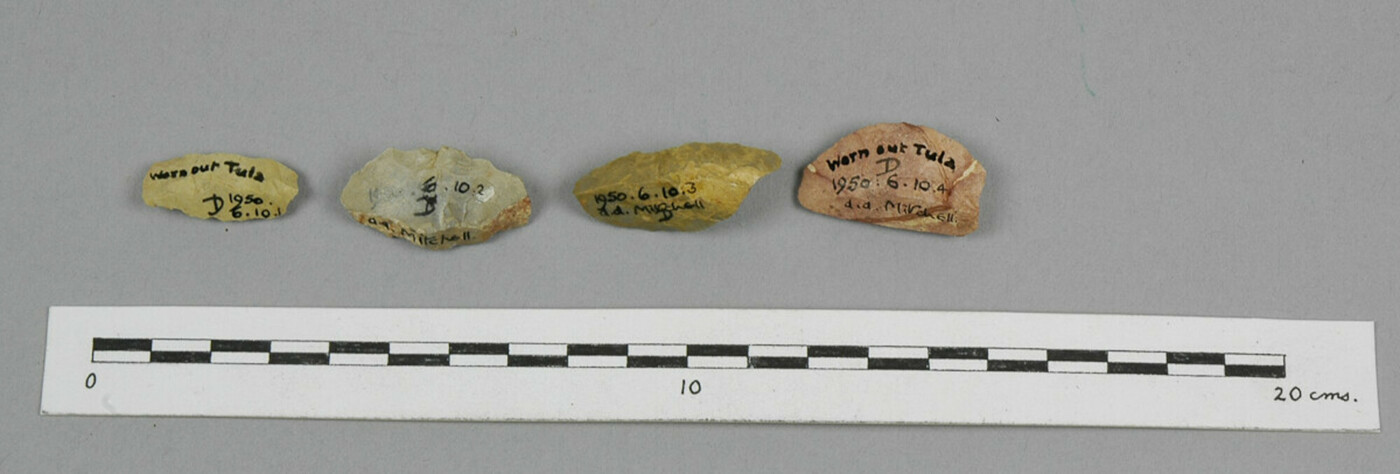 1950.6.10.1'Tula'-type adze1950.6.10.1