
- Collection type
- Object
- Description
- Fighting sword edged with sharks' teeth. [AB [OPS Move] 20/6/2017]
- Long description
- Fighting sword edged with sharks' teeth. Carved from wood with sharks' teeth set into the edges. Each end is pointed, at one end the wood has an oval section and acts as the handle. The blade has a raised ridge along the centre on each side. The tip has a woven palm leaf and sennit cap. [AB [OPS Move] 20/6/2017]
- Date / Period
- Date made: Before 1840
- Date collected
- 1819 - 1840
- Acquisition information
- Donated: 1936
- Materials and processes
- Material Shark Tooth Fish, Material Wood Plant, Material Plant Fibre, Material Palm Leaf Plant, Material Sennit Coconut Seed Fibre Yarn Plant, Process Bound, Process Carved, Process Perforated
- Dimensions
- Width: max 64 mm, Depth: max 41 mm, Length: max 742 mm
- Object numbers
- Accession number: 1936.26.12
- Research and responses
Janet West of the Scott Polar Research Institute, Cambridge, has identified Edward Lawson as being active in the South Seas from 1819-1840, rather than 1800-1820 as given in the original accession record (see her letter in RDF/ Collectors/Lawson). [JC 1996 1 30]
Carved from coconut wood, grooved to accommodate the teeth of the Tiger Shark (Galeocerdo cuvier) and/or the Grey Nurse Shark (Carcharias taurus). These teeth are drilled through and lashed onto the blade with the pinnules (side-ribs) of the coconut leaf, and occasionally female human hair. The aim for the use of all I-Kiribati weapons was to open the enemy’s abdomen, or the major artery inside the elbow. Warriors took magical precautions before battle to deflect their enemy’s weapons. Immediately before the battle, the warrior would strip a single pinnule of a coconut leaf and join the ends into a necklace to wear. As he joined the ends, he chanted: “The weapon is descending, it has nearly descended! But I shall deflect it downwards or upwards. The weapon is descending, but it is afraid, it is a coward. Uh! All is well!”. Relevant Reading: Murdoch, G.M. (1923) Gilbert Islands Weapons & Armour. In: Journal of the Polynesian Society, Vol.32, pp.174-5. Gudger, E.W. (1930) Helmets from Skins of Porcupine Fish. In: Illustrated Science Monthly, Vol.30, pp.432-442. Guiart, J. (1963) The Arts of the South Pacific. London: Thames & Hudson. Grimble, A. (1972) Migrations, Myth & Magic from the Gilbert Islands. London: Routledge & Kegan Paul. Koch, G. (1986) The Material Culture of Kiribati. Suva: University of the South Pacific. Grimble, A.F. (1989) Tungaru Traditions: Writings on the Atoll Culture of the Gilbert Islands. Honolulu: University of Hawaii Press. Research Conducted for DCF Cutting Ede 2006/2007 [AM]
Further items to explore
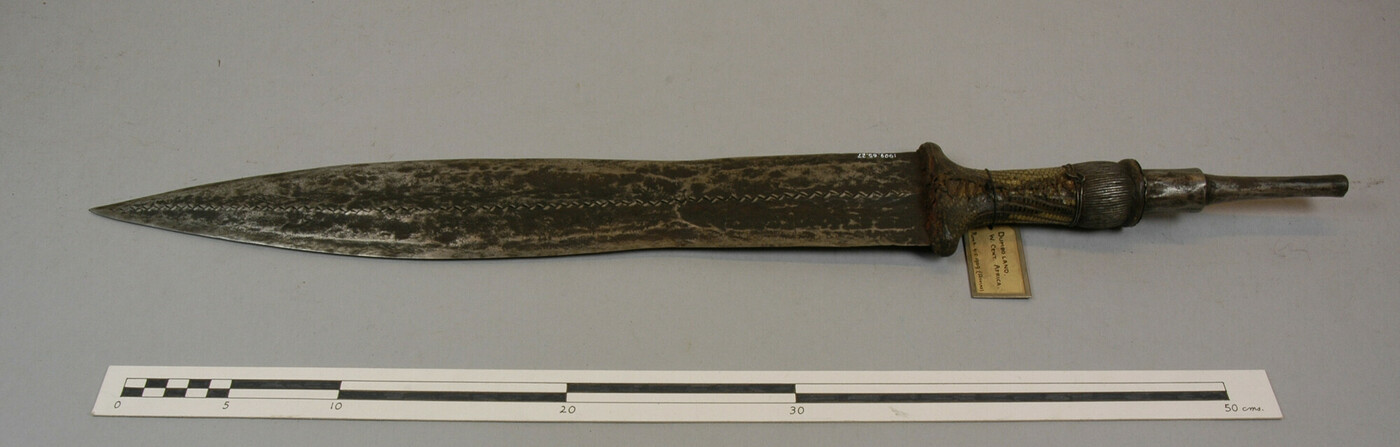 1909.65.27Sword with short, two edged blade with stamped decoration and reptile skin bound wooden hilt with tapering iron pommel. [SM 25/10/2007]1909.65.27
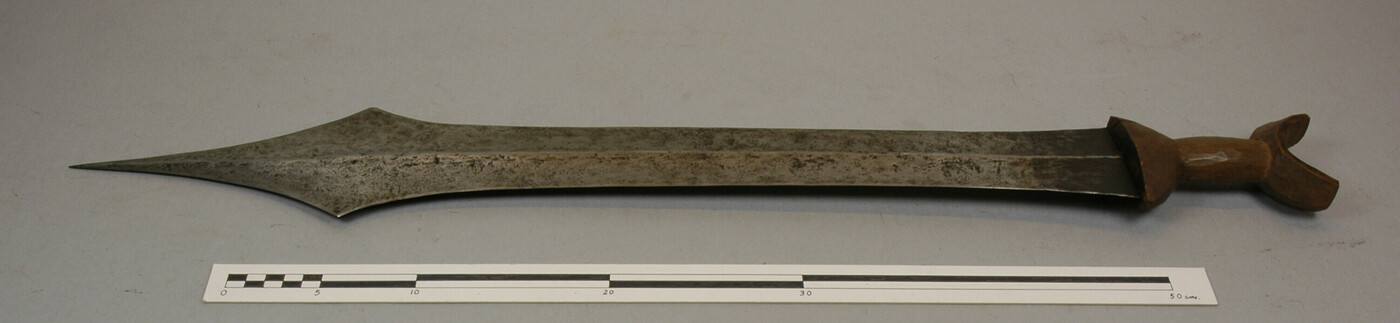 1910.5.3.1Sword with slightly concave edges ending in diamond-shaped tip, with wooden grip with crescent-shaped pommel. For corresponding sheath see 1910.5.3.2. 1910.5.3.1
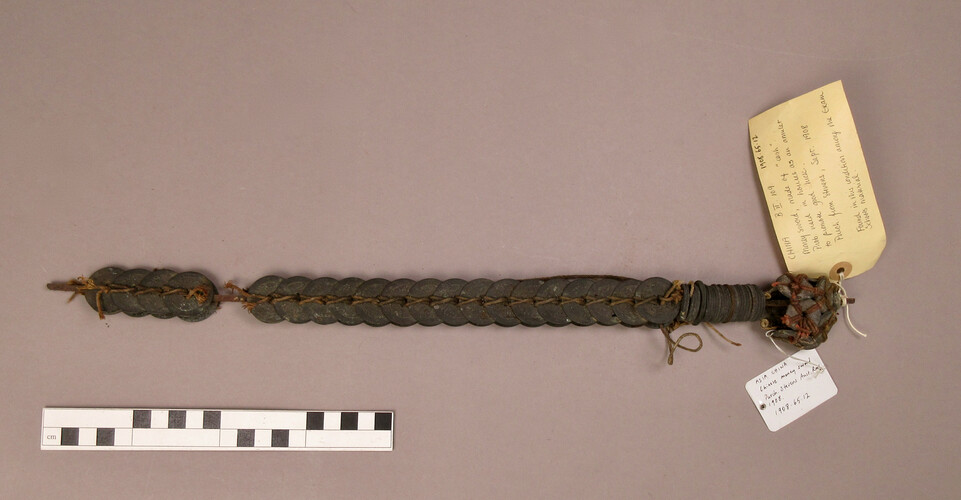 1908.65.12Chinese money sword.1908.65.12
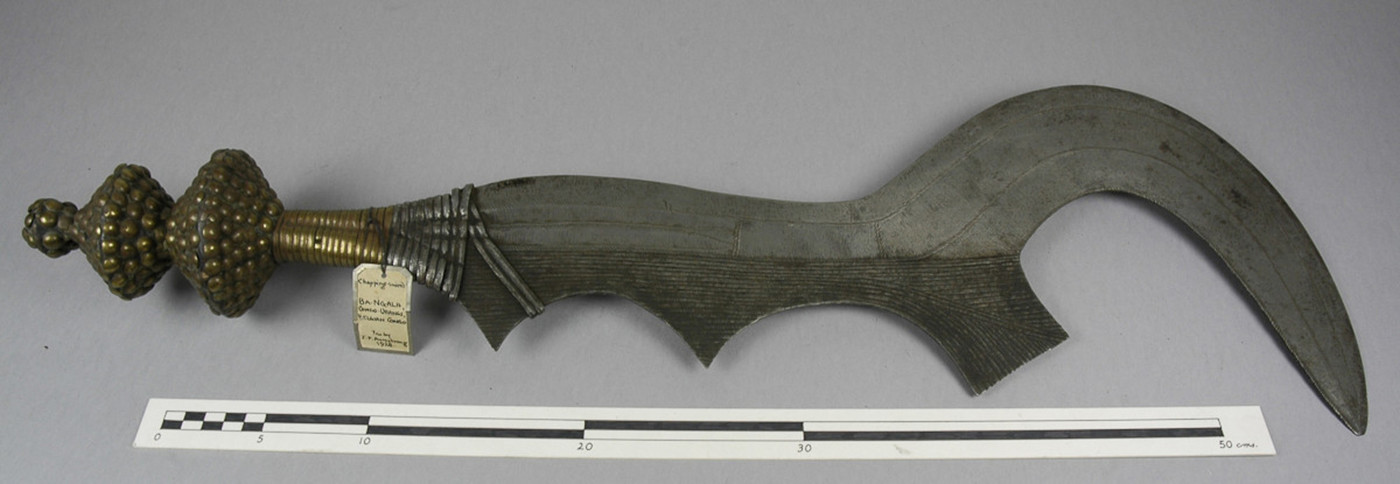 1928.14.9Chopping-sword with elaborately-curved iron blade and triple-knobbed pommel [SM 14/06/2007]1928.14.9
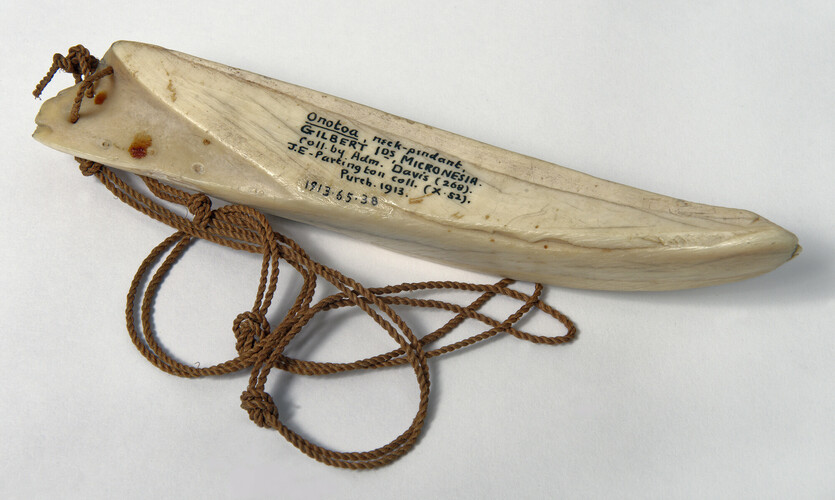 1913.65.38Pendant of whale tooth cut in half lengthwise, with twisted string. [El.B 'DCF 2004-2006 What's Upstairs?' 12/12/2005]1913.65.38
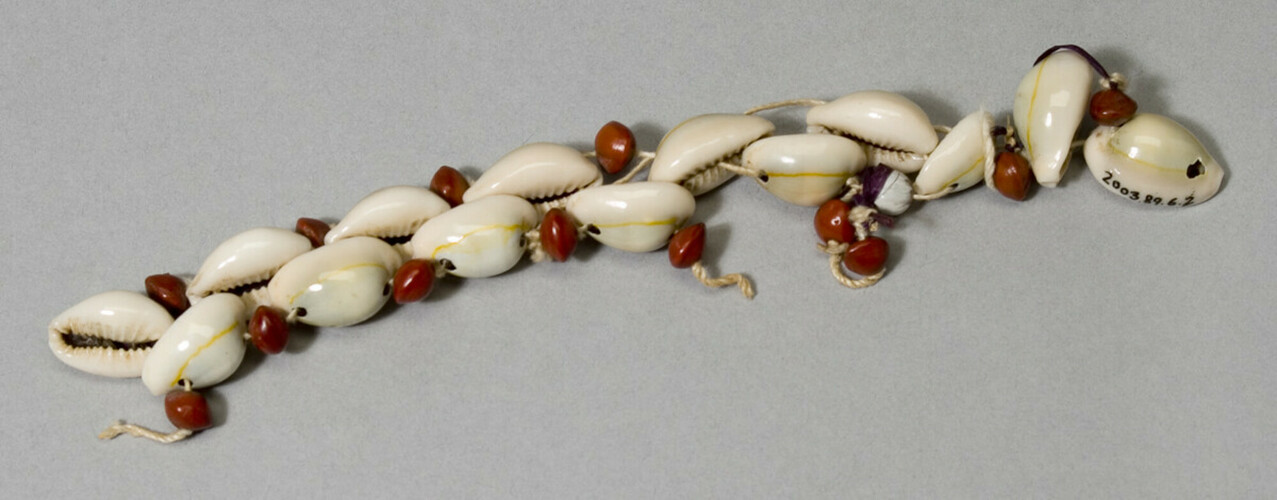 2003.89.6.2Short string of cowrie shells and red (abrus precatorius) seeds. [El.B 'DCF 2004-2006 What's Upstairs?' 3/1/2006]2003.89.6.2
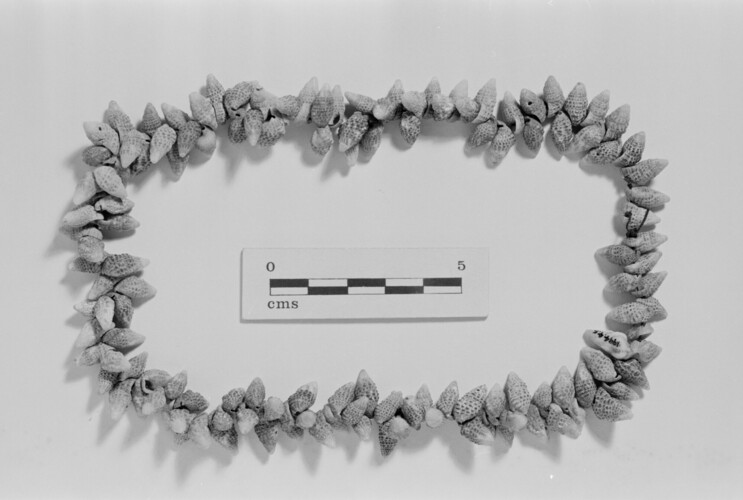 1994.4.5Necklace consisting of brown, conical shells (each approximately 12 mm in length) threaded on thin black commercial string. [LM 'DCF 2004-2006 What's Upstairs?' 17/8/2005]1994.4.5
 1884.23.8Shark tooth weapon. [AB [OPS Move] 19/6/2017]1884.23.8