
- Collection type
- Object
- Description
- Knife. Carved from wood with sharks teeth bound to the edge of the blade. The handle is square in section, the blade has a central raised rib along the length. The handle curves slightly. The handle is perforated with a loop of ?ribbon passing through. The teeth are bound to the blade with coconut fibre. [AB [OPS Move] 23/5/2017]
- Date / Period
- Date made: Before 1937
- Date collected
- By 1937
- Acquisition information
- Donated: 1937
- Materials and processes
- Material Shark Tooth Fish, Material Wood Plant, Material Coconut Fibre Plant, Process Carved, Process Bound, Process Knotted, Process Perforated
- Dimensions
- Depth: max 20 mm, Length: max 387 mm, Width: max 41 mm
- Object numbers
- Accession number: 1937.41.2
- Research and responses
Knives were generally constructed from the barb of stingray. These daggers were generally hidden in the thatch of the home to ward off intruders. The aim for the use of all I-Kiribati weapons was to open the enemy’s abdomen, or the major artery inside the elbow. Warriors took magical precautions before battle to deflect their enemy’s weapons. Immediately before the battle, the warrior would strip a single pinnule of a coconut leaf and join the ends into a necklace to wear. As he joined the ends, he chanted: “The weapon is descending, it has nearly descended! But I shall deflect it downwards or upwards. The weapon is descending, but it is afraid, it is a coward. Uh! All is well!”. The PRM holds one of the most extensive collections of Kiribati arms and armour in the world. Relevant Reading: Murdoch, G.M. (1923) Gilbert Islands Weapons & Armour. In: Journal of the Polynesian Society, Vol.32, pp.174-5. Gudger, E.W. (1930) Helmets from Skins of Porcupine Fish. In: Illustrated Science Monthly, Vol.30, pp.432-442. Guiart, J. (1963) The Arts of the South Pacific. London: Thames & Hudson. Grimble, A. (1972) Migrations, Myth & Magic from the Gilbert Islands. London: Routledge & Kegan Paul. Koch, G. (1986) The Material Culture of Kiribati. Suva: University of the South Pacific. Grimble, A.F. (1989) Tungaru Traditions: Writings on the Atoll Culture of the Gilbert Islands. Honolulu: University of Hawaii Press. Research Conducted for DCF Cutting Ede 2006/2007 [AM]
Further items to explore
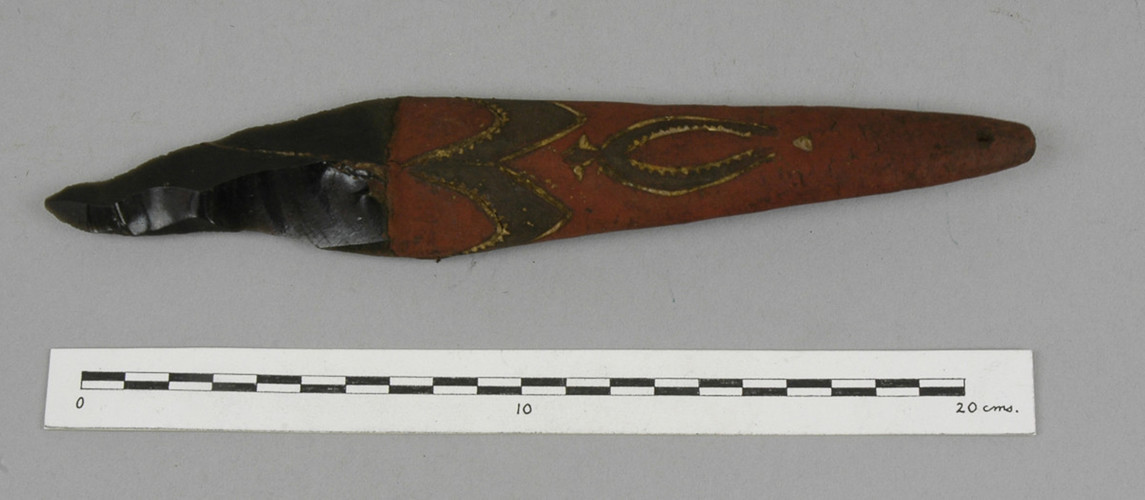 1911.65.21Dagger with obsidian blade and tapering handle painted red with carved geometric decoration that is painted black and white [SM 27/07/2007]1911.65.21
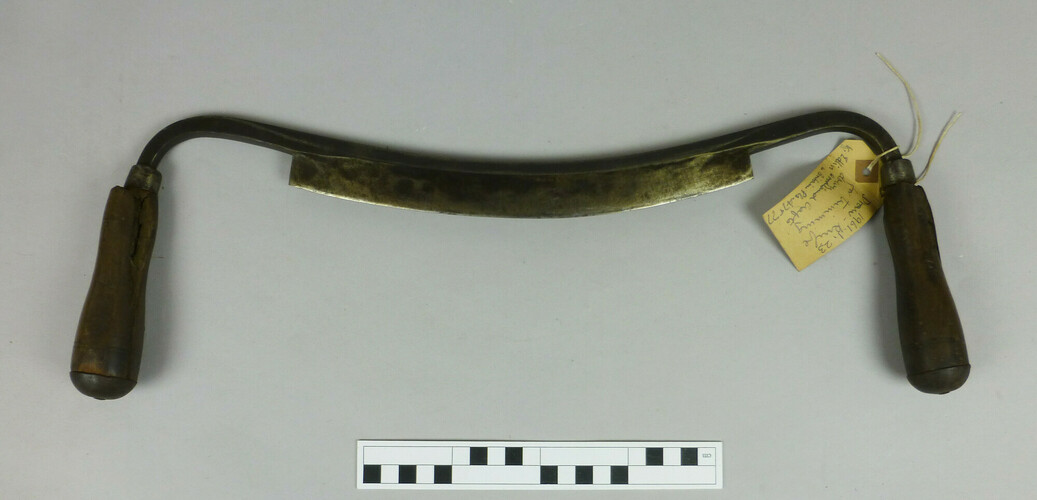 1961.1.23Wheelwright's draw-knife with a curved iron blade and two turned wooden handles. Used for trimming felloes, spokes etc. [SM (Verve) 02/03/2015]1961.1.23
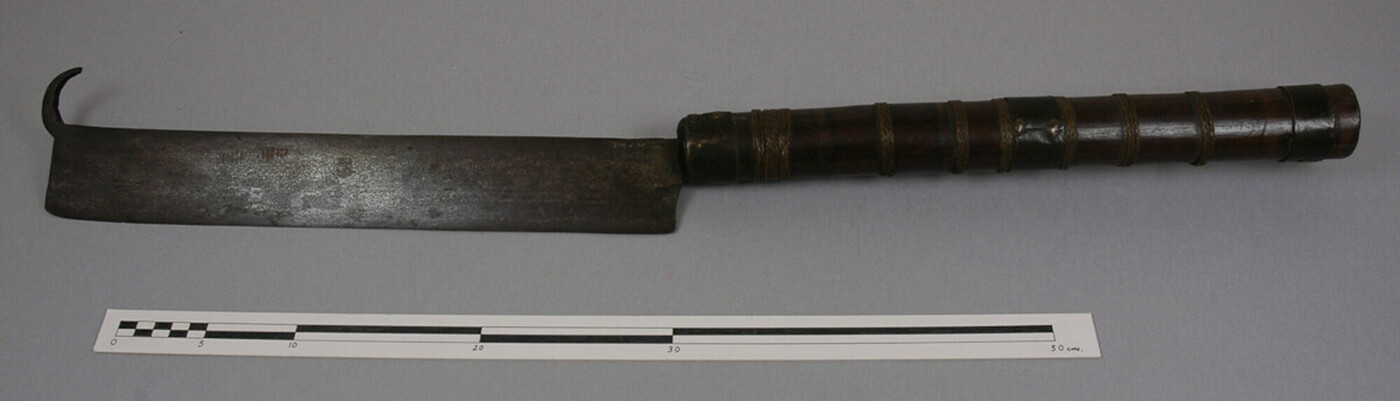 1940.5.30Knife "nifo'oti". Single edged iron blade with hook on the end and bound wooden haft. [SM 17/04/2007]1940.5.30
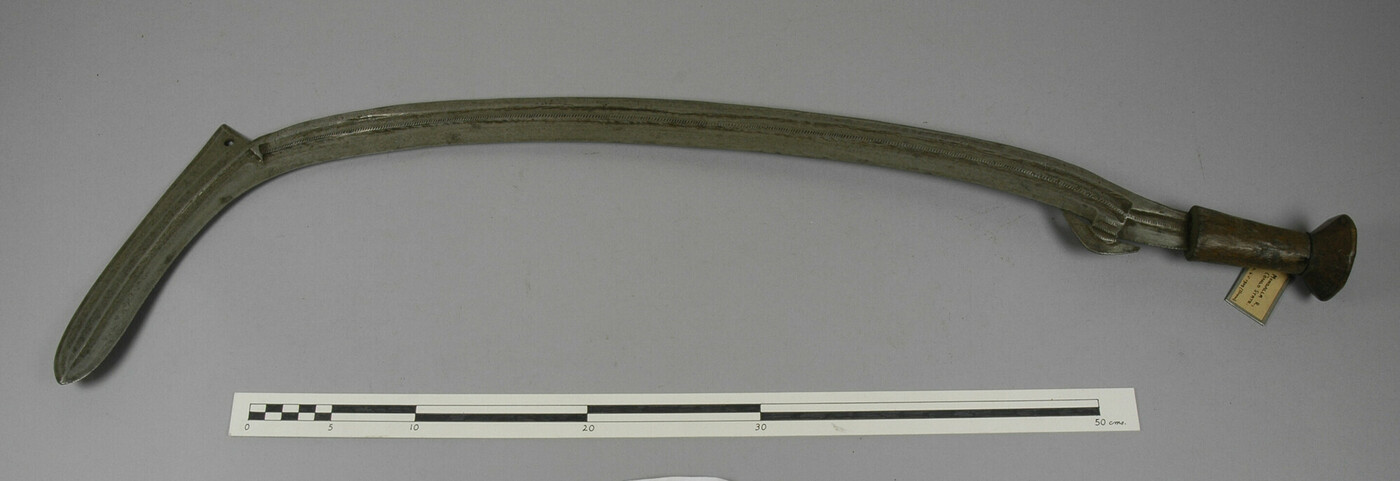 1909.65.8Long curved sword/throwing knife with wooden hilt and expanded butt. The blade has a concave edge. [SM 26/04/2007]1909.65.8
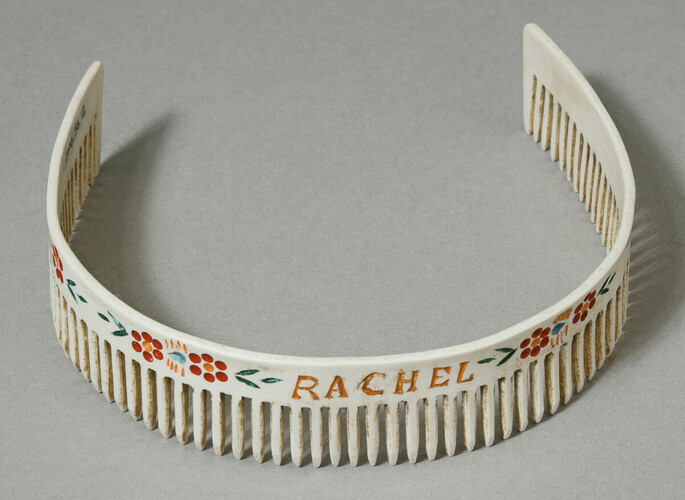 2004.56.12Curved, horseshoe shaped white plastic 'Alice band' / Hair ornament made from a section of recycled plastic drainpipe. Incised and painted with the donor's name and floral motifs. [JP 17/6/2004]2004.56.12
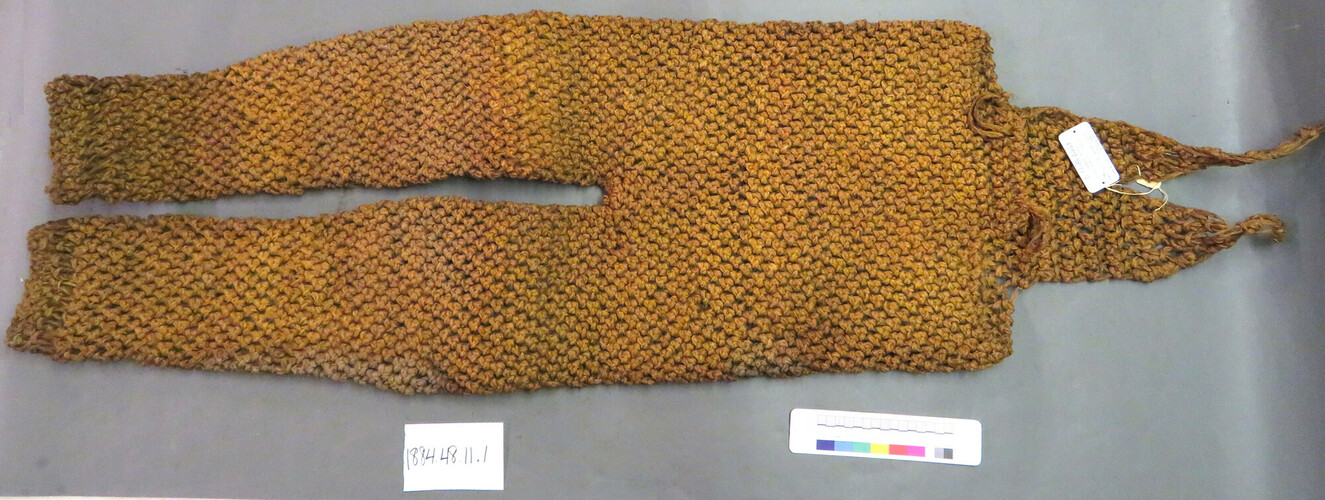 1884.48.11.1Coconut fibre trousers, part of coconut fibre armour. [BH [OPS move] 5/9/2017]1884.48.11.1
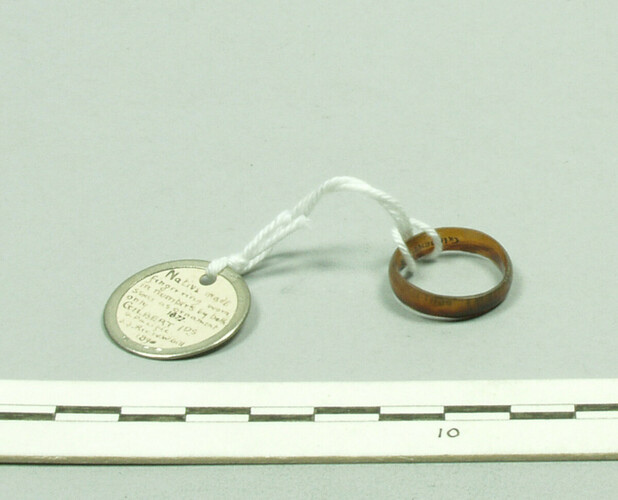 1890.5.4Finger Ring of turtle shell [L.Ph 'DCF 2004-2006 What's Upstairs?' 19/5/2005]1890.5.4
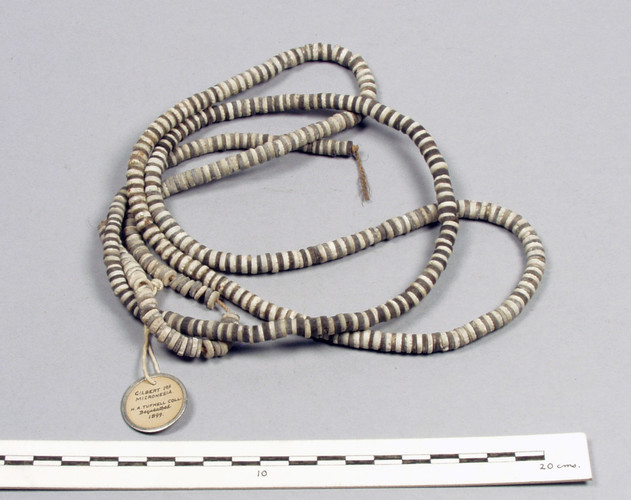 1899.62.459.2Strings of shell and coconut-shell beads alternating black and white [El.B 'DCF 2004-2006 What's Upstairs?' 3/6/2005]1899.62.459.2