
- Collection type
- Object
- Description
- Coconut fibre trousers, part of coconut fibre armour. [BH [OPS move] 5/9/2017]
- Long description
- Coconut fibre trousers, part of coconut fibre armour. The armour covers the whole legs, with a body section that comes up to the middle of the chest. The shoulder straps attach to two loops on the central protrusion. [BH [OPS move] 5/9/2017]
- Person
- Maker Unknown Maker
- Field collector Unknown Collector
- PRM source Augustus Henry Lane Fox Pitt Rivers founding collection
- Date / Period
- Date made: Possibly before 1874
- Date collected
- By 1874
- Acquisition information
- Donated: 1884
- Materials and processes
- Material String, Material Coconut Fibre Plant, Material Coconut Fibre Textile Plant, Material Net Textile, Process Netted
- Dimensions
- Depth: max 40 mm, Width: max 435 mm, Length: max 1580 mm
- Object numbers
- Accession number: 1884.48.11.1 PR Cat other PR nos: 3427
- Research and responses
These suits often bore woven designs on the chest – either in a darker shade of coconut fibre, dyed by immersion in the mangrove swamp of the lagoon, or in female human hair. These designs occasionally represented animals such as dolphin in a stylised form. Such suits often have a large square back-board rising from the shoulders behind the head, which would protect the warrior from the numerous stones thrown by the women of his own side at his opponents. The full suit of coconut-fibre armour reflects a form of armour very close to Old World clothing, and it has been suggested by some scholars that early contact with Europeans promoted the invention of this full armour suit in Kiribati. However, the earliest records describe this armour alongside the other forms. In the I-Kiribati myth of The War of the North & the South, the hero Auriaria is dressed for battle by his proud father Tabakea, who says: “Come hither, for I shall make thee ready. Put on the corselet of knotted rope, set thy spiked helmet of fish skin upon thy head, strengthen the mesh of thy corselet and fasten on a belly piece of the hide of a sting-ray. Tell all the men of my side that they are to gather here before dawn, for thou shalt be the leader in this war…If thou art wounded, thou shalt return hither, that I may tend thee”. Auriaria and his brother fight a pitched battle with throwing sticks until one of them falls wounded, and the battle is considered to be over for the day. Like Iliadic warfare, the killing of large numbers was not the aim. Instead, I-Kiribati warfare was about the preservation of male honour, and seeking revenge for insults. It is clear that it was very difficult to fight in these multiple layers of textile and fish skin, with spears 4-5m in length. In I-Kiribati duels, each warrior had an assistant to keep him on his feet and point him in the right direction. Relevant Reading: Murdoch, G.M. (1923) Gilbert Islands Weapons & Armour. In: Journal of the Polynesian Society, Vol.32, pp.174-5. Gudger, E.W. (1930) Helmets from Skins of Porcupine Fish. In: Illustrated Science Monthly, Vol.30, pp.432-442. Guiart, J. (1963) The Arts of the South Pacific. London: Thames & Hudson. Grimble, A. (1972) Migrations, Myth & Magic from the Gilbert Islands. London: Routledge & Kegan Paul. Koch, G. (1986) The Material Culture of Kiribati. Suva: University of the South Pacific. Grimble, A.F. (1989) Tungaru Traditions: Writings on the Atoll Culture of the Gilbert Islands. Honolulu: University of Hawaii Press. Research Conducted for DCF Cutting Ede 2006/2007 [AM]
Search terms: Cordage, Armour Weapon, Armour, Breast Plate Armour
Further items to explore
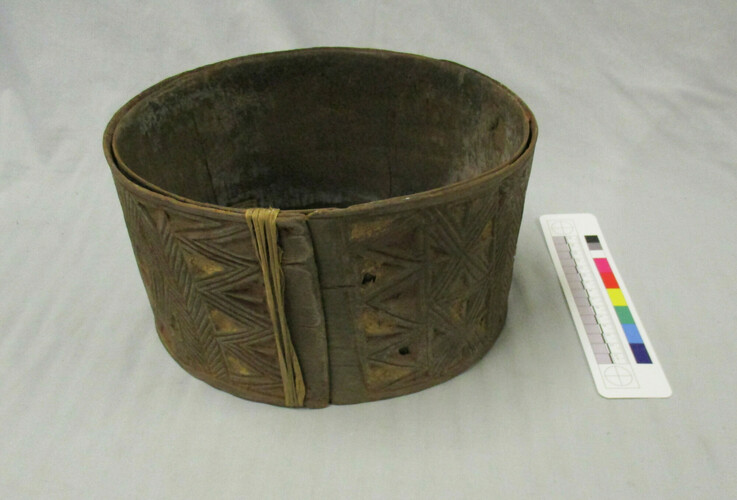 1937.39.42Belt of spirally wound bark. Carved all over the outer surface and infilled with pigment. The two ends of the belt are tied together with plant fibre. [ASh [OPS move] 18/08/2016]1937.39.42
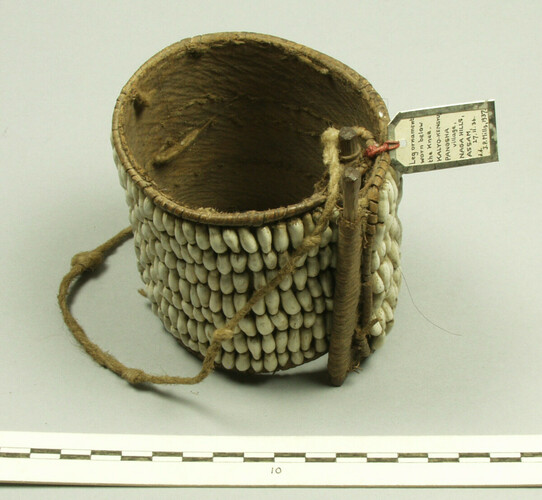 1934.82.167.2Leg band: a strip of inner bark of sago palm, stitched with strings of coix seeds placed vertically. There are bamboo stiffeners at each end of the band and it is edged with red-dyed cane binding. [LM 'DCF 2004-2006 What's Upstairs?' 2/11/2005]1934.82.167.2
 1884.31.41.16Specimen of mail with welded links and ?imitation rivets. [SM (Verve) 23/10/2014]1884.31.41.16
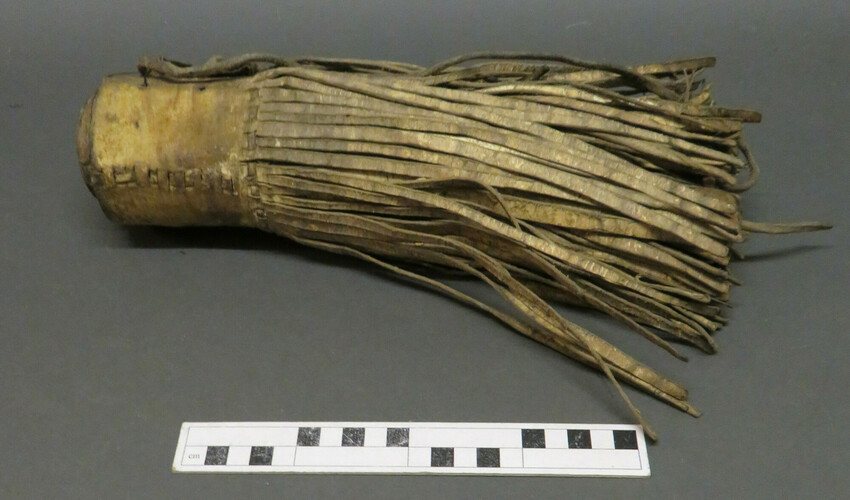 1908.25.4Man’s fringed cow-hide belt, grey/beige in colour. [FB 09/04/2015]1908.25.4
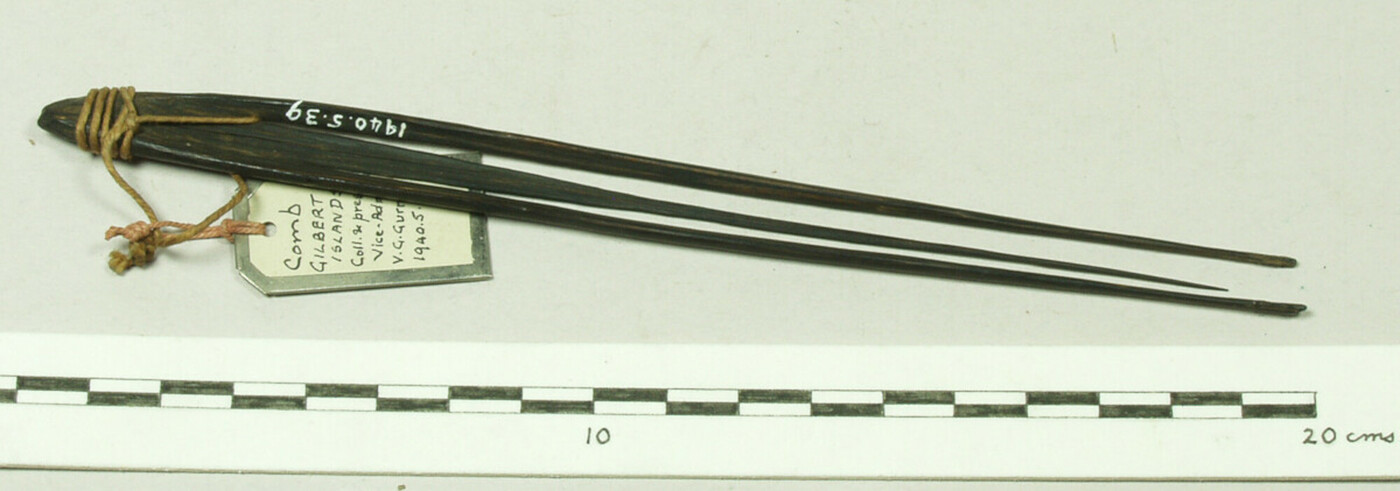 1940.5.39Comb of dark wood with three long teeth. [E.S-R 'DCF 2004-2006 What's Upstairs?' 15/12/2004]1940.5.39
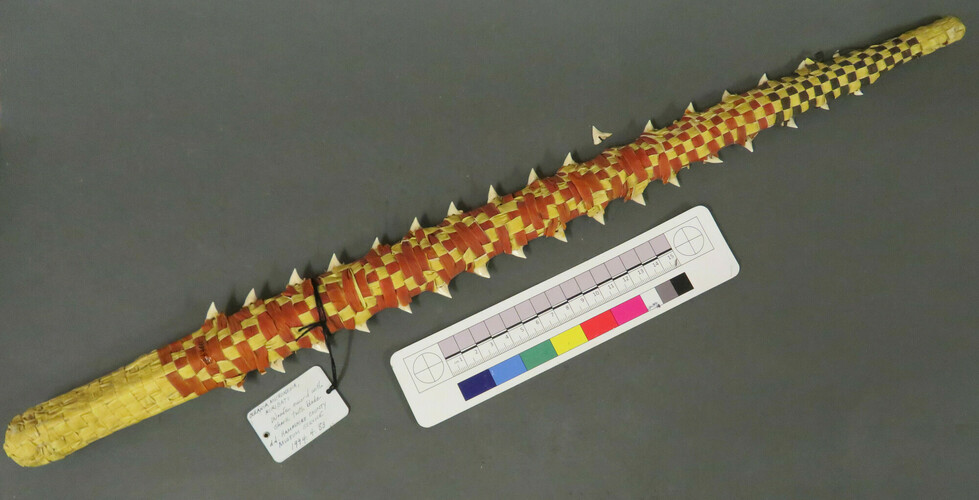 1994.4.83Wooden sword covered with woven strips of plant fibre and sharks teeth attached to the sides. [MJD (Verve) 23/5/2017]1994.4.83
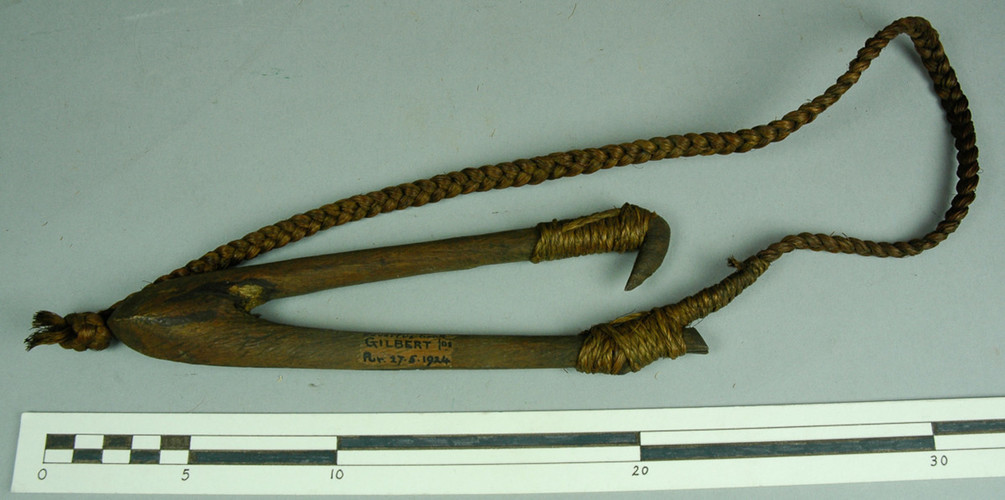 1924.62.8Narrow 'V' shaped wooden fish hook with wood point. A plaited sennit line is bound to the shank. [MJD 31/03/2009]1924.62.8
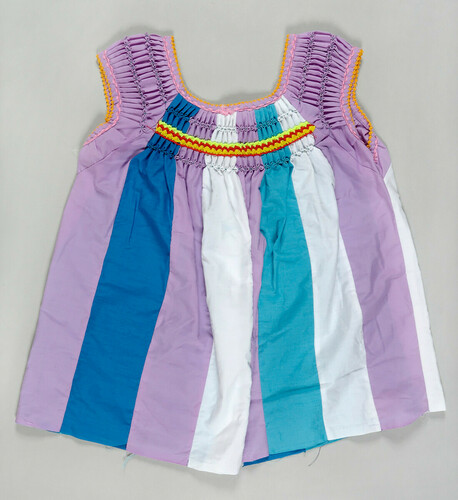 2004.56.6Purple, blue, and white striped sleeveless 'smock-top' / blouse with pleated shoulder straps and neck, both of which are edged with a thin crocheted orange band and pink rick-rack braid. A bright yellow and red crocheted band is stitched onto the pleated section of the front. [JP 16/6/2004]2004.56.6