
- Collection type
- Object
- Description
- Complete suit of coconut fibre armour, consisting of coconut-fibre cap [.1], a cuirass with a high back [.2], a jerkin [.3] and leggings [.4]. [El.B 23/3/2007]
- Date / Period
- Date made: Before 1929
- Date collected
- By 1929
- Acquisition information
- Donated: 1941
- Materials and processes
- Material Coconut Fibre Plant, Process Woven
- Dimensions
- Diameter: max 247 mm, Length: max 1050 mm, Length: max 700 mm, Length: max 470 mm
- Object numbers
- Accession number: 1941.2.74.1 Accession number: 1941.2.74.2 Accession number: 1941.2.74.3 Accession number: 1941.2.74.4 Other numbers: 2419 & 2575
- Research and responses
The helmet, 1941.2.74 .1 has wrongly been affiliated with the rest of the armour. According to Beasley's original documentation, the cuirass, arms and shoulder armour and dungarees (1941.2.74.2-4) were all exchanged with the Horniman Museum and added to Beasley's registers on 30/07/1929 and given the collection number 2419. Beasley exchanged them for three S. Indian boomerangs (which he had in his collection). The coconut fibre helmet however (1941.2.74.1) entered Beasley's register on 17/05/1930 and was given the Beasley inventory number 2575. This is under the heading ‘in exchange with the Rijksmuseum, Leiden, Holland’ and not the Horniman as the other three pieces of armour. So Beasley obviously wanted a complete set or armour – but it appears that the helmet does not belong with the other three pieces on display. [FB 24/10/2016]
The following notes are drawn from research compiled by Andy Mills as part of the DCF Cutting Edge project in 2006-2007. The most highly developed armour in the Oceanic region came from the small Micronesian archipelago of Kiribati (pron. Kiribass). Kiribati is comprised of low-lying coral atolls, and so very few raw materials are available. Consequently, this armour is made from woven coconut fibre and fish skin.
The full suit of coconut-fibre armour reflects a form of armour very close to Old World clothing, and it has been suggested by some scholars that early contact with Europeans promoted the invention of this full armour suit in Kiribati. All we can say for certain is that the earliest records speak of this armour alongside the other forms. These suits often bore woven designs on the chest – either in a darker shade of coconut fibre, dyed by immersion in the mangrove swamp of the lagoon, or in female human hair. These designs occasionally represented animals such as dolphin in a stylised form.
Such suits often have a large square back-board rising from the shoulders behind the head, which would protect the warrior from the numerous stones thrown by the women of his own side at his opponents.
The thing that’s clear from photographic evidence and the descriptions available is just how hard it must have been to fight in all of these layers of textile and leather, with massive spears as long as 4-5m. The descriptions of duels include each warrior having an assistant with him, to help keep him upright and point him in the right direction. [SM 07/05/2008]
- Associated publications
- This object features in the Museum's audio guide produced during the DCF-funded 'Cutting Edge’ project, 2007-2009. [HH 20/06/2010]
Search terms: Armour Weapon, Clothing, Clothing Headgear, Armour, Hat, Helmet
Further items to explore
 1884.119.480Copper alloy ring1884.119.480
 1912.14.1.3A sample showing the front of sliding-rivet armour. Part of a display of samples of early European armour [1912.14.1 .1 - .15]. [MOBB [OPS move] 4/8/2017]1912.14.1.3
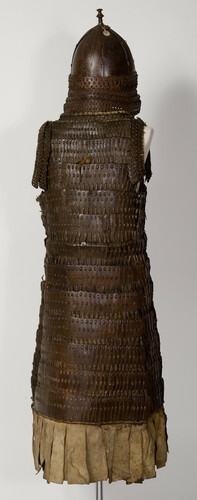 1941.2.126.1Plate armour, composed of rows of narrow iron laminae overlapping and supported on thongs.1941.2.126.1
 1896.33.41Belt made from strip of bark curled into a spiral. [MOBB [OPS move] 1/9/2017]1896.33.41
 1884.23.8Shark tooth weapon. [AB [OPS Move] 19/6/2017]1884.23.8
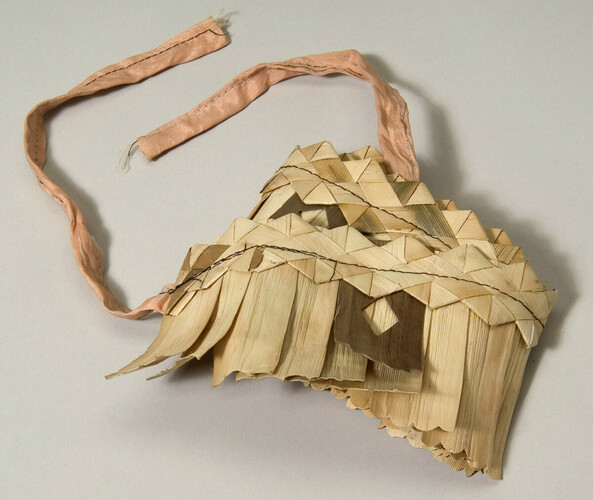 2004.56.20.14Part of a complete woman's dance costume: Sash made from strips of pale palm leaf with scalloped ends, decorated with brown-dyed strips of palm leaf with a diamond shape cut out of their centres. [JP 18/6/2004]2004.56.20.14
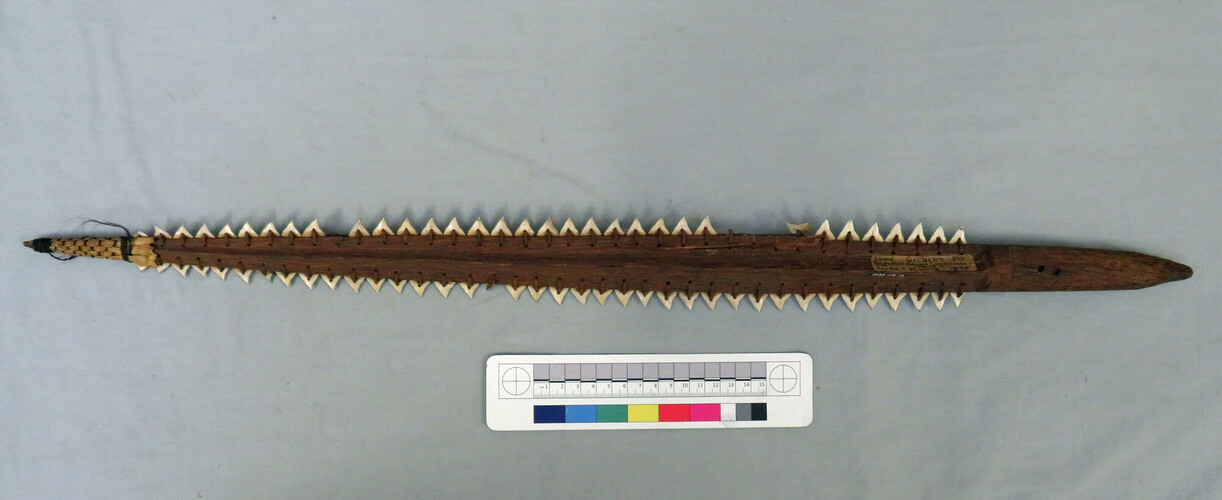 1936.26.12Fighting sword edged with sharks' teeth. [AB [OPS Move] 20/6/2017]1936.26.12
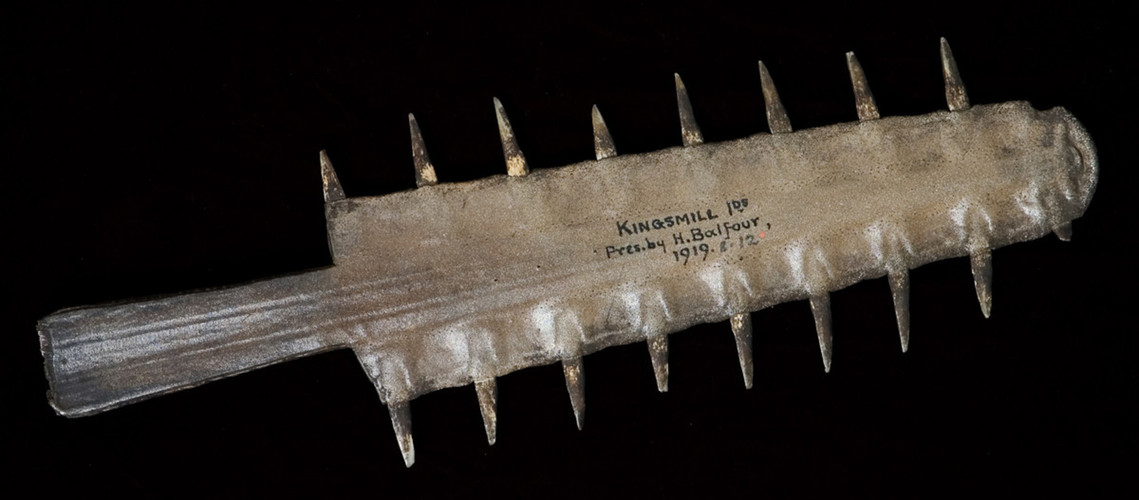 1919.8.12Sword. Made from the toothed snout of a sawfish. It is grey in colour, the teeth of the snout have been carved away at the handle. The handle is darker in colour. [AB [OPS Move] 23/5/2017]1919.8.12