
- Collection type
- Object
- Description
- Plate armour, composed of rows of narrow iron laminae overlapping and supported on thongs.
- Long description
- Plate armour with 11 rows of scales, perforated and tied to each other with leather strips. There are 2 further rows for each arm opening. The neck and arm openings are lined with leather; A leather fringed skirt is attached to the lowest row of scales.
- Geographical reference
- Person
- Field collector William George Lawrence Beynon
- Field collector British Expedition to Tibet
- Field collector Francis Edward Younghusband Expedition
- PRM source Irene Marguerite Beasley
- Date / Period
- Date made: Before 1904
- Date collected
- 1903 or 1904
- Acquisition information
- Donated: 1941
- Materials and processes
- Material Animal Leather Skin, Material Iron Metal
- Dimensions
- Width: max 560 mm, Height 1160 mm approx
- Object numbers
- Accession number: 1941.2.126.1 Other numbers: 536
- Research and responses
Donald La Rocca, Curator of Arms and Armor at the Metropolitan Museum of Art, New York notes that the armour is a particularly good example as it has not been altered from its original state - it still has the traces of attachment ties inside which show how the armour was laced onto the body. There is leather lining and stiffening around the collar. He agreed with the display label that it probably is a horseman's armour. [CF 16/10/2002]
Information from Donald LaRocca, Curator of Arms and Armor at the Metropolitan Museum of Art, New York in 2005: There is an original cloth label (a narrow rectangular strip of a linen-like fabric) attached to the lacing at the inner edge at the second row down on the proper right side of the chest. There are faint traces of writing on it, probably Tibetan inventory numbers. There is the end of what may have been another fabric label on the bottom of the second row of lamellae on the exterior of the center of the back. On the leather skirts: exterior of the second layer, beneath the lappets, in the front on the proper left is the Tibetan number 7 (?) in ink. On the exterior of the central leather lappet in the back faint traces of Tibetan letter(s), possibly bya kha (?). Beneath the leather lappets on the proper left rear on the exterior of the second layer of leather there is Tibetan writing, in a type of dbu med script, including the numbers 1133. [JN 29/3/2005]
- Associated publications
- This object features in the Museum's audio guide produced during the DCF-funded 'Cutting Edge’ project, 2007-2009. [HH 20/06/2010] Donald La Rocca, Curator of Arms and Armor at the Metropolitan Museum of Art, New York suggests that this armour (1941.2.126 .1) appears to be the same as that illustrated in the article 'Tibet: Notes on Laminated Armour', by H. G. Beasley, in Ethnologia Cranmorensis, 1938, pl. V, where it is captioned 'Collected by Major-Gen. Sir William Beynon, Younghusband Expedition, 1903. From Phari Jong. Cranmore Museum reg. no. 536.' [JN 29/3/2005; JC 9 10 2009] Published (with 1941.2.126.1) as catalogue number 4 'Lamellar Armor and Helmet' on pages 60-62 of Warriors of the Himalayas: Rediscovering the Arms and Armor of Tibet, by Donald J. LaRocca (New York: Metropolitan Museum of Art / New Haven and London: Yale University Press, 2006): 'Lamellar Armor and Helmet / Tibetan, possibly 16th-17th century / Iron, leather, and textile / H. as mounted approx. 60 in. (152.4 cm) / Pitt Rivers Museum, Oxford (1941.2.126.1, .2) / This is an armor and helmet of good quality, but slightly less so than the preceding examples. The chief differences are that the lamellae are slightly flatter and not as finely finished, they are larger, and they overlap in a different pattern than on the previous examples. Also, the surface is russet brown, rather than silvery iron. The helmet has noteworthy markings on it. / The helmet is very similar in size, form, and construction to the Edinburgh helmet (cat. no. 1), being of the same eight-plate type and having full cheek and nape defenses. The lamellae around the rim of the helmet bowl measure 5.5 by 2 centimeters, have eleven lacing holes each, and, like those on the British Museum helmet (cat. no. 3), overlap in one direction all the way around. The cheek defenses consist of seven rows, the lamellae measuring 3 by 2 centimeters and having eight holes. The nape defense is of three progressively wider rows, the lamellae measuring 4 by 2 centimeters and having eleven holes each. The words mgon khang shar are inscribed in large dbu can characters on the front of the helmet on the first inner plate to the proper left of center. The inscription indicates that the armor was kept in the shrine (mgon khang) of a guardian deity on the east (shar), either the eastern shrine or the east side of a particular shrine. Inscribed in very small dbu can characters on the base of the plume tube finial is shong ba or shod ba (?) followed by the Tibetan number 58 (see detail[ed image, i.e. fig. 4]), which compares with the inscription in the same place on the British Museum helmet (cat. no. 3). The meaning is not clear, but it seems to refer to inventory numbering or storage in an arsenal or fortress, before its use in a mgon khang. / The armor opens lengthwise down the front and has no shoulder defenses. It consists of eleven rows in the front and twelve rows in the back, including the collar row, which is lined with leather. The waist is the fifth row, counting down in the front. The lamellae are larger than those of the previous armors, measuring 8 by 2 centimeters at the top of the chest, 9.4 by 2 centimeters in the fourth row, and 9 by 2 centimeters in the bottom row. They have nine lacing holes. Unlike the previous armors, the lamellae of this armor do not overlap outward from the front and meet at the center of the back. Instead, the lamellae of the top two rows of the chest (which stop at the arm openings) overlap right over left, and the lamellae of all the other rows overlap left over right from the front all the way around the back. The difference in the overlap pattern between this and the previous armors may be an indicator of a later date or a regional style, or reflect a trend towards simplification in armor-making techniques. / There are two rows of lamellae over the top of the arm opening, set perpendicular to those on the chest, and attached in the same way as the first two rows of a complete shoulder defense. This feature is also found on other armors without shoulder defenses (see cat. nos. 5, and 6). These lamellae measure 3 by 1.5 centimeters and have eight holes each. There are remains of stop ribs at the top of the chest and under each arm. The armor has a detached belt, made of a strip of leather with an iron buckle. A rectangular strip of textile with faint traces of Tibetan characters is attached to the proper right side of the chest at the inside of the end of the second row. Two knotted ends of fabric in the center of the second row of the back are probably also the remains of similar textile labels. The back of the armor is split on either side by two vertical seams for the six rows below the waist. A border consisting of two layers of leather is attached to the bottom row of lamellae around the base of the armor. The upper layer is split into rectangular lappets, and the lower layer is made of solid rectangular panels. There are inscriptions written on the lower layer, including Tibetan characters in dbu med script and numbers. The leather lacing of the armor and the helmet are stiff and relatively brittle in comparison with the previous examples. / The russet brown color of the lamellae does not appear to be a modern coating but seems to be an original surface treatment or a natural patina from generations of storage in a mgon khang. The identification of the armor as coming from a fortress, Phari Jong (see Provenance), may seem at odds with the inscription on the helmet, which clearly indicates that it was kept in a mgon khang. However, if the provenance is correct, this suggests that there was a mgon khang in Phari Jong, possibly the same shrine room from which L. A. Waddell is known to have obtained a complete one-hundred-volume set of the Kangyur (bka' 'gyur). For Phari Jong see also catalogue number 7. / Provenance: Collected at Phari Jong (phag ri rdzong) in Tibet by Major-General Sir William Beynon (1866-1955) during the Younghusband Expedition, 1903 (according to Beasley 1938); H. G. Beasley, Cranmore Museum (536), Chiselhurst, Kent. / Publication: Beasley 1938, pl. V, provenance given in caption.' [JN 18/5/2005; JC 9 10 2009]
Search terms: Armour Weapon, Armour
Further items to explore
 1954.3.4.6Lenticular shaped textile. [BH [OPS move] 25/8/2017]1954.3.4.6
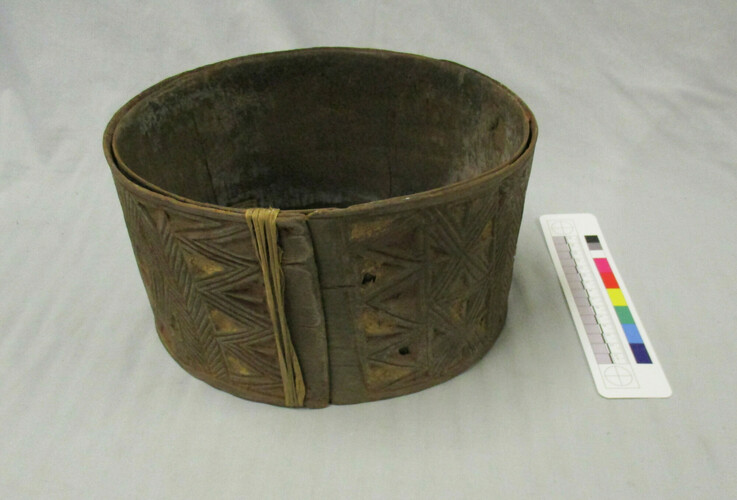 1937.39.42Belt of spirally wound bark. Carved all over the outer surface and infilled with pigment. The two ends of the belt are tied together with plant fibre. [ASh [OPS move] 18/08/2016]1937.39.42
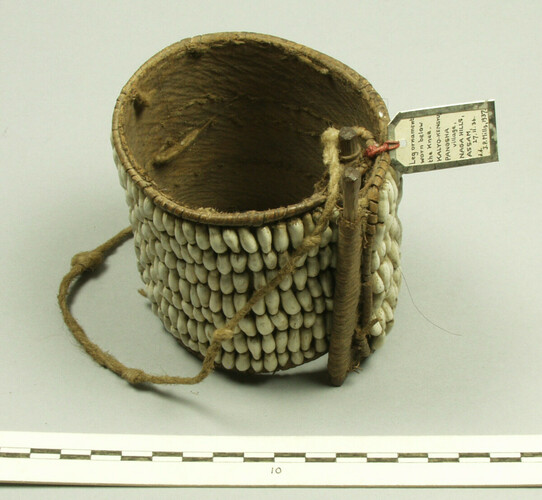 1934.82.167.2Leg band: a strip of inner bark of sago palm, stitched with strings of coix seeds placed vertically. There are bamboo stiffeners at each end of the band and it is edged with red-dyed cane binding. [LM 'DCF 2004-2006 What's Upstairs?' 2/11/2005]1934.82.167.2
 1884.31.41.16Specimen of mail with welded links and ?imitation rivets. [SM (Verve) 23/10/2014]1884.31.41.16
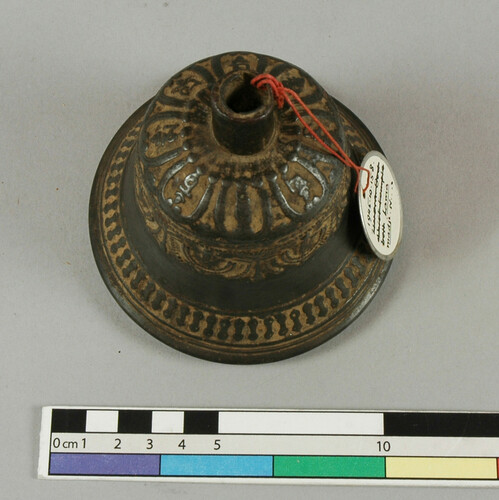 1945.10.158Clapperless bell, possibly used as currency. [El.B 13/09/2011]1945.10.158
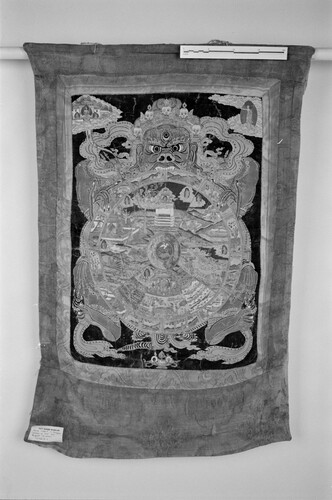 1996.7.1Thangka1996.7.1
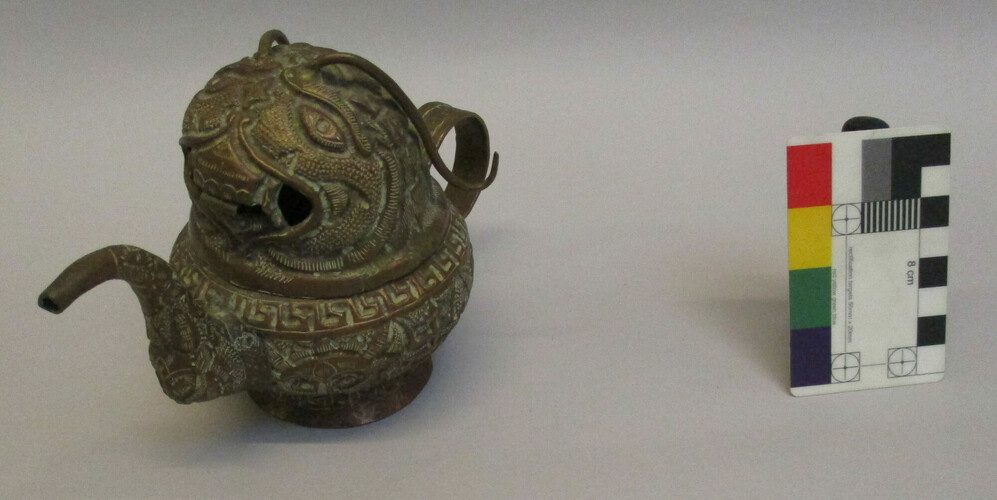 1967.30.21Metal tea pot with hinged lid, repousse work of heads and geometric designs. [ZM 13/1/2006]1967.30.21
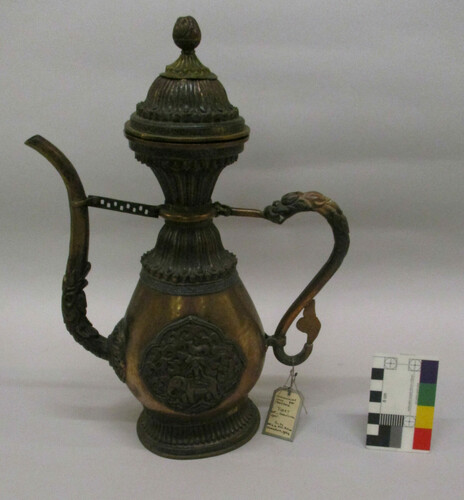 1934.12.37.1Ewer of copper and brass with dragonesque handle. Decorated with two panels of repoussé work, one depicting a foliate design with an elephant, the other a human figure seated beneath a tree. For lid see [1934.12.37 .2] [JC [OPS move] 14/7/2016]1934.12.37.1