
- Collection type
- Object
- Description
- Paper shogi board with yellow squares and colourful painted human images on the front. For wooden chess pieces see [1917.53.489 .2 - .42]. [JMC 13/12/2018]
- Geographical reference
- Cultural groups
- Japanese
- Date / Period
- Date made: Before 1885
- Date collected
- 1885
- Acquisition information
- Donated: 1917
- Materials and processes
- Material Wood Plant, Material Paper Plant, Material Pigment, Process Painted, Process Drawn, Process Inscribed, Process Carved
- Dimensions
- Length: max 352 mm
- Object numbers
- Accession number: 1917.53.489.1
- Research and responses
History of the game
Shogi is one of many chess games that are believed to have the common ancestor chaturanga- a game which also uses three-dimensional pieces from the Gupta Empire, which was first referenced in writing around the 6th century CE. How and when chess games came to Japan is unknown, but the oldest shogi pieces, believed to be from the mid-11th century, were excavated at the Kofukuji-temple in the Nara prefecture in 1993.
In 1947, a popular professional shogi player called Kozo Masuda was summoned for an interview by the GHQ. At the time, the GHQ was considering prohibiting Shogi because one of the top players had been very close to Japanese military officers and influenced them. Masuda was asked about the 'dropping rule' of shogi, allowing a player to reuse the pieces taken from the opponent as their own, which was regarded by GHQ as similar to the abuse of prisoners of war. He responded to them that this shogi rule allows the opponent's captured pieces to be used with the same ranks, which is real democracy, unlike Western chess in which the opponent's pieces are captured and killed (and never given another chance). He managed to persuade the GHQ to allow shogi to remain legal in Japan.
Today, Shogi is widely played by both men and women, and children and adults. In Japan, there are professional shogi players. Much like other forms of chess, Shogi operates on an ELO system- if you win, you can go up, but if you lose, you will go down.
Etymology
'Sho' 将of Shogi 将棋means a general, and 'gi' 棋, square wooden board.
Difference between shogi and hasami shogi
The rules of shogi are very complicated. Therefore, just like go and gomoku narabe, a much simpler game was invented, called hasami shogi. 'Hasami' comes from a Japanese verb 'hasamu' which means to sandwich something by blocking both sides.
Game rules
Shogi is a two-player war-themed game played on a 9x9 board. Unlike other forms of chess, pieces for each player are not differentiated by colour and captured pieces can re-enter the game. The aim of the game is to capture your opponents ‘King’ piece.
The pieces are called as follows:
王将, Osho (King)
玉将, Gyokusho (opposing King)
金将, Kinsho (Gold General)
銀将, Ginsho (Silver General)
桂馬, Keima (Knight)
香車, Kyosha (Lance)
角行, Kakugyo (Bishop)
飛車, Hisha (Rook)
歩兵, Fuhyo (Pawn)
All of these ranks, aside from the King and golds, can be promoted within marked “promotion zones” on the board.
Sources:
Oriental Board Games by David Pritchard (1977)
Shogi (game of generals) by Masukawa Koichi (2004)
Board and Table Games from Many Civilizations by R. C. Bell (1960)
The Science, Philosophy and Bioethics of Gerontology: An Individual and Community Journey from Japan by Ryo Takahashi (2019)
A letter in the Archive, Tylor correspondence C6, from Chamberlain to Tylor dated 1 April 1885, lists a series of Japanese games sent to Tylor. This includes a "Chess-board and one bag men".
- Associated publications
- For information on Japanese games: Griffiths (or Griffins), Vol. II, and Chaplin-Ayrton, Vol. V, Pt. I, 'Transactions of the Asiatic Society of Japan'. [CF 30/4/2001]
Search terms: Toy and Game, Figure, Board Game, Gaming Piece
Further items to explore
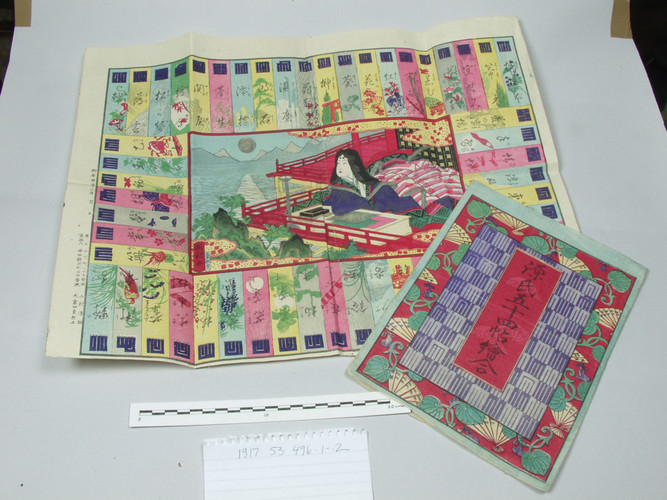 1917.53.496.1Paper board for a game with colourful squares in blue, pink and yellow [.1]. Includes a storage envelope [.2] painted in red with foliage designs and Japanese characters on the front. [E.S-R 'DCF 2004-2006 What's Upstairs?' 26/1/2005]1917.53.496.1
 1917.53.489.33Wooden chess piece with Japanese characters on both sides. For paper chess board see [1917.53.489 .1] and for the other chess pieces see [1917.53.489 .2 - .32] and [1917.53.489 .34 - .42]. [JMC 13/12/2018]1917.53.489.33
 1917.53.489.4Wooden chess piece with Japanese characters on both sides. For paper chess board see [1917.53.489 .1] and for the other chess pieces see [1917.53.489 .2 - .3] and [1917.53.489 .5 - .42]. [JMC 13/12/2018]1917.53.489.4
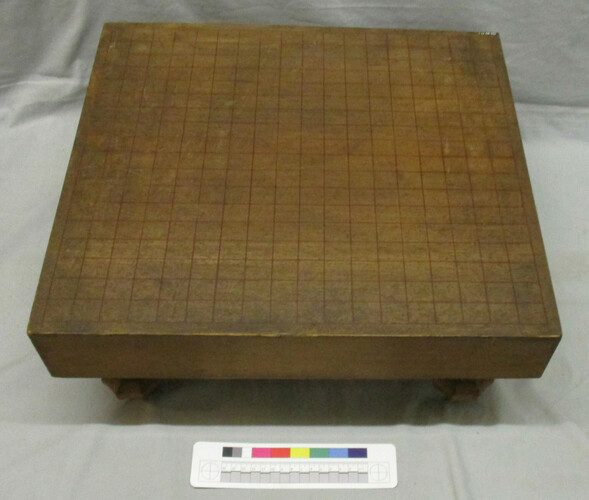 1910.42.17.1Board for go game. The board made from wood and rectangular in shape. It stands on four legs which have been carved. There is a grid painted onto the top of the board for the game, the underside of the board has a square carved into the centre. [AB [OPS Move] 20/7/2016]1910.42.17.1
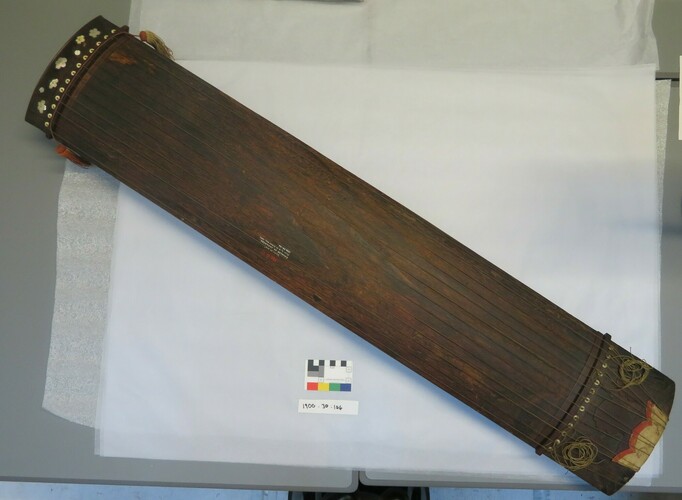 1900.30.106Zither1900.30.106
 1917.53.489.14Wooden chess piece with Japanese characters on both sides. For paper chess board see [1917.53.489 .1] and for the other chess pieces see [1917.53.489 .2 .13] and [1917.53.489 .15 - .42]. [JMC 13/12/2018]1917.53.489.14
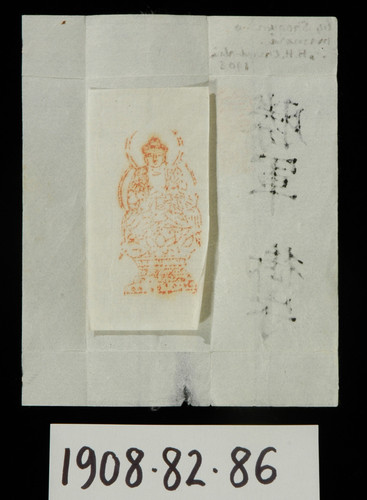 1908.82.86Amulet envelope stamped with inscriptions in black and red, containing a print of a deity in red ink. [SM 16/10/2008]1908.82.86
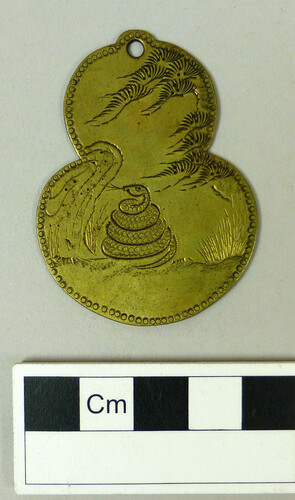 1985.53.957Plaque of copper alloy in a figure of 8-shape suggesting a gourd, incised with a picture of a snake, with loop at the top for suspension. [El.B 10/12/2013]1985.53.957