
- Collection type
- Object
- Description
- Helmet emblem, part of a complete suit of Japanese armour. [MOBB [OPS move] 31/8/2017]
- Long description
- Helmet emblem, part of a complete suit of Japanese armour. Piece of ?rawhide cut into a pair of antlers with three prongs each, and coloured (?lacquered) gold. On the reverse at the bottom, a large section of lacquer is missing revealing the material and with a single projecting ?nail and five small nail holes. [MOBB [OPS move] 31/8/2017]
- Geographical reference
- Cultural groups
- Japanese
- Date / Period
- Date made: Before 1920
- Date collected
- By 1920
- Acquisition information
- Donated: 1920
- Materials and processes
- Material Animal Hide Skin, Material Lacquer Varnish, Material Pigment, Process Lacquered Varnished, Process Painted
- Dimensions
- Depth: max 17 mm, Width: max 144 mm, Length: max 125 mm
- Object numbers
- Accession number: 1920.16.13.34
- Research and responses
Note that some of the Japanese items are marked as being obtained by J. Cole Hartland and donated via his brother Edwin Sidney. It seems hard to believe that the other items from Japan were not also obtained by J. Cole Hartland. Note that there is no evidence to date that Edwin Sidney Hartland ever visited Japan [AP 16/2/2009]
The following notes are drawn from research compiled by Andy Mills as part of the DCF Cutting Edge project in 2006-2007. This kabuto (helmet) is of the suji-hachi type - the bowl comprised of several riveted wedge-shaped plates. This example is made from 32 plates. Thirty-two plate helmets were commonest in the Momoyama period (1568-1614), but later copies (such as this one) became popular, and had an ancient air about them. The fukigaeshi (‘turn-backs’, recurved upper plate of the shikoro intended to prevent their lacings being cut by downward sword strokes) are of particular interest in this suit. They are relatively small, in the later style, and lacquered in the same charcoal-derived grey-black as all other parts of the armour. However, like the brim of the helmet (mabizashi), this charcoal-grey lacquering is over-detailed with gold lacquer tracery, depicting foliage termed ‘Chinese Grass’. The fukigaeshi also formerly bore over-detailed gold kamon (heraldic crest of the bushi or his daimyo), which appear to have been erased by rubbing. Whilst this may have been accidental, and some superficial wearing-out also occurs on the brim of the helmet, this area around the former kamon seems particularly heavily abraded, and in an exactly circular pattern. I would suggest that this was consequently the armour of a ronin – a samurai who had abandoned, and become disenfranchised from, his daimyo. As with many retainer armours, there were relatively few kamon on this suit of armour, and this rubbing-out of those on the helmet made it anonymous. This said, the menpo (half-length face-mask), lacquered in a rich russet-maroon, bears an unremovable relief kamon on the left side of the chin. I have not been able to concretely identify this floral kamon from available sources, although it would seem to be some form of Ume-Bachi (Plum Flower) design – one associated with the daimyo Michizane Sugawara and Maedo Kenshin in the Sengoku Jidai (Age of Wars) period. Such a design was one of the more popular kamon, however. [SM 08/05/2008]
Search terms: Armour Weapon, Helmet
Further items to explore
 1914.28.5Padded protective helmet made of cotton, filled with kapok, finished with blue cotton trim and adorned with five tassels. 1914.28.5
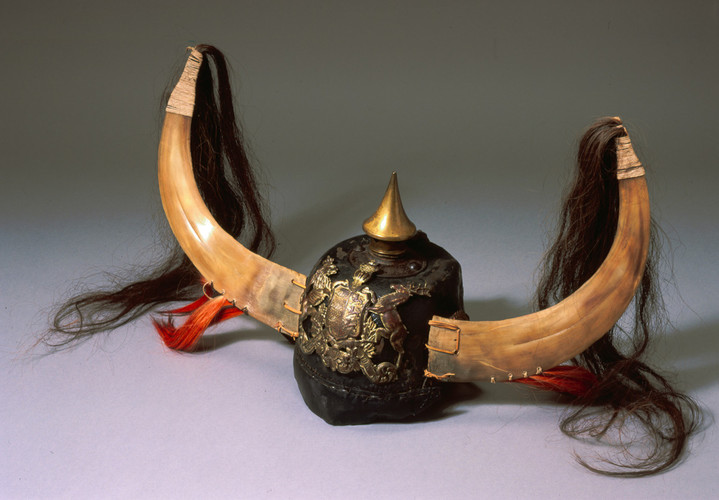 1928.69.200Dance hat made from old German military helmet, with horns and hair attached. [CM]1928.69.200
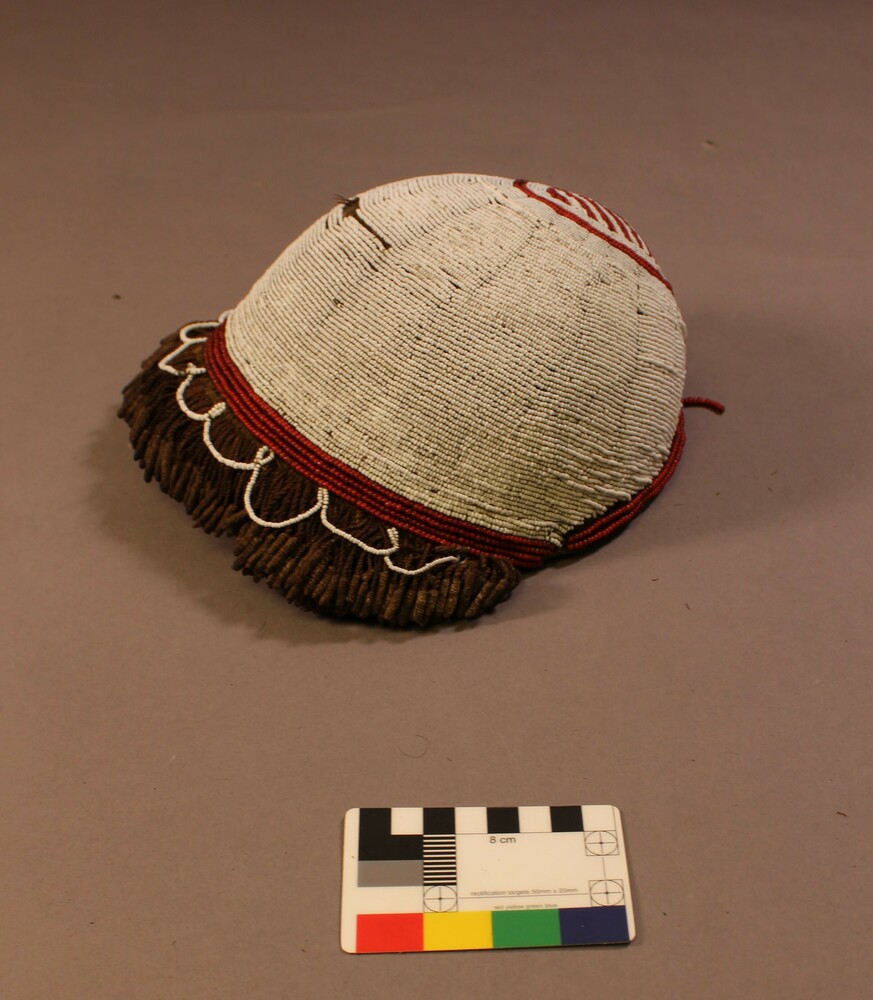 1884.32.26Basketry headgear with bead decoration1884.32.26
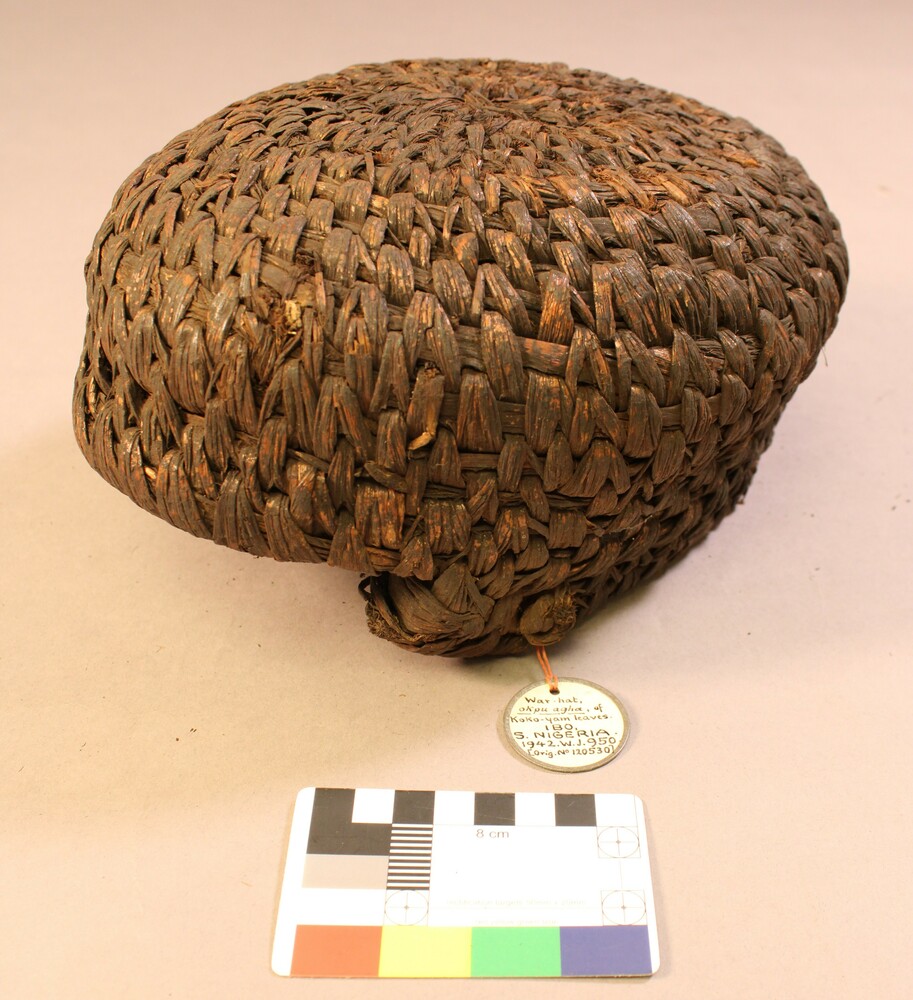 1942.13.950Helmet1942.13.950
 2024.22.28.2Bundle of 26 toothpicks in paper sleeves. 2024.22.28.2
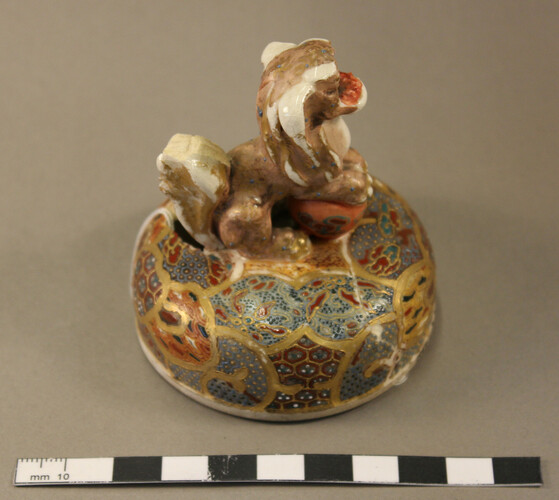 1969.1.3.2Lid for Satsuma ware jar [1969.1.3 .1]. The lid has a kylin (a composite animal commonly figured on Japanese pottery) as a handle.1969.1.3.2
 2024.22.31.1Miniature Yosegi-Zaiku (Hakone marquetry) chest (2024.22.31.1) with three drawers (2024.22.31.2-4).2024.22.31.1
 1910.68.24Spade. Made from carved wood. The handle is cylindrical and expands at one end for the spade head. The head is flattened and has a rounded end. [AB [OPS Move] 30/11/2016]1910.68.24