
- Collection type
- Object
- Description
- War bonnet of eagle feathers with decorative band of beads across forehead.
- Long description
- War bonnet of immature golden eagle feathers with decorative band of white, yellow and green trade beads across forehead. The cap and the train are made of animal hide, very likely semi-tanned leather which looks like buffalo hide as remains of distinctive brown hair can be seen on the inside of the train. 32 feathers at the crown and 44 feathers on the train are attached to a running leather strip with the quill loop technique. The feathers at the crown have silk ribbons knotted at the tips and remains of what must have been small colourful feathers. The train is covered with a piece of pattern cotton textile. Two small pieces of red woollen trade cloth, or Stroud cloth, decorate each side of the crown and a larger piece of Stroud cloth is stitched to the base of the train and finishes with a white selvedge. The rectangular junction of the leather train and the piece of Stroud cloth is decorated with white and blue beads. A leather chin strap is attached to the cap. [LMo 30/08/2011]
- Geographical reference
- Cultural groups
- Native American
- Date / Period
- Date made: Before 1850?, uncertain
- Date collected
- By 1954
- Acquisition information
- Donated: 1954
- Materials and processes
- Material Bird Feather, Material Buffalo Cattle Skin Animal, Material Bead, Material Textile, Material Silk Textile Animal, Material Cotton Seed Fibre Textile Plant, Material Animal Skin, Process Beadwork, Process Stitched, Process Woven
- Dimensions
- Length 1700 mm approx
- Object numbers
- Accession number: 1954.8.140
- Research and responses
Peter Bowles, Visiting Researcher from California, USA studied this object on 4 March 2010 and stated the hide trailers are finely tanned and look like buffalo hide. The textile at the top of the crown feathers looks like silk, as it is lighter and finer than cotton. The red textile at the base of the train and edges of the headband is trade cloth, probably made in England. The piece of trade cloth at the bottom of the headdress has a white selvedge (where the cloth was held during dying), which is usually left on the cloth as decoration. The feathers are immature golden eagle feathers. The cotton textile stitched on to the buffalo hide trailers may possibly be covering drawings on the leather. The headdress has a leather strip to tie it around the waist. The length indicates that it was worn whilst on a horse. The chinstrap is made of commercial leather. [MJD 04/03/2010]
This may have been collected by William Blackmore and later acquired from the Blackmore Museum, Salisbury by Harry Beasley. It appears to be the bonnet worn by Blackmore in a photograph held in the collections of the Sidford Hamp Collection at the American Heritage Center, University of Wyoming. This photograph seems to have been first reproduced as Plate 6 on page 17 of ‘“Ho, for the Great West!” Indians and Buffalo, Exploration and George Catlin: The West of William Blackmore’, by Colin Taylor, in Barry C. Johnson (ed.), ‘Ho, for the Great West!’ and Other Original Papers to Mark the 25th Anniversary of the English Westerners’ Society, London: Eatome Ltd (for The English Westerners Society), pp. 8–49 (photocopy in RDF: Biographies: Blackmore). Taylor's caption reads: 'Blackmore dressed in American Indian regalia. This photograph - probably taken c. 1875 - is an extraordinary example of Victorian English eccentricity. The head-dress is now in the Pitt Rivers Museum, Oxford. (Siegford [Sidford] Hamp Collection, Western History Research Center, University of Wyoming.). The photograph has also been published by Blackmore's biographer: see page 187 of Collecting the American West: The Rise and Fall of William Blackmore, by Anthony Hamber (Salisbury: The Hobnob Press, 2010). Hamber's caption reads: 'Blackmore dressed as Sioux Indian Chief | Albumen Print | Sidford Hamp Collection, W American Heritage Centre (AHC) | University of Wyoming'. Hamber refers to the war bonnet on page 188, where he writes: ‘In the 1870s Blackmore’s obsession with North American Indian culture led him to have himself photographed in Sioux Indian regalia, including a head-dress and blanket, possibly given to him by Red Cloud (1822–1909), a war leader of the Oglala Lakota (Sioux) in June 1872. The only known copy of this image is in the Sidford Hamp Collection, American Heritage Centre, University of Wyoming. It is possible that Blackmore was made an honorary member of the Sioux tribe as a result of his meetings with Red Cloud in the summer of 1872. It is also possible that the photographer was Alexander Gardner. It seems unlikely that no other copy of this image existed and that William would have kept copies for his own collection or to distribute to family and friends. The head dress worn by Blackmore is visible in a photograph in the Salisbury & South Wiltshire Museum of Humphrey Blackmore seated in the Blackmore Museum. It appears in the wall cabinet behind Humphrey and is now in the Pitt Rivers Museum in Oxford.’ For the photograph of 'Humphrey Blackmore seated in the Blackmore Museum', see page 10 of Colin Taylor's paper and page 23 of Hamber's book. Both Taylor and Hamber give the date of this photograph as 'circa 1870', but if the war bonnet on display is the one William Blackmore is wearing in the photograph then it must have been taken after Blackmore had acquired the bonnet. Similarly, if they are one and the same, then the bonnet must have been acquired before the photograph in the museum was taken. [JC 11 10 2010, 2 12 2010, 10 2 2011]
- Associated publications
- Illustrated as a sketch as Figure 8 on page 9 of 'Plains Indian Headgear', by Colin F. G. Taylor, in The English Westerners' Brand Book: The Quarterly Publication of the English Westerners' Society, Vol. 4, no. 3 (April 1962; 'publication no. 78'), pp. 1-10. Also, discussed on page 8: 'Further south, the Sioux seem to have adopted the trail at an early period. A specimen formerly in the Beasley Collection and now at Oxford (specimen number P. R. 192.H. [sic; this is a PRM photograph reference number], shown at Figure 8, which has features consistent with pre-1850 development, tends to confirm this. Unlike the two Northern specimens referred to above, however, the feathers are attached by means of the quill loop technique.' (Copy of article in RDF; Researchers: Taylor, Colin F.) [JC 7 10 2010] Illustrated in black and white as figure 42 on page 115 of Wapa'ha: The Plains Feathered Head-dress / Die Plains-Federhaube, by Colin F. Taylor (Wyk auf Foehr: Verlag für Amerikanistik, 1998). Caption (same page) reads: '42. Flaring style head-dress with tail of eagle feathers, which are attached by the quill-loop technique... This probably dates from circa 1850 and is from the Central Plains region. Pitt Rivers Museum Oxford (specimen number 1954.8.140). The object is also discussed on page 73: 'Further south, the Sioux seem to have adopted the trail at an early period. A specimen formerly in the Beasley collection and now at Oxford (specimen number P. R. 192.H. [sic; this is a PRM photograph reference number], has several features which suggest it was made before 1850; unlike the two Northern specimens referred to above, however, the feathers are attached by means of the quill loop technique'. The object is also discussed on page 123: 'A flaring style head-dress with a tail of eagle feathers ... and now in the Pitt Rivers Museum, Oxford ..., has the feathers attached to a cap of buckskin in a similar fashion to the head-dress collected by George Catlin .... This head-dress probably dates prior to 1850; of particular interest is that the top side of the feathers is presented to the left - a side commonly turned towards the enemy.' Taylor goes on to discuss this practice. [JC 17 11 2009] Illustrated in an 1870s portrait of William Blackmore, who is wearing it along with other N. American items, which is published by Anthony Hamber in his book Collecting the American West: The rise and fall of William Blackmore (Salisbury: The Hobnob Press, 2010) on page 187. [CM 17/06/2015] Illustrated in colour on page 157 of The Pitt Rivers Museum: A World Within, by Michael O’Hanlon (London: Scala, 2014). Caption (same page) reads: ‘116 This eagle-feather headdress passed from its original owner (possibly Sioux war leader Red Cloud), perhaps via William Blackmore to Harry Beasley's Cranmore Museum before being donated to the Pitt Rivers Museum by Beasley's widow. Northeastern Plains, United States Length approx. 1700 mm Donated by Mrs. I.M. Beasley 1954.8.140' [MJD (Verve) 8/3/2016]
Search terms: Clothing Headgear, Armour Weapon, Headdress
Further items to explore
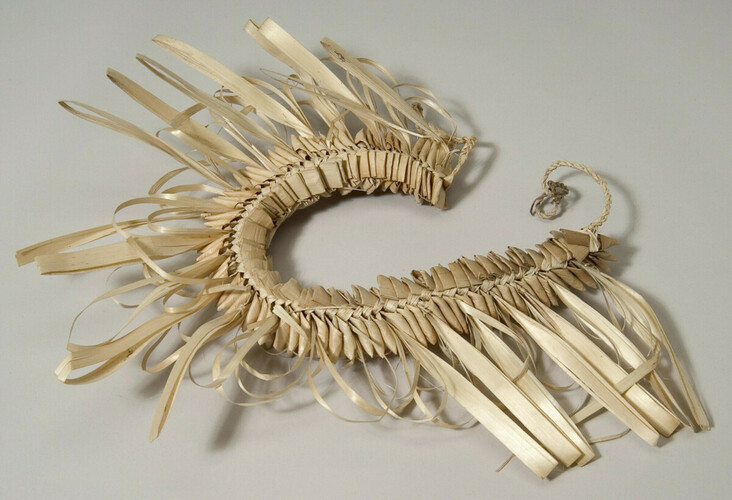 2004.56.20.5Part of a complete woman's dance costume: Headdress of palm leaf strip intricately folded into a three-dimensional band of two rows of densely packed triangles. [JP 18/6/2004]2004.56.20.5
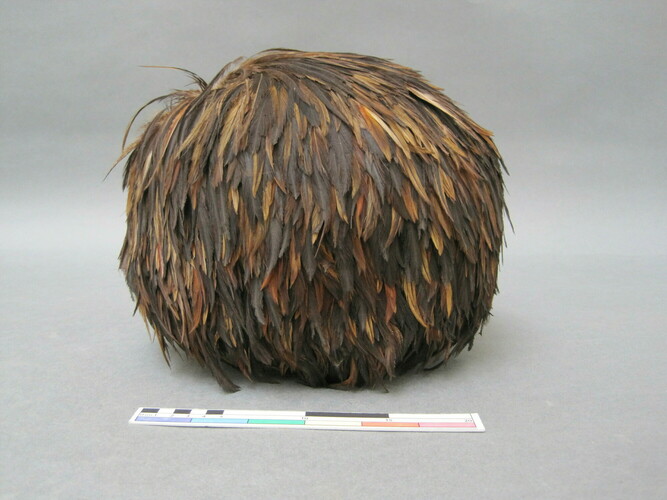 1926.17.1Headdress of coiled basketry covered with cocks' feathers. [LM 'DCF 2004-2006 What's Upstairs?' 6/12/2005]1926.17.1
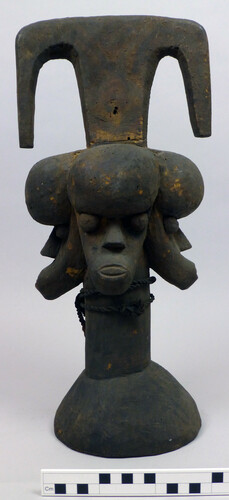 1916.45.103Headdress mask with four faces, painted and soot-blackened. [ZM 20/09/2013]1916.45.103
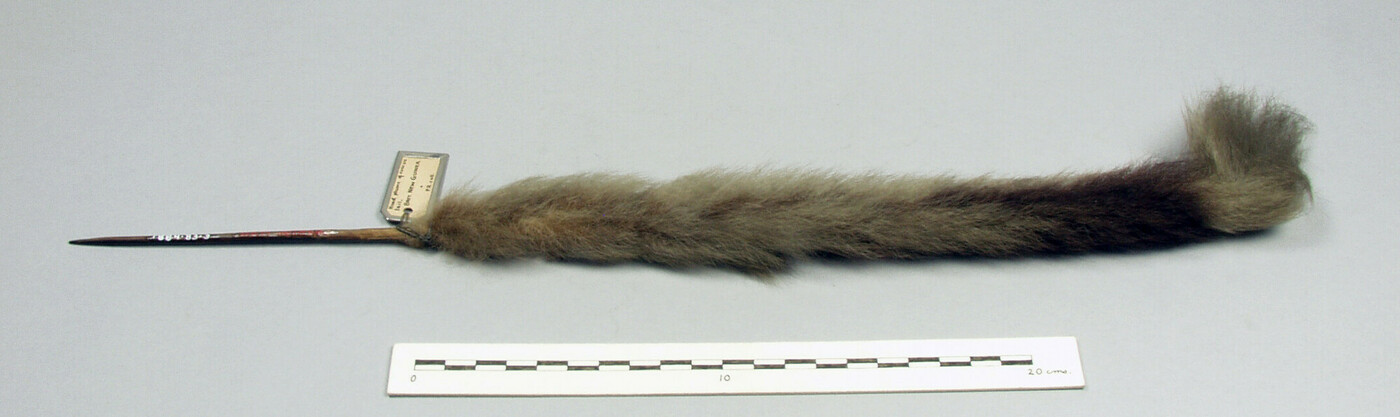 1884.83.3Head ornament of a cuscus tail mounted on a stick. [El.B 'DCF 2004-2006 What's Upstairs?' 8/12/2005]1884.83.3
 1937.21.5Bone bead1937.21.5
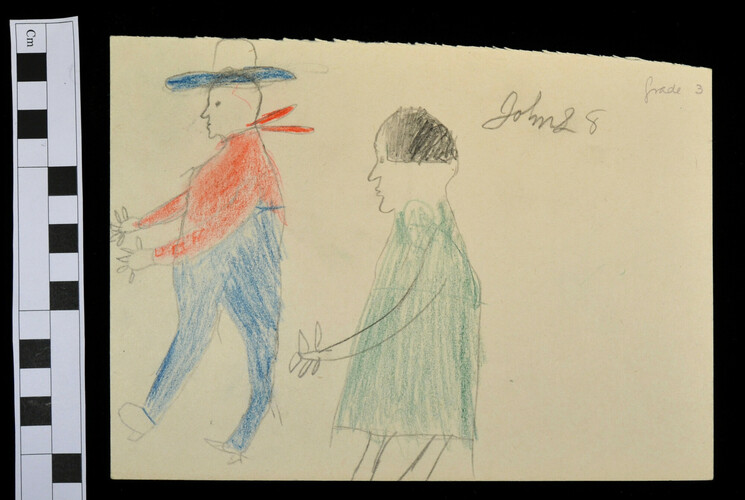 1994.15.139Drawing by child of two figures. [MJD 22/12/2014]1994.15.139
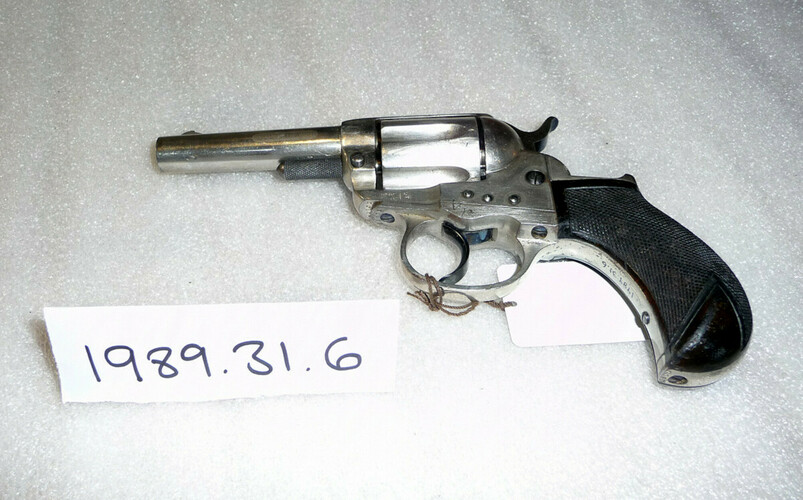 1989.31.6Colt short barrelled Lightning .38 calibre revolver pistol.1989.31.6
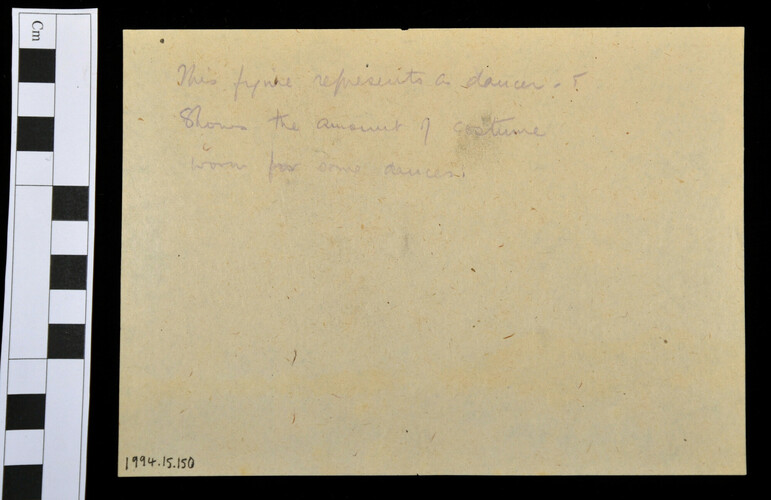 1994.15.150Drawing by schoolchild of two figures. [MJD 22/12/2014]1994.15.150