
- Collection type
- Object
- Description
- Stone tool with one rounded end, a groove on one side and the other end broken at a 90 degree angle. [CAK 17/05/2010]
- Long description
- Stone tool with one rounded end, a groove on one side and the other end broken at a 90 degree angle. [CAK 17/05/2010]
- Geographical reference
- British Columbia Haida Gwaii (Queen Charlotte Islands) NW Coast
- Cultural groups
- Haida
- Date / Period
- Date made: Before 1924
- Date collected
- By 1924
- Acquisition information
- Donated: 1924
- Dimensions
- Length: max 210 mm
- Object numbers
- Accession number: 1924.33.2
- Research and responses
The following information comes from Haida delegates who worked with the museum’s collection in September 2009 as part of the project “Haida Material Culture in British Museums: Generating New Forms of Knowledge”:
This tool was viewed alongside other stone tools on Monday Sept 14, 2009. Christian White identified this is a wedge, missing the tip. He also characterised it as a splitting axe. He thought it would have been lashed to a handle. He suggested that this tool, as well as 1924.33.1 and 1924.33.4 could be used to shape a canoe. Another delegate thought the tool would have been held by clamping one's hand over the groove in the topside of the tool, with the groove positioned between the thumb and first-finger. The user would place their other hand, clenched into a fist with the knuckles (to the topside of the lower fingers), placed underneath the tool to provide support. Jaalen Edenshaw identified this tool as a hammer. See also 1924.33.1.
In response to the collection of stone tools, delegates commented that the manufacture of stone tools occurred on Haida Gwaii and that it is possible to identify places where tools were made today based on archaeological analysis of detritus at the sites. They noted that there are a variety of stone types on Haida Gwaii and most of the tools found on Haida Gwaii were produced locally. There are sources of obsidian, for instance, although basalt is more common. [CAK 17/05/2010]
Further items to explore
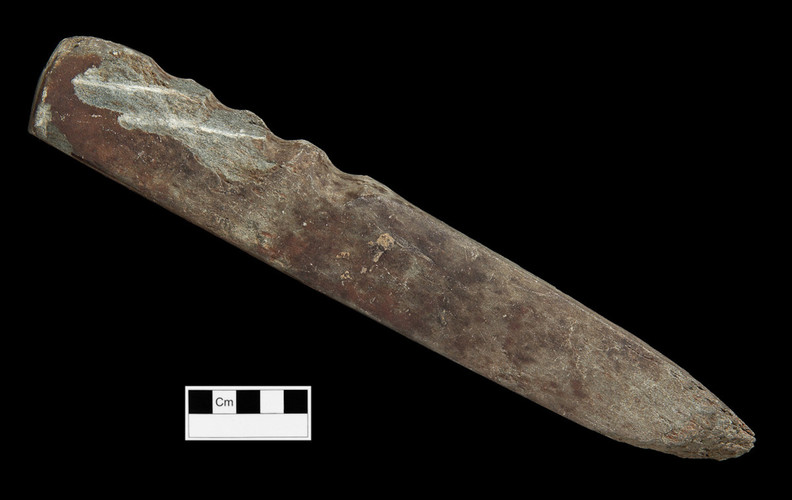 1924.33.1Stone wedge showing lots of wear, particularly at the pointed edge. [CAK 29/05/2009]1924.33.1
 1942.7.36.1Split stick, to be used with wedge [1942.7.36 .2] for holding roughed out rings while filing, part of a kit containing ad hoc tools and materials for making aluminium finger rings by Italian prisoners of war in Britain. [N.B. 'DCF 2004-2006 What's Upstairs?' 21/6/2005]1942.7.36.1
 1942.7.36.2Wedge, to be used with split stick [1942.7.36 .1] for holding roughed out rings while filing, part of a kit containing ad hoc tools and materials for making aluminium finger rings by Italian prisoners of war in Britain. [N.B. 'DCF 2004-2006 What's Upstairs?' 21/6/2005]1942.7.36.2
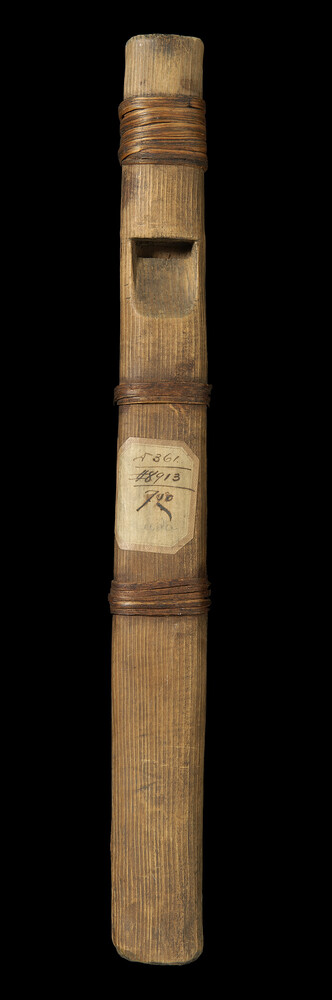 1921.24.32Wooden double whistle bound with cedar bark. [CAK 04/06/2009]1921.24.32
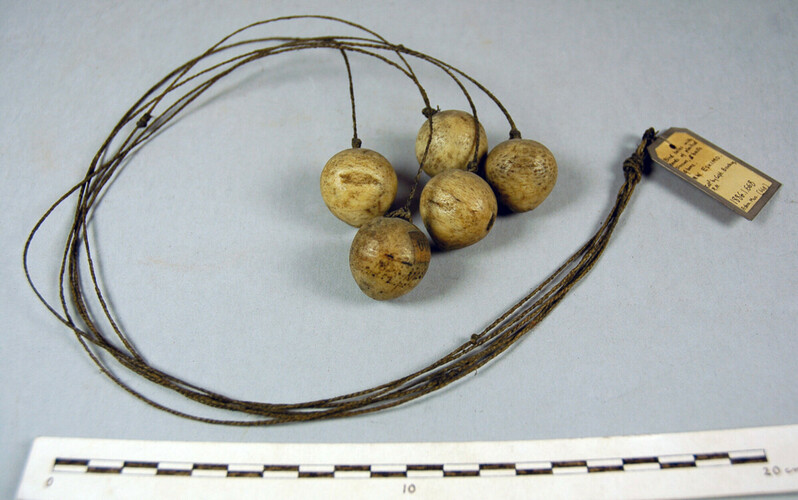 1886.1.668Bolas of five ball-shaped bone weights attached to fine lines of plaited sinews tied together at end. [MJD 23/11/2009]1886.1.668
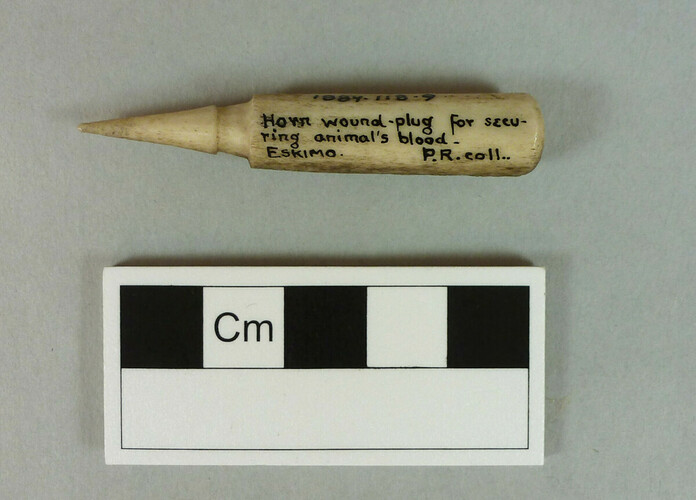 1884.118.9Cylindrical pointed plug of caribou antler. [El.B 01/05/2012]1884.118.9
 2003.86.2Moosehair embroidery LM 3/5/20062003.86.2