
- Collection type
- Object
- Description
- Beaded bag made from blue, green and orange Czech beads. [FC 11/03/2011]
- Long description
- Beaded bag made from blue, green and orange Czech beads. The bag is rectangular in shape. The bag has a carrying strap consisting of geometric patterns of light blue, orange and green beads. The dark blue flap conceals a panel of green and blue striped design. [FC 11/03/2011]
- Geographical reference
- Cultural groups
- Panará
- Date
- Date collected
- 16 December 2010
- Acquisition information
- Purchased: 14/02/2011
- Materials and processes
- Material Bead, Material Nylon Synthetic, Material Glass, Process Strung, Process Perforated, Process Tied
- Dimensions
- Width: max 190 mm, Length: max 465 mm including carrying strap
- Object numbers
- Accession number: 2011.10.5
- Research and responses
Notes from the collector Elizabeth Ewart [in RDF] "Beadwork from Panará; December 2010 - collected in the context of John Fell funded project 'Glass beads in Amazonia' During my field trip from 1 December 2010 to 21 December 2010 a small workshop was organised on the subject of the Panará beadwork. The larger aims of this field trip were to explore Panará beadwork and to initiate conversations on the value, aesthetics, repertoire of designs and techniques as well as the processes of acquisition and transmission of beads. Panará women met the idea of a 'bead project' with huge enthusiasm; partly, at least, since they were trying to find opportunities to sell some of their work to outsiders rather then giving the bulk to their brothers, husbands and children. After explaining the project to the women seated in the central men's house, they decided to share out the beads there in the centre and work collectively in small groups. I provided enough rice, beans, pasta and tomato sauce for a midday meal to be prepared on two consecutive days. Women make necklaces and bracelets for their own temporary use before giving the items away to others or unpicking them once again. Much of the beadwork may be used for some time and then unpicked again and the beads reused for making other objects. There is a wide range of techniques and designs present in Panará bracelets and necklace and both design and techniques are subject to constant innovation. As such neither the designs nor the techniques refer to a set canon or 'tradition'. However, as far as beads for personal use are concerned, the bulk of women's glass beads are threaded onto long threads to be worn in heavy single coloured reams diagonally across their chests during rituals. When needed, small quantities from these 'bandoliers' can be taken to make bracelets or necklaces. When not in use these beads are stored carefully out of sight in suitcases and large wooden chests inside the houses.
Beadwork is made using a single thread of nylon fishing line (usually 0.3 mm to 0.2 mm). Beads are threaded on from either end, and then the threads crossed over through a middle bead, and further beads added. Depending on the style, the beadwork can also be made to be more 3-dimensional, which is a technique that seemed to have just started in 2007. By 2010 women were producing the 3-D work, but with addition of gaps within the work, to produce a finer, 'lace-like' effect.
On the whole, most women claimed to have taught themselves this technique with gaps. In particular, one woman in Sonkuy, Kârampô, claimed to have invented the technique and then taught it to others. However, in Nansepotiti, similar things were said, namely that they had themselves made up the designs and had not learnt them from others. This is interesting, as it is commonly acknowledged that in the first place, beadwork was learnt in the mid to late 1970's from the Kayapo people. In fact, one man, Kiompe, says he was the first to learn and then passed the knowledge on to his wife. However, in 2010 no more references were made to learning new beadwork techniques from others and instead invention was claimed to be a personal thing.
While Czech beads remain the most desirable beads, and Asian ones are unanimously considered to be ugly and much inferior, a new tiny size of Czech bead has entered the market and this tiny size is unanimously considered to be the most beautiful of all. It is also the most expensive, costing some R$ 35 - 50 per 500 g packetin São Paulo. Most shops in Avendia 25 de Março are no longer trading in Czech beads, as the Asian ones are cheaper. Casa Laskani still stocks the Czech 'Jablonex' make, while Casa Costa was clearing their stocks of Czech beads in December 2010, saying there was no adequate market for them. Avienda 25 de março remains the best place to purchase glass beads, though the bulk of their stock is sold for Afro-Brazilian religious purposes and not to indigenous people who seem to make up just a minor part of the clientele.
Asked about the designs, women fairly consistently said they had invented the designs and techniques themselves. The word for design, used by the school teacher Perankô, who helped with the project, was haprepi, which can also mean 'image,', 'photo', 'ghost' and which differs from kâprepi which refers to 'paper', 'tarpaulin', whereby kâ refers to 'skin' or 'covering'.
Asked about the names of designs, it was often the case that women (especially younger ones) would say they did not know. And just as often, women would look at the object, sometimes together with Peranko and apparently find a name for it right there on the spot. e.g. 'looks like stars'." [FC 11/03/2011]
Further items to explore
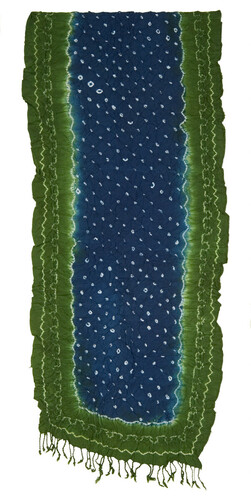 2003.69.28Rectangular sash consisting of blue centre field with wide green border and green fringe at either end. The green border is decorated with three white lines created by tritik resist dying and the blue centre field with white dots created by plangi resist dying. The creases created by the resist dying method are still present. [JP 27/3/2003]2003.69.28
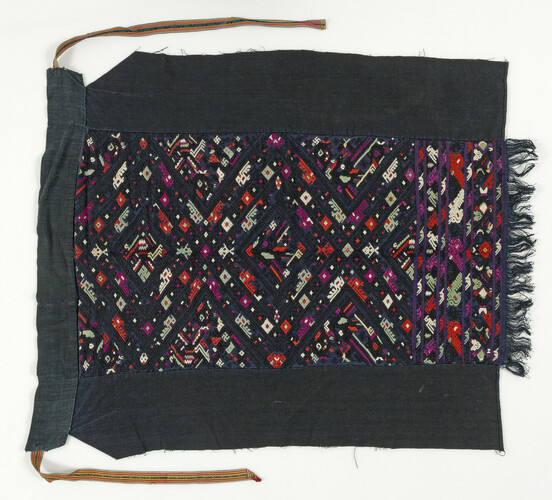 2009.135.139Embroidered Apron. [FB 24/07/2012]2009.135.139
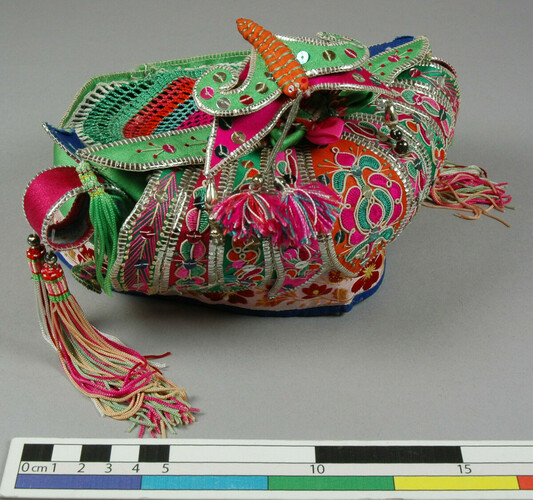 2010.3.9Baby's festival hat brought new from Zhaoxing village.2010.3.9
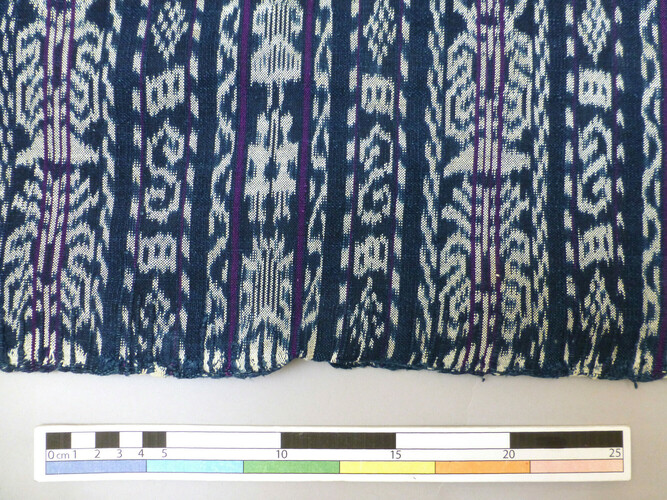 2012.104.33Tubular skirt of indigo cotton with resist-dyed patterns in bands. [FB 05/03/2014]2012.104.33
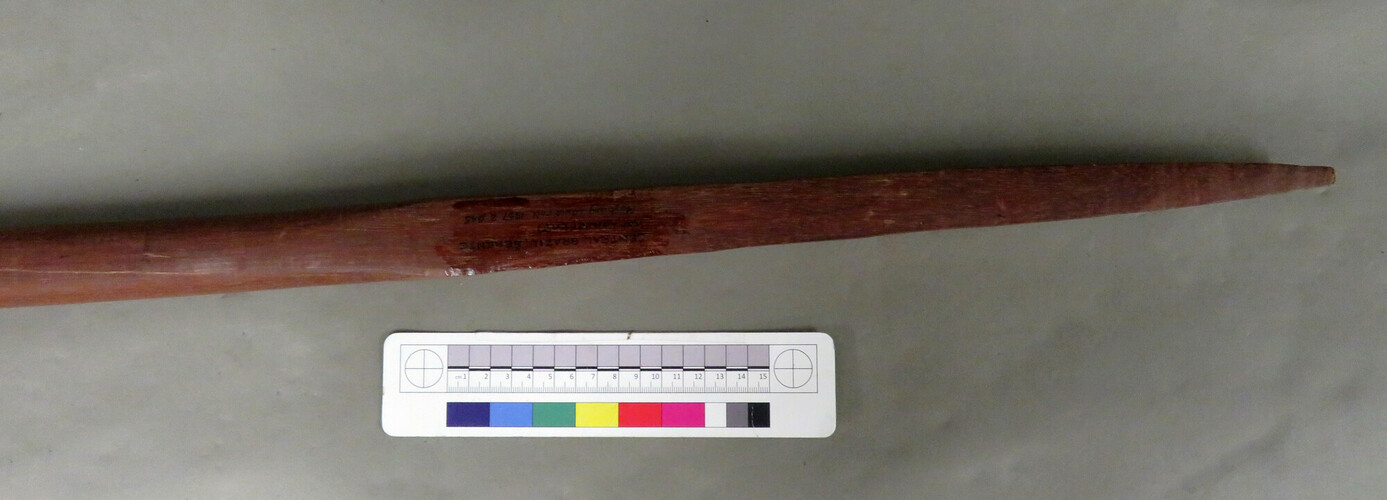 1957.2.45BWar lance, made of Brazil wood. Stained dark brown. [ASh [OPS move] 20/8/2018]1957.2.45B
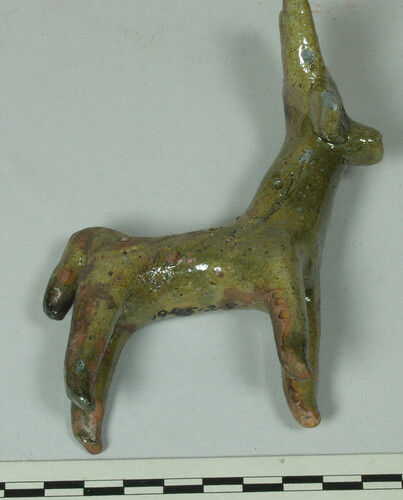 1945.2.8Pottery toy figure of a cow-like animal.1945.2.8
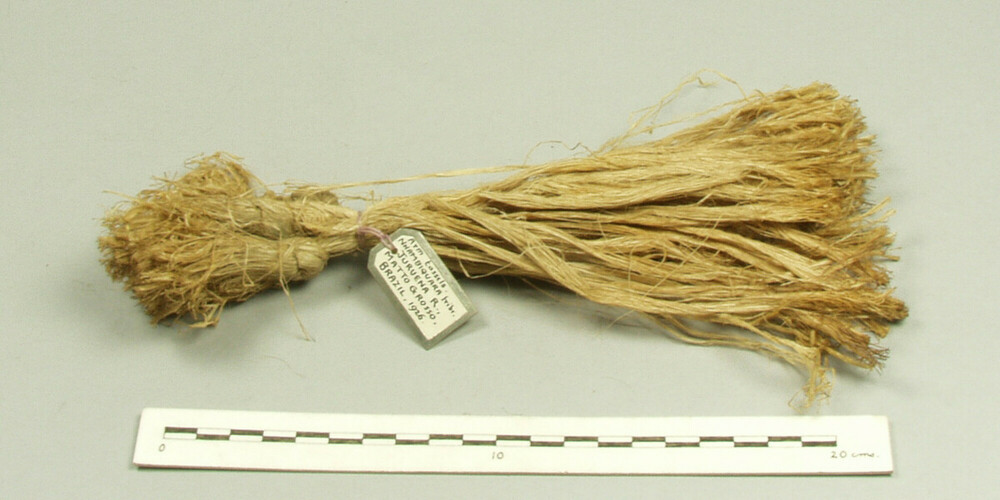 1929.16.4Arm tassel of shredded fibre. [El.B 'DCF 2004-2006 What's Upstairs?' 14/2/2006]1929.16.4
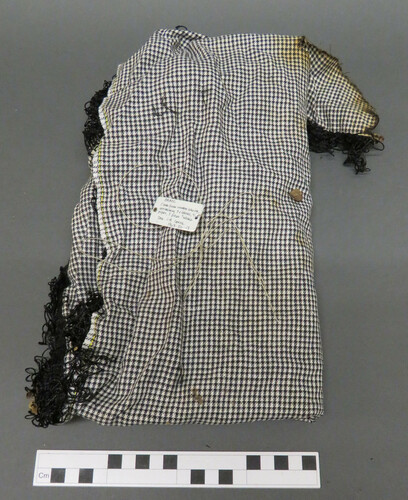 1967.50.17.1Black and white checked cotton cloth with synthetic black fringe. Part of Afro-Brazilian shrine.1967.50.17.1