
- Collection type
- Object
- Description
- A woman's black cotton dress from Beit al Faqih, embroidered and applied with white cotton and lurex braid. [FC 22/01/2010]
- Long description
- A woman's black cotton dress from Beit al Faqih, embroidered and applied with white cotton and lurex braid. The centre front, side hips, back yoke and sleeves of the dress have been applied with mostly white cotton and some red and silver lurex yarn in long vertical lines and short horizontal lines and geometric shapes. The front neck placket has been embroidered with silver plate thread and red and green cotton yarn approximately 425 mm long and 213 mm wide. An insert of brightly coloured printed shiny textile has been stitched into the neck placket. The bottom of the sleeves of the dress have been edges with the same design as the neck placket using silver plate thread, green, orange and red cotton yarn approximately 50 mm wide. The bottom of the dress has been edges with a braid of white, red, green and silver metallic yarn approximately 20 mm wide and a length of gold metallic woven textile which has become unwoven and is missing in places and is approximately 36 mm wide. The very bottom edge of the dress has been lined with a length of red cotton textile approximately 49 mm wide and stitched to the black cotton textile of the dress with white cotton yarn. The centre front and back of the dress and part of the sleeves have been lined on the inside with white cotton textile. [FC 22/01/2010]
- Person
- Field collector Sheila Rosemary Paine
- PRM source Julia Nicholson
- PRM source Pitt Rivers Museum
- PRM source Dreweatts Auctioneers
- PRM source Matilda Oppenheimer
- Date / Period
- Date made: Before 1987
- Date collected
- December 1987
- Acquisition information
- Donated: 2008
- Materials and processes
- Material Cotton Seed Fibre Textile Plant, Material Cotton Seed Fibre Yarn Plant, Material Synthetic Yarn, Material Synthetic Textile, Process Embroidered, Process Stitched, Process Appliqué, Process Braided
- Dimensions
- Width: max 1273 mm, Length: max 1140 mm
- Object numbers
- Accession number: 2008.116.43 Other numbers: 183
- Research and responses
Taken from the sales catalogue, information about the time Sheila Paine spent in Yemen: "I first went to Yemen in 1897 to look at the embroidery situation there. I of course went alone and travelled around on buses and occasionally a shared taxi. it wasn't easy. I stayed in funduks where there was the dormitory accommodation, but as I was always the only woman (and almost always the only foreigner) I had a large room to myself. I went all over the country and had to have a permit to go into each town. This was inspected by tribesmen on the outskirts of each town and it was clear that they couldn't read and mostly looked at the permit upside down. They were particularly difficult at Sa'ada and downright dangerous at Marib. The most dangerous experience I had was when I tried to get to Mocha. The bus left me at a junction on the high road by a garage, where the road onwards to Mocha turned of into the desert.
There was no bus onwards but the man at the garage stopped a truck going there and asked them to give me a lift - something I would never have done on my own. There were two men and when we got into the desert it was dark and they made it clear they wanted sex. Remembering my driving lesson, I thumped on the dashboard and yelled 'stop'. They were so surprised, they did. I grabbed my bag (another reason to carry just a small light bag) and fled into the desert, going as far as I could before hiding behind a scrub. They could easily have followed me on foot and I wouldn't have stood a chance, but they turned their truck around and went back, so they hadn't really been heading for Mocha at all. I hid for an hour or so and then went back to the road. Only one pick-up van passed and didn't stop. Then I saw his braking light and ran after him as fast as I could. I rode the rest of the way to Mocha sitting in the back of the pick-up and arrived covered in sand.
One Monday morning in 1995 I was at home washing up when the phone rang . It was a TV company called Domaine who were making Travelog films for Channel 4. They said they'd really enjoyed the Afghan Amulet and would like to take me travelling and film me. Wherever in the world I'd like to go. I said Yemen (and thought afterwards I could have said Bhutan or somewhere even more exotic).
I pointed out that they would have to have an all-female crew. We went there for two weeks. The first week I was with the director and the producer and we went up in a circuit and set everything up. The second week we were joined by the camerawoman and sound engineer. They were all pretty young woman and the local men who gathered around to watch was astounded that it was the old woman among them who was being filmed. some of the scenes we had set-up didn't materialise, as woman who had promised to take part vanished when we came back, no doubt told to do so by their menfolk.
The two weeks finished up as a 15 minute film, and then Pete MacCarthy discarded some of it to have himself filmed sitting in Eastbourne and commenting that that was usually where 65 year-olds spent their holidays. I was pleased that he added that of all the places they'd shown in their series, Yemen was dangerous and not recommended.
I returned to Yemen in 2006 on a tour with the British-Yemeni Society. The north around Sa'ada was now too dangerous and out of bounds. We went to rather different areas - west from Sana'a via al-Marwit and mainly to the Hadramaut, which was why I went. There were very few embroideries to buy, though some in Hadramaut.
As the embroidered garments are among the best examples of Yemeni costume in this country, most of them were borrowed for exhibitions at the Zamani Gallery in London, and for a Yemeni exhibition in Cardiff". [FC 22/01/2010]
- Associated publications
- Object: Embroidered Visions, Photographs by Sheila Paine, Main author: Katherine Clough; Main author: Philip N. Grover, 2017, Page illustrated: 3
- Listed and reproduced in colour on page 60 as Lot 183 in the sales catalogue The Sheila Paine Embroidery Collection Tuesday 22nd April 2008, Drewetts Auctioneers, Donnington Priory Salerooms:"183 A woman's black cotton dress from Beit al Faqih, the centre front, side hips, back yoke and sleeves applied with white cotton and lurex braid, the front neck placket embroidered with silver plate thread, red and green cotton, 109cm long 9Y-05. Brought Beit al Faqih (Tihama) market, 1987." [FC 22/01/2010] This dress has been reproduced (in colour) in Katherine Clough and Philip N. Grover, Embroidered Visions: Photographs by Sheila Paine (Oxford: Pitt Rivers Museum, 2017), p.3: 'Woman's black cotton dress with embroidery and appliqué, bought by Sheila Paine in Bayt al-Faqih, Yemen 1987 (2008.116.43)'. [PG 03/02/2017]
Further items to explore
 1949.9.41Bodice1949.9.41
 2006.89.1Cloth, black with three thin mid blue stripes. [MJD 28/1/2010]2006.89.1
 1914.42.15.3Bone Shuttle. Flat square of bone with four small holes perforating the corners. On one side white with a narrow strip of yellow, and darker shade of cream on reverse. [IL [OPS Move] 29/3/2017]1914.42.15.3
 1938.16.181Plant fibre costume with arms and legs. With fringing at the bottom of the legs and sleeves and around the neck. [FB 08/01/2015]1938.16.181
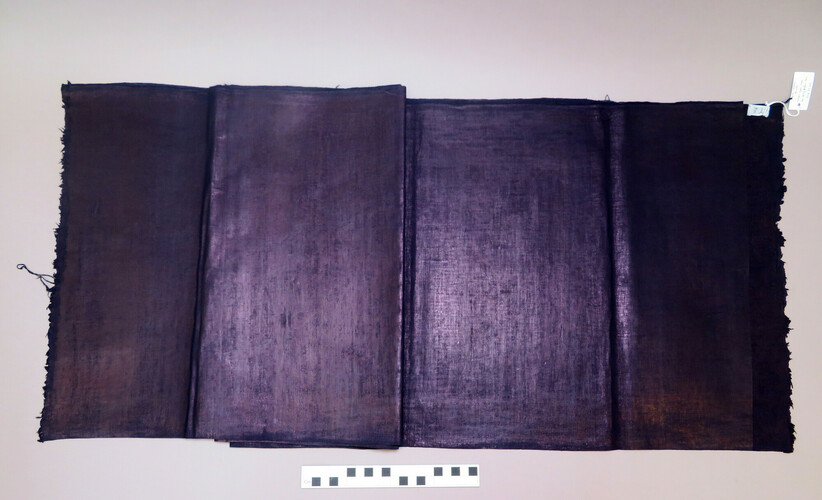 2018.37.109A length of Indigo dyed cloth, which has been calendered to produce a shiny surface. [AFS [OPS move] 6/8/2019] [ThW 3/2/2020]2018.37.109
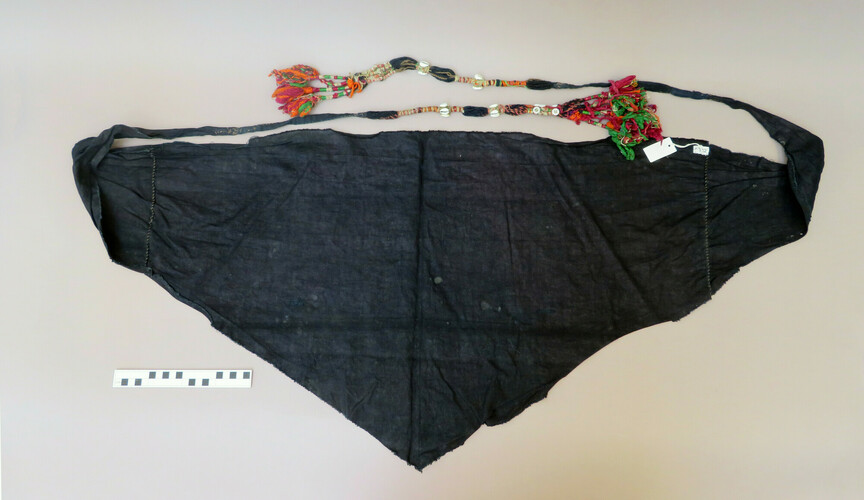 2018.37.84Indigo dyed headdress with braided ties, decorated with plastic buttons and cowrie shells. [AFS [OPS move] 2/8/2019]2018.37.84
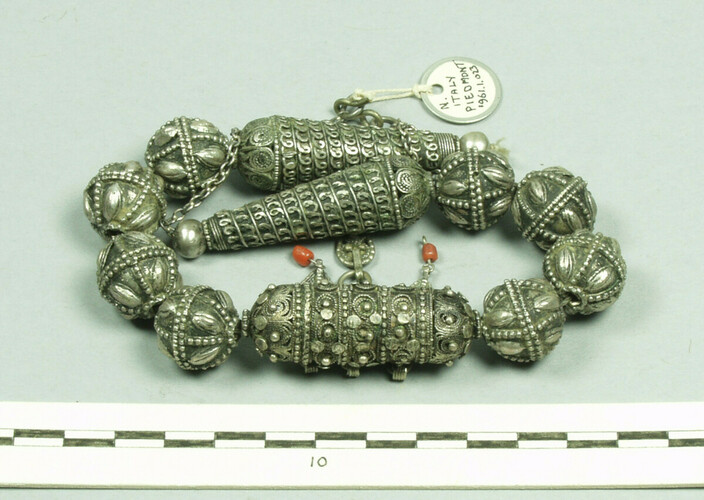 1961.1.023Neck ornament, consisting of large silver filigree beads from which hang 3 small pendants of which 2 have a coral bead attached; the necklace fastens with a hook-and-eye clasp attached at either end to a large, conical filigree bead. [N.B. 'DCF 2004-2006 What's Upstairs?' 7/7/2005]1961.1.023
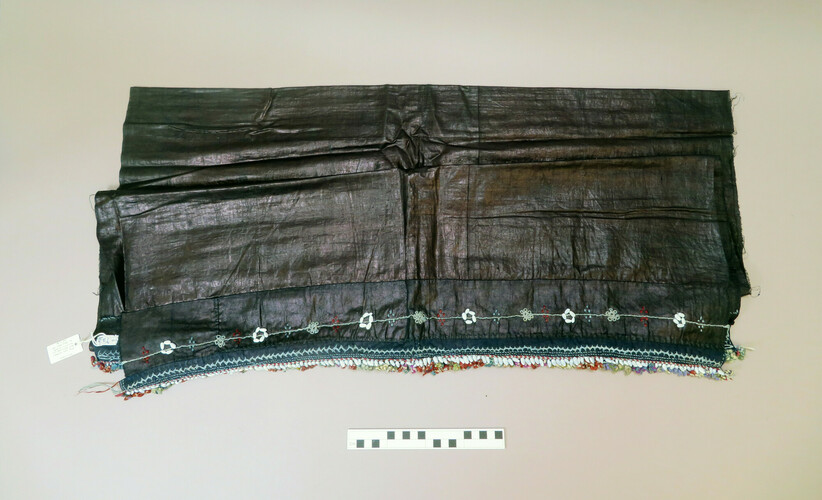 2018.37.85Indigo dyed head scarf / shawl, decorated at the shorter ends with blue and red embroidery, and shells. [AFS [OPS move] 2/8/2019]2018.37.85