
- Collection type
- Object
- Description
- Pipe for smoking tobacco, with wooden stem [.2] and stitched hide covering over a pottery bowl [.1] [RTS 28/9/2004].
- Long description
- Composite tobacco pipe consisting of a curved wooden stem with circular section [.2]; this has been cut flat across the top edge and carved out to form a hollow pipe. Shaving marks are visible on the outer surface, where the yellowish brown wood (Pantone 7508C) has been stained a darker brown colour (Pantone 440C). A ceramic bowl has been fitted onto the end of this stem [.1], and the junction of the two elements obscured by a rectangular strip of animal hide, yellowish brown in colour (Pantone ), with traces of short buff animal hair preserved in patches. This strip has been wrapped around the lower part of the stem, with the ends just touching and sewn together using sinew thread. A gap has been left where the pottery bowl extends outwards from the body, with the end of the hide strip folded up and over the curved base of the bowl. No stitches are visible at this point, and the hide may have been simply folded, damped and then shrunken into place. Two slits have been cut into the back of the hide piece, parallel to one another, and there are gouge marks visible in the clay below. This may have been used to seat an attachment, such as a cord. The surface of the hide appears to have been tooled with a narrow blade that has left short horizontal marks covering the surface, particularly on its upper part. The ceramic bowl section [.1] consists of a slightly curved, hollow cylindrical body, the upper part of which has been fitted onto the end of the wooden stem, the lower part of which ends with a rounded, closed base. This area is obscured by its hide covering. The bowl itself projects at an acute angle from one side, almost halfway down the length; this has almost straight sides that taper out slightly to a narrow, flat-topped rim, and is circular in plan view. This part is made of a moderately well levigated fabric, fired dark gray just below the surface and on the interior walls. The exterior surface has been covered in a fine slip, fired a deep red and highly burnished (Pantone 478C). The visible part of the bowl has been decorated with incised hatching around the outer edge of the rim, then a broad section of crosshatching covering its lower part, interrupted by a band of vertical hatching framed by horizontal lines above and below, that runs horizontally across the centre of this area. The decoration on the lower body has been filled with white pigment, and there are traces of similar pigment visible in some of the rim incisions as well. It seems likely that this pipe is not complete, as it might be expected to have a separate mouthpiece, and the hide slits imply the presence of a cord at some stage, probably to aid carrying or hanging the object. It still smells strongly of tobacco. The stem part is complete, but has some cracks near the top; the ceramic bowl is complete except for some damage to the back of its vertical part; the hide covering is nearly complete, but has some holes near the junction of pipe stem and bowl. The object weighs 420.6 grams, and has a length of 558 mm. The wooden part has a maximum width of 29.5 mm, while the top opening is 15 mm wide; the ceramic bowl measures 32 by 30.2 mm across its top socket, and 45.3 by 44 mm across the rim, with a mouth opening 34 mm in diameter; it is 126 mm long and the walls are 5 mm thick. The sinew thread is 1 mm wide [RTS 28/9/2004].
- Geographical reference
- Cultural groups
- Zande
- Person
- Maker Unknown Maker
- Field collector John Petherick
- PRM source Augustus Henry Lane Fox Pitt Rivers founding collection
- Date / Period
- Date made: Before 1865?, uncertain
- Date collected
- 1858
- Acquisition information
- Donated: 1884
- Materials and processes
- Material Wood Plant, Material Terracotta Pottery, Material Pottery, Material Animal Hide Skin, Material Animal Sinew, Material Pigment, Process Carved, Process Stained, Process Handbuilt, Process Incised, Process Inlaid, Process Stitched, Process Tooled
- Dimensions
- Diameter: max 45.3 mm, Width: max 29.5 mm, Length 558 mm total, Length 126 mm, Weight 420.6 g
- Object numbers
- Accession number: 1884.101.43.1 Accession number: 1884.101.43.2 Other numbers: 110 PR Cat other PR nos: 3110
- Research and responses
Collected by John Petherick, a businessman who lived in Khartoum from 1853 to 1858, mounting several trading expeditions into the Sudanese interior during this period. He entered Zande territory for the first time on 24th February 1858, while on his fifth such expedition, visiting the villages of Mundo, Kangamboo and Baranj. This object was probably collected during this trip, as Petherick did not venture into this region again. His collection was shipped back to England in 1859. This object was subsequently acquired by Pitt Rivers, probably at the auction of Petherick's collection collection conducted by Mr Bullock of High Holborn, London, on 27th June 1862 (see The Catalogue of the very interesting collection of arms and implements of war, husbandry, and the chase, and articles of costume and domestic use, procured during several expeditions up the White Nile, Bahr-il-Gazal, and among the various tribes of the country, to the cannibal Neam Nam territory on the Equator, by John Petherick, Esq., H.M. Consul, Khartoum, Soudan). 36 Sudanese pipes were included in this auction, as parts of various mixed lots. Pitt Rivers sent this object to Bethnal Green Museum for display, probably in 1874; it was later displayed in the South Kensington Museum and eventually transferred from there to form part of the Pitt Rives Museum founding collection in 1884.
Petherick said that the Zande 'were great smokers of tobacco, of their own growth, mixed with the rind of the banana, also indigenous to the country’ (J. Petherick 1861, Egypt, The Sudan and Central Africa, p. 466). Evans-Pritchard discusses the history of clay tobacco pipes amongst the Zande, based on the writings of Schweinfurth, Piaggia and Czekanowski. He adds that the small bowl into which a long wooden stem is fitted, as here, is called Mbomu; this term presumably derives from his own fieldwork between 1926 and 1930. Both types were illustrated by Schweinfurth. The pipe bowl may have been made by a male potter, as according to Evans-Pritchard, all Zande potters were of that sex (Evans-Pritchard 1971, The Azande, pp 95-96)..
Larken also discusses Zande pipes: "Tobacco pipes vary from the big kind three feet in length ... to the more portable one a third of this size. The bowls are well made of pottery... the stem is of hollowed wood, the joint between it and the bowl being sometimes lapped with leather. The mouthpiece is the stone of the akua palm fruit (Ar. dom) from which the kernel has been removed and replaced by a mass of fibre obtained by scraping the stalk of a plant. Sometimes tobacco is lacking ... and this packing of fibre is used instead, all soaked as it is in nicotine and saliva... [the Zande word for tobacco] is gbakara or bagbuduma" (P.M. Larken, 1926, "An Account of the Zande", Sudan Notes and Records IX no. 1, p. 92). One might wonder, from this description, whether the pipe catalogued here originally had such a mouthpiece [RTS 30/8/2005].
Search terms: Narcotic, Pottery, Pipe, Tobacco Accessory
Further items to explore
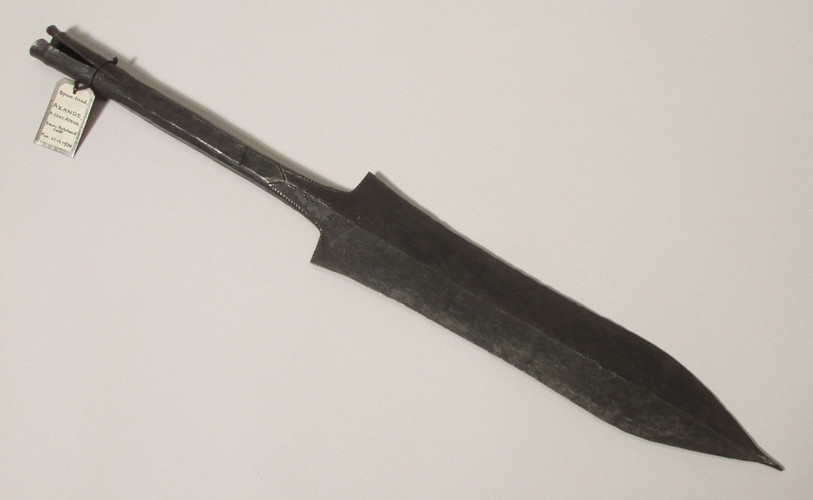 1930.86.14Socketed iron spear-head with decorated body [SM 26/06/2007]1930.86.14
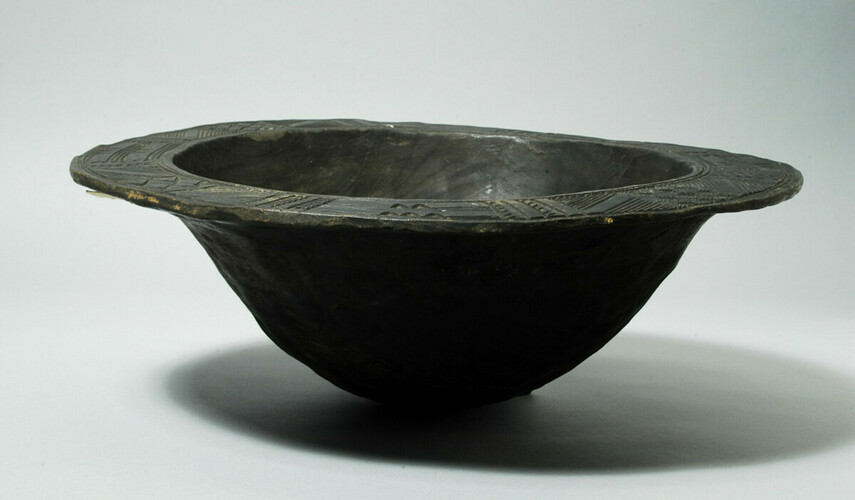 1966.25.3Hemispherical wooden bowl with broad flat everted rim, decorated with incised geometric linear designs, stained black [RTS 6/4/2005].1966.25.3
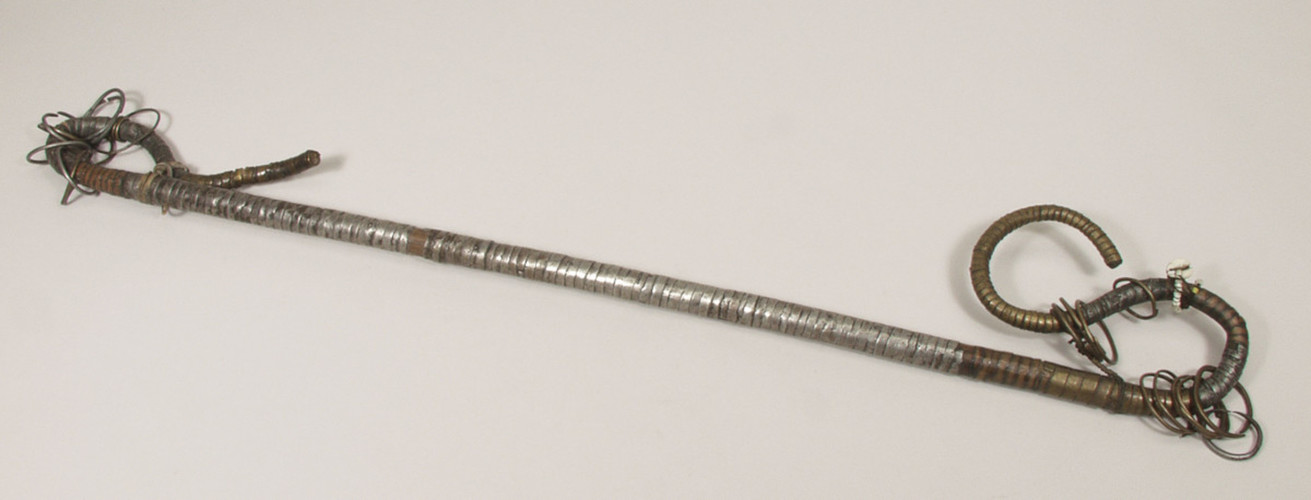 1928.67.3Wooden staff with incurved ends, bound with iron, brass and copper strips; part of the insignia of the prophet Car Koryom [RTS 25/10/2004].1928.67.3
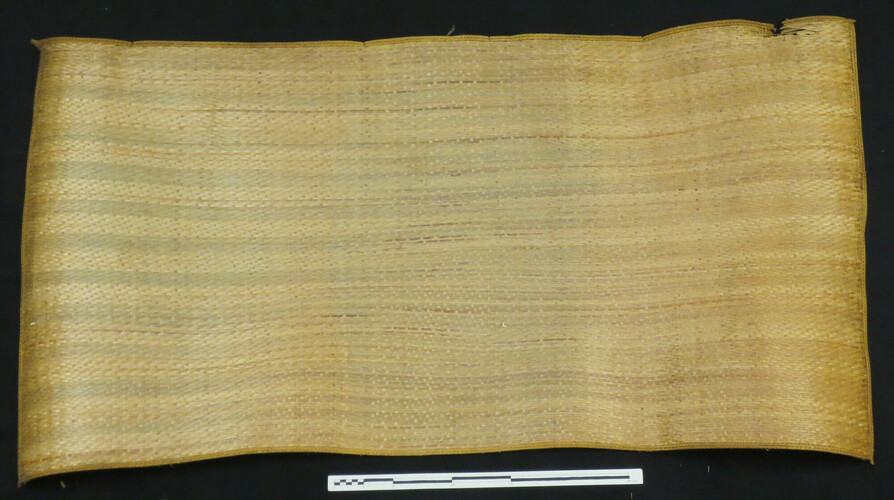 1948.2.159.3Rectangular mat made of chequerwoven strips of yellow plant fibre with fringed inner edges [RTS 9/8/2005].1948.2.159.3