
- Collection type
- Object
- Description
- Wooden staff with incurved ends, bound with iron, brass and copper strips; part of the insignia of the prophet Car Koryom [RTS 25/10/2004].
- Long description
- Ceremonial staff that was part of the insignia of the prophet Car Koryom, consisting of a round sectioned wooden body that tapers towards the ends that have been bent over into S- and Z-shaped curves respectively, both turning inwards towards one another on the same side of the shaft. The wood is an orangey brown colour (Pantone 4635C). The shaft body curves slightly concavely along its length, and its surface has been almost completely covered with decorative metal binding, leaving only small sections exposed. This binding has been made from a series of narrow iron, copper and brass strips, with crudely cut edges, wound tightly around the shaft in a spiral; in some cases their ends have been bent over and hammered into the wooden body to hold them in place. The beaded end of the shaft consists of strips made from brass (Pantone 872C), iron (Pantone 420C), copper (Pantone 876C), iron , brass and copper; the central part of the body is decorated with 3 sections of iron binding, and the lower part is decorated with strips of copper, iron and brass. The curling ends of the shaft have been fastened to the shaft body, using a length of plaited hide that divides into double loops at either end on the upper part, and a narrow strip of yellowish brown hide in combination with a length of twisted hide cord at the lower end (Pantone 465C), secured with knots. A series of metal rings have also been added to the looped ends, which would have produced a jangling sound when the staff was shaken; these end ties act as barriers to keep the rings in place. The upper loop has 12 brass rings in place, made from simple round or oval sectioned rods bent into a loop with their ends variously overlapping, touching, or being slightly apart. These vary in diameter. An iron ring has been fastened onto 3 of these brass examples; this is made from a rod with semicircular section, flat on its inner face, tapers to its ends, which are very slightly apart, and has a decorated outer face created by a series of oblique chisel blows across the surface. A piece of twisted hide cord with several beads threaded onto it has been doubled over the shaft and tied in place. The beads consist of a white cowrie shell with its back removed, 20 opaque white glass ring beads, and 1 white and 1 yellow glass cylindrical bead (Pantone Yellow C). The lower looped end of the staff is decorated with a brass rod, wound into a tight spiral around the body, and then 2 brass and 6 iron rings, through which an additional large brass ring has been threaded. Most are made from simple rods bent into loops, as described above; one of the larger iron rings has one flattened end, doubled over itself, and some traces of a spirally twisted body. The staff is complete, but in poor condition, with the lower end being particularly fragile where it has been repaired and restored. It has a weight of 784.5 grams, is 955 mm long with a shaft diameter of 21 mm at the centre, and 11.5 mm at the upper end. The upper end loop measures 103 mm across, and extends for 143 mm from the shaft body; the lower end loop is much less curved. The metal strips have a width ranging from 3 to 7 mm; the white ring beads have a diameter of 4.5 mm and the cowrie shell bead is 21 mm long. The loose metal rings have a typical width of 3 mm and thickness of 1.7 mm [RTS 17/1/2005].
- Cultural groups
- Lau Nuer
- Date / Period
- Date made: Before 1928
- Date collected
- Probably between 11th and 19th February 1928 [RTS 28/10/2004].
- Acquisition information
- Loaned: 1928
- Materials and processes
- Material Wood Plant, Material Iron Metal, Material Brass Metal, Material Copper Metal, Material Animal Hide Skin, Material Glass, Material Cowrie Shell, Process Carved, Process Forged (Metal), Process Hammered, Process Bound, Process Bent, Process Strung, Process Tied
- Dimensions
- Length 955 mm, Diameter: max 21 mm shaft, Width: max 143 mm ends, Weight 784.5 g
- Object numbers
- Accession number: 1928.67.3
- Research and responses
For the term 'wizard' use 'prophet' instead [pers. comm. Jeremy Coote; JN 13/11/2001].
Johnson provides further information on the career of Char Koryom (also spelt Car Koryom/ Koriom) and his capture in 1928 (see D.H. Johnson, 1994, Nuer Prophets, 167-169). He was known as the prophet of Deng, a divinity which disliked fighting. After 1917, Car Koryom dealt directly with the administrators of Mongalla province, and according to Johnson, was 'considered harmless' by the government prior to 1928. From that time, he was seen as a supporter of Guek Ngundeng, another Lou prophet who had come into conflict with the government and whom they were trying to suppress. Car Koryom surrendered to mounted troops that had been sent to his camp on 11th February 1928, and he presented himself to Percy Coriat carrying an ostrich plume fan; Johnson illustrates a photograph of Car under arrest, with his fan, in his figure 7. He escaped from custody around midnight on the 19th February, but the fan appears to have been left behind, and eventually came to the PRM later that year (see 1928.67.2). Car Koryom remained active until the middle of 1930, when he yielded to family pressure to give himself up to the authorities; he was imprisoned briefly in Malakal, then released, to return to his home where he lived until his death in 1948 (Johnson 1994; P. Coriat, 1993, Governing the Nuer, pp 119-120. See also the papers of Percy Coriot, who was involved in this brief capture, in Rhodes House, Oxford (MSS Afr.s.1684) [RTS 25/10/2004].
A staff of similar form, but without the added rings is illustrated by E.E. Evans-Pritchard in his 1956 book, Nuer Religion, p. 236, fig. 4 (1931.66.33). The metal strips on that example differ slightly, in having a ridged centre. It is captioned as an 'instrument used in wedding invocations'. He goes on to say: 'I was told that a wife may act as master of ceremonies in her husband's place and shout out the spear-name of his clan at a wedding ... It must be a very rare occurrence for a woman to play this role. Probably she can only take the part if she is acting on behalf of the bridegroom's family and hence holds in her hand, not a spear, but the instrument called dang (Fig. 4)' (op.cit. pp 236-7). A similar form is published by Boccassino, attributed to the Dinka or Nuer (Boccassino, R., 1960, "Contributo allo studio dell'ergologia delle popolazioni Nilotiche e Nilo-Camitiche, Parte Prime: le armi", Annali Lateranensi XXIV, fig. 203a; Leipzig, Museum für Völkerkunde MAf. 1474 and 8011). Also possibly comparable with the marriage stick in the Cambridge Museum of Archaeology and Anthropology 1983.134, which is said to have s-shaped ends and metal binding, but associated with the Shilluk [RTS 28/7/2004] .
Dang (plural deng) is a Dinka word meaning bow (D.G. Beltrame 1880, Grammatica e Vocabolario della lingua Denka, p. 190 gives definition as 'arco, schioppo, lancia). See also Schweinfurth 1873, The Heart of Africa, where dang is used to described a bow-shaped type of parry shield. The Nuer also use the word to describe a type of staff with curling ends, which may be related to this form [RTS 8/11/2004].
The Upper Nile Province referred to here is not the same as the modern administrative district called 'Upper Nile'; this was a larger area that existed only until 1981, covering the districts now known as Upper Nile, Jonglei, Wahda and part of el Buheyrat [RTS 12/11/2003].
Further items to explore
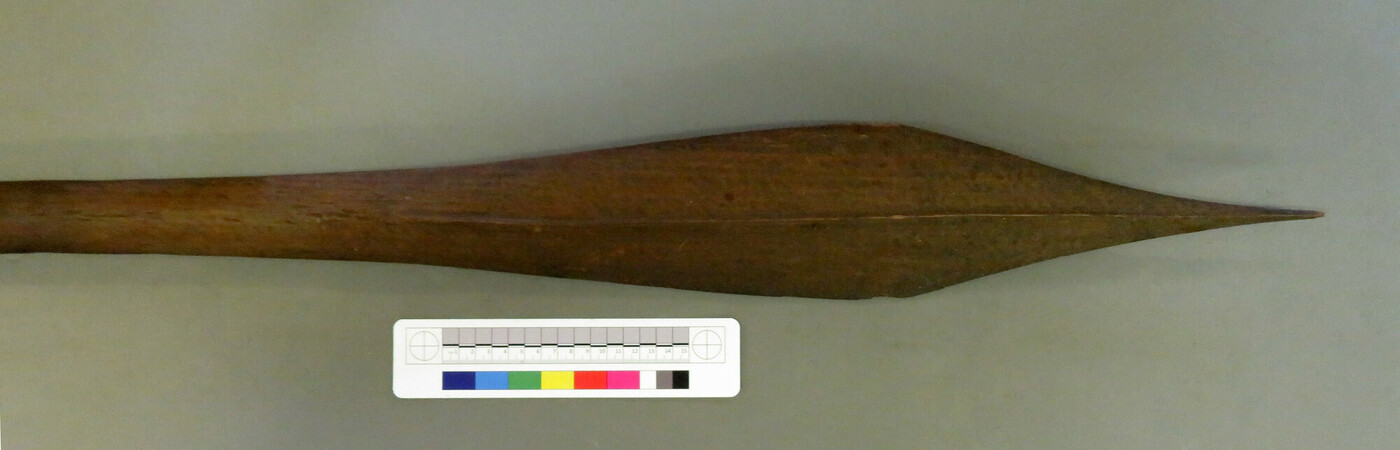 1884.19.93Spear or staff of light wood with centrally raised ridge. The spear shaft lenticular in section. The head expands from ridge then narrows to a point. [DV [OPS move] 21/6/2018]1884.19.93
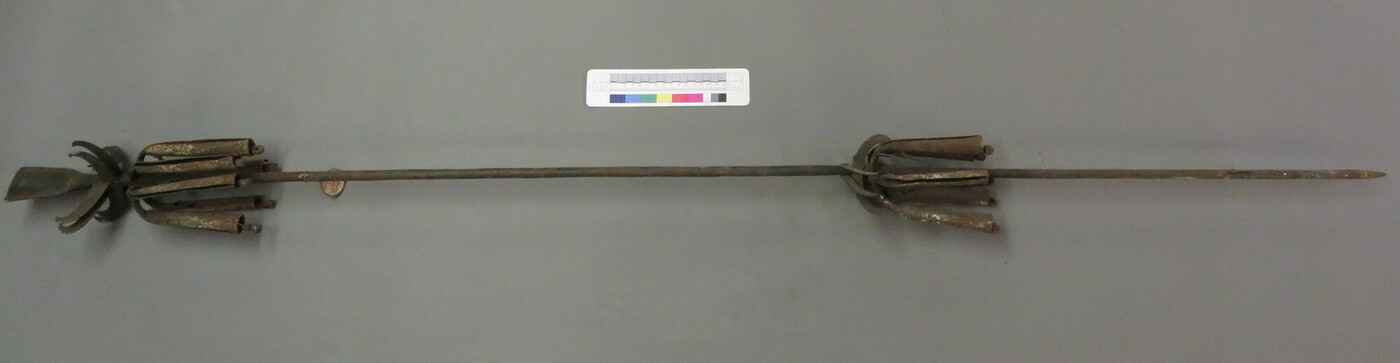 1942.13.1734Staff/ musical instrument.1942.13.1734
 1917.53.409Shepherd's crook, with a wooden shaft handle and a metal hook. [AB [OPS Move] 27/1/2017]1917.53.409
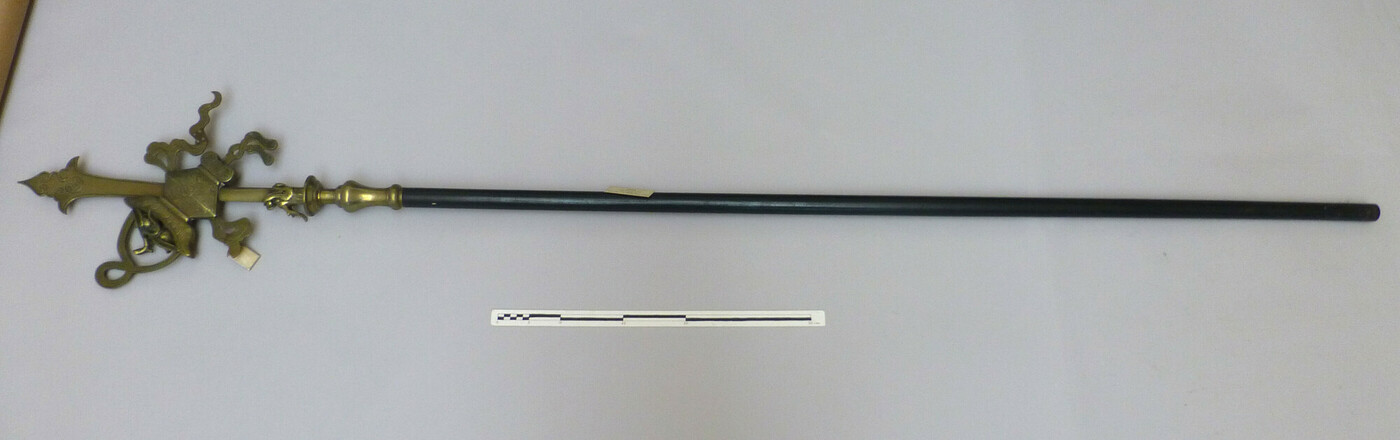 1940.5.46Ceremonial staff with brass top. [MJD (Verve) 12/05/2015]1940.5.46
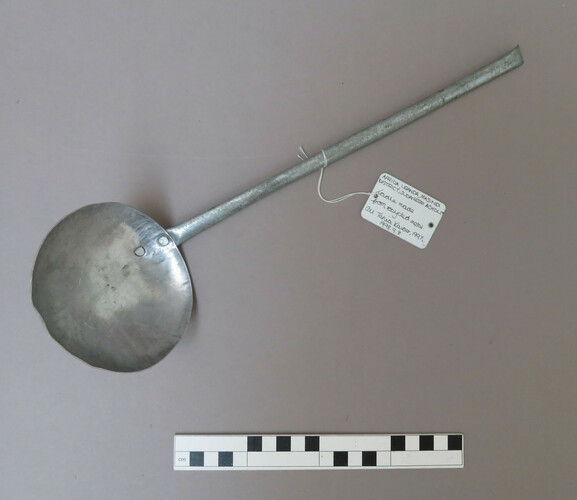 1998.9.8Long handled ladle made from recycled aluminium [RTS 18/6/2004].1998.9.8
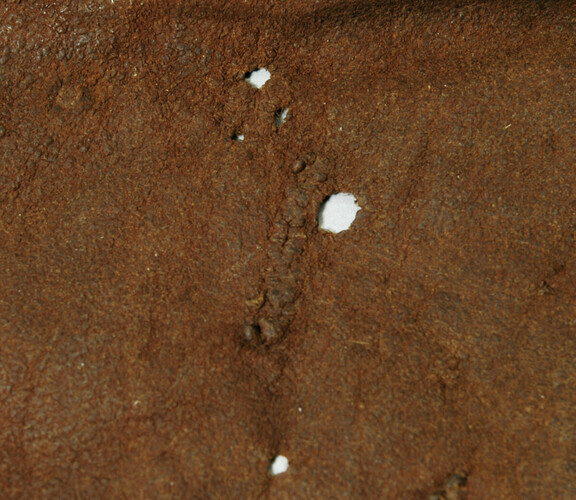 1940.7.091.12 pieces of goatskin, worn as a shirt by men [RTS 16/2/2005].1940.7.091.1
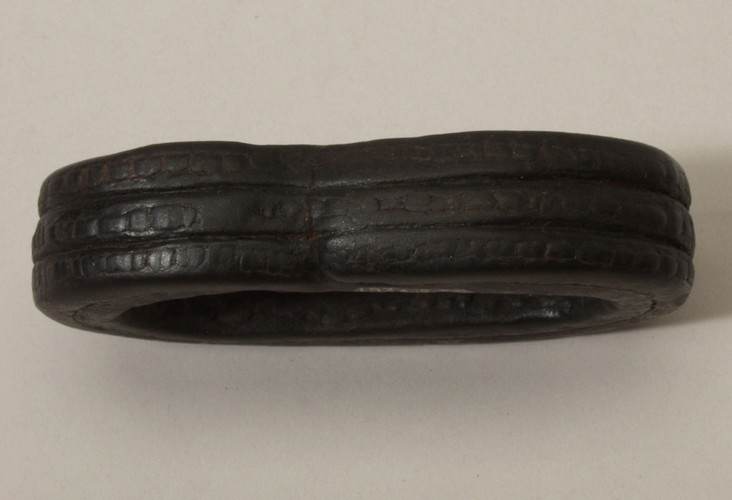 1934.8.34Oval archer's accessory made from sewn hide, used to assist drawing the bow string [RTS 5/3/2004].1934.8.34
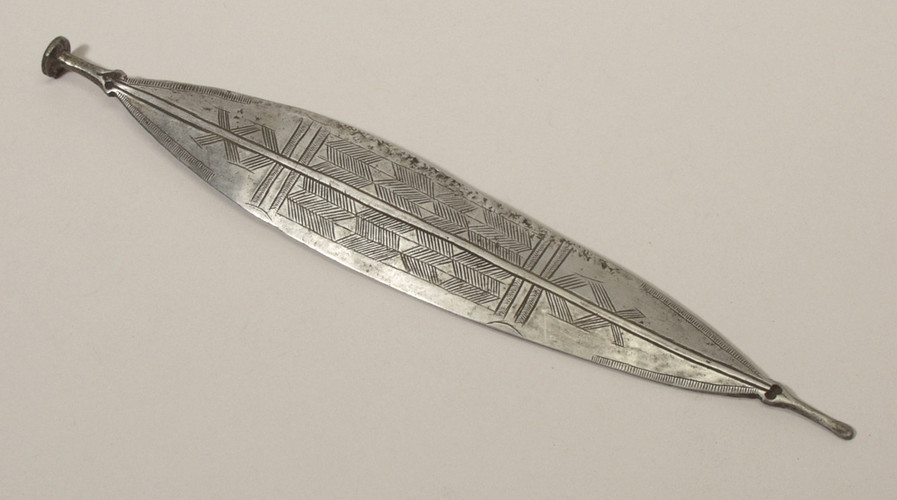 1884.24.206Woman's lenticular iron knife with incised line decoration, used by women [RTS 9/3/2004].1884.24.206