
- Collection type
- Object
- Description
- Woman's lenticular iron knife with incised line decoration, used by women [RTS 9/3/2004].
- Long description
- Woman's lenticular iron knife with incised line decoration, used by women. Iron knife, made in a single piece consisting of a flat, circular head with a depression in the top that is probably a manufacturing flaw, on a short, round sectioned stem that widens at its base where it has been hammered flat. This then tapers out to form a lenticular blade with flat underside and slightly convex upper surface; this thins to a cutting edge on either long side. The blade tapers in again at the other end, where there is a bulbous, flattened terminal, with a narrow elongated point with ovoid section and a slightly splayed end with bevelled edges below. The upper surface of the blade is decorated with a series of incised motifs, made up of straight lines that were probably created using a metal chisel or punch. The flattened terminal areas at top and base of the blade are each decorated with two circular depressions, with two broad incised parallel grooves running down the centre of the blade between them. The tapering sides at the top of the blade is decorated with a line running parallel with the outer edge on either side, filled with closely spaced hatching. The body below is decorated by a vertical zigzag motif, made up of three groups of parallel oblique lines running in opposing directions, with short lines across the ends of each group; this design is reflected on either side of the central grooves. After this there are two bands of tightly spaced >-shaped chevrons, framed by parallel lines above and below, with a single arc at either end. The middle part of the blade is filled with three vertical lines on either side of the central grooves, with the space between filled with groups of oblique lines, arranged in opposing directions to form a series of zigzags. There are four horizontal bands of these zigzag groups, with the spaces between each group left as a blank lozenge or triangle. Below this, the patterns previously described are repeated as a mirror image, creating a symmetrically balanced design. The knife is complete and intact, with some wear evident along one edge. The iron is in good condition, with a silvery gray coloured surface (Pantone 877C). Total length 323 mm, diameter of handle 15.7 mm, diameter of shaft 5.2 mm, maximum width of blade 47 mm, minimum width of blade just above point 7 mm, maximum thickness of blade 2.5 mm, thickness at cutting edge 0.1 mm [RTS 9/3/2004].
- Cultural groups
- Bongo
- Person
- Maker Unknown Maker
- Field collector Unknown Collector
- PRM source Augustus Henry Lane Fox Pitt Rivers founding collection
- Date / Period
- Date made: Before 1874
- Date collected
- By 1874
- Acquisition information
- Donated: 1884
- Materials and processes
- Material Iron Metal, Process Hammered, Process Punched, Process Incised
- Dimensions
- Length 323 mm, Width: max 47 mm, Thick: max 2.5 mm
- Object numbers
- Accession number: 1884.24.206 PR Cat other PR nos: 2887
- Research and responses
The accession book gives this a West African provenance, probably on analogy with 1884.24.205 and 1884.24.207, which are said to be from Gabon. However this information may be incorrect. This knife is probably the same piece published in J.G. Wood's The Natural History of Man Volume I, 1868, p. 503 fig. 3, badly drawn; Wood states that this was made by the Jur of Sudan, which he seems to use as a general term for Central Sudanic speaking groups. Petherick, who may have been the collector in all cases, associated these knives with the Bongo (see 1884.63.28 and 1884.63.29). Schweinfurth calls this type of knife a tibah, and states that women use them to peel vegetables and slice up gourds (G. Schweinfurth, 1975, Artes Africanae, pl. IV.7,8; In the Heart of Africa, 1873, p. 281). See also E. Castelli, 1984, Orazio Antinori in Africa Centrale 1859-1861, cat. no. 26-29, pp 49-50, all attributed to the Bongo (Museum of Perugia 49525-8). A further example in the British Museum was collected in 1867; their attribution to the Zande is probably incorrect (Accession number 4460, E. Schildkrout & C.A. Keim, 1990, African Reflections, fig. 5.10) [RTS 2/2/2005].
- Associated publications
- This knife is probably the same piece published in J.G. Wood's The Natural History of Man Volume I, 1868, p. 503 fig. 3, badly drawn. [AP Leverhulme project on founding collection 1995-1998]
Further items to explore
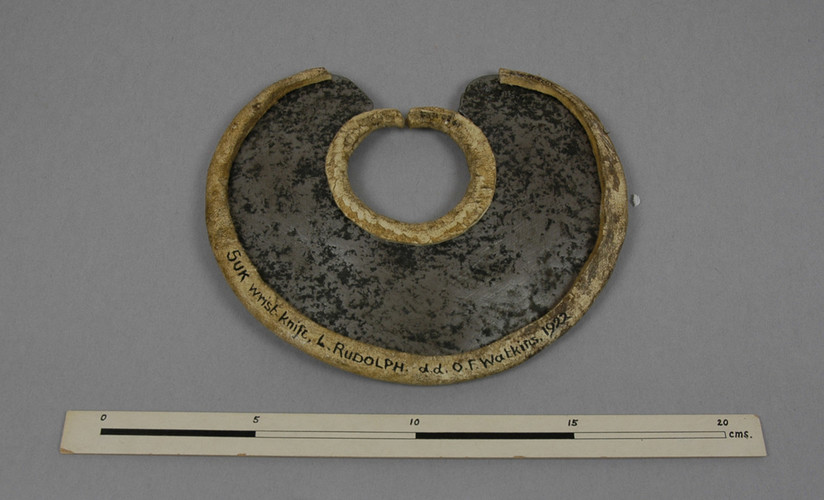 1922.12.9.1Fighting wrist knife [.1] with inner and outer sheathes [.2, .3] [SM 20/04/2007]1922.12.9.1
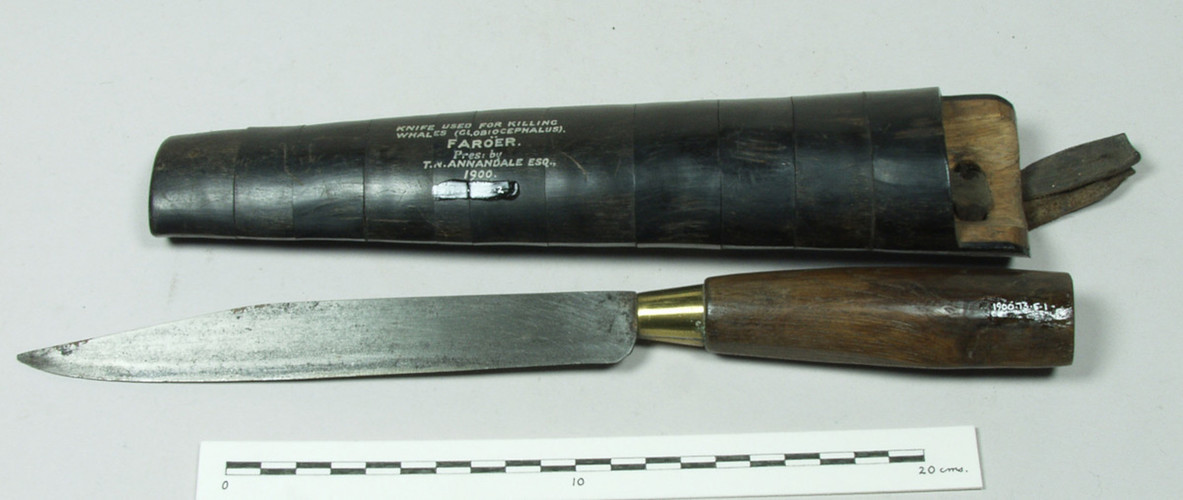 1900.13.5.1Knife [.1] with wooden handle and metal blade in wooden sheath [.2] covered with a layer of ?horn and a leather loop attached at the open end. [ZM 'DCF 2004-2006 What's Upstairs?' 18/11/2004]1900.13.5.1
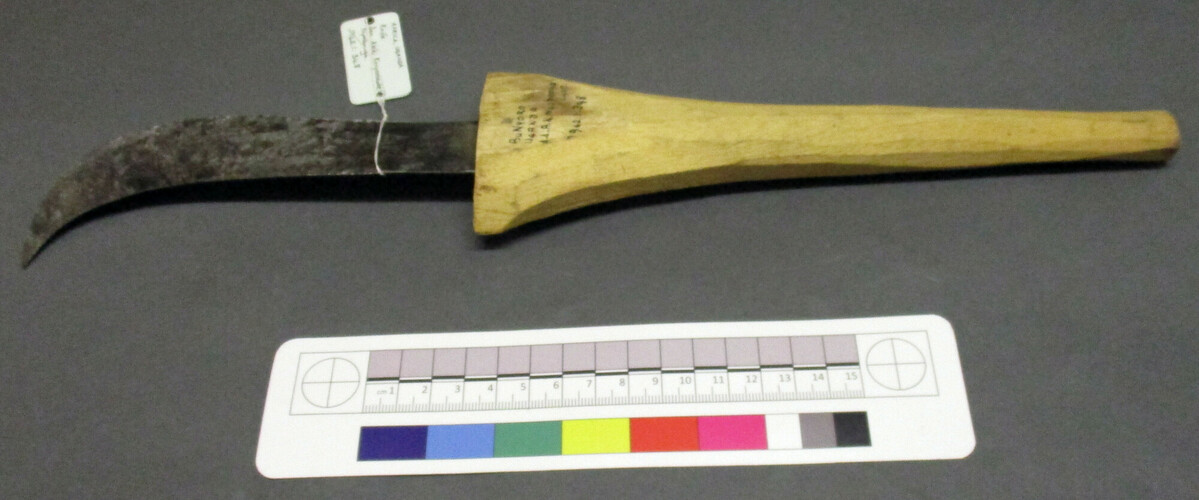 1942.1.348Knife, with a curved blade set into a roughly carved wooden handle. [AB [OPS Move] 13/12/2016]1942.1.348
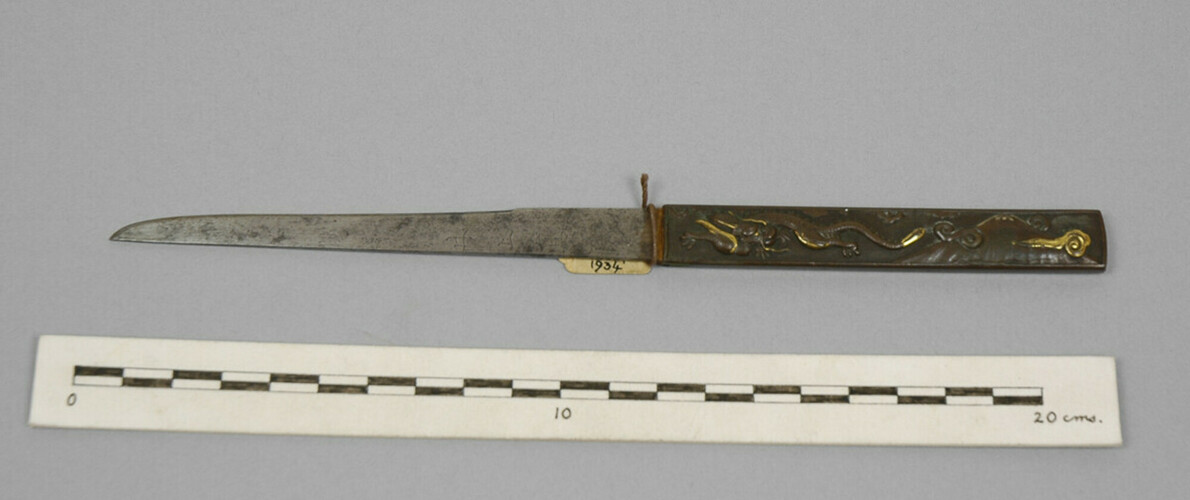 1934.25.56Small knife with single-edged blade and flat bronze handle, embossed on one side with figure of a dragon and a mountain with clouds, partly gilded. Japanese letters incised on the blade. [El.B 25/4/2007]1934.25.56