
- Collection type
- Object
- Description
- Rectangular mat made of chequerwoven strips of yellow plant fibre with fringed inner edges [RTS 9/8/2005].
- Long description
- Rectangular mat made from narrow plant fibre strips, woven together at right angles to one another in a chequeweave pattern, with each strip running over 4 cross strips before passing back into the weave (over 4, under 1). The strips are predominantly yellow (Pantone 7508C), especially on the interior surface, but some of the strips running along the length of the mat vary in colour on their outer faces from orangey brown (Pantone 729C) to greenish gray (Pantone 7535C). This gives the exterior a banded appearance that, while faint, is probably be deliberate; it is not clear if the strips have been deliberately dyed or just chosen for variable colour. On the inside face of the mat, the loose ends of each of strip has been folded over back against the surface at an oblique angle, creating an inward 'fringe' around all four edges. These edges have also been finished with a border made from 2 parallel strips, folded over at each corner to form 2 interlocked loops, one of which projects out from the edge. These border strips have been stitched together using narrower fibre strips as the thread, with 2 sets of vertical stitches across the frame edge and a row of horizontal stitching running down the centre between the two edging strips. The inner row of stitches also catches the upper edge of the 'fringe' strips, keeping this edging securely in place. The mat is complete, but damaged, with one edge badly broken and the weave split and some minor splits elsewhere. The interior has been stained with reddish brown patches, and the outer face has been marked where it had been tied with a cord. It has a weight of 648.8 grams, and is 1502 mm long, 778 mm wide and 5 mm thick at the edges; the constituent fibre strips are 5 mm wide, while the stitching is made of strips with a width of 2 mm [RTS 8/8/2005].
- Geographical reference
- Cultural groups
- Zande
- Date / Period
- Date made: Before 1930
- Date collected
- 1927 - 1930
- Acquisition information
- Found unentered: 1948
- Materials and processes
- Material Plant Fibre, Process Chequer Woven, Process Basketry, Process Stitched, Process Dyed
- Dimensions
- Width 778 mm, Length 1502 mm, Thick 5 mm, Weight 648.8 g
- Object numbers
- Accession number: 1948.2.159.3
- Research and responses
Collected by Evans-Pritchard during his fieldwork amongst the Zande, which took place during 1927, part of 1928 and 1929 and for several months during 1930.
For similar mats, see 1948.2.159.1-2, 6, 9-14, and for decorated versions, 1948.2.159.4 and 7 (with geometric designs at the centre) and 1948.2.159.8, with a dark brown border, said to be used in circumcision rites. The photographic collections at the museum hold a number of images of these types of mats being used during these ceremonies: see for example, 1998.341.166 and 1998.341.338 (initiate with roll of matting over head), 1998.341.169, 1998.341.387 and 1998.341.567 (initiates wearing and sitting on mats).
According to Larken, this type of grass weaving is done by men: "Split stems of certain grasses are scraped free from pith, forming thin strips as wide as a pencil, with a hard, polished surface, and edges that are absolutely parallel. Of this material is made a sleeping mat, ira, two and a half feet broad by twice as long, strips being passed laterally, alternatively over and under others lying longitudinally; the fracture of the strips being so regular, it is a simple matter to ensure an exact fit of each against the other, so that there are no unsightly interstices, and a perfect finish is obtained" (P.M. Larken, 1927, "Impressions of the Azande", Sudan Notes and Records X, p. 133). The technique used for making this mat is reminiscent of Zande basketry hats such as 1930.86.32 and 1948.2.162-164, where similar fibre strips are woven together, and a fringe is left at the base.
Evans-Pritchard states that 'of mats, the type called karakpa is said to be both Mbomu and Miangba, while those called nakorogbo and bagburu came from the Abile people to the south of the Bomokandi, a branch of the Azande containing a high proportion of foreign elements (E.E. Evans-Pritchard, 1971, The Azande, p. 101). It is not clear which of these types of mats is represented by this example. [RTS 25/8/2005].
Search terms: Furniture Dwelling, Basketry, Mat
Further items to explore
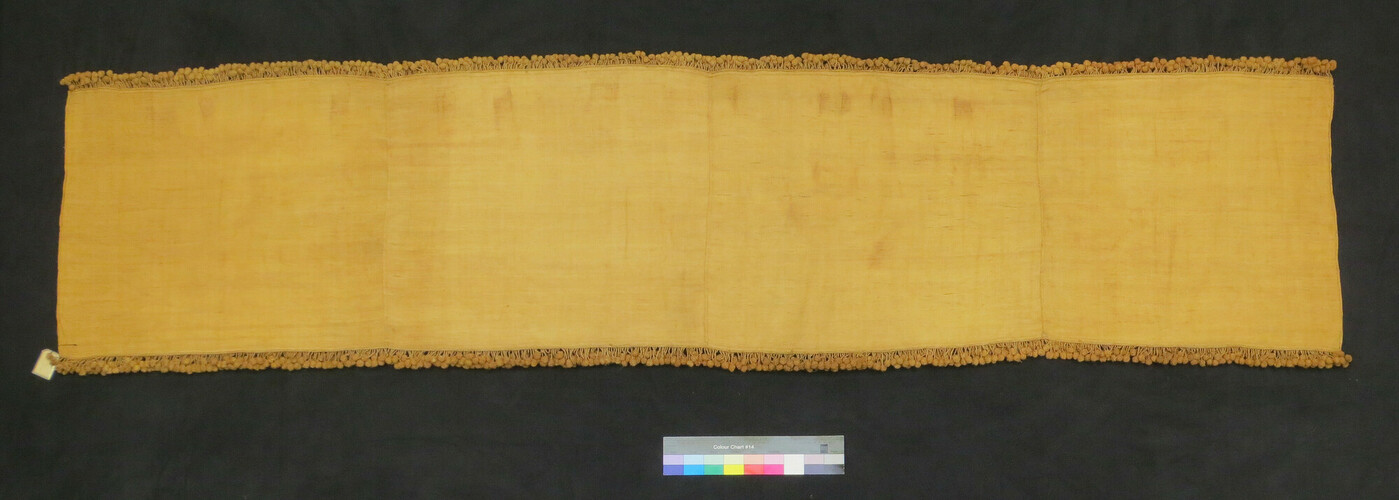 1910.51.13A sleeping mat with fringing along both long lengths. The fringing is made of plant-fibre pom poms.1910.51.13
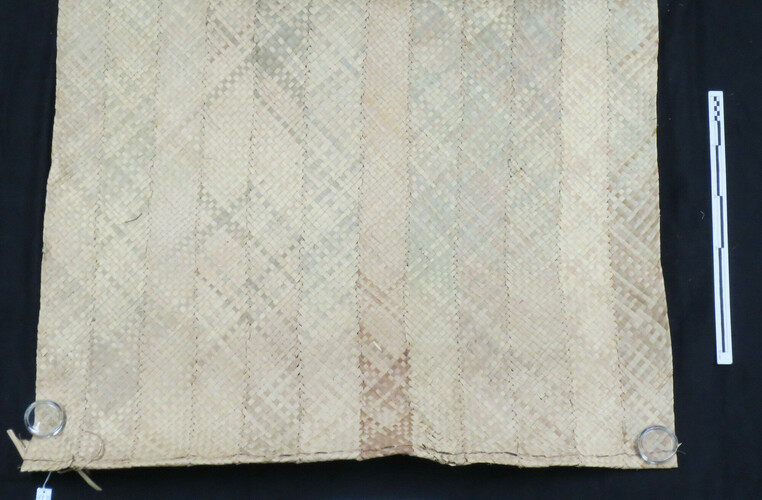 1973.14.74Sleeping mat of woven leaves. [SM (Verve) 15/11/2016]1973.14.74
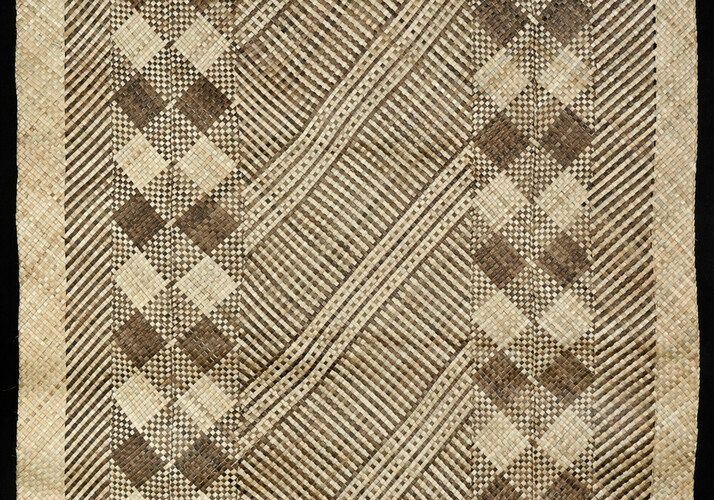 2004.56.22Mat woven from dark and light strips of ?pandanus leaf. On one side the pattern features two longitudinal bands of diamonds connected by diagonal lines on a chequered ground. The other side shows only the ground of small chequer. [BS [OPS Move] 29/6/2017]2004.56.22
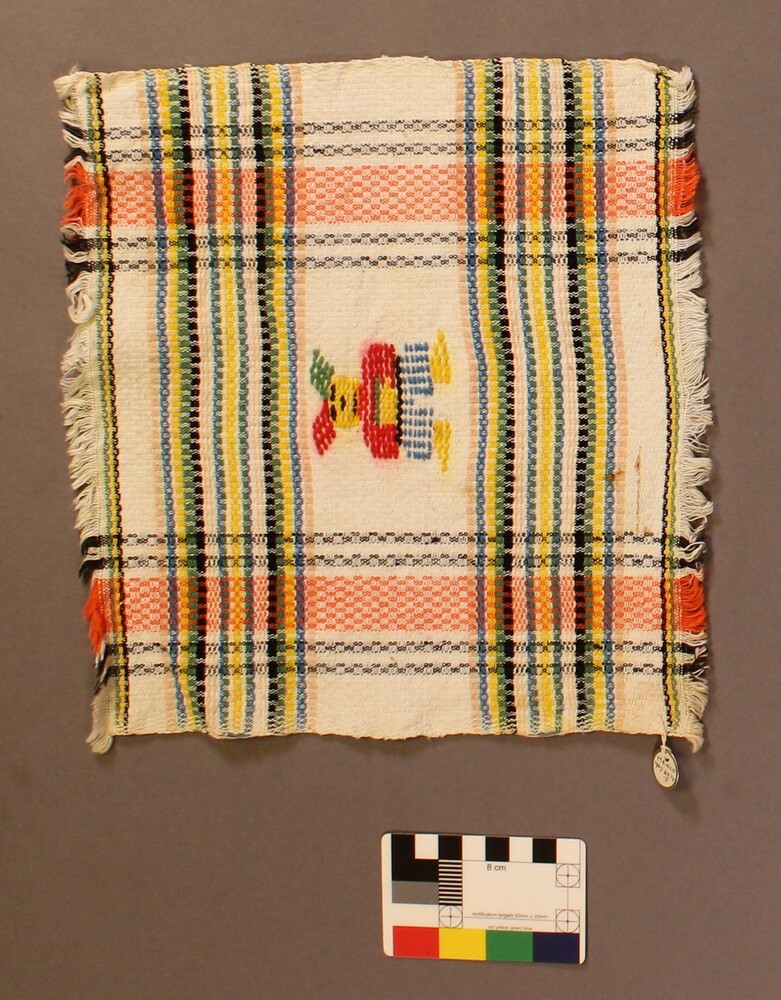 1967.42.14.5Cotton table mat with white ground, multicoloured border and central anthropomorphic figure.1967.42.14.5
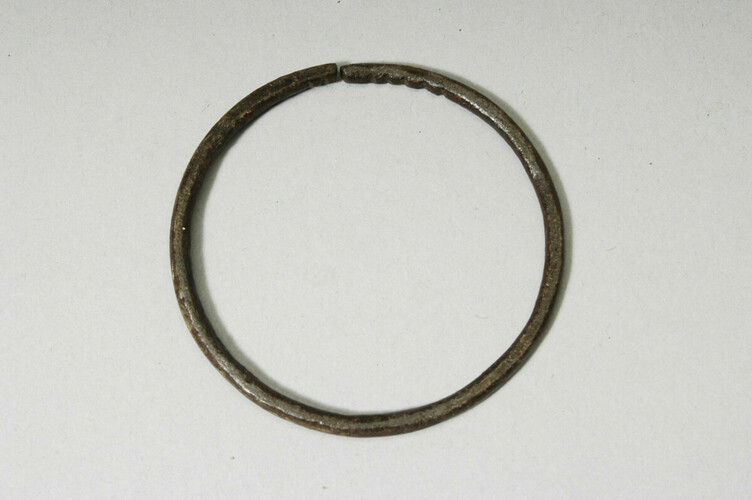 1966.1.517.5Penannular iron arm or leg ornament with oval section and 7 notches on the inside face [RTS 21/7/2005].1966.1.517.5
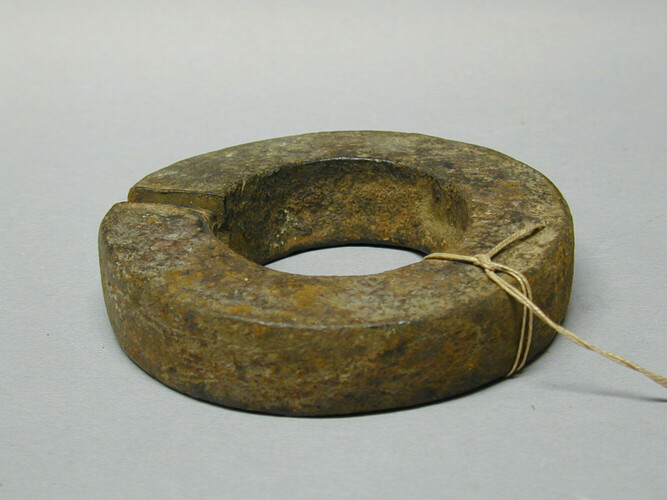 1979.20.42Heavy penannular iron bracelet with square section, made from a reworked hoe and formerly used as brideswealth [RTS 6/8/2004].1979.20.42
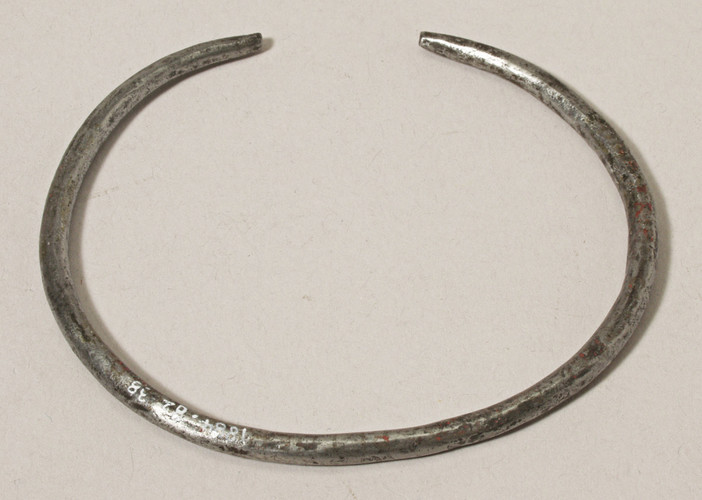 1884.82.38Thin, penannular iron bracelet with round section [RTS 2/4/2004].1884.82.38
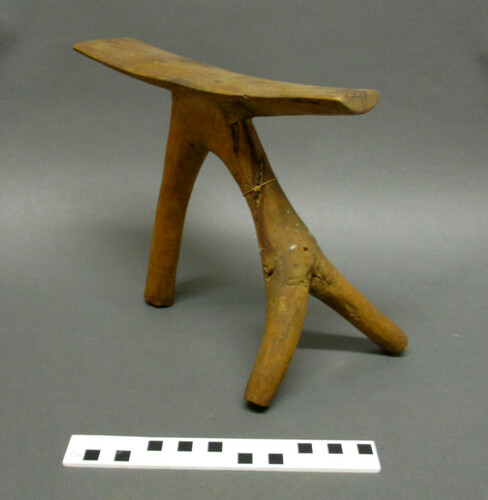 1942.1.439Wooden stool or headrest formed from a single branch. The seat curves upwards slightly at each end. The legs split in two from the bottom of the seat. One leg further splits in two half way down. [RH [OPS Move] 10/4/2017]1942.1.439