
- Collection type
- Object
- Description
- Unfinished wooden 3 legged stool, used by men or elders of both sexes [RTS 22/3/2005].
- Long description
- Unfinished stool carved from a single piece of yellowish brown wood (Pantone 7403C). This is an example of 'found form', where a naturally occurring tree branch with subsidiary limbs coming off the main body has been chosen because its shape was particularly suited to the intended use. This was shaped by trimming off excess foliage, cutting the legs to the same height and removing the outer bark covering; however in this instance, the dark reddish brown coloured bark has still been left on the surface of the back leg (Pantone black 7C to 4625C). This might suggest that the actual trimming to shape occurred before the surface was finished. The stool consists of a narrow seat, almost inperceptibly flattened across the top but retaining a convex curve across its width, and a much stronger concave curve across its length, rising to either end where at the front the flattening of the upper surface becomes more marked. This front end is also broader, and has been cut flat across the front face before thickening below. The back end has also been trimmed and is almost circular in section. Two branches extend from the underside of the seat. The one at the front is thicker, with a central shaft that divides at its base to form 2 legs that splay out in opposite directions, in an inverted Y shape, while a single branch extends from the back of the stool, almost at right angles to the body. The bases of the front legs have been cut at a marked angle; these rest on the edges of the feet, but show no use-wear on these surfaces. The back leg has been cut flat across its underside, and has a very small amount of polish running along the centre. The stool is complete and intact; there are a few scorch marks over knots in the wood, where smaller branches appear to have been burnt off. It has a weight of around 749.1 grams, and is 509 mm long, with a height of 228 mm. The seat is 460 mm long, 32.2 mm wide and 33 mm thick; the back leg has a diameter of 22.5 by 21.5 mm; the bark is 2 mm thick [RTS 22/3/2005].
- Cultural groups
- Northern Laarim
- Date / Period
- Date made: Before 1979
- Date collected
- 24 March 1979
- Acquisition information
- Purchased: 1979
- Materials and processes
- Material Wood Plant, Material Bark Wood Plant, Process Carved, Process Burnt
- Dimensions
- Height: max 230 mm, Length: max 508 mm, Width: max 194 mm, Weight 749.1 g
- Object numbers
- Accession number: 1979.20.160 Other numbers: Langton Collection PL 53
- Research and responses
This type of object is known as taba, and was probably made by specialist men. They are used as stools by men, and by women when they become old. Some stools are specially made for elders. For a similar example, see 1979.20.161, which was purchased with a cotton shirt [RTS 8/9/2005].
Search terms: Furniture Dwelling, Status, Technique, Stool
Further items to explore
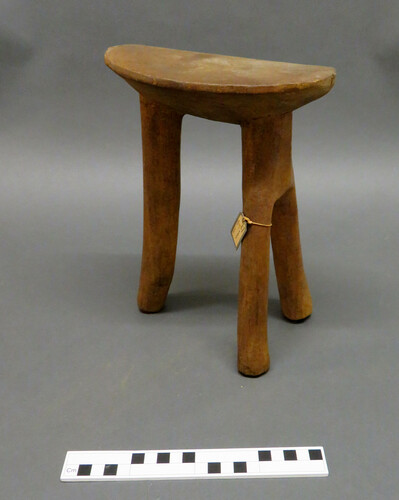 1942.1.440Wooden stool with oval seat and three legs. One leg extends straight down at one end of the seat, and another extends from the other end and widens before splitting into two, creating three legs. [JC [OPS Move] 10/4/2017]1942.1.440
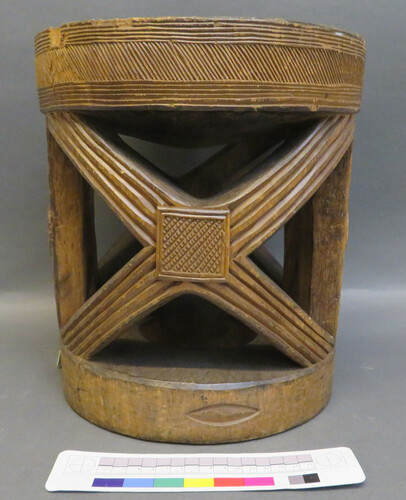 1972.24.196Cylindrical wooden stool with circular seat and base, hollowed out in the middle to form four ornamental supports. The seat and supports are intricately carved with geometric and linear designs. [JC [OPS Move] 8/5/2017]1972.24.196
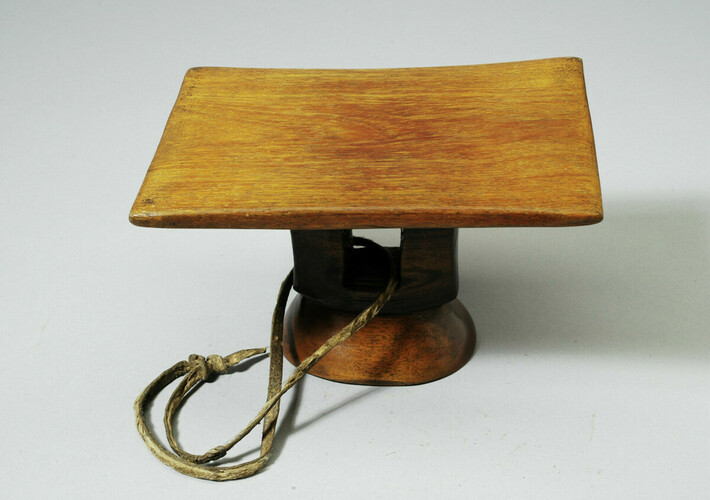 1939.7.03Wooden stool with rectangular seat, fenestrated pedestal foot with splaying base and hide carrying loop, owned by Chief Amet of the Amiel [RTS 11/4/2005].1939.7.03
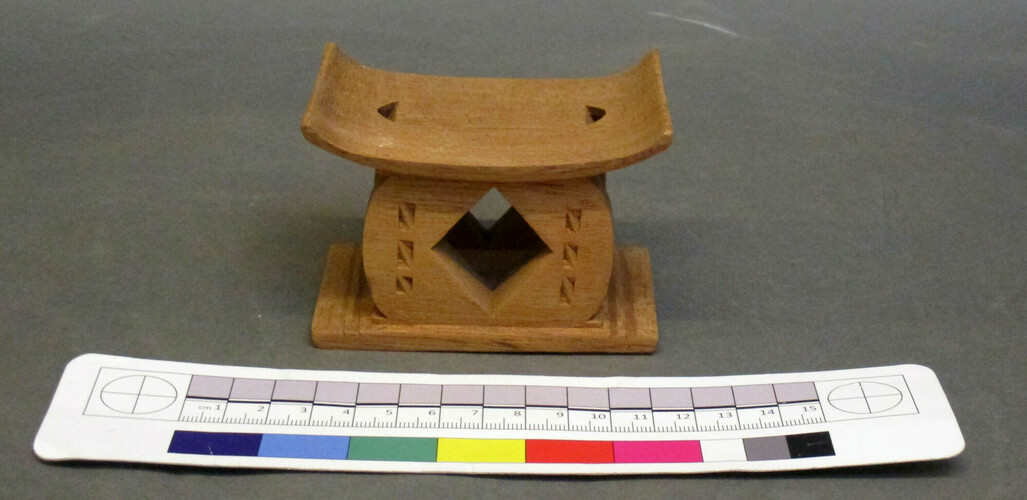 1945.12.5BModel stool, made of wood. It has a concave, rectangular seat and rectangular base, with two oval supports which each have a central, diamond-shaped window. The outer faces of the supports are decorated with chip carved triangles. There are two crescent shapes cut out of the seat. [JC [OPS move] 16/5/2017]1945.12.5B
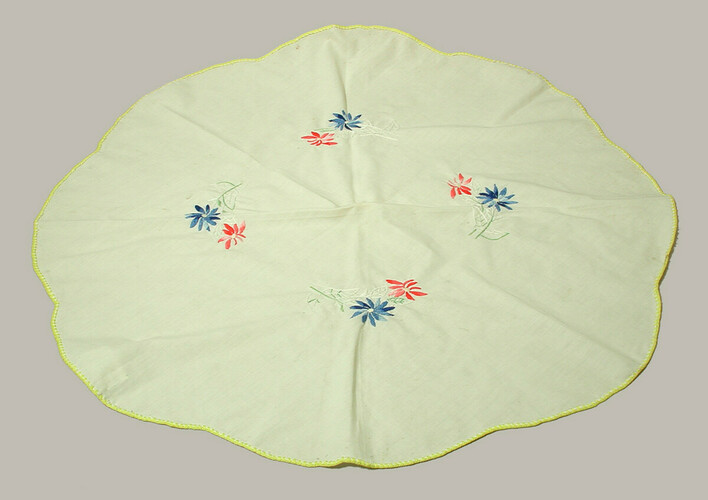 1998.9.12Circular cream-coloured tablecloth with with embroidered flowers at centre and scalloped edge overstitched in yellow wool [RTS 22/2/2005].1998.9.12
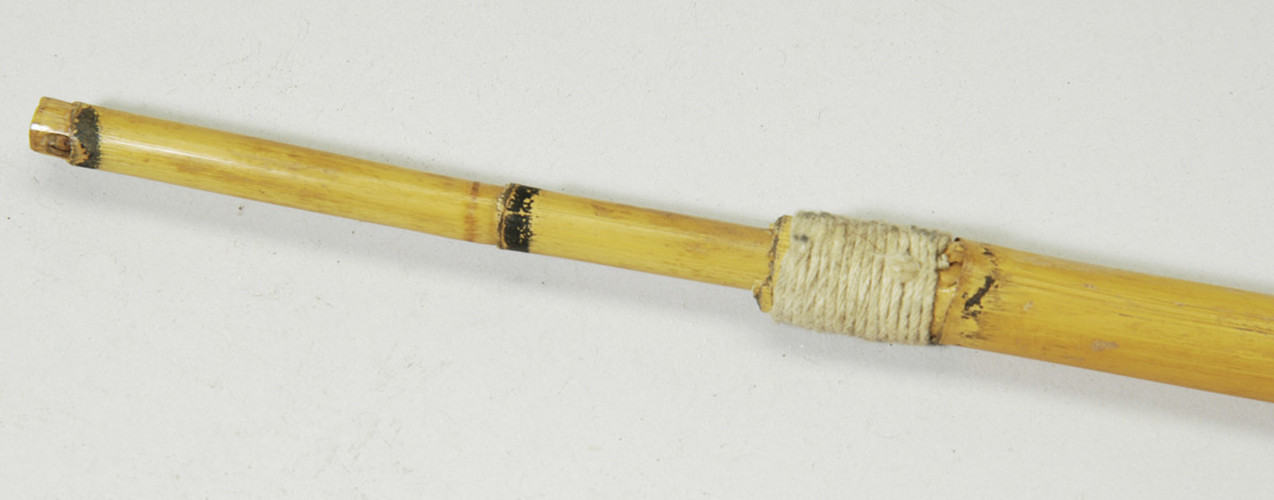 1903.2.2.1Tobacco pipe made from a two piece bamboo stem [.2], bound with string, with a decorated pottery pipe bowl [.1] fitted onto the end and secured with string [RTS 21/10/2004].1903.2.2.1
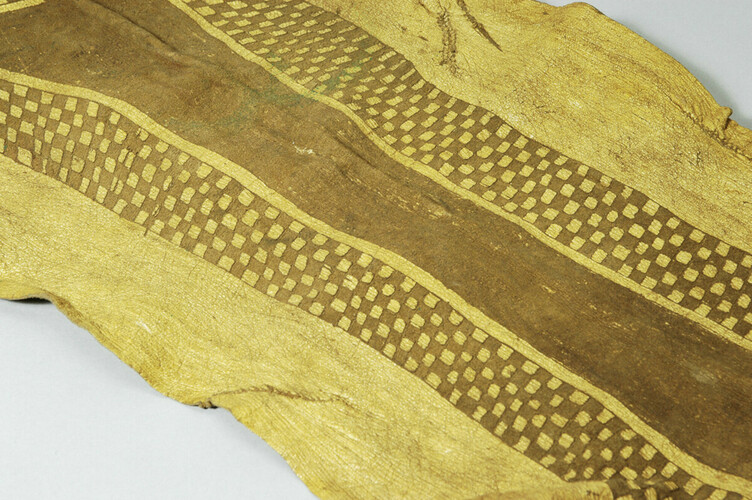 1940.7.096Apron made from a piece of yellowish hide with a brown pattern of plain and chequered bands cut into the surface, worn by women [RTS 9/3/2005].1940.7.096
 1931.66.5Witchdoctor's rattle, with 2 iron pellet bells mounted on a wooden handle [RTS 6/9/2005].1931.66.5