
- Collection type
- Object
- Description
- Circular cream-coloured tablecloth with with embroidered flowers at centre and scalloped edge overstitched in yellow wool [RTS 22/2/2005].
- Long description
- Circular tablecloth cut from a finely woven piece of pale cream coloured cotton or synthetic cloth (paler than Pantone 7499C), probably machine made, in a simple checkweave of over 1, under 1. This may have been recycled from something like a bed sheet. The edge is scalloped, with 8 shallow arcs undulating around the circumference. This has been folded over, and then overstitched using a bright yellow wool that is at least 4-ply in weight in a crochet edging stitch (Pantone 100C). 4 groups of flowers have been embroidered near the centre, equally spaced from each other and curving slightly as though forming part of a circle, with gaps between. This has been done using a satin stitch in white, green (Pantone 358C), cream (approximately Pantone 600C), light pink (Pantone 176C), dark pink (Pantone 192C), light blue (Pantone 290C) and dark blue cotton yarn (Pantone 661C). Each motif has been created to the same template, with a blue petalled flower with yellow centre on a leafy stalk, next to a pink petalled flower with yellow centre on a second stem, positioned slightly behind the first and with smaller leaves. The only variation that occurs is with the placement of different tones of the same colour. This seems to be a result of the colouring of the yarn itself, which seems to have single skeins dyed in varying tones, thus ranging from white to pale green, pale to darker pink and light to dark blue on a single length of yarn. This variation is most obvious on the stem and leaf areas. The embroidery is of high quality, with few errors; it has been done double-sided, so the cloth could be used with either surface facing upwards. The tablecloth is complete, but has some surface stains that show it has been used. There is an x-shaped crease running across the centre, where it has been folded into quarters. It has a weight of 61.3 grams, and a diameter of 845 by 839 mm. Each embroidered motif is around 135 mm long [RTS 22/2/2005].
- Geographical reference
- Cultural groups
- Acholi
- Date / Period
- Date made: Before 1997
- Date collected
- 1997
- Acquisition information
- Purchased: 19/01/1998
- Materials and processes
- Material Textile, Material Wool Yarn Animal, Material Cotton Seed Fibre Yarn Plant, Material Cotton Seed Fibre Textile Plant, Material Synthetic Textile, Process Chequer Woven, Process Machine-made, Process Embroidered, Process Stitched, Process Crocheted, Process Decorated, Process Recycled
- Dimensions
- Diameter: max 845 mm, Length 135 mm floral motifs, Weight 61.3 g
- Object numbers
- Accession number: 1998.9.12 Other numbers: Kaiser no. 13 Other numbers: PRM invoice item 12 (see RDF)
- Research and responses
This object is one of a collection made by Tania Kaiser, a D.Phil. student of Linacre College, during her fieldwork in the Kiryandongo Refugee Settlement. She conducted fieldwork in the camp from October 1996 to March 1997, and between June and November 1997. The population of the camp had originally come from Parajok in the Torit district of Southern Sudan, and was a mix of Acholi from that area and previously displaced Sudanese refugees (For details of her work, see: T. Kaiser, 1999, Living in Limbo: Insecurity and the Settlement of Sudanese Refugees in Northern Uganda (Unpublished PhD); T. Kaiser, "Making Do and Making Beautiful: Recycling in an African Refugee Settlement", in: J. Coote, C. Morton and J. Nicholson (eds), Transformations, the Art of Recycling, 44-47; T. Kaiser, 2000, UNHCR's Withdrawal from Kiryandongo: Anatomy of a Handover, New Issues in Refugee Research Working Paper No. 32, 1, 3).
Compare this with embroidered bedspread 1998.9.11, where the stitching is designed to be viewed from one side only, but which makes use of similar varicoloured yarn [RTS 22/2/2005].
Search terms: Furniture Dwelling, Textile, Table-cloth, Embroidery
Further items to explore
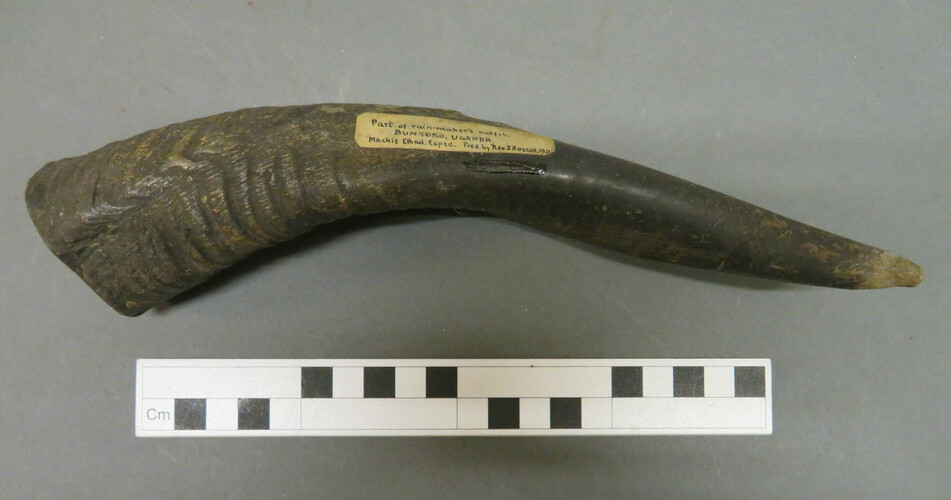 1921.9.133Vessel horn, part of rain maker's outfit. [ASh [OPS move] 12/5/2017]1921.9.133
 1978.9.17Adjustable bracelet; thick elephant hairs with 2 knotwork sliders. [EC 'DCF 2004-2006 What's Upstairs?' 21/10/2005]1978.9.17
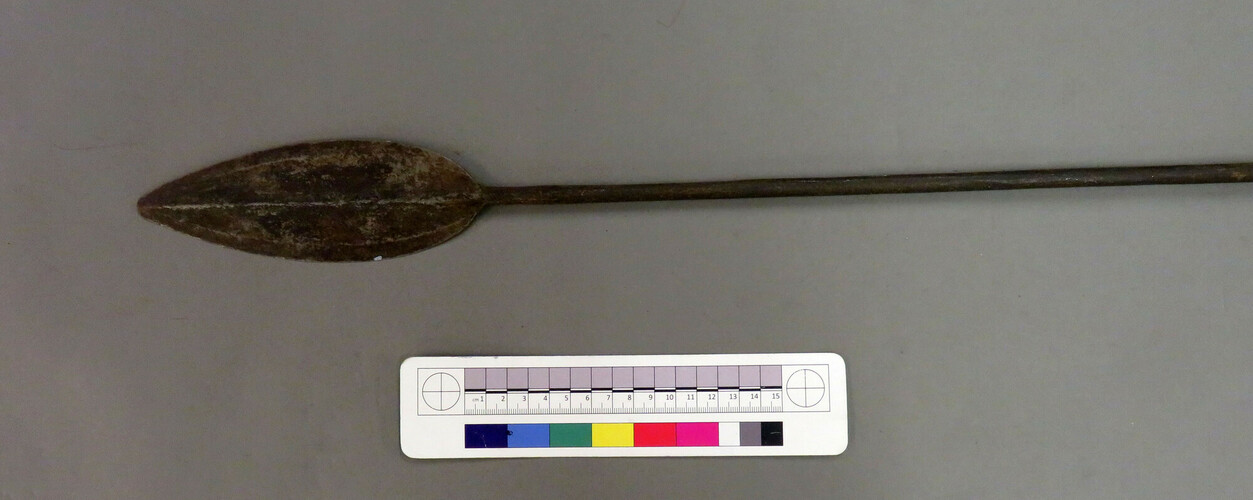 1999.4.1Spear with small, leaf-shaped metal blade on a very long and narrow foreshaft, socketed to a wooden shaft. At the butt is a very long socketed metal spike. [JMC [OPS move] 28/8/2018]1999.4.1
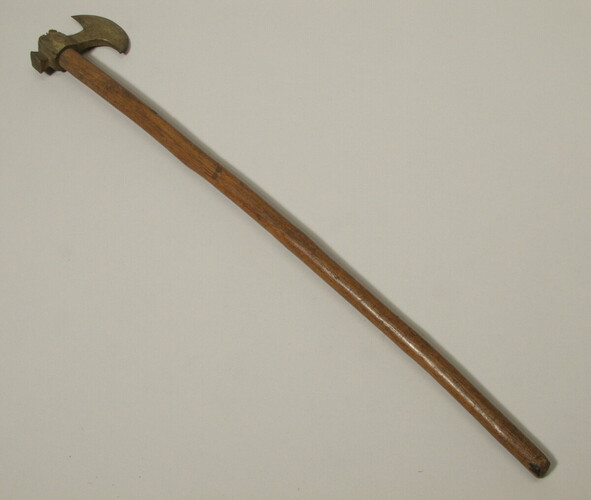 1939.7.57Axe with socketed brass and iron head on wooden handle. [AR 11/07/2007]1939.7.57