
- Collection type
- Object
- Description
- Wooden stool with rectangular seat, fenestrated pedestal foot with splaying base and hide carrying loop, owned by Chief Amet of the Amiel [RTS 11/4/2005].
- Long description
- Stool carved from a single piece of wood and consisting of a rectangular seat with very slightly concavely cut front and back edges and straight sides. The upper surface is essentially flat, with an extremely slight convex slope across the width, and concave slope along the length. A pedestal foot extends from the centre of the seat underside; this is rectangular in section with concave sides, and has a retangular window cut through the centre. It has been offset from a solid, conical foot with convex sides on a flat, oval base that has bevelled edges along the two long sides. The natural colour of the wood appears to be a yellowish brown (Pantone 7510C), with the seat and lower foot being stained an orange (Pantone 723C) to reddish brown colour (Pantone 497C), the latter most marked on the flat sides of the seat, while the pedestal section has been either stained or burnt a darker brown (Pantone black 4C). All surfaces except the underside of the foot have also been highly polished. A carrying loop has been tied through the centre of the pedestal, cut from 2 narrow strips of animal hide with buff hair on its outer face (Pantone 7401C). One of the strips is much longer than the other; they are secured at one end with a loop and knot combination. The stool is complete and intact, and in very good condition, with minor scratch marks on the upper surface of the seat. Most tool marks have been polished away, except in the fenestrated area where a rough chiselled surface has been left. It is 138 mm high; the seat is 225 mm long, 163 mm wide and 14 mm thick at the edges; the pedestal body is 80 mm long, 97.5 mm wide and 36.8 mm thick, while the opening through its centre measures 50 by 35 mm; the foot is 114.8 mm long and 94 mm wide, and the carrying strap is 328 mm long as tied, 6.8 mm wide and 1.2 mm thick [RTS 11/4/2005].
- Geographical reference
- Cultural groups
- Acholi
- Date / Period
- Date made: Before 1939
- Date collected
- By 1939
- Acquisition information
- Loaned: 1939
- Materials and processes
- Material Wood Plant, Material Animal Hide Skin, Process Carved, Process Stained, Process Polished, Process Knotted
- Dimensions
- Length: max 230 mm, Width: max 165 mm, Height: max 150 mm, Weight 1000 g
- Object numbers
- Accession number: 1939.7.03
- Research and responses
It is said to be made of Balanites aegyptica, or heglig wood. Note that heglig is an Arabic term, and not its Acholi name. This wood is hard, durable, and easy to work (see Hall, J.B. and Walker, H.D. 1991. Balanites aegyptiaca: A Monograph, School of Agriculture and Forest Sciences Publication No. 3, University of Wales, Bangor). This is the type of stool called a 'leg-and-base' stool by M. Trowell & K.P. Wachsmann, which is used by the Acholi, Bari and Madi (Tribal Crafts of Uganda, 1953, pp 153-154, pl. 34F). [RTS 14/9/2005].
Search terms: Furniture Dwelling, Status, Stool
Further items to explore
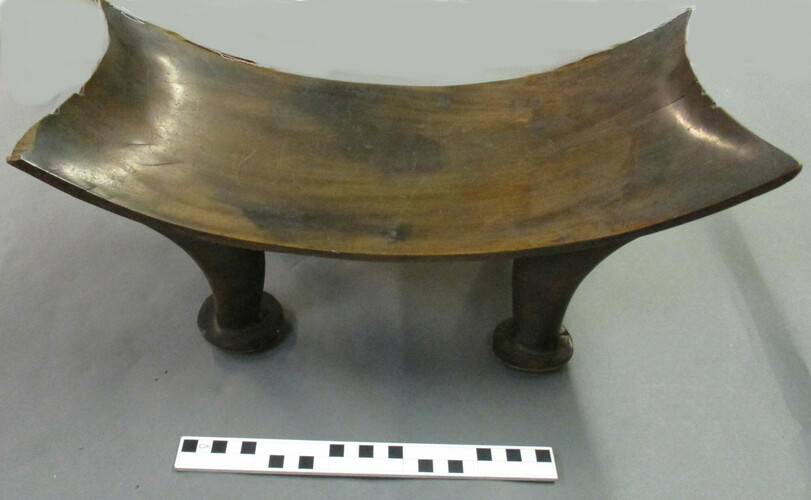 1936.26.3Wooden four-legged stool. The seat is rectangular with a deep concave curve. The long edges are straight while the short edges are concave and the corners pointed. The four legs are each sub-triangular in section and terminate in a disc at the foot, domed on the underside. The wood is dark and polished. [JC [OPS Move] 2/5/2017]1936.26.3
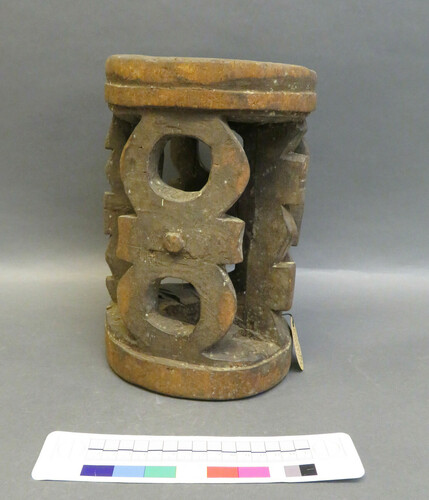 1942.13.27Wooden carved stool. Both the seat and base are circular and are supported by two pillars in the shape of figures of eight with a rectangular section in the middle including two circular projections. There are four flat dented supports to the sides with rectangular and triangular notches cut out. There is a groove on the side of the seat and the base has a circular perforation in the middle. [PR [OPS move] 4/5/2017]1942.13.27
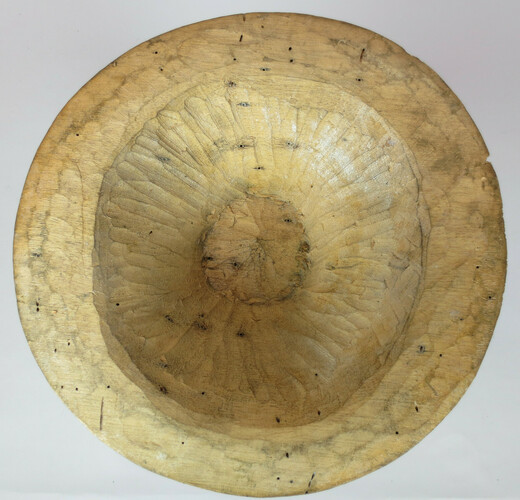 1922.48.2Pedestal stool with circular seat, wide stem support and wide base carved with linear and cross-hatched designs. [SM (Verve) 13/05/2014]1922.48.2
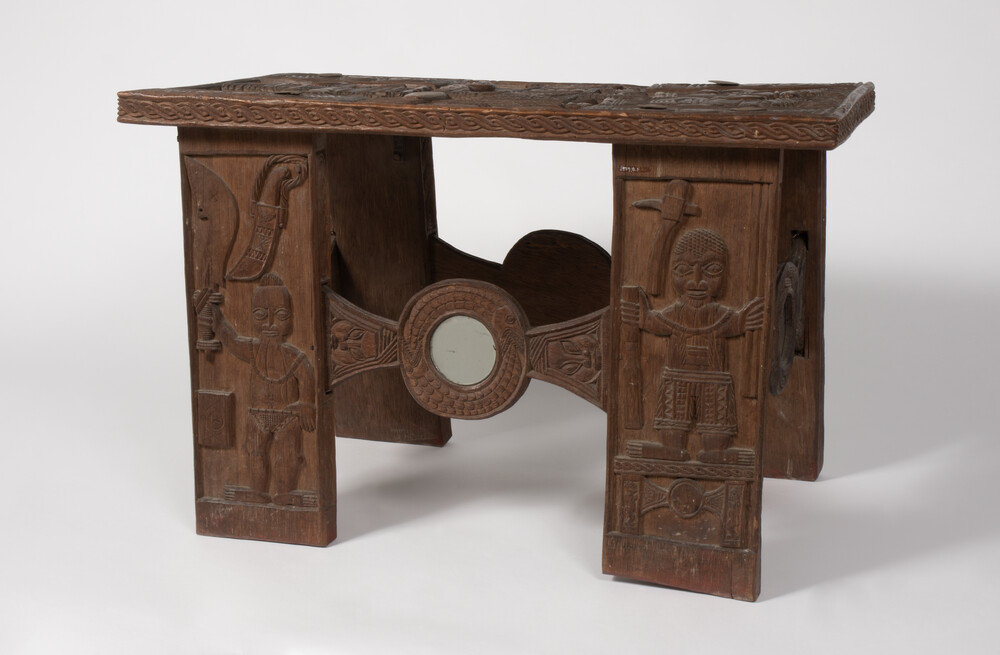 1979.8.1Wooden stool with four legs and flat rectangular top. Carved with human figures and abstract designs.1979.8.1
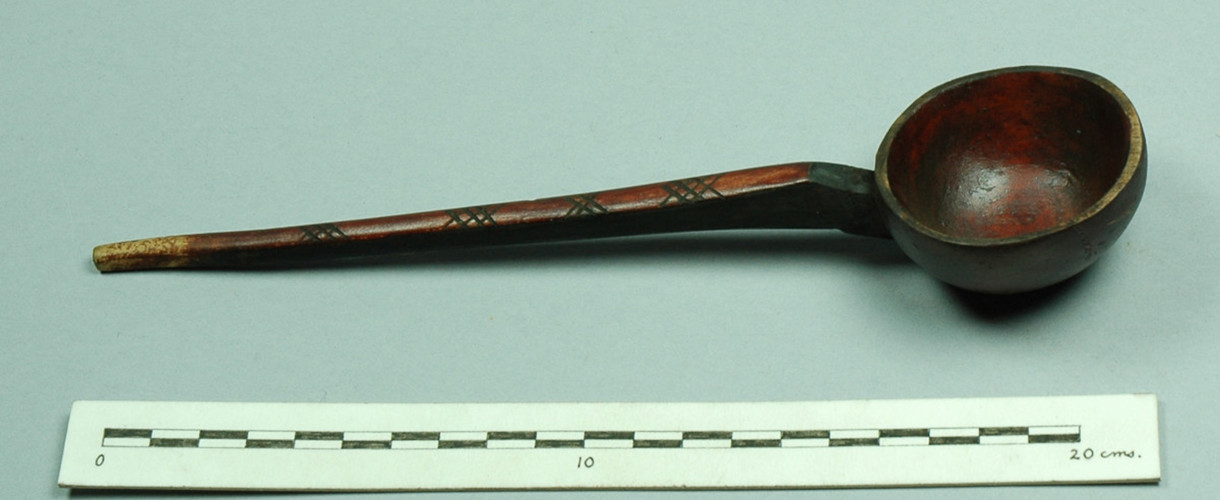 1920.101.48Wooden vegetable spoon for royalty, with circular bowl, stained red and black, handle incised with criss-cross lines. [El.B 'DCF 2004-2006 What's Upstairs?' 15/3/2006]1920.101.48
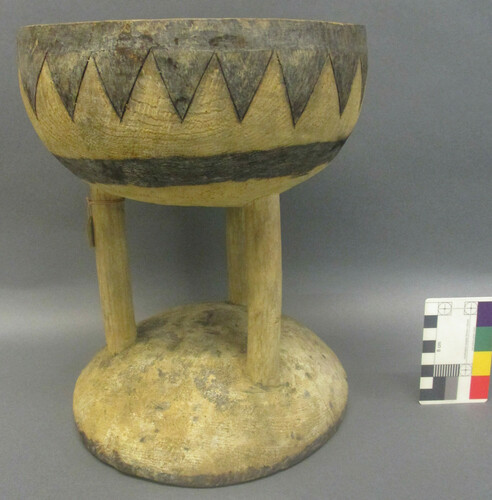 1921.9.5Round wooden meat dish on 3 legs extending from a circular stand. Burnt triangular design around rim, with a horizontal band below. [RM [OPS move] 19/9/2016]1921.9.5
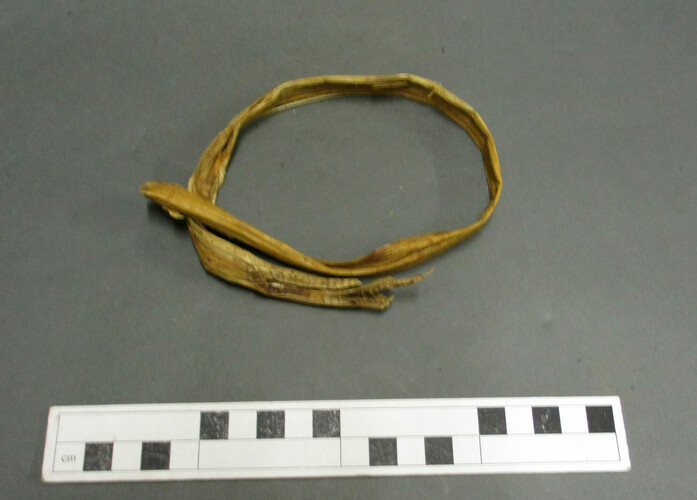 2017.121.14Strip of plant leaf. Part of a rainmakers outfit. [FB 1/6/2017]2017.121.14
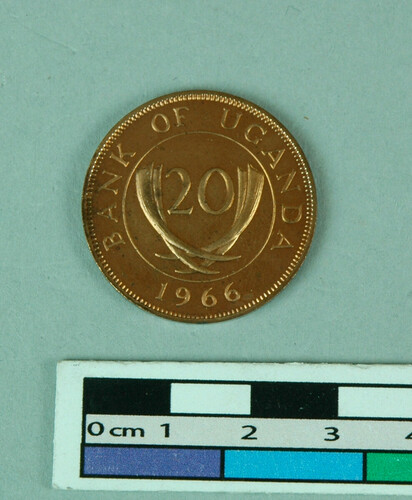 1992.19.38.3Circular copper coin, 20 cents. [MJD 16/04/2010]1992.19.38.3