
- Collection type
- Object
- Description
- Hemispherical gourd bowl with small lug on rim, decorated with pyroengraved lozenges, triangles and lines; probably used for eating [RTS 25/3/2005].
- Long description
- Gourd bowl consisting of a narrow flat-topped rim, slightly flattened on one side and with a solid swollen flat-topped lug extending from the rim opposite, reflecting the shape of the base and neck of the original plant; this rim sits on a hemispherical body with convex underside, and is oval in plan view. The interior has been hollowed and the shell dried out, and is now a matt yellow (Pantone 7508C), covered with numerous insect bore holes. The exterior is smooth and a dark orange colour (Pantone 724C), with a few patches of the surface skin remaining. The upper rim and lug surfaces have been blackened for decorative effect (Pantone black 6C), while on the exterior a heated blade has been used to add a series of bands around the upper body. These consist of 3 parallel lines around the circumference, with the spaces between filled with hatched triangular motifs arranged as 2 broad bands; the overall effect is of a running pattern made up of a central hatched lozenge (actually 2 triangles reflected from the central line), with one triangle balanced above, and another below. Underneath this series is a further black band, made up of multiple short incised lines, from 4 to 7 cuts in thickness. The bowl is complete and intact, and has a weight of 187.9 grams. It is 140 mm high, 264 mm long and 237 mm wide, with a rim thickness of 4 mm [RTS 25/3/2005].
- Geographical reference
- Northern Bahr el Ghazal Dhangrial
- Cultural groups
- Dinka Tuich
- Date / Period
- Date made: Before 1979
- Date collected
- 18 February 1979
- Acquisition information
- Purchased: 1979
- Materials and processes
- Material Gourd Plant, Process Hollowed, Process Dried, Process Decorated, Process Burnt, Process Pyroengraved Pokerwork
- Dimensions
- Height 140 mm, Length 284 mm, Width: max 237 mm, Thick 4 mm rim, Weight 187.9 g
- Object numbers
- Accession number: 1979.20.54 Other numbers: Langton Collection 109
- Research and responses
At the time this object was collected, the Bahr el Ghazal province was bordered by the Upper Nile Province to the east and Western Equatoria to the south; this area is now divided into the districts of Western Bahr el Ghazal, Northern Bahr el Ghazal, and parts of Warab and El Buheyrat. Dhangrial is located within Northern Bahr el Ghazal. For a map showing the distribution of Dinka Tuich groups, see J. Ryle, 1982, Warriors of the White Nile: The Dinka, p. 25.
Langton comments under the record for 1979.20.50 that 'Decorated gourds are used as plates to eat from by men, or female guests'; 1979.20.54 has the same body shape, and a similar function may be inferred.
According to Langton's notes on 1979.20.50, the Dinka word anyel means 'decorated'. Nebel gives the definition for Aduok, pl. aduk, as a large bowl, and Anyäl, pl. Anyel, as a calabash with drawings (A. Nebel 1979, Dinka-English Dictionary, p. 5, 10).
Langton describes this method of decorating Dinka gourds in her entry for accession number 1979.20.91, with the pattern being marked out in charcoal, and then with a type of needle called a with (for this tool, which is made of iron, see 1979.20.59), which is then scored over using a heated spear or knife blade [RTS 3/12/2004].
Search terms: Vessel, Food and Drink, Bowl, Food Accessory
Further items to explore
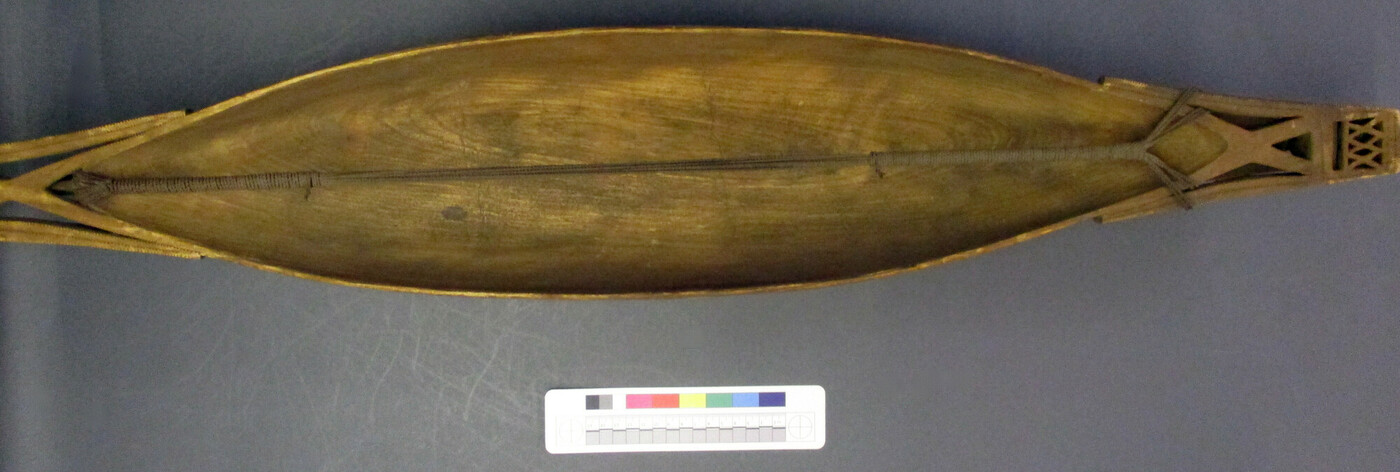 1896.59.1Carved oval wooden bowl shaped like a boat. [RM [OPS move] 17/10/2016]1896.59.1
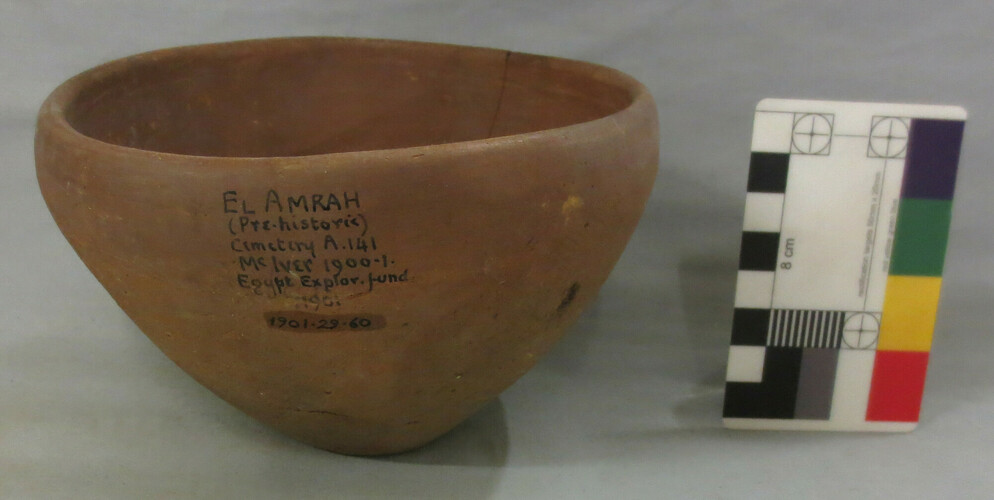 1901.29.60Plain red open bowl with slip inside and on the external rim face [AS 15/08/2012]. There is a visible crack in the body, but the object is sound.1901.29.60
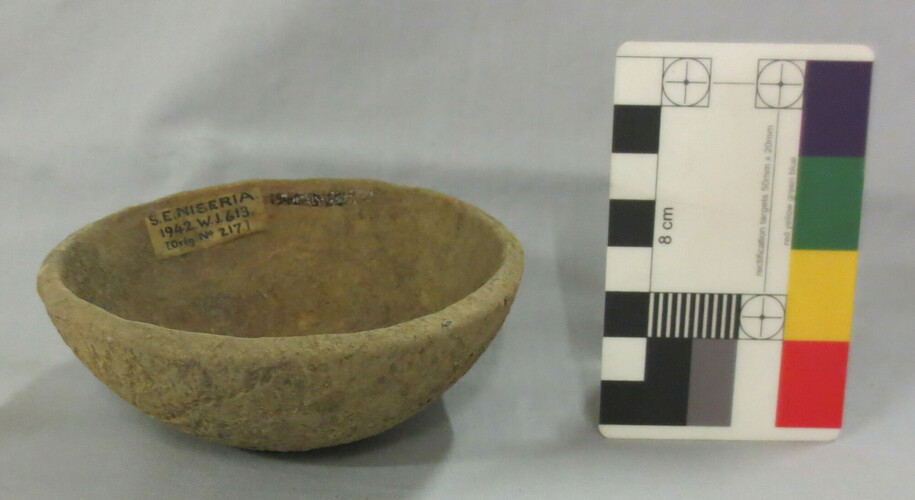 1942.13.613Shallow round bowl, light reddish pottery, cord marked.1942.13.613
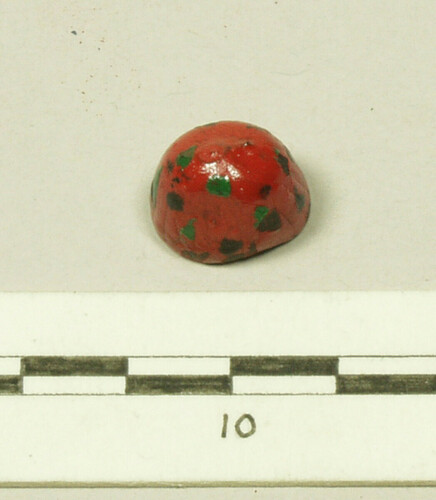 1951.11.125Bowl made of half a small gourd, painted with floral designs in bright colours: red and green [N.B. 'DCF 2004-2006 What's Upstairs?' 14/3/2005]1951.11.125
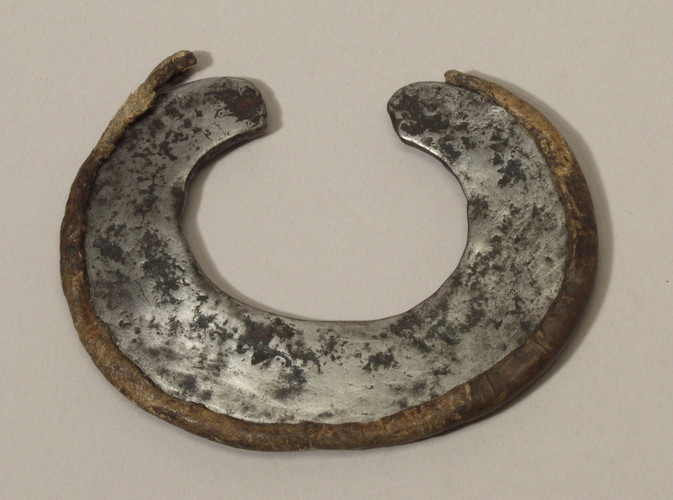 1884.140.579.1Iron wrist knife [.1] and hide sheath [.2] [RTS 9/3/2004].1884.140.579.1
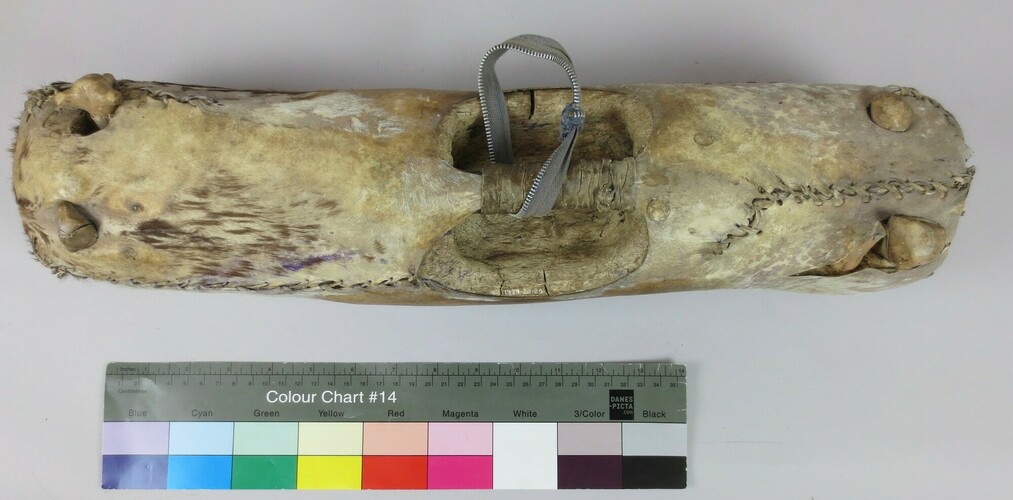 1979.20.80Lightweight wooden parrying shield covered in calf skin, also used as a headrest and seat [RTS 11/1/2005].1979.20.80
 1979.20.128Ivory pendant earring decorated with incised and inlaid ring and dot motif on the outer face [RTS 8/7/2004].1979.20.128
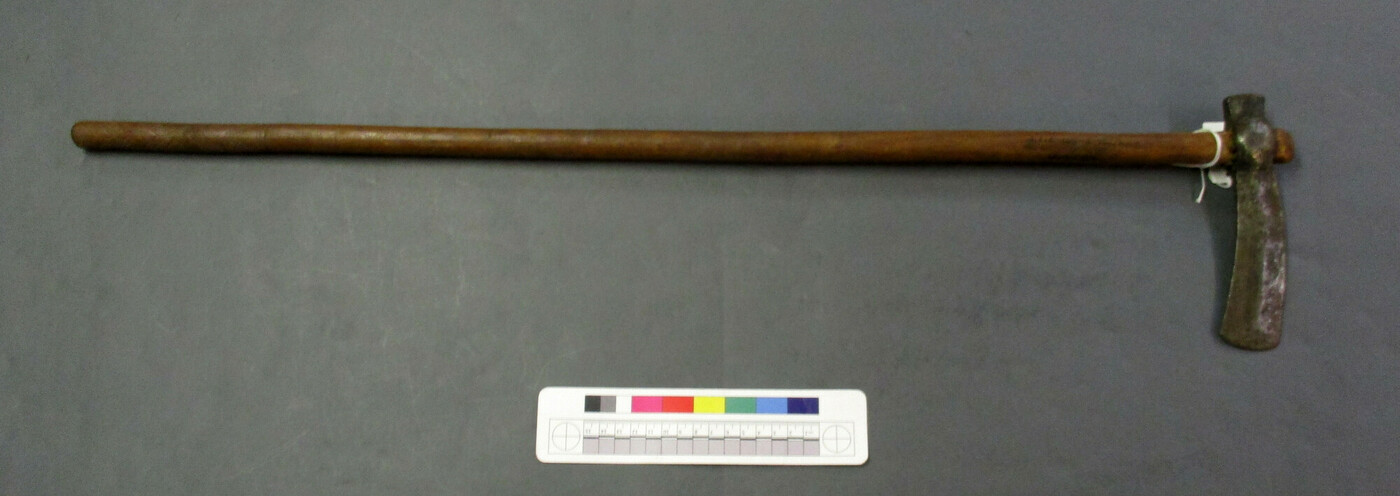 1966.1.272Axe with socketed iron blade hafted onto a wooden handle with incised geometric decoration around grip [RTS 1/7/2005]1966.1.272