
- Collection type
- Object
- Description
- Lightweight wooden parrying shield covered in calf skin, also used as a headrest and seat [RTS 11/1/2005].
- Long description
- Object that can be used as a parrying shield, headrest or seat, carved out from a single piece of soft, lightweight ambatch wood with a cylindrical body, oval in section, that is slightly rounded at either end. The wood is a pale yellowish brown colour (Pantone 7506C). The centre of the body has been carved out to form a rectangular handle on one side, with a convex inner face where the fingers would fit around it; below this the wood is hollowed out to form a concave surface that provides room for the knuckles. Holes have been cut into the four corners of the handle side, and short trimmed lengths of knotty branches fitted into them, some of which still have traces of bark on the surface. This is probably made from a denser and harder wood type, which is a stronger yellowish brown (Pantone 7508C). These presumably act as short feet when the object is being used as a seat; they vary in base size, and range from triangular to almost round. The entire surface has also been covered in a rectangular piece of calf skin, covered with mottled dark brown and cream coloured hair (Pantone 439C and 7499C). This has a slight ridge running along the centre of the length on the upper side; the hair has worn away in a few patches across the surface. The hide cover has been sewn in place using narrow hide strips, with the seams positioned at either end and on the underside, and a length of twisted string has been wound several times around one of the feet. Lentoid shaped slits have been cut into this to expose the feet, with oval holes on either side of the handle to allow the hand to pass through. The handle itself has been bound around with a broader strip of brown hide, knotted in place near the end (Pantone 7532C). A faded bluish gray textile zip with iron teeth has been tied into a loop around the handle, possibly as a carrying aid. The original colour of the fabric is somewhat darker (Pantone 5415C). The object appears to be complete, although there are some splits in the visible part of the wood, and a cut on one side of the grip. It has a weight of 580.6 grams, is 510 mm long, 115 mm wide and 93 mm thick; the handle has a width of 25 mm, and the strip binding the handle is 8 to 11 mm wide. The zip has a width of 13 mm, and the thong used as stitching is around 2 to 4 mm wide [RTS 11/1/2005].
- Geographical reference
- Northern Bahr el Ghazal Dhangrial Wun Rog Mayen
- Cultural groups
- Dinka Tuich
- Date / Period
- Date made: Before 1979
- Date collected
- 21 February 1979
- Acquisition information
- Purchased: 1979
- Materials and processes
- Material Cattle Skin Animal, Material Wood Plant, Material Animal Hide Skin, Material Plant Fibre, Material String, Material Textile, Material Tin Metal, Process Carved, Process Hollowed, Process Covered, Process Stitched, Process Bound, Process Tied, Process Recycled
- Dimensions
- Length 510 mm, Width 115 mm, Depth 93 mm, Weight 580.6 g
- Object numbers
- Accession number: 1979.20.80 Other numbers: Langton Collection 186
- Research and responses
At the time this object was collected, the Bahr el Ghazal province was bordered by the Upper Nile Province to the east and Western Equatoria to the south; this area is now divided into the districts of Western Bahr el Ghazal, Northern Bahr el Ghazal, and parts of Warab and El Buheyrat. Dhangrial, Wun Rog and Mayen lie within Northern Bahr el Ghazal. For a map showing the distribution of Dinka Tuich groups, see J. Ryle, 1982, Warriors of the White Nile: The Dinka, p. 25.
Nebel gives the definition for adet as ‘a stool of ambash-wood, used also as bag’; is this the same word? (Nebel 1979, Dinka-English Dictionary, p. 5, 10). The design of this is very similar to parry shields 1937.34.44 (Nuer) and 1932.30.4 (Rueng Dinka, used also as a seat), but neither is quite as broad, covered so completely or provided with 'feet'. This example lacks the internal storage compartments often seen on objects of this type [RTS 11/1/2005].
Search terms: Weapon, Furniture Dwelling, Shield, Headrest, Stool, Furniture
Further items to explore
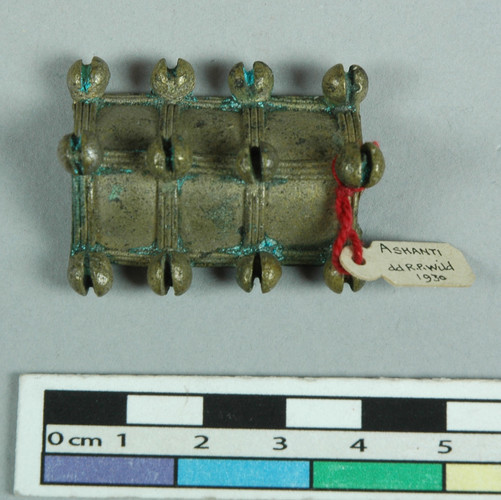 1930.44.495Copper alloy weight for weighing gold, representing a shield. [MJD 17/06/2011]1930.44.495
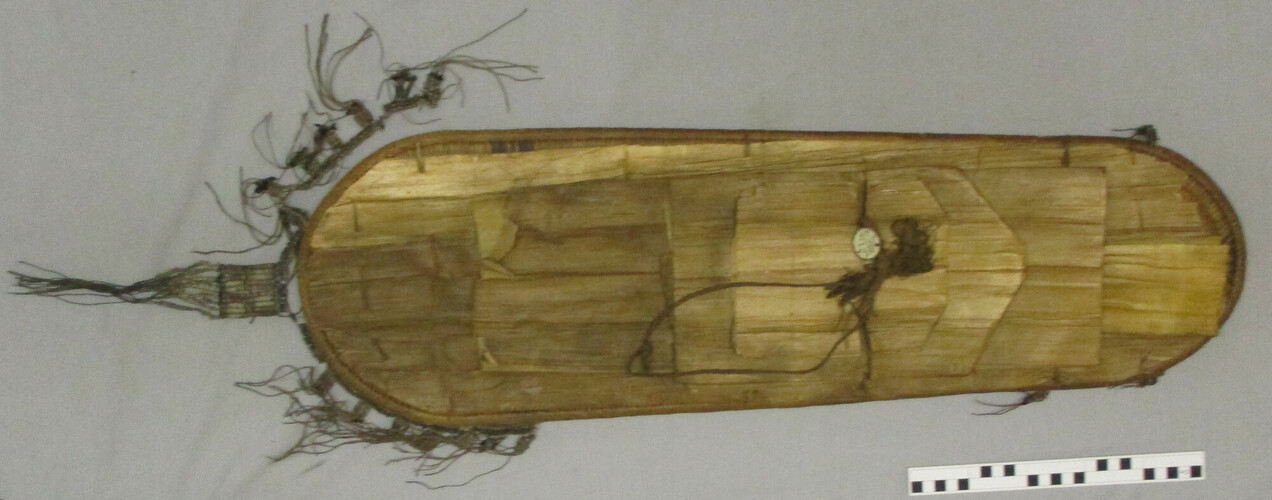 1954.4.14Shield, parallel sides with rounded ends, of cane rods bound together by coiling. Shell disc-bead fringe plaited and secured onto one end. [ZM 27/05/2008]1954.4.14
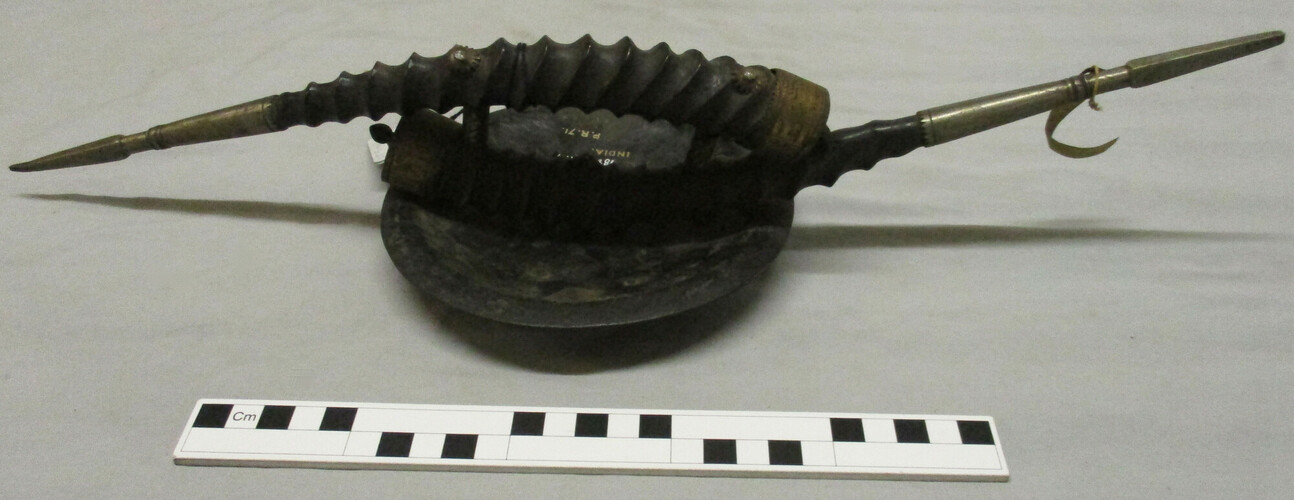 1884.30.27Indian parrying shield, made from antelope horns, with central circular hand shield. The ends of the horns are capped with metal points. There are four metal bosses on the hand shield. The horns are joined together with metal screws with incised designs. [CW [OPS move] 23/8/2016]1884.30.27
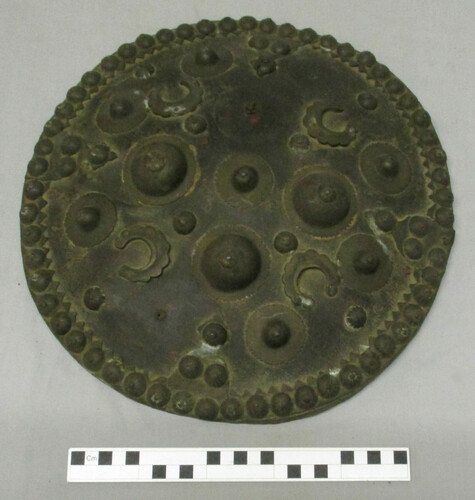 1943.6.109Shield of buffalo hide. It is round and domed, ornamented with metal bosses and studs. On the underside there are two leather handles attached with metal rings with a leather pad beneath them. [AB [OPS Move] 19/8/2016]1943.6.109