
- Collection type
- Object
- Description
- Axe with socketed iron blade hafted onto a wooden handle with incised geometric decoration around grip [RTS 1/7/2005]
- Long description
- Axe consisting of a narrow iron axehead fitted onto a wooden handle. The axehead has been made from a single piece of iron, and has a narrow body. This consists of a short square butt with rectangular section that projects from the back of the handle, an oval socket, and then a rectangular blade that curves down slightly towards the convex cutting edge, itself bevelled on both sides. The blade has a raised ridge running down the centre of both sides, giving it a lozenge-shaped section. It is currently a metallic gray colour (Pantone 422C). The axehead has been hafted onto a wooden handle, resting just below the top and held firm by a couple of wooden wedges within the socket on either side, and five iron bars or nails, whose rectangular sectioned ends are visible at the socket base. The handle is made from a brown coloured wood (Pantone 730C), with the top of the handle shaved to create a point, and a slightly rounded butt. This has a round section and smoothed surface throughout. The butt end has been covered with a thick band of incised decoration, that may also help to roughen the grip area. This consists of 3 parallel lines around the circumference at the top and bottom of the design, with the area between being divided into 2 sections by pairs of vertical lines. One section has been filled with incised crosshatching, while the other contains 2 v-shaped crosshatched chevron bands meeting a pair of similarly filled ^-shaped bands. The object is complete, but has some cracks and cut marks on the handle. It has a weight of 519.4 grams, and a total length of 835 mm. The axhead is 173 mm long, with a maximum width of 39 mm, thickness of 8.2 mm and socket diameter of 36.8 mm, while the handle has a diameter of 20.2 mm [RTS 1/7/2005].
- Geographical reference
- Panikware
- Cultural groups
- Acholi
- Person
- Field collector Frederick John Jackson
- PRM source Ipswich Museum
- PRM source Patricia Margaret Maclaren Butler
- Date / Period
- Date made: Before 01/06/1912
- Date collected
- 1st June 1912
- Acquisition information
- Purchased: 1966
- Materials and processes
- Material Iron Metal, Material Wood Plant, Process Carved, Process Decorated, Process Incised, Process Socketed, Process Forged (Metal), Process Hammered, Process Wedged
- Dimensions
- Depth 8.2 mm axehead, Diameter 36.8 mm socket, Diameter 20.2 mm handle, Width: max 39 mm axehead, Length: max 835 mm, Length 173 mm axehead, Weight 519.4 g
- Object numbers
- Accession number: 1966.1.272
- Research and responses
The inscription on the handle indicates that the axe was either obtained from a person or place called Panikwar on the 1st of June 1912, which falls within the period in which Jackson was governor of Uganda (1911-1917). Note that C.G. Seligman visited somewhere known as 'the Panikware resthouse' in 1922, which was in the what is now the district of Eastern Equatoria, around 12 miles from the Acholi village of Magwe. This makes it seem likely that we are dealing with a geographical place than an individual, although the tendency for the same name to be used for different places within a region has been noticed, which may mean that Jackson's Panikware was not the same as that visited by the Seligmans [partly based on information collected by Fran Larson from the unpublished diaries of C.G. and B.Z. Seligman in the Archives of the London School of Economics (Seligman manuscripts, files 1/4/1 and 1/4/6); RTS 4/7/2005].
Further items to explore
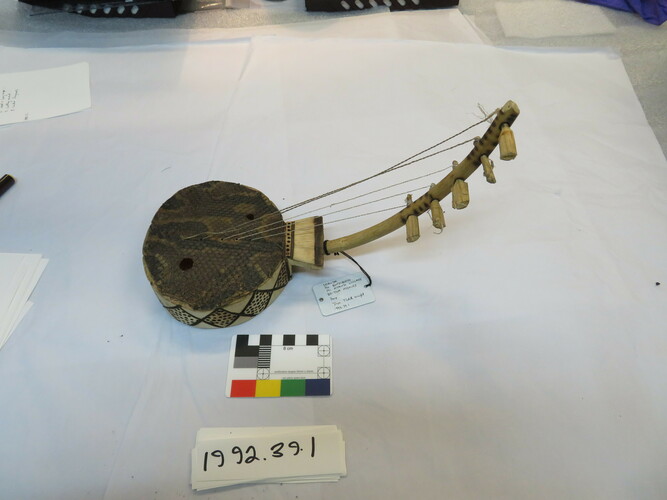 1992.39.1Bow harp of wood, snake skin, and metal [RR 24/1/2020]1992.39.1
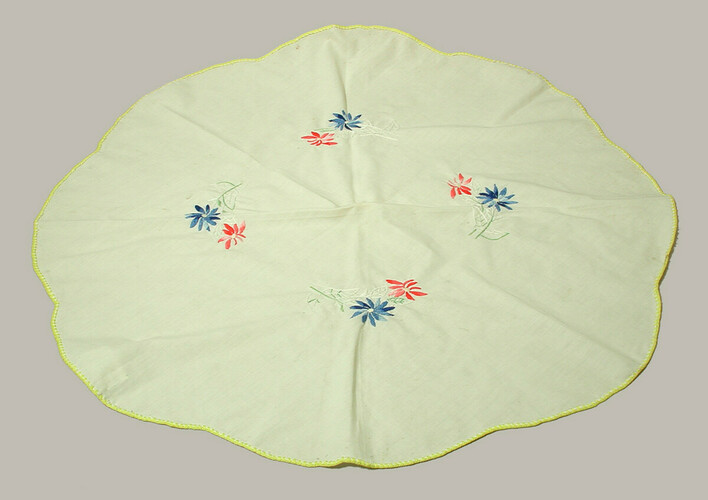 1998.9.12Circular cream-coloured tablecloth with with embroidered flowers at centre and scalloped edge overstitched in yellow wool [RTS 22/2/2005].1998.9.12
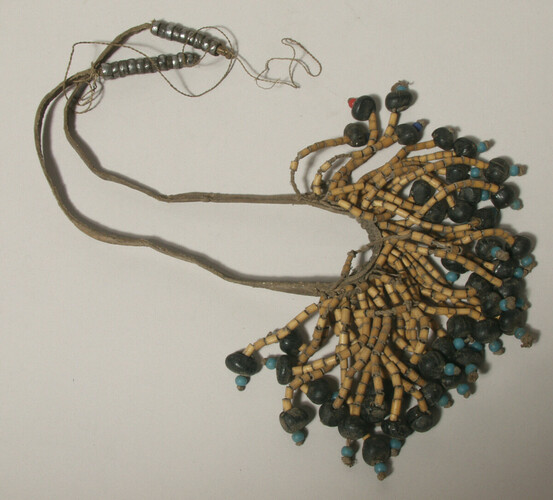 1940.7.049Pubic cover made from a hide strip hung with grass stem and glass bead tassels, with iron beads threaded on the tie ends; worn by small boys [RTS 10/8/2004]1940.7.049
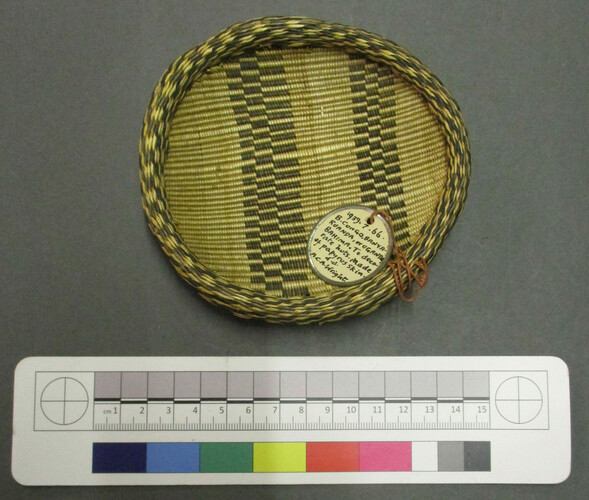 1939.7.66Basket for decorating house1939.7.66