
- Collection type
- Object
- Description
- Tobacco pipe with cane stem and beaded carrying loop [.1] and a black pottery pipe bowl with ochre filled geometric decoration [.2] [RTS 7/3/2005].
- Long description
- Woman's tobacco pipe, made in several parts. The mouthpiece appears to be missing. The stem, 1940.7.087.1, has been made from a short cylindrical length of cut cane or bamboo, with a segmented body and hollow interior that shows signs of sooting; this is a warm yellowish brown colour (Pantone 7509C). The lower end has been shaved to allow it to fit into the top of the pipe bowl. A short handle has been attached, made from 2 strands of plant fibre twisted together to make a single cord; this is a light yellowish brown (Pantone 7508C). This was wound twice around the lower part of the pipe stem, with the two ends then brought together to act as a double handle and threaded with a series of cylindrical glass beads, in an opaque light blue colour (Pantone 2975C), with 2 slightly darker blue beads (Pantone 5493C) and a single green bead (Pantone 346C). The ends of the cord were then wound several times around the upper part of the pipe shaft, then threaded along the length of this binding to leave a small loop projecting from its top; this loop was also strung with light blue beads, and was probably used for suspension. 106 beads were used in the entire construction. A separate pipe bowl, 1940.7.087.2, was then fitted onto the base of the shaft. This has been hand made from a well levigated fabric with numerous tiny mica inclusions, fired black all over and burnished over the outer surfaces (Pantone black 7C). The bowl is hollow throughout. It has a cylindrical upper part, with a narrow flat topped rim and a body that swells out immediately below before becoming slightly concave. This joins onto a second piece at right angles, with a tapering spur forming the pipe rest on one side, and a body that swells out to form a trumpet-shaped bowl mouth on the other with a slightly raised collar rim, bevelled on its upper surface. The mouth is nearly circular, and the interior walls have been coated with white ash; there is a darker deposit of ash and perhaps tobacco visible in the base of the interior. The pipe bowl has been decorated with incised patterns, some of which appear to be deliberately infilled with red ochre or pigment (Pantone 484C). This consists of two main zones. The first occurs on the cylindrical stem, which has 2 parallel lines around the circumference, then a band of crosshatching that covers the swollen area below and a further incised line around its base. The second focuses on the bowl mouth and is quite strongly coloured red; it consists of 5 parallel lines around the lower part, at the point where the bowl comes off the stem body at right angles. Above this there is a broad band of crosshatching, divided into four quadrants by vertical motifs, made up of a single column of ^-shaped chevrons, that alternates with a double column of stacked squares. Above this, the sides of the bowl are slighty stepped, with each of the 2 steps being covered in similar crosshatching. The object is complete, except for the missing mouthpiece; there is some damage to the surface at the top of the pipe stem. It has a weight of 70.7 grams and is 279 mm long. The visible part of the pipe stem is 223 mm long, with a diameter of 10.7 by 9.7 mm; the hole through the centre has a diameter of 6 mm. The blue beads are of roughly similar size, with a typical example being 3 mm long and 4 mm in diameter. The twisted cord has a diameter of 1 mm. The pottery pipe bowl is 55 mm long, from stem top to base, and 77 mm long from bowl mouth to pipe rest. The swollen stem is 22.3 by 22 mm wide; the bowl mouth has a diameter of 35.5 by 35 mm and the rim is 4 mm wide [RTS 7/3/2005].
- Geographical reference
- [Equatoria] Eastern Equatoria Jebel Imatong
- Cultural groups
- Imatong
- Date / Period
- Date made: Before 1940
- Date collected
- By 1940
- Acquisition information
- Loaned: 1940
- Materials and processes
- Material Pottery, Material Plant Fibre, Material Glass, Material Bead, Material Ash Wood Plant, Material Cane Plant, Material Bamboo Plant, Process Carved, Process Handbuilt, Process Fire-Hardened, Process Twisted, Process Strung, Process Incised, Process Inlaid
- Dimensions
- Diameter: max 22.3 mm bowl stem, Length 279 mm, Length 223 mm stem visible, Length 55 mm bowl, stem to base, Length 77 mm bowl, mouth to pipe rest, Diameter: max 35.5 mm bowl rim, Diameter: max 10.7 mm stem, Weight 70.7 g
- Object numbers
- Accession number: 1940.7.087.1 Accession number: 1940.7.087.2
- Research and responses
A province known as 'Equatoria' or 'Al Istiwa'iyah' was in existance from some time in the 1940's to 1981, after which point it was divided into the districts of Eastern and Western Equatoria; in the 1990's these were subdivided further into the modern administrative districts of Western Equatoria, Bahr el Jebel, and Eastern Equatoria [Times Comprehensive Atlas, 1999, plate 86]. The 'Imatong' tribe are presumably a group located somewhere around Jebel Imatong, which is a mountain peak in Southeastern Sudan, in Eastern Equatoria, south of Torit.
Lightweight pipes of similar type are known amongst other groups in the region; the closest is 1979.20.162 from the Northern Larim, also associated with women and with some similarities in decoration, but see also 1925.14.13 from the Lango, 1934.8.100 from the Jur and 1903.2.2 from the Bari. Most of these have a separate mouthpiece; it seems likely that the mouthpiece in this example is missing. Similar beads are known on objects from the Northern Larim (1979.20.154), Toposa (1979.20.206) and the 'Upper Nile' (1942.1.446) [RTS 7/3/2005].
- Associated publications
- Illustrated in colour as figure d on page 36 of A Shared Struggle: The People & Cultures of South Sudan, edited by Tim McKulka (no place [Juba]: Ministry of Culture, Youth and Sports, Government of the Republic of South Sudan and the United Nations Mission in South Sudan, 2013). Caption (same page): 'Imotong iron and wood tobacco pipe'. [JC 28 2 2014]
Search terms: Narcotic, Pottery, Trade, Bead, Pipe, Tobacco Accessory
Further items to explore
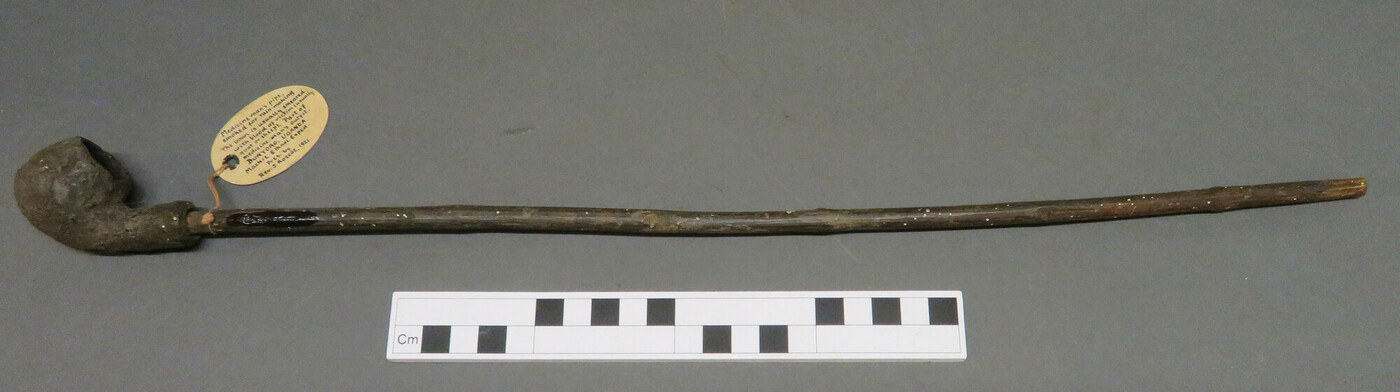 1921.9.167Medicine man's wooden pipe. [ASh [OPS move] 12/5/2017]1921.9.167
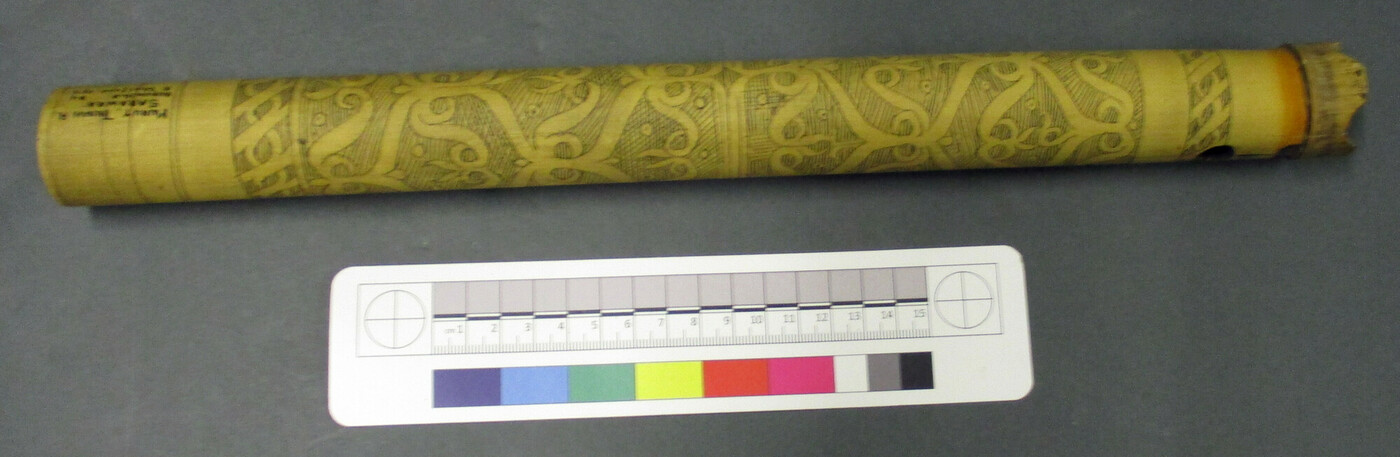 1912.31.44.2Bamboo pipe stem and body. Section of bamboo, decorated with incised scroll-like patterns. The bowl for this pipe is 1912.31.44 .1. [MOBB [OPS move] 24/10/2016]1912.31.44.2
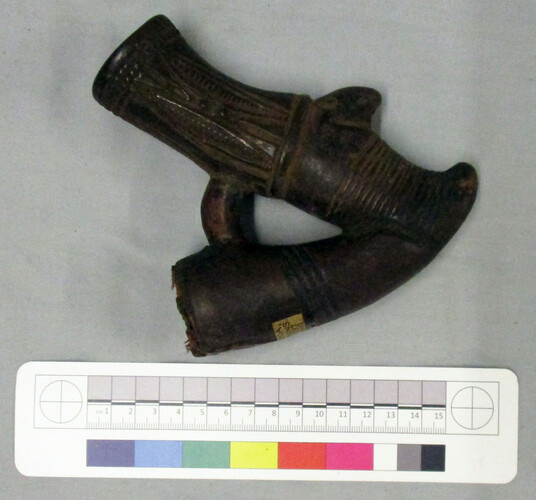 1942.13.287.1Red pottery bowl. For the carved cylindrical wooden pipe stem with tubular metal mouthpiece see 1942.13.287 .2. [CW [OPS Move] 5/10/2016]1942.13.287.1
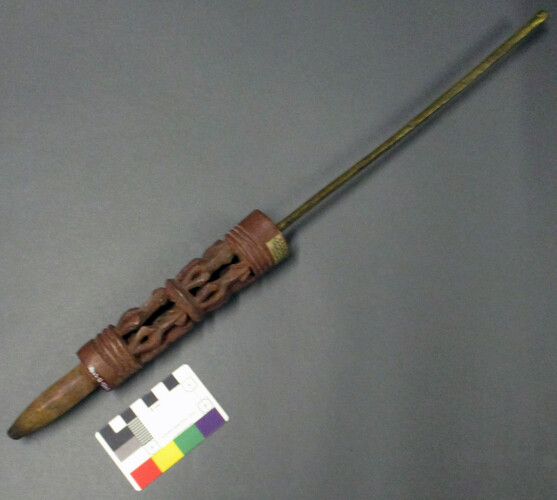 1942.13.1330.2Cylindrical wooden pipe stem with copper alloy mouthpiece, part of a pipe with black pottery pipe bowl. The pipe stem is coated with a reddish pigment. The stem is decorated with openwork carving in two tiers of conventionalised ?elephant heads. A long tubular copper alloy mouthpiece sith an overturned rim is inserted into the top of the wooden stem. For the black pottery pipe bowl moulded with three standing animals in relief. [CW [OPS move] 10/10/2016]1942.13.1330.2
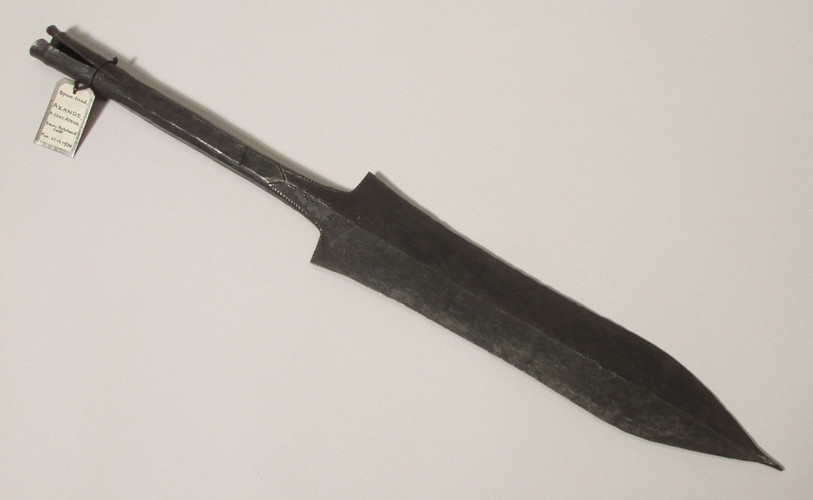 1930.86.14Socketed iron spear-head with decorated body [SM 26/06/2007]1930.86.14
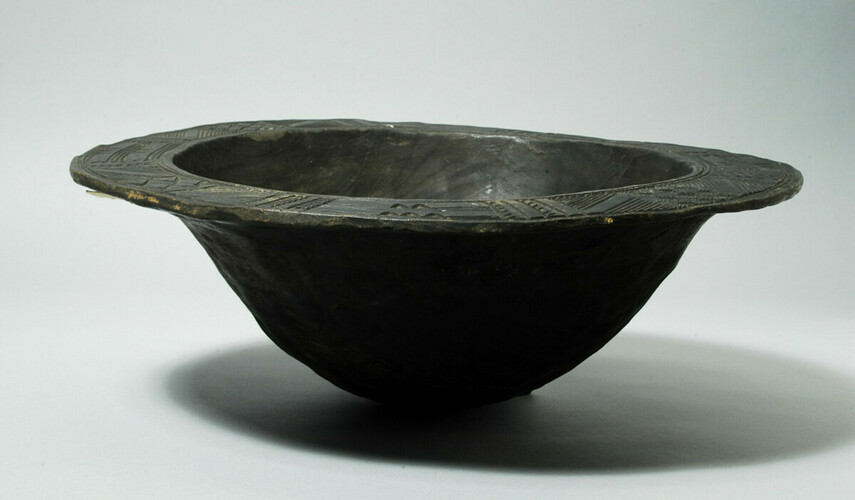 1966.25.3Hemispherical wooden bowl with broad flat everted rim, decorated with incised geometric linear designs, stained black [RTS 6/4/2005].1966.25.3
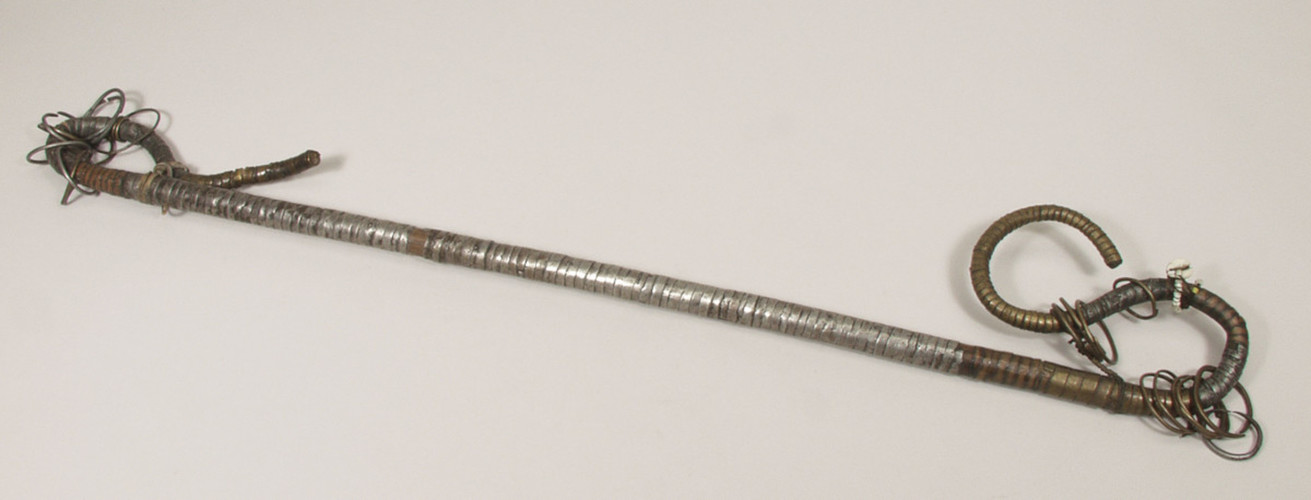 1928.67.3Wooden staff with incurved ends, bound with iron, brass and copper strips; part of the insignia of the prophet Car Koryom [RTS 25/10/2004].1928.67.3
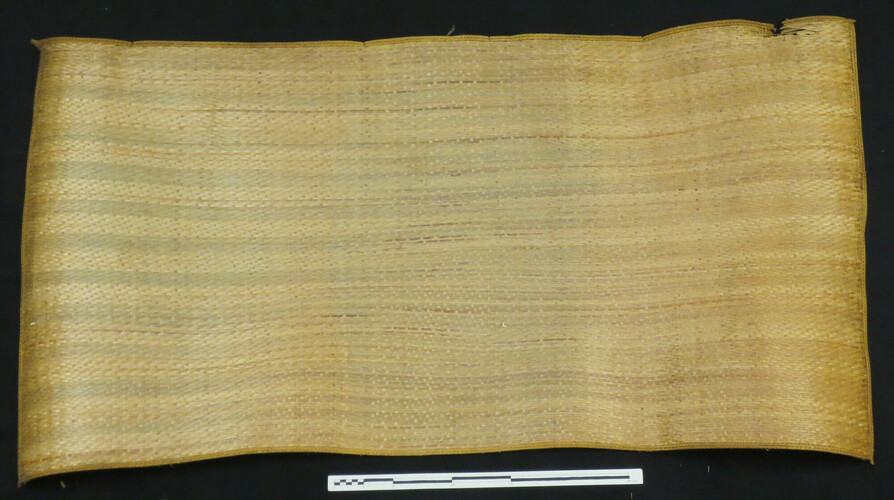 1948.2.159.3Rectangular mat made of chequerwoven strips of yellow plant fibre with fringed inner edges [RTS 9/8/2005].1948.2.159.3