
- Collection type
- Object
- Description
- Waist ornament consisting of a broad leather belt with a fringe of narrow iron strips, worn by very young girls [RTS 8/3/2005].
- Long description
- Young girl's waist ornament consisting of a waist band made from one long and one short rectangular pieces of leather, sewn together along one end using a thick hide thong in a simple ladder stitch; the loose ends of the hide have been pushed down the centre of the join on either side to form 2 stiffening ribs. The shorter piece of leather has been cut to have a tapering end that comes to a point. A series of holes have been punched through this from the inside face, with 4 holes in a row down the width, 4 holes along the upper edge, and 3 holes along the lower curving edge. These may have originally had some leather strips attached to serve as waist ties. The other end of the belt has been cut straight, and perforated somewhat irregularly with 2 holes along the straight edge, 3 holes along the lower edge but gradually moving inwards to the centre of the belt, and 4 more regularly placed holes along the upper edge. A series of narrow hide strips have been threaded through these, leaving a regular horizontal stitch on the inside face and with their 2 ends hanging loose from the exterior. These may be partially decorative, and partially intended to help tie the garment in place in conjunction with similar strips now missing from the other end of the belt. The outer face of the belt is textured, perhaps deliberately, and coloured with red ochre or pigment with tiny mica inclusions (Pantone 483C). A triangular iron clamp has been fitted over the top edge of the belt. This was used to hold the collector's paper label in place, and it is not clear if it is part of the original object or a later addition. The lower edge of the belt has been perforated with a row of 18 holes. All but one of these is currently used to seat a series of narrow iron strips, that hang down the front of the belt as a fringe. Each strip is made from a rectangular bar of iron, hammered flat, with a straight or slightly convex lower edge, and tapering to its upper end where it has been pushed through each hole and bent back towards the metal body to form a loop. The looped tops are much thicker than the flat bodies, and are visible on the outer face of the garment. The strips vary in length and width, gradually becoming longer and wider to the centre of the object. There are 3 sizes of strip involved; those at the sides are 130 mm long, 10.7 mm wide and 2 mm thick, with 5 of these on one side and 3 (of an original 4) on the other. Then there are 2 pairs of longer strips on either side, 162 mm long, 14 mm wide and 1.8 mm thick, and a group of 5 strips at the centre that are longer still, measuring 190 by 14.2 by 1.2 mm. Some strips have oblique hammering marks visible, and bear traces of red ochre. The iron is still a metallic gray colour (Pantone 877C), but blackening in place. The belt is nearly complete, but one iron strip appears to be missing and a series of ties; the leather has curled up and can no longer be stretched out to its full length. It has a weight of 553 grams. With the two belt ends touching, the belt has an approximate diameter of 235 mm, and is 52.5 mm wide and 4 mm thick, while the total length of the object, with fringe, is 236 mm. The hide stitching is 5 mm wide; the hide ties vary in size, but a typical example is 9 mm wide and 0.8 mm thick; some of these still have traces of animal hair on the surface [RTS 8/3/2005].
- Geographical reference
- [Equatoria] Bahr el Jebel Singi
- Cultural groups
- Bari (Nilotic)
- Date / Period
- Date made: Before 1940
- Date collected
- By 1940
- Acquisition information
- Loaned: 1940
- Materials and processes
- Material Animal Leather Skin, Material Iron Metal, Material Pigment, Material Ochre, Process Forged (Metal), Process Hammered, Process Bent, Process Perforated, Process Stitched, Process Tied, Process Tooled
- Dimensions
- Diameter 235 mm approx, Height: max 236 mm including fringe, Height 52.5 mm belt, Weight 553 g
- Object numbers
- Accession number: 1940.7.011
- Research and responses
A province known as 'Equatoria' or 'Al Istiwa'iyah' was in existance from some time in the 1940's to 1981, after which point it was divided into the districts of Eastern and Western Equatoria; in the 1990's these were subdivided further into the modern administrative districts of Western Equatoria, Bahr el Jebel, and Eastern Equatoria. Singi is located in Bahr el Jebel [RTS 11/11/2003].
Search terms: Clothing, Ornament, Status, Apron, Waist Ornament, Groin-cover
Further items to explore
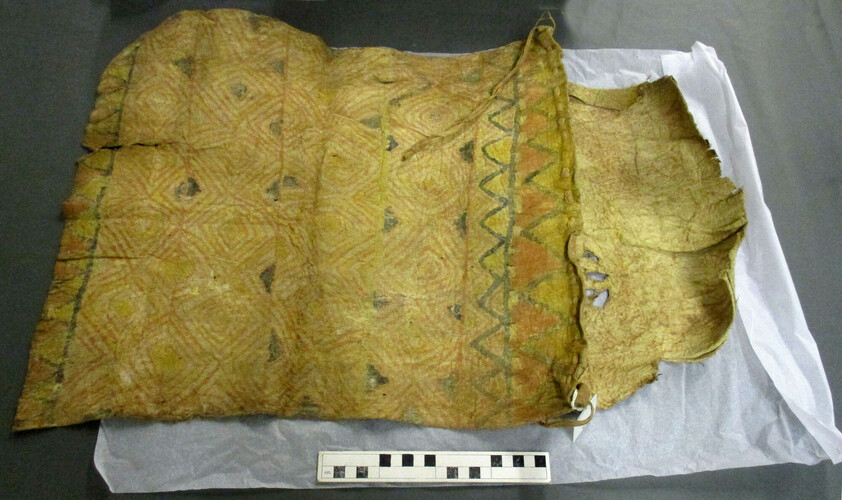 1940.12.521Barkcloth ?apron. Square piece with bark cord threaded through a fold along one side of it. It is decorated with rows of triangles and concentric diamonds in yellow, red and black. [AF [OPS Move] 19/7/2017]1940.12.521
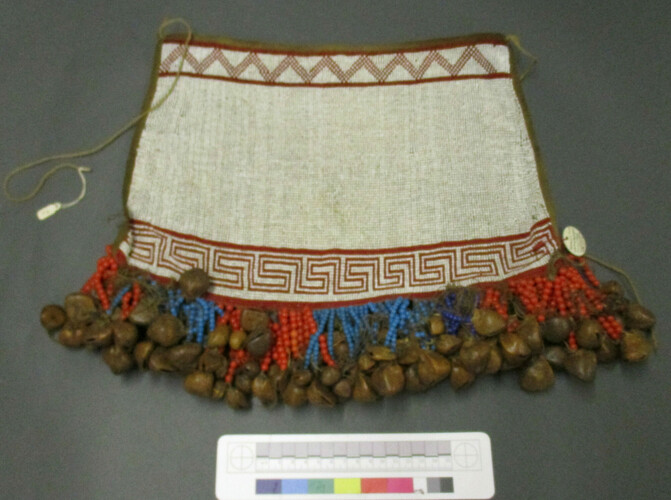 1964.8.39BWoman’s bead apron (keweyu) made of red & white seed beads interwoven with cotton. Decoration on the lower fringe consists of larger blue & red beads in short strings, with a terminal attachment of suspended tree seeds. [ASh [OPS move] 22/11/2016]1964.8.39B
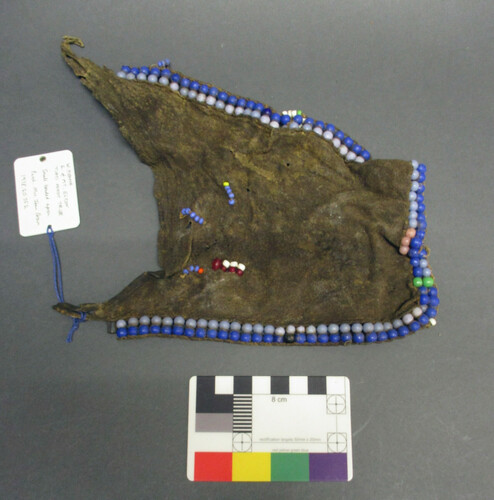 1978.20.352Leather apron. A rectangular section of leather edged with large (mostly) dark and light blue glass beads. Small mends are also decorated with beads. [ASh [OPS move] 9/12/2016]1978.20.352
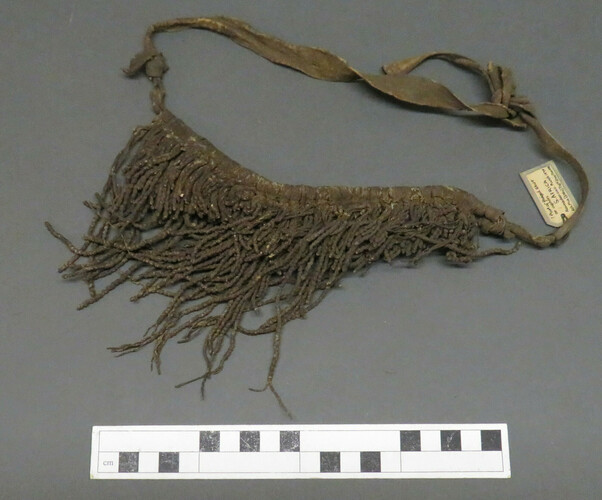 1886.1.638.2Plant fibre skirt of numerous closely knotted threads, and then coated with some brown dirty looking substance, and attached at top to a narrow strip of leather. [FB 19/02/2015]1886.1.638.2
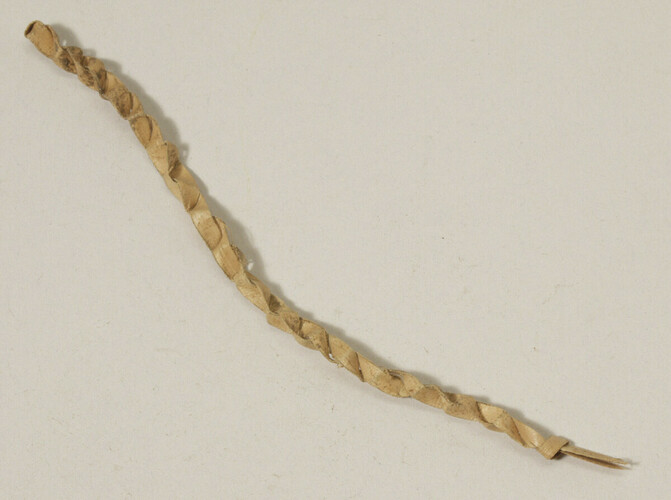 1979.20.149Roulette for decorating pottery, made from plaited and twisted grass strips [RTS 25/5/2004].1979.20.149
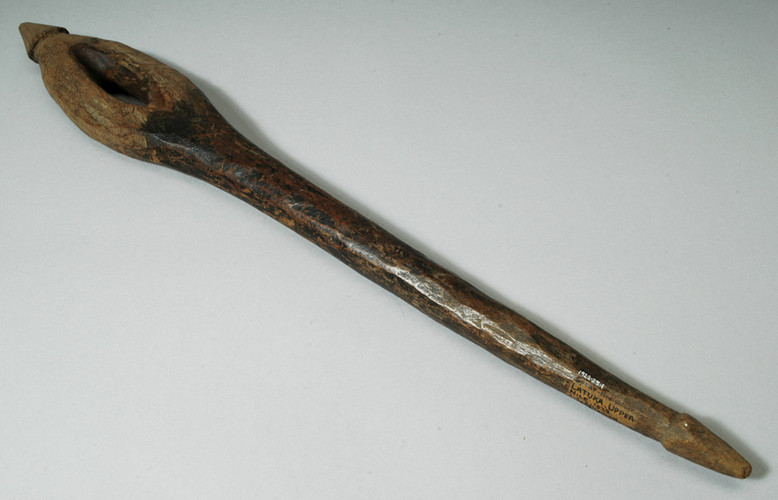 1922.25.1Wooden shaft-straightener with conical knob at top, broad upper body with oval hole through centre and cylindrical handle with conical butt [RTS 28/6/2005].1922.25.1
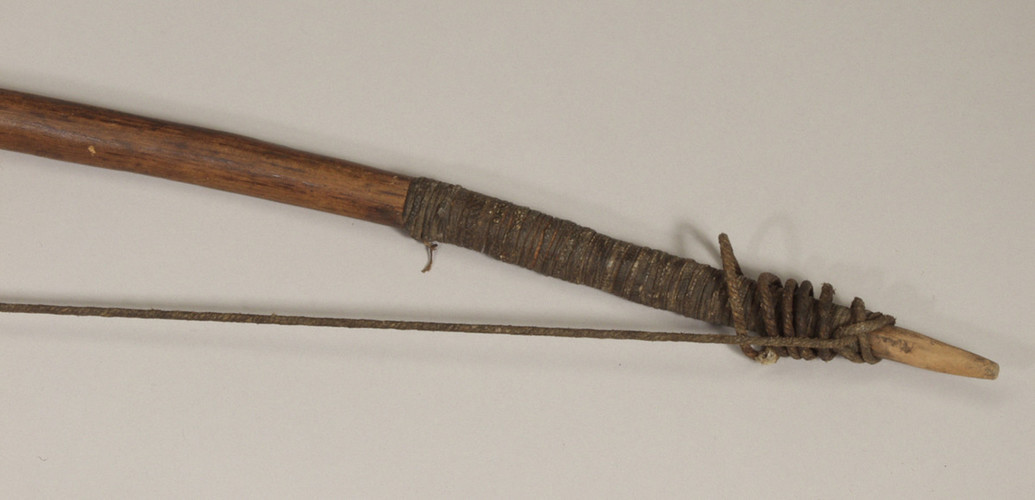 1917.25.6Wooden bow with sinew bow string and reptile skin binding [RTS 20/2/2004].1917.25.6
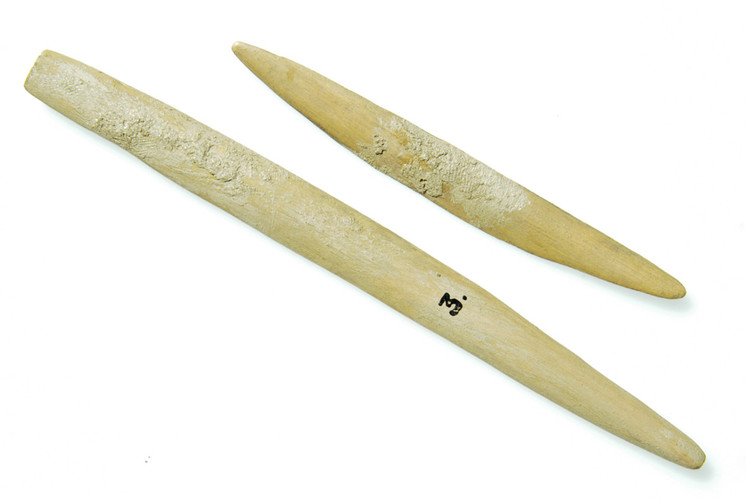 1934.8.132.4Narrow wooden spatula, cut flat at one end and pointed at the other, used as potter's tool [RTS 15/10/2004].1934.8.132.4