
- Collection type
- Object
- Description
- Wooden shaft-straightener with conical knob at top, broad upper body with oval hole through centre and cylindrical handle with conical butt [RTS 28/6/2005].
- Long description
- Shaft straightener carved from a single piece of wood, with a conical knob on top of an ovoid body that tapers in to a solid cylindrical handle, the base of which has been carved in the shape of a more elongated cone with pointed tip. An oval hole has been cut into the centre of the upper body, with the surface of the wood sloping down towards the opening at its top and bottom ends on both sides. A wooden shaft would be fitted through this hole, and rubbed along these sloping areas to finish its surface. These areas have been worn smooth through use. The straightener is essentially complete, but with some chips and flaws across the surface and a few cut marks. The upper part is a light brown colour; the handle is a darker reddish brown (Pantone 4625C). It has a weight of 698.1 grams and is 660 mm long, with a maximum width of 89 mm and thickness of 35.5 mm, and an opening that measures 53 by 22 mm across. L = 660, max W = 89, th = 35.5, opening L = 53, W = 22 mm [RTS 28/6/2005].
- Geographical reference
- Bahr el Jebel Eastern Equatoria
- Person
- Field collector Charles Gabriel Seligman
- Field collector Brenda Zara Seligman
- PRM source Charles Gabriel Seligman
- Date / Period
- Date made: Before 03/1922
- Date collected
- January to March 1922
- Acquisition information
- Donated: 1922
- Materials and processes
- Material Wood Plant, Process Carved, Process Perforated
- Dimensions
- Length: max 660 mm, Depth: max 43 mm, Width: max 89 mm, Weight 698.1 g
- Object numbers
- Accession number: 1922.25.1
- Research and responses
The Seligmans travelled through Southern Sudan in late 1921 and 1922, reaching Lokoiya and Lotuko territory in January 1922, with their itinerary including visits to the Bellinian rest house (11th-13th), a resthouse on the Mongalla-Torit road (14th), Ngala and Hangare Lokoiya (15th), Lokoiya (17th), Lokila (18th), Lobula (19th), Torit (20-23rd), Lebalwa (24th), Tarangala (25th January to 4th February), Idumela and Lugurn (4th February), Lopi (6th), Kiri Kiak (7th), Legoprof (10-16th), Lopir and Lomu (16th), Losua village (17th) and then back to Torit on February 20th. After that, they ventured into Acholi territory, then back into Torit and the surrounding area from March 5th to around March 15th [based on information collected by Fran Larson from the unpublished diaries of C.G. and B.Z. Seligman in the Archives of the London School of Economics (Seligman manuscripts, files 1/4/1 and 1/4/6); RTS 4/7/2005].
Although the term 'Upper Nile' is now used to refer to a modern administrative district, covering a stretch of the Bahr el Abiad from Geigar to Malakal, and the Sobat River to Nasir, at the time this object was collected the term was used differently. Up until 1981, it was the name of a province that covered the districts now known as Upper Nile, Jonglei, Wahda and part of el Buheyrat. It may also have been used to describe the Bahr el Abiad and/or Bahr el Jebel rivers.
For similar shaft straighteners, see 1940.12.624-625 (Lotuko), 1929.47.2 (Rumbek Jur) and 1940.12.623 (Bari) [RTS 28/6/2005] [RTS 6/2/2004].
Search terms: Tool, Shaft-straightener
Further items to explore
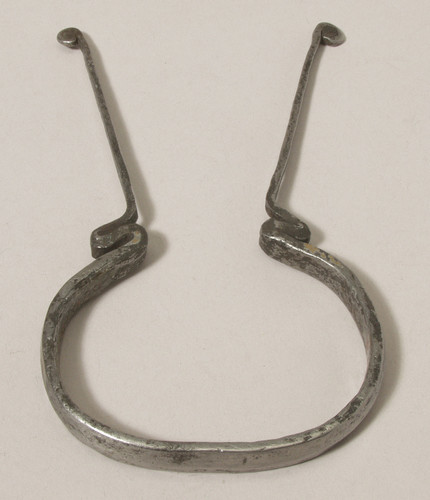 1884.82.53Penannular iron bracelet with triangular section and narrow, elongated projecting ends curled over at their tips [RTS 5/4/2004].1884.82.53
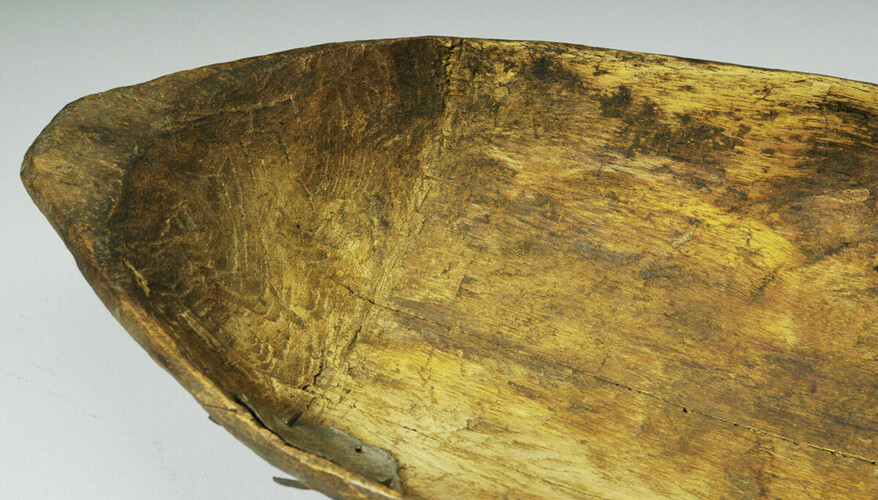 1941.4.65Large wooden dish with flat lugs at either end, repaired with a piece of stamped tin, for eating meat and fish [RTS 3/6/2005].1941.4.65
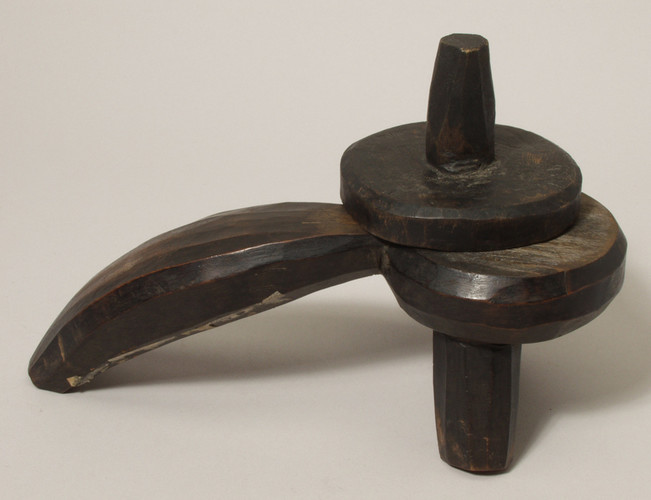 1931.66.36.1Rubbing board oracle, consisting of a wooden table [.1] with a modern replica of the circular upper rubber [.2]1931.66.36.1
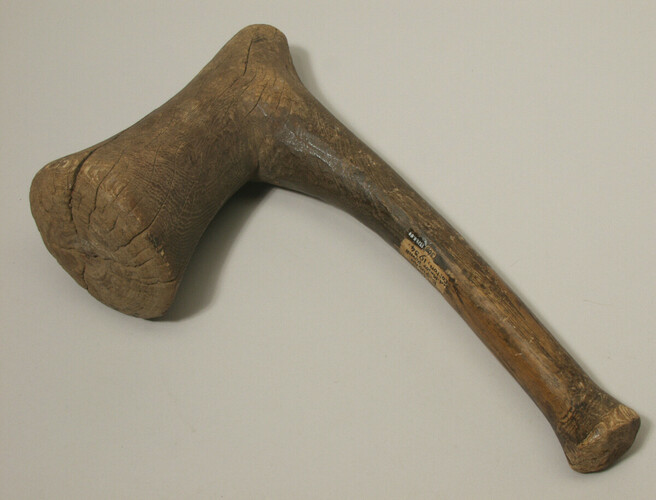 1934.8.89Heavy mallet carved from a single piece of wood [RTS 5/7/2004].1934.8.89