
- Collection type
- Object
- Description
- Penannular iron bracelet with triangular section and narrow, elongated projecting ends curled over at their tips [RTS 5/4/2004].
- Long description
- Penannular arm ornament made from an iron band with flat inner face where it would rest against the wrist, flat sides, and an angular ridge running around the centre of the outside face, giving it a triangular section. This bar is bent into an oval loop with open ends, 25 mm apart; this bar then becomes rectangular in section and begins to taper to the ends; it has been doubled over itself twice on either side, before straightening out into two narrow arms that extend out from the body at a slight angle. These arms are curled over at their tips. The object is complete and intact, and is currently a metallic gray colour (Pantone 421C) with a polished surface. It measures 73 mm across the outside edges, and 125.3 mm across the width, including the arms, while the band from which it has been made has a width of 9.2 mm and a thickness of 3.5 mm, and the arms have a width of 2.2 mm and a thickness of 1.5 mm. It weighs 48.7 grams [RTS 5/4/2004].
- Geographical reference
- Cultural groups
- Bongo
- Person
- Maker Unknown Maker
- Field collector John Petherick
- PRM source Augustus Henry Lane Fox Pitt Rivers founding collection
- Date / Period
- Date made: Possibly before 1858
- Date collected
- 1858
- Acquisition information
- Donated: 1884
- Materials and processes
- Material Iron Metal, Process Forged (Metal), Process Hammered, Process Polished
- Dimensions
- Length 73 mm, Width 125.3 mm, Width 9.2 mm band, Thick 3.5 mm band, Weight 48.7 g
- Object numbers
- Accession number: 1884.82.53 PR no.: 103/ 1621
- Research and responses
This object is said to have been collected in 1858; in that year Petherick led a trading expedition through Bongo territory, an account of which is given in his 1861 volume, Egypt, The Sudan and Central Africa; he refers to this group as the Dor. The expedition entered Bongo territory on January 25, 1858, visiting villages called Djau, Kurkur, Maeha, Mura, Umbura, Modocunga, Miha, Nearhe, Gutu, Mungela, Ombelambe and Lungo. Later in February they passed back through the Bongo villages of Djamaga and Lungo again. This material was shipped back to England in 1859 [RTS 20/1/2004].
In Egypt, The Sudan and Central Africa, 1861, p. 401, Petherick describes Bongo women as wearing numerous iron bracelets on their wrists. See also J.G. Wood, 1868, The Natural History of Man Vol. I, p. 499. “On their wrists they wear bracelets, made simply of iron bars cut to the proper length, and bent round the wrist.”. This particular example is illustrated by Wood as a Djibba bracelet, but that is probably an error on his part (J.G. Wood 1868, p. 520 fig. 5). Schweinfurth published variations on this type, attributed to the Bongo, but said to be used by both elders amongst the Dinka and the Jur as well (G. Schweinfurth 1875, Artes Africanae, tab. III figs 14 and 16-17). Schweinfurth shows this type of ornament being worn by Bongo men, under the local name 'dangabor', meaning 'rings one above another'; these are placed on the arm in sets, gradually increasing in size with the projecting ends adjacent to one another (Schweinfurth 1973, The Heart of Africa Vol. I, p. 282) [RTS 14/1/2004].
Gayer-Anderson illustrates anklets or bracelets of similar design, which he says were worn by Kederu women for defense (R. Gayer Anderson, 1911, "Some Tribal Customs in their Relation to Medicine & Morals of the Nyam-Nyam and Gour Peoples Inhabiting The Bahr-el-Ghazal", Wellcome Tropical Research Laboratories, Khartoum, rep. no. 4, vol. B, pl. XVIII nos 9 and 12) [RTS 17/9/2004].
Search terms: Ornament, Arm Ornament
Further items to explore
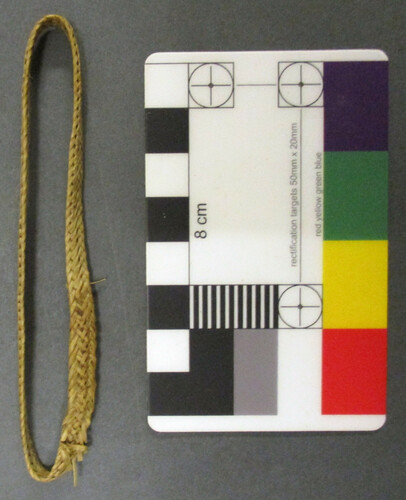 1938.36.645Armlet, made from pandanus plant fibre plaited into a band. Roughly oval in shape. [ASh [OPS move] 14/11/2016]1938.36.645
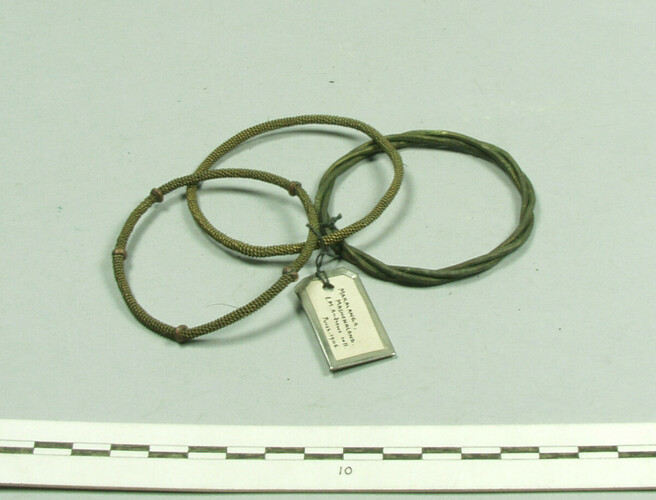 1906.78.28Metal arm ornament; thin, flexible circlet of twisted brass wires wound around a base of ?hair. [EC 'DCF 2004-2006 What's Upstairs?' 12/10/2005]1906.78.28
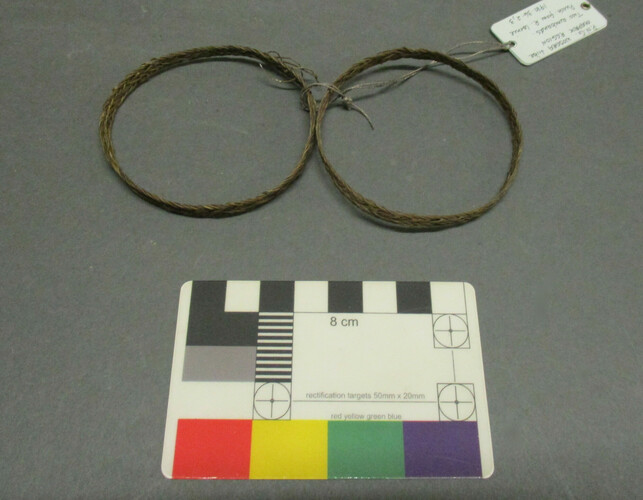 1981.36.2Armband, made of plaited vegetable fibre formed into circles. Dark brown in colour. [ASh [OPS move] 4/1/2017]1981.36.2
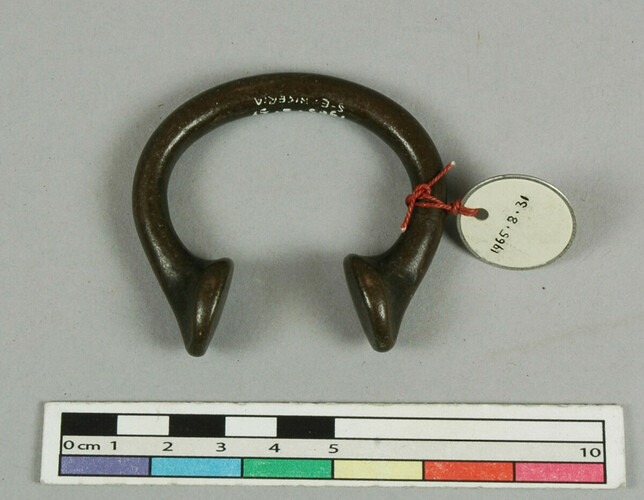 1965.8.31Counterfeit manilla. [El.B 28/04/2011]1965.8.31
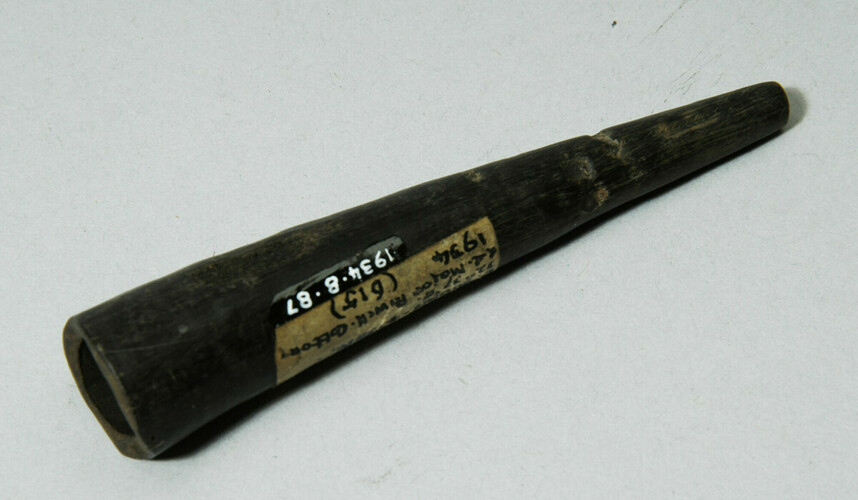 1934.8.87Notched end-blown flute of antelope horn with a short tapering body and single finger-hole at base, used by boys [RTS 28/5/2004].1934.8.87
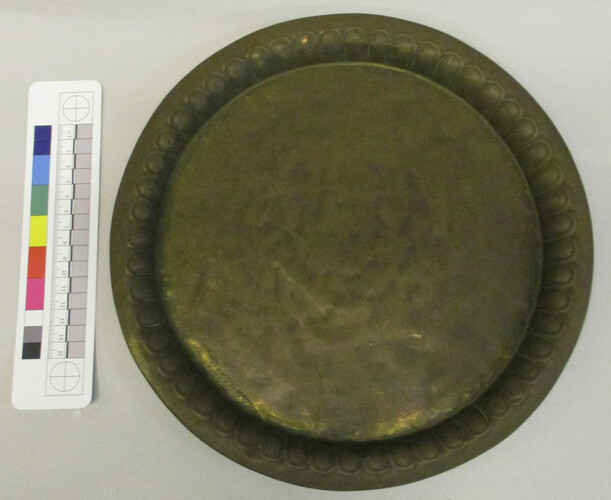 1949.8.126.1Circular copper alloy tray with geometric pattern around the rim. Belonging to a coffee set. For the full set including three cups see [1949.8.126 .1 - 1949.8.126 .4] [RM [OPS Move] 26/7/2016]1949.8.126.1
 1930.86.64Wooden male figure representing deceased person, for placing near a grave.1930.86.64
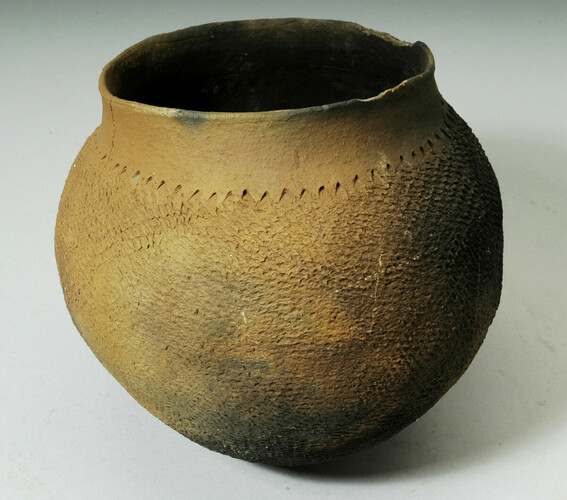 1979.20.33Deep pottery vessel with upright rounded rim, short concave neck and globular body covered with impressed decoration [RTS 17/5/2005].1979.20.33