
- Collection type
- Object
- Description
- Wooden bow with sinew bow string and reptile skin binding [RTS 20/2/2004].
- Long description
- Bow made from a long piece of light brown wood (Pantone 464C), tapering to either end, and strung so that the bow shaft forms a simple, shallow arc. The shaft is round to slightly oval in section throughout. The wood has been polished. A short narrow strip or strips of reptile skin, possibly crocodile or lizard, around 2 mm in width, has been wound around the bow shaft some 53 mm from the end, with the loose end of the strip secured in place by tucking it underneath the other loops. This forms a 24 mm long band that acts as a stop, to keep the end of the bow string located in the correct position. This part of the bow shaft appears to be coated with a dark purple brown material (Pantone 4975C), possibly resin, that may have been painted on as an adhesive or binding agent; on top of this a piece of leather or hide has been wound round the shaft, perhaps to provide padding when carrying the bow over one shoulder. This covers an area of 143 mm, and no overlapping or joining pieces are visible; the surface is a similar colour to the material on the wood below, and the binding has probably received a further coating of this over its surface. This piece may have originally extended further down the bow shaft, covering a further 62 mm, but subsequently come away from the shaft, leaving the underlying adhesive exposed. A further narrow strip or strips of reptile skin has been wound around the shaft, 50 mm from the other end, and covering a larger area, 178 mm in length. The ends of this can be seen tucked under the binding in two areas. The bow has been strung with a single cord made of twisted sinew. This is attached to one end with a double loop around the bow shaft, the cord pulled through this and knotted, then fastened at the other end with another double loop that has been pulled tight, the loose end of the cord then wound several times around the bow shaft and tucked underneath the resulting loops. The bow string is no longer taut. The original colour of the string would appear to be a light yellow brown (Pantone 466C), but the surface is much darker. Length (when strung) 1548 mm, width of shaft at centre 24.4 mm, thickness of shaft at centre 24 mm, diameter of bow string (taut area) 2.8 mm, diameter of cord wound around shaft 3.5 mm [RTS 20/2/2004].
- Geographical reference
- Northern Bahr el Ghazal Western Bahr el Ghazal Warab Lakes Western Equatoria
- Cultural groups
- Jur
- Date / Period
- Date made: Before 1917
- Date collected
- By 1917
- Acquisition information
- Donated: 1917
- Materials and processes
- Material Wood Plant, Material Animal Sinew, Material Reptile Skin, Material Resin Plant, Material Animal Hide Skin, Material Animal Leather Skin, Process Carved, Process Twisted, Process Bound
- Dimensions
- Length 1548 mm, Width 2.8 mm bow string, Width 24.4 mm bow shaft
- Object numbers
- Accession number: 1917.25.6
- Research and responses
This object was probably collected in the period immediately before World War I (1909-1913, or 1910-1914?, according to Gayer-Anderson's biographical history). It is assumed here that 'Bahr el Ghazal' refers to the province, rather than to the river. At the time this object was collected, the Bahr el Ghazal province was much larger than it is today, extending from roughly the Bahr el Arab all the way to the border with the Belgian Congo; this area is now divided into the districts of Western Bahr el Ghazal, Northern Bahr el Ghazal, and parts of Warab, El Buheyrat and Western Equatoria [RTS 10/11/2003].
- Associated publications
- Illustrated in colour as figure c on page 56 of A Shared Struggle: The People & Cultures of South Sudan, edited by Tim McKulka (no place [Juba]: Ministry of Culture, Youth and Sports, Government of the Republic of South Sudan and the United Nations Mission in South Sudan, 2013). Caption (same page): 'Jur (Beli or Modo) wood bow'. [JC 28 2 2014]
Search terms: Archery Weapon, Cordage, Bow
Further items to explore
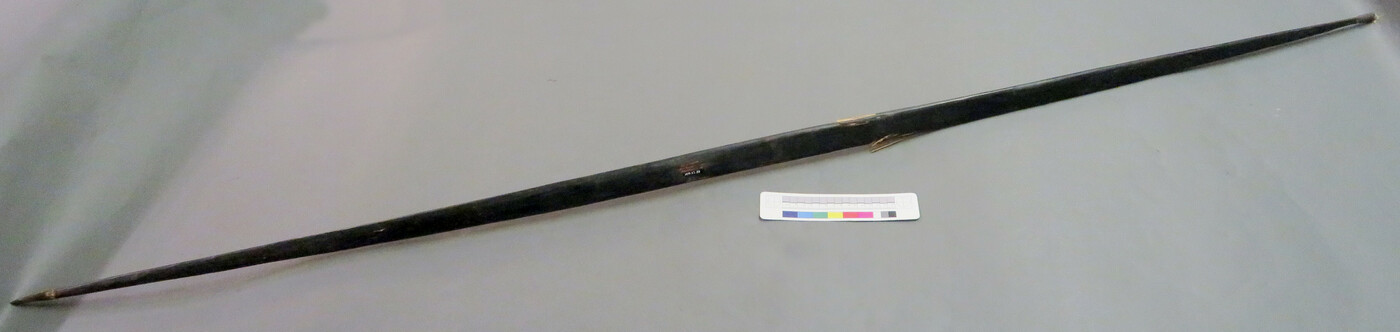 1899.62.97Long bow, made from palm wood. The bow is semicircular in section and tapers towards the pointed tips. One side of the bow is stained black and the other side is dark brown. The wood has split on each side towards the centre of the bow. Towards one tip there is a section of plaited plant fibre. At the other end there is an extending section of plant fibre covered with ?resin. There is no bowstring present. [SB [OPS move] 15/8/2017]1899.62.97
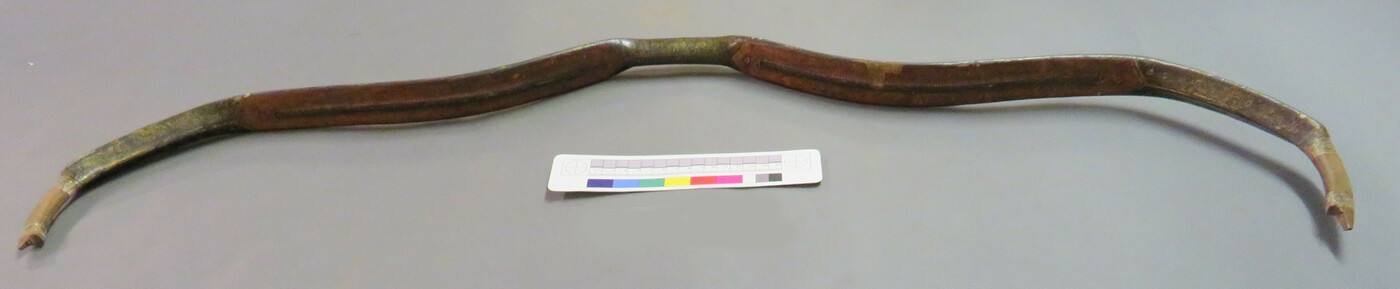 1932.89.84Composite bow, painted and lacquered and made from wood. The tips of each end of the bow are decorated with sections of foliate design. The main body of the bow is decorated on the inner and outer edge with a zig-zag design. The bow narrows to the grip in the centre of the bow which is black in colour. [SB [OPS Move] 4/7/2017]1932.89.84
 1902.47.1Palm wood bow. [ASh [OPS move] 1/8/2017]1902.47.1
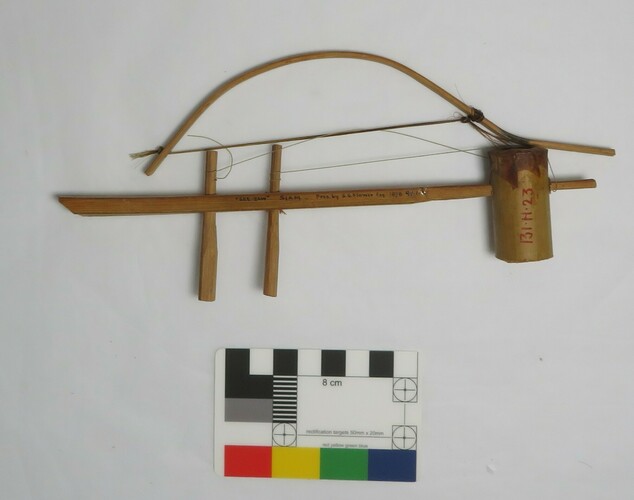 1898.49.1.1Miniature fiddle made of bamboo, for associated bow see 1898.49.1 .2 [RH 15/1/2020]1898.49.1.1
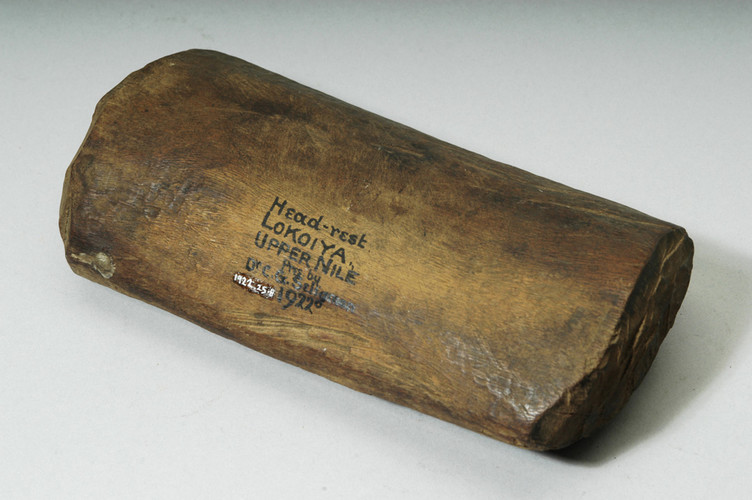 1922.25.8Rectangular headrest with convex upper face, carved from a single block of wood [RTS 27/5/2005].1922.25.8
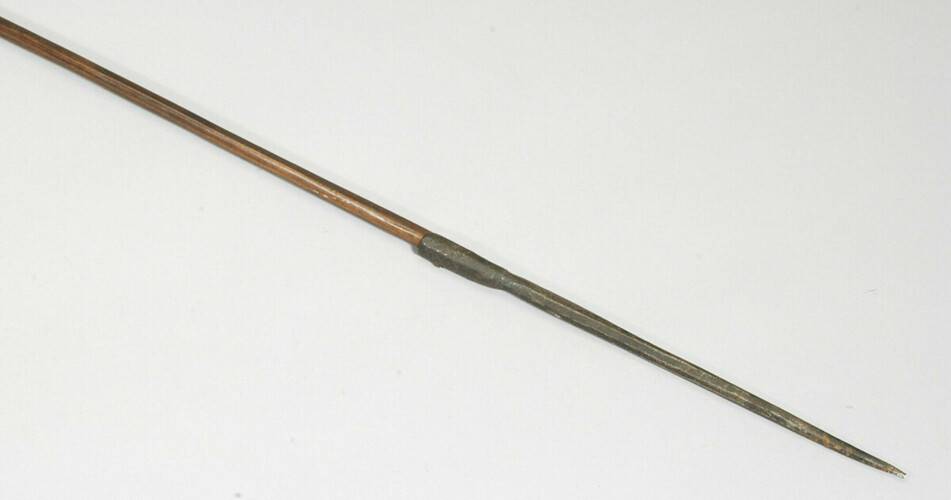 1969.29.106.1Socketed iron head with ogee-sectioned blade and barbed shank. [AFS [OPS move] 5/7/2018]1969.29.106.1
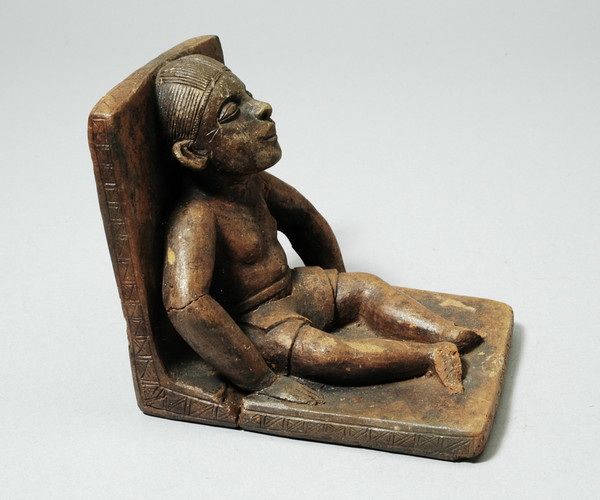 1934.8.135L-shaped pottery book-end with a seated male figure wearing shorts sculpted in high relief [RTS 28/1/2005].1934.8.135
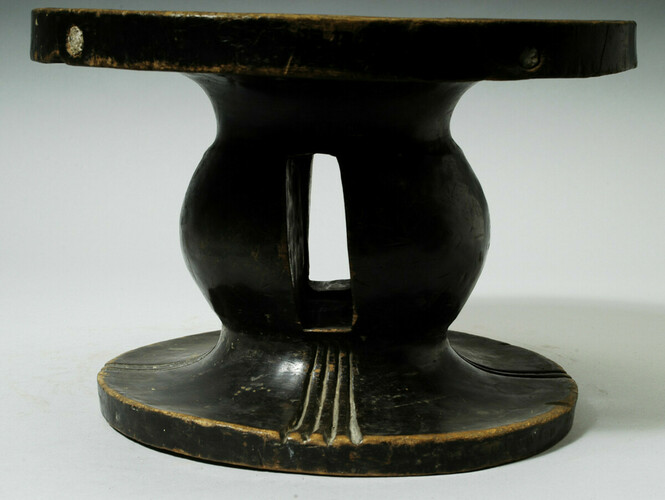 1970.38.10Slightly oval wooden stool with lentoid hand grip cut near the edge of the seat. [RTS 14/4/2005].1970.38.10