
- Collection type
- Object
- Description
- Circular wooden stool on a low pedestal foot, with semicircular hand grip cut near the seat edge. The central support has a square opening in the middle. [PR [OPS move] 10/5/2017]
- Long description
- Stool carved from a single block of wood, consisting of a circular top with narrow flat rim and flat, slightly recessed seat with semicircular hand-grip cut near one edge. The underside is flat, and has a squat cylindrical pedestal extending from its centre. This has a thickened, convex-sided central section with square window cut through the body, set on a flaring disc foot with a shallow ovoid depression carved into the centre of the underside, probably added to increase the stability of the form. A series of four v-shaped grooves have been cut into the base of the pedestal, radiating out to the edge of the base. The upper part of the seat and the underside of the foot have been left the natural yellow colour of the wood (Pantone 7508C), but all other areas, including the inside edges of the fenestration, have been stained a dark brownish black (Pantone black 7C); numerous small metallic flecks on the surface of these areas may be the result of mica mixed in with the stain. The stool is complete, with a minor crack and some stains across the seat top, and a few hairline cracks in the foot, along with some surface damage. It is 210 mm high, with a seat diameter of 310 by 308 mm and thickness of 24.5 mm; the handle grip hole is 92 mm long and 23 mm wide; the fenestration in the pedestal is 73 mm tall and 65.5 mm wide, while the base has a diameter of 269 by 265 mm and is 23.5 mm thick [RTS 14/4/2005].
- Geographical reference
- Cultural groups
- Zande
- Date / Period
- Date made: Before 1930
- Date collected
- 1927 - 1930
- Acquisition information
- Found unentered: 1948
- Materials and processes
- Material Wood Plant, Material Pigment, Process Carved, Process Stained, Process Decorated, Process Grooved
- Dimensions
- Height: max 210 mm, Diameter: max 322 mm, Weight 1000 g
- Object numbers
- Accession number: 1948.2.138
- Research and responses
For similar Zande stools, see also 1970.38.10-11, and 1948.2.139 (with a solid pedestal); these were all collected by Evans-Pritchard.
Evans-Pritchard photographed a similar type of stool being manufactured by the Zande woodworker Kisanga - see the photographic archives for accession numbers 1998.341.22, 1998.341.79, 1998.341.316 and 1998.341.319 where a nearly completed stool is being stained by applying a liquid to it from a clay pot boiling on a fire, showing that, unlike some of the wooden bowls, stools were stained by the craftsman, not the subsequent owner. Other images show Kisanga using an adze to carve out the wood (e.g.: 1998.341.27, although in this case the stool has a square top - either because it is unfinished, or because it is a slightly different form). This type of stool also appears in images 1998.341.152, 1998.341.185 and 1998.341.502, and being sat on by men in 1998.341.206 and 1998.341.211.
Larken describes these stools as follows: "Solid wood… is employed in the manufacture of the stools, mbata, which are made after the fashion of this dish [a circular dish on a pedestal stem, sometimes pierced, with round base]; the seat is slightly hollowed so that there is a flat raised rim at the circumference, and is usually pierced so that it may be hung up by a cord out of the way of white ants. Such stools are about a foot in height, or rather more, the diameter being the same, though bigger ones are not uncommon … sections of logs … must be used for the standing dishes, stools and mortars." (P.M. Larken, 1927, "Impressions of the Azande", Sudan Notes and Records X, p. 132).
This style of object seems to be produced also by the Mangbetu, called nobarra, and carved by male craftsmen. These stools were used by Mangbetu women, who sometimes passed a carrying strap around the top of the pedestal and through the hand grip, with the strap either going across the forehead so the stool could hang down their back, or over one shoulder (see E. Schildkrout & C.A. Keim, 1990, African Reflections, pp 119-121, fig. 6.25, and photos showing these stools in use, figure 7.3 and 7.5) [RTS 1/6/2005].
- Associated publications
- Illustrated in colour as figure d on page 35 of A Shared Struggle: The People & Cultures of South Sudan, edited by Tim McKulka (no place [Juba]: Ministry of Culture, Youth and Sports, Government of the Republic of South Sudan and the United Nations Mission in South Sudan, 2013). Caption (same page): 'Azande wood stool'. [JC 28 2 2014]
Search terms: Furniture Dwelling, Stool, Furniture
Further items to explore
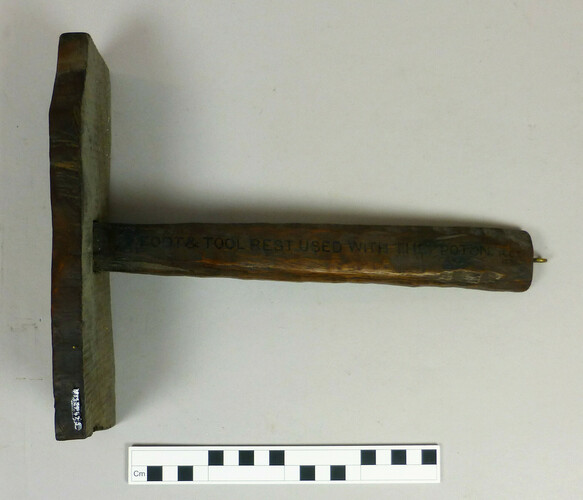 1889.29.47.3Foot and tool rest for wooden lathe or Poton. For the wooden lathe see [1889.29.47 .1] and for the seat and foot rest see [1889.29.47 .2]. [RH [OPS Move] 22/6/2017]1889.29.47.3
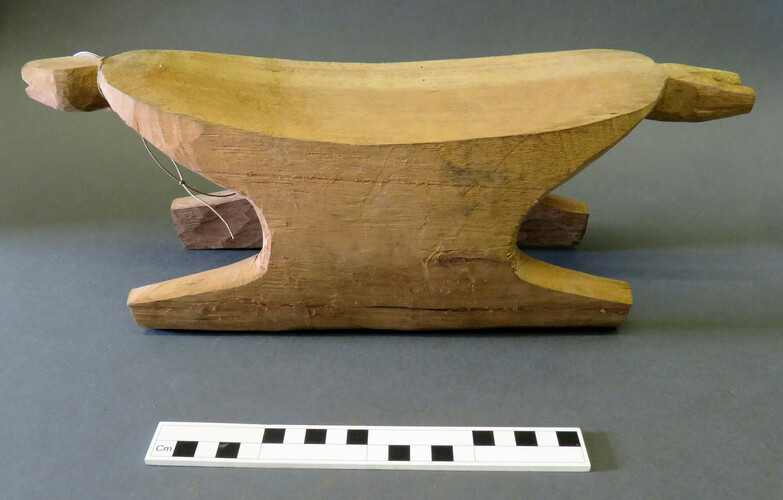 1954.2.122Stool carved from a single piece of wood in the form of a stylised turtle. [RH [OPS Move] 11/4/2017]1954.2.122
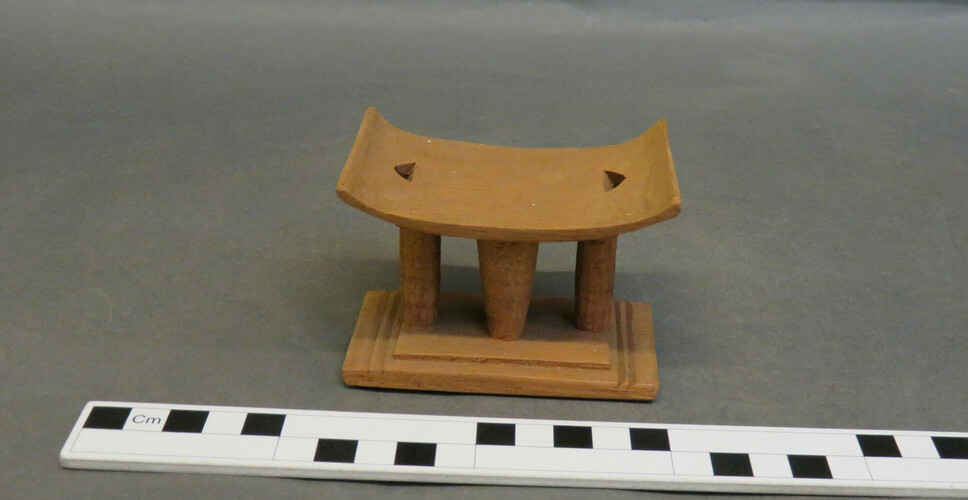 1945.12.45BModel stool1945.12.45B
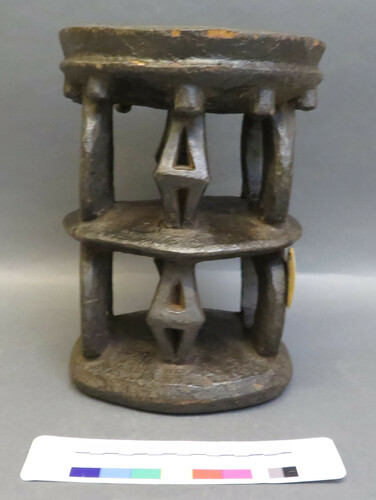 1942.13.10Wooden stool consisting of an oval seat, base and central platform, four ring supports creating two figure-of-eight shapes, and four open-work dogleg supports. [JC [OPS Move] 4/5/2017]1942.13.10
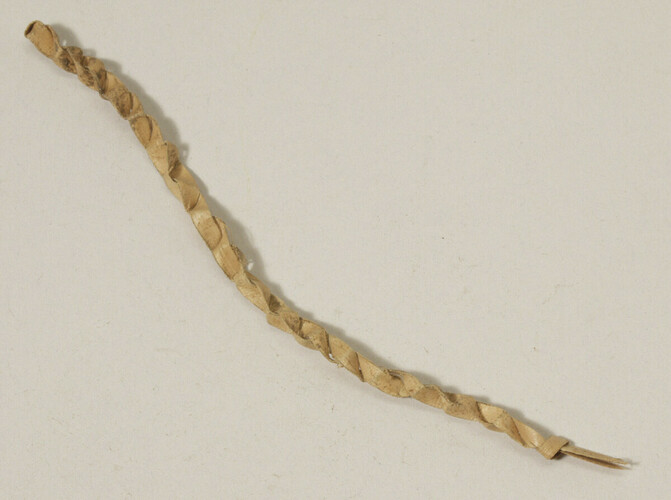 1979.20.149Roulette for decorating pottery, made from plaited and twisted grass strips [RTS 25/5/2004].1979.20.149
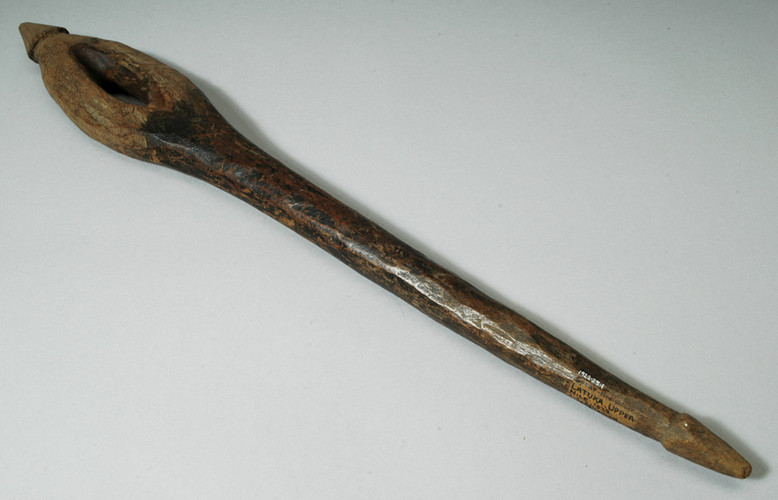 1922.25.1Wooden shaft-straightener with conical knob at top, broad upper body with oval hole through centre and cylindrical handle with conical butt [RTS 28/6/2005].1922.25.1
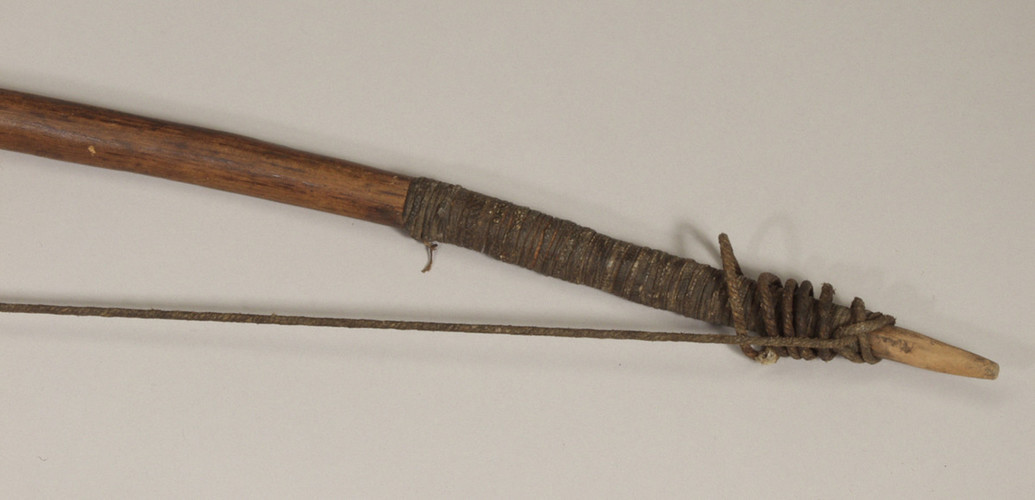 1917.25.6Wooden bow with sinew bow string and reptile skin binding [RTS 20/2/2004].1917.25.6
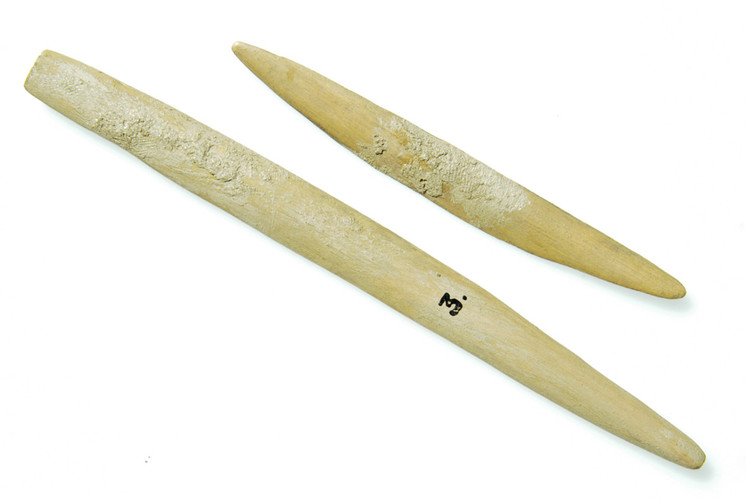 1934.8.132.4Narrow wooden spatula, cut flat at one end and pointed at the other, used as potter's tool [RTS 15/10/2004].1934.8.132.4