
- Collection type
- Object
- Description
- Sword [.1] with single edged long blade, velvet-padded counterguard and hooked pommel. With sheath [.2] [SM 02/05/2007]
- Long description
- Sword [.1] with single edged long blade, velvet-padded counterguard and hooked pommel. With sheath [.2] The counterguard, reinforcing blade strips and pommel are decorated with incised patterns of leaves and flowers. The reinforcing strips also depict the god Hanuman on one side and a male figure holding a lotus flower? on the other side. The blade has a fuller on each side near the spine. The grip is bound with string, but much of this is now missing. The pommel is decorated with a copper alloy disc, divided into eight sections with a hole through each section. [SM 02/05/2007]
- Date / Period
- Date made: Before 1935
- Date collected
- By 1935
- Acquisition information
- Transferred: 1935
- Materials and processes
- Material Steel Metal, Material Velvet Textile, Material String, Material Copper Alloy Metal, Process Forged (Metal), Process Incised
- Dimensions
- Width: max 128 mm sword, Length: max 1350 mm sword
- Object numbers
- Accession number: 1935.48.11.1
- Research and responses
The following notes are drawn from research compiled by Andy Mills as part of the DCF Cutting Edge Project 2006-2007. This is a fine example of a Rajput khanda – a two-edged longsword with strong reinforcement fillets along the majority of the back edge, and the lower part of the front edge. These reinforcements are fretted in a manner reminiscent of Rajput architectural forms, such as we see in the palaces of Jaipur, Jodhpur and so on (Wikipedia). Insofar as this sword was a gift from the Maharaja of Jaipur, this style is hardly surprising. The section of the blade is flat, and the reinforcements serve to counteract the extreme flexibility of the blade’s steel. This combination of a highly flexible steel blade and inflexible reinforcement plates creates a useful mixture: a blade that will withstand impact, and neither chip nor shatter easily, without bending out of shape. There is quite clear evidence on the middle portion of the blade of True Damascus steel – dark longitudinal striations in the steel resembling the grain of wood
The khanda is a weapon of considerable cultural significance in India. It was known as the ‘national sword’ of Orissa, and carried by each member of the Pahris, one of the Mahratta landed militia of that eastern region (see Indian & Oriental Armour. by Lord Egerton of Tatton, published in 1896 by Arms and Armour Press. p107).
As Egerton (see Indian & Oriental Armour. by Lord Egerton of Tatton, published in 1896 by Arms and Armour Press. p.105) discusses, the khanda is an integral part of the 9-day Hindu festival of Nauratra / Navaratri in Rajasthan and other Rajput areas.
The khanda also has great cultural significance for Sikhs, and the chosen symbol for Sikhism is known as the khanda, containing a composition of a central upright khanda, encircled with a chakram war-quoit, and fringed by two curved kirpan swords. The Sikh symbolism of the khanda draws on its two-edged nature, both blades requiring to be equally honed and in balance. This alludes to the one of the central teachings of Guru Gobind Singh (1666-1708), the 10th and last Sikh guru (see Sikhism by W. O. Cole,) published in 1994 by Hodder & Stoughton. p.13). Against the historical background of an genocidal policy of Aurangzeb (1618-1707), the 6th great Mogul emperor, whereby a war was waged to convert all Sikhs to Islam, or exterminate them (Wikipedia), Gobind Singh taught that the Sikh khalsa (religious community) should become sant-sipahi (‘saint-warriors’), both devout and martial. The khanda’s two blades symbolise this (Cole, ibid) necessary fusion of military and religious qualities, which has come to markedly characterise Sikh culture. [SM 17/06/2008]
What P.S Rawson categorised as a sukhela is a type of sword associated with southern India and particularly with south-eastern India: Madras, Mysore, the Mahratha territories and the Deccan (where the form is called a dhup). There is evidence to suggest that sukhelas were swords of state, rather than fighting swords...The presence of sukhelas in Mughal paintings - where they are shown being worn by courtiers or being received as gifts by the Emperor - would explain the status of such a sword as one quite likely to have been found in the private apartments of a prince. [Stephen Wood, contributor to the Oxford Companion to Military History (ed. R. Holmes, OUP: 2001), notes taken from www.stephenwoodresearch.com, accessed 08/01/2008. HA 08/01/2008]
Further items to explore
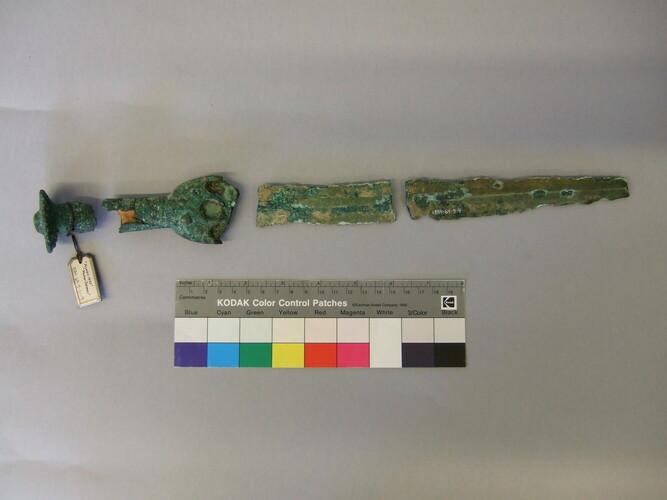 1884.64.9.1Sword, now in four pieces [.1 - .4].1884.64.9.1
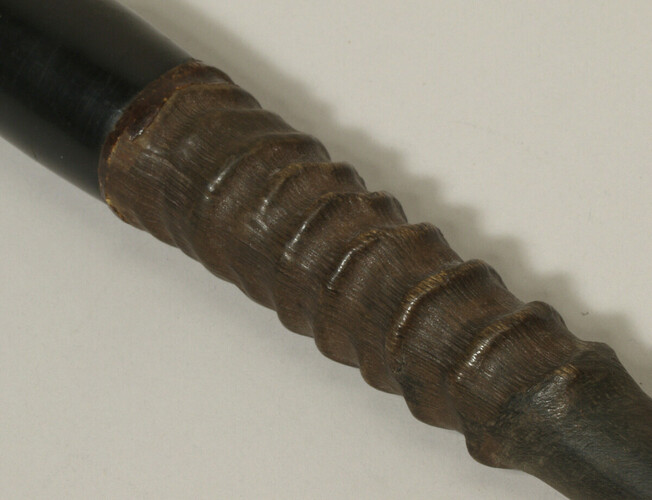 1915.25.101Staff weapon of an oryx horn with black lacquered wooden handle, with rounded butt. [El.B 23/08/2007]1915.25.101
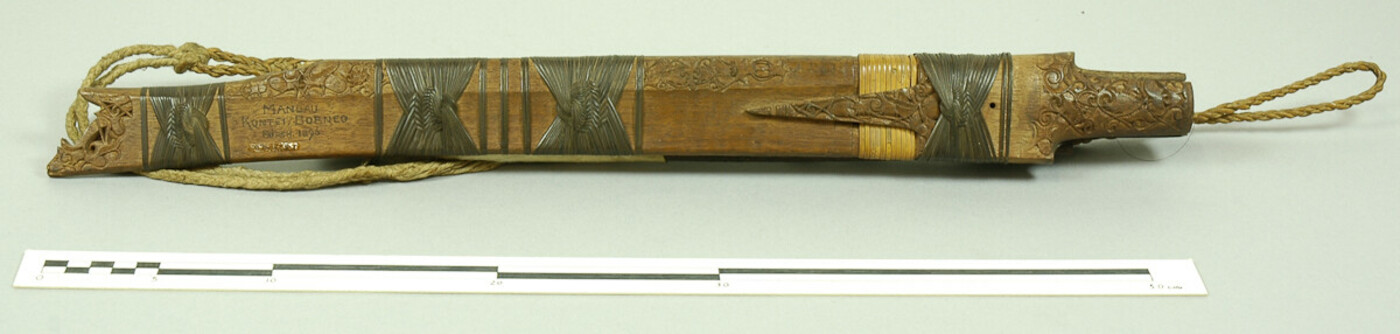 1896.67.5.2Carved wooden sheath [.2] for a sword [1896.67.5 .1]. The sheath is made of two pieces of wood bound together with cane [SM 15/02/2007]1896.67.5.2
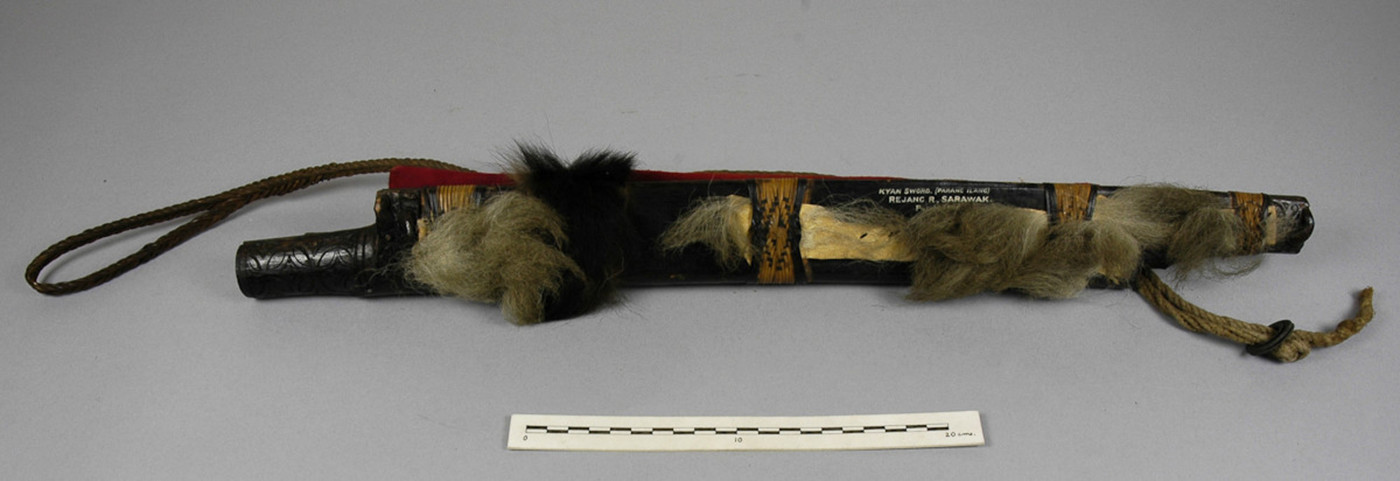 1900.63.1.2Wooden sheath [.2] for a sword [1900.63.1 .1]. Decoratively carved and bound with four bands of rattan and cane strips. [SM 16/05/2007]1900.63.1.2
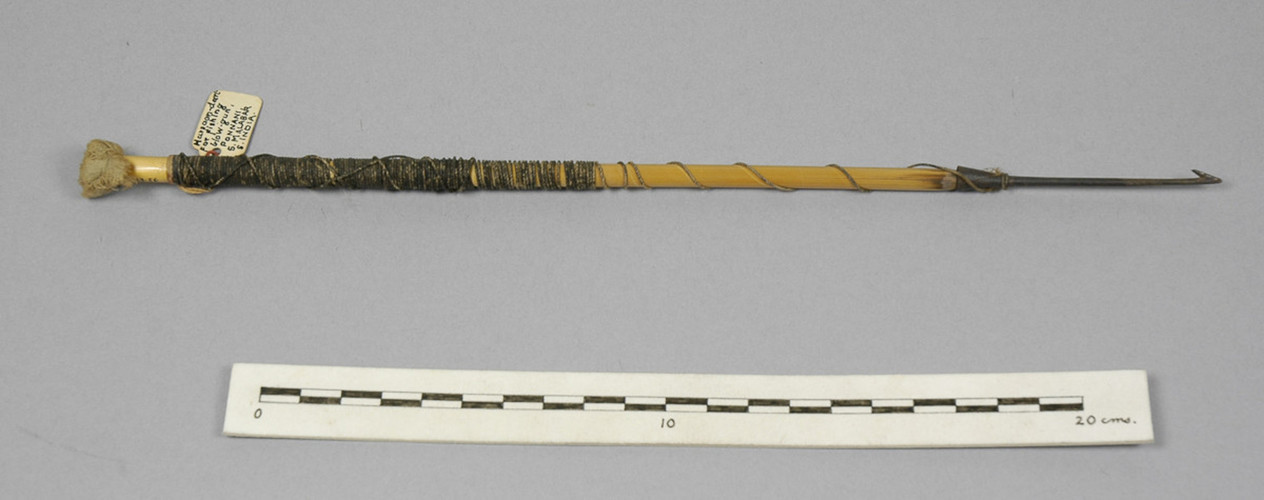 1923.56.1.2Harpoon-dart [.2] [for blowpipe 1923.56.1 .1], of bamboo, with barbed iron head and string for retrieving it. The butt is of ragged textile. [El.B 4/5/2007]1923.56.1.2
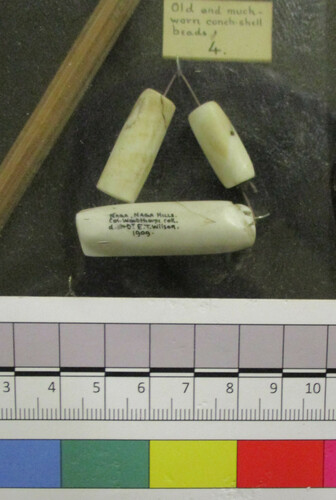 1909.21.64Shell bead, cylindrical with a central perforation and roughly rounded ends. [BS [OPS Move] 4/1/2017]1909.21.64
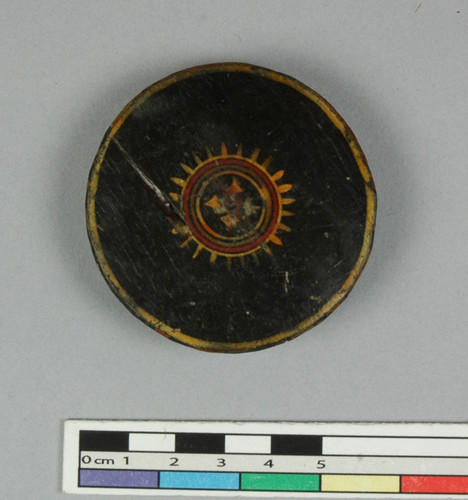 1925.28.24Circular painted wooden ear-lobe disc. [El.B DDF Body Arts Project 2010/2011 28/10/2010]1925.28.24
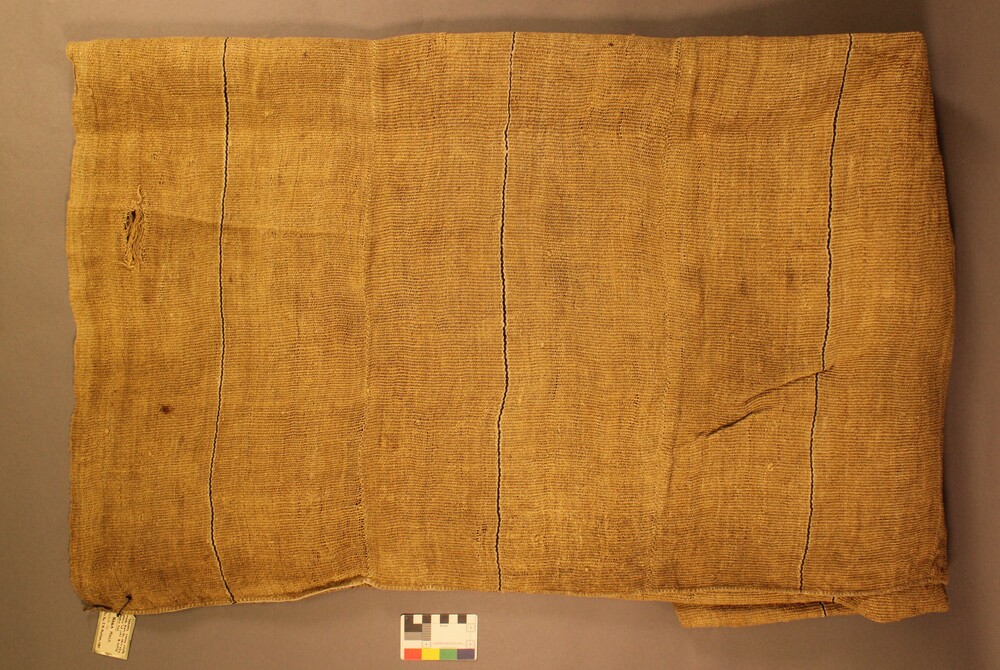 1923.84.152Coarse cloth made from the skin of a kind of jute gakro.1923.84.152