
- Collection type
- Object
- Description
- Sword, now in four pieces [.1 - .4].
- Person
- Maker Unknown Maker
- Field collector Peder Jensen
- PRM source Augustus Henry Lane Fox Pitt Rivers founding collection
- Date
- Date collected
- 1857
- Acquisition information
- Donated: 1884
- Materials and processes
- Material Copper Alloy Metal, Material Bronze Metal, Process Cast, Process Incised
- Dimensions
- Length: max 50 mm, Length: max 97 mm, Length: max 100 mm, Length: max 163 mm
- Object numbers
- Accession number: 1884.64.9.1 Accession number: 1884.64.9.2 Accession number: 1884.64.9.3 Accession number: 1884.64.9.4 PR Cat other PR nos: 1720
- Research and responses
These objects represent the earliest swords in Europe, and indeed, the earliest archaeologically attested manifestation of it globally – swords appear to have been invented in the Middle Bronze Age in the eastern Alps (Harding, 1998: 331-2). One important change in the Early Bronze Age (ca. 2000 – 1300 BC), predating that from which our swords come, was the introduction of the horse-drawn chariot around 2000 BC, although true riding (evidenced by the excavation of stirrups) was to come somewhat later, in the Middle Bronze Age. In the Middle (ca. 1400-1000 BC), and particularly Late (ca. 1000-500 BC) Bronze Ages, significant numbers of swords, sheet bronze armour and other weapons appear in the archaeological record, alongside a vastly increased incidence of hilltop fortifications. This seems to have gone hand in hand with the development of complex chiefdoms across Northwest Europe. Experimental archaeologists have tested replicas of swords such as these against the sheet bronze breastplates, shields and helmets which are associated with elite burials of the period. These tests have found that the soft metal armours were no match for these weapons, and easily cut through. Indeed, the leather and wooden armours and shields which the bronze versions mimic in form were found to be a much better defence against such swords. Consequently, archaeologists have argued that these bronze armours were high-status parade armours, and reflect a prominent militaristic culture of chiefly display in the later Bronze Age. These swords were an integral part of that display process. Metallographic analyses (Allen, Britton & Coghlan, 1970) have revealed a complex set of smithing skills being practiced in northwest Europe at this time, including casting, forging, cold-forging, annealing, and heat-treatments alluding to the beginnings of the pursuit of tempering, 3,500 years away in northern Europe (Megaw & Simpson, 1988: 258-9). Research Conducted for DCF Cutting Edge 2006/2007 [AM]
Further items to explore
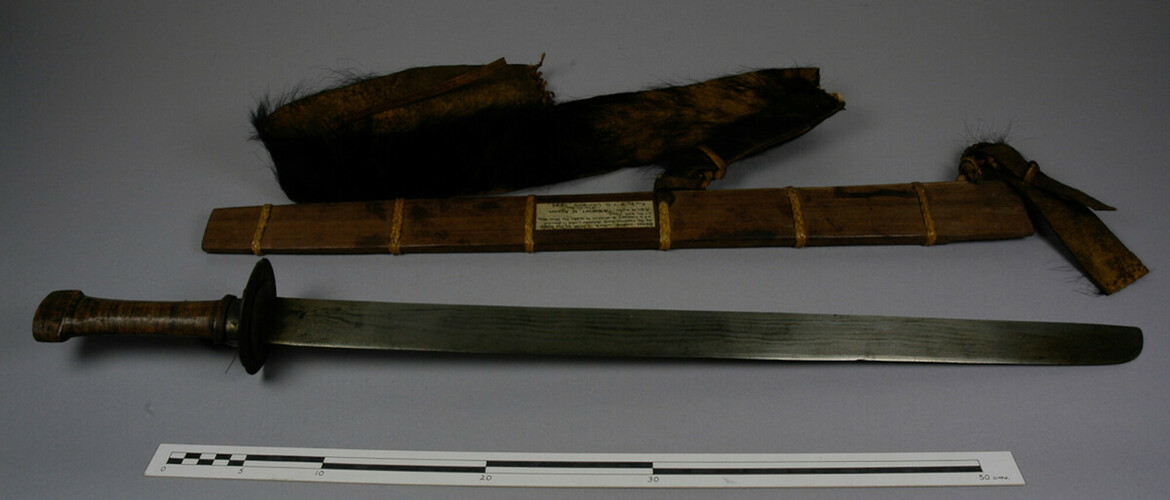 1936.36.94.1Short sword [.1] with loose brass discs on hilt. Wooden scabbard [.2] open on one side with a strap, which is broken, of animal hide with patches of dark fur. [ZM 29/3/2004]1936.36.94.1
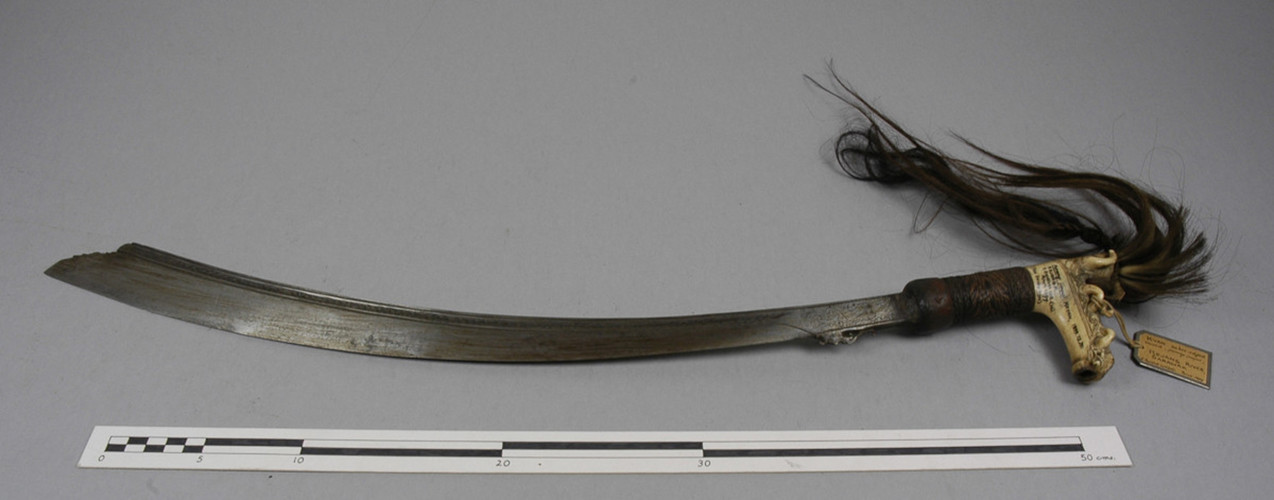 1899.72.29.1Sword [.1] with curved, decorated blade and carved ivory or antler hilt with dyed hair tassels. [Sheath 1899.72.29 .2] [SM 06/09/2007]1899.72.29.1
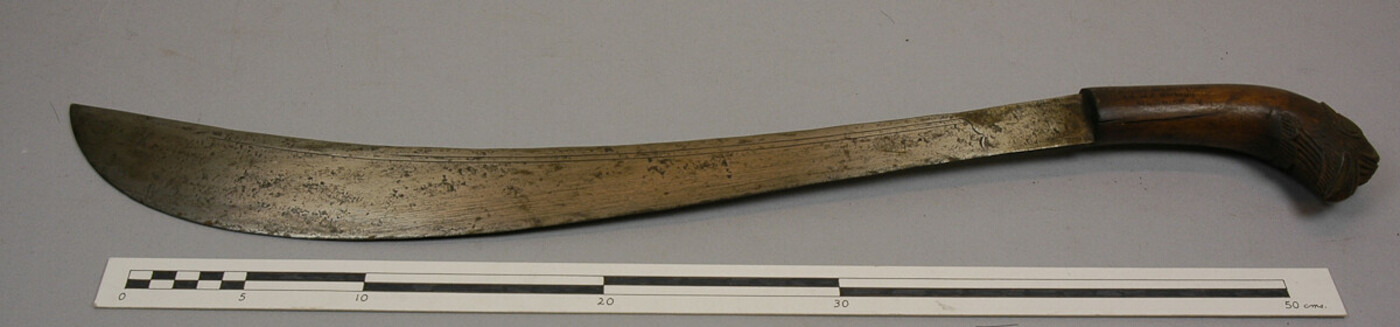 1945.6.55Sword with curved, single edged blade and wooden hilt carved in the shape of a bird's head. [SM 04/01/2008]1945.6.55
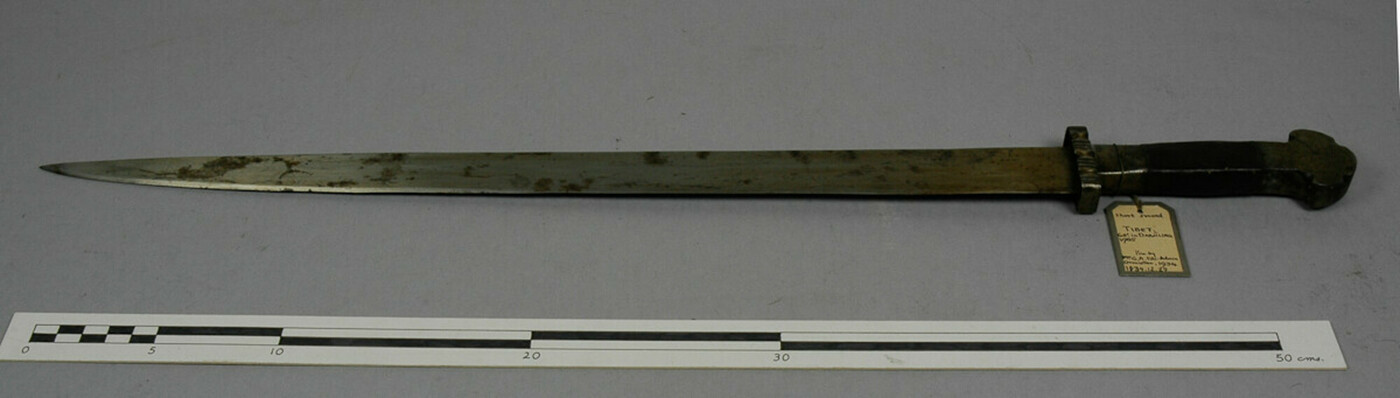 1934.12.29Short sword, single-edged, with hilt covered with iron and grip bound with leather. [El.B 14/11/2007]1934.12.29
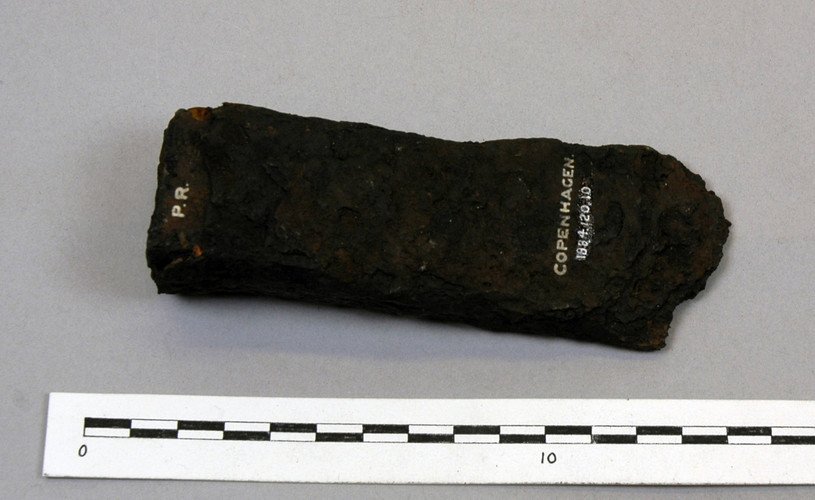 1884.120.10Axe head with slightly expanded blade. Very damaged at blade edge and missing its socket. [SM 28/01/2008]1884.120.10
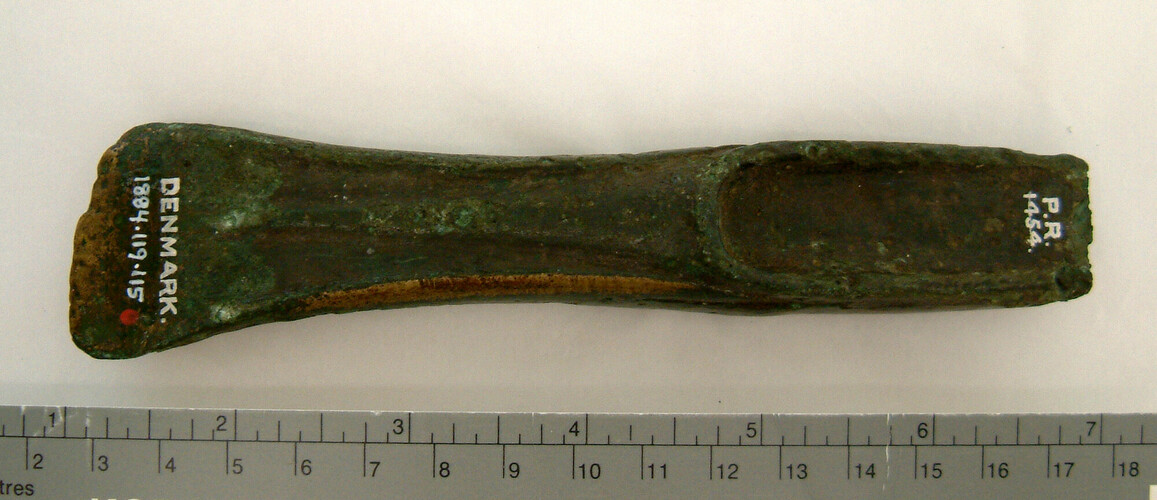 1884.119.115Long narrow bronze axe.1884.119.115
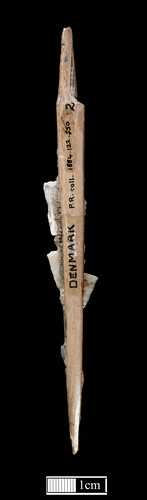 1884.122.550Bone projectile tip with four microlithic flakes embedded in the sides and held in with a resin-like substance [SM (Verve) 4/10/2016]1884.122.550
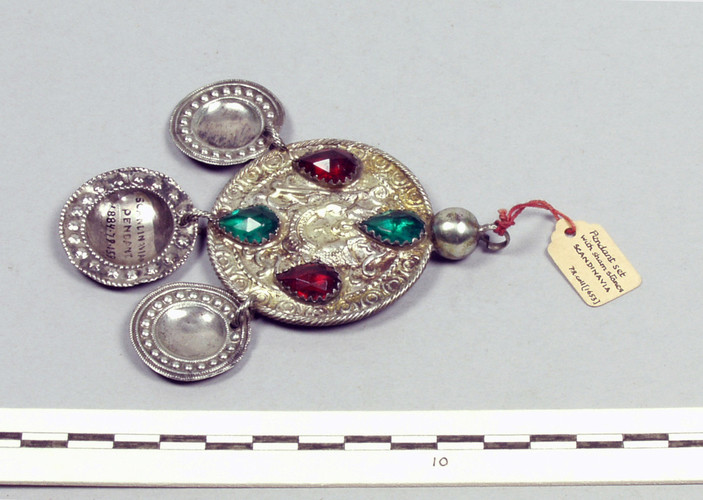 1884.79.159Disc-shaped pendant, silver gilt, with 3 pendant discs with embossed borders, centre of ornament embossed with winged angel torso set with 2 red and 2 green glass 'gems' [El.B 'DCF 2004-2006 What's Upstairs?' 26/7/2005]1884.79.159