
- Collection type
- Object
- Description
- Plaited hide belt with stringwork apron in front and projecting 'tail' at back, worn by married women [RTS 24/5/2004].
- Long description
- Belt and fringe apron made from 3 strips of dark brown animal hide (Pantone black 4C), plaited tightly together to create a herringbone design, and bent into a circle that would fit around the waist. The long ends have been left unplaited, and gathered together into a bundle that extends for a further 276 mm beyond the body, forming a 'tail' that would stand stiffly out from the back. This tail is kept stiff with another thin strip of hide that has been wound tightly around the body. The binding been secured at its base by pushing it through the plaited body of the belt; a second binding strip has been knotted on halfway along the tail before being tied off near the top. An apron made of a fringe of loose hanging strings with swollen ends has been attached to the centre of the belt, opposite the tail. These are heavily coated with red ochre, as is the belt itself (Pantone 477C), which partially obscures the method by which the strings are attached - although there seems to be an additional hide strip woven in and out of the body at this point. The object is complete and intact, although the end of the binding strip is beginning to fray. There are a few odd dark hairs projecting from the tail, beneath the binding; these could be the remnant of hairs still attached to the surface of some of the hide strips. The apron has a weight of 101.1 grams, and is 718 mm long. The tail measures by 7.5 by 9 mm across its bound area; the binding strips are 5 mm wide. The belt body is 6.5 by 8 mm wide; the string apron has a length of 126 mm, while each individual string is roughly 1 mm in diameter [RTS 30/7/2004].
- Cultural groups
- Lango
- Date / Period
- Date made: Before 1925
- Date collected
- By 1925
- Acquisition information
- Donated: 1925
- Materials and processes
- Material Animal Hide Skin, Material Ochre, Material String, Process Plaited, Process Knotted, Process Bound
- Dimensions
- Length 718 mm, Length 126 mm apron strings, Weight 101.1 g
- Object numbers
- Accession number: 1925.14.6
- Research and responses
Driberg discusses this type of garment in his book on the Lango: 'From about the age of five girls wear over the pudenda a few strings or threads (called chip) made from the hibiscus, increasing in number with the age of the wearer. There are attached to a thin leather girdle (del) which is fastened behind and twisted into a stick-like leather continuation (achudi) which projects backwards. If the father is prosperous, an unmarried girl wears an ariko, or apron of small metal chains in place of threads. (J.H. Driberg 1923, The Lango, pp 64-65). The chip and achudi del are illustrated by a photograph opposite p. 64.
According to Driberg, achudi is simply defined as a Protuberance or projection. 'Achudi del' is specifically the projecting ends of this type of girdle (J.H. Driberg, 1923, The Lango, p. 359, defined in his Lango-English dictionary at the back of the volume).
Driberg's discussion in his book does not seem to suggest that this particular style of apron should be associated specifically with married women, as stated in the accession book entry - unless this is implicit in the size of the chip. Yet presumably the description of the object in the accession book had originated with the donor - and this information appears on what seems to be a non-PRM tag which probably have arrived with the object.
2 decades after Driberg published his book on the Lango, Hayley observed that 'The chip is only worn on certain ceremonial occasions by the modern woman who wears clothes' (T.T.S Hayley, 1947, The Anatomy of Lango Religion and Groups, p. 183) [RTS 14/6/2004].
Search terms: Clothing, Ornament, Status, Marriage, Waist Ornament, Belt, Apron, Status Object, Groin-cover
Further items to explore
 1966.1.517.12Penannular iron arm or leg ornament with trapezoidal section and overlapping ends [RTS 21/7/2005].1966.1.517.12
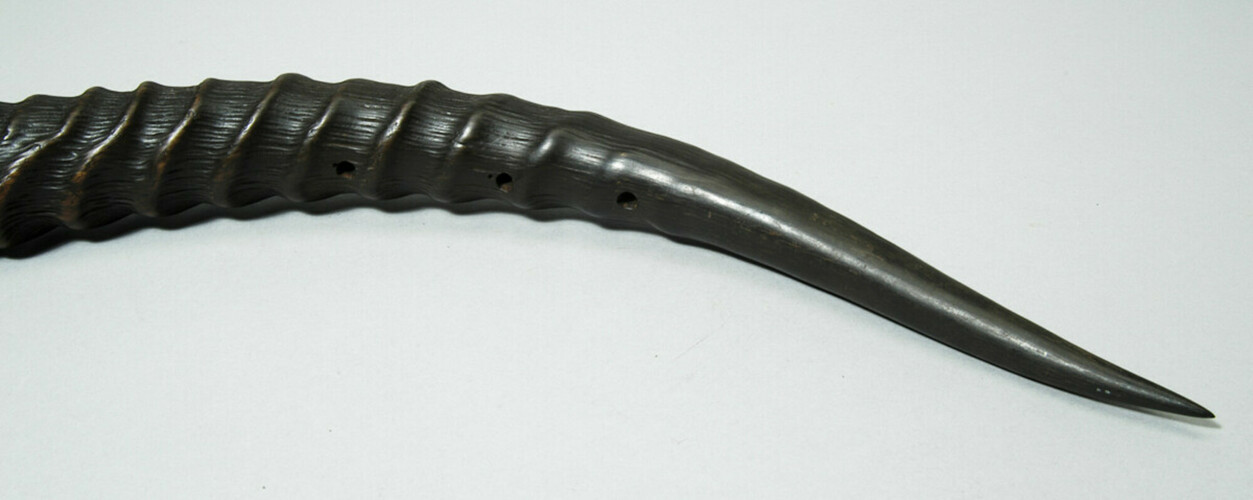 1925.14.14Large notched end-blown flute carved from a waterbuck's horn, with added resin narrowing the embouchure and 3 finger-holes on the concave side [RTS 7/12/2004].1925.14.14
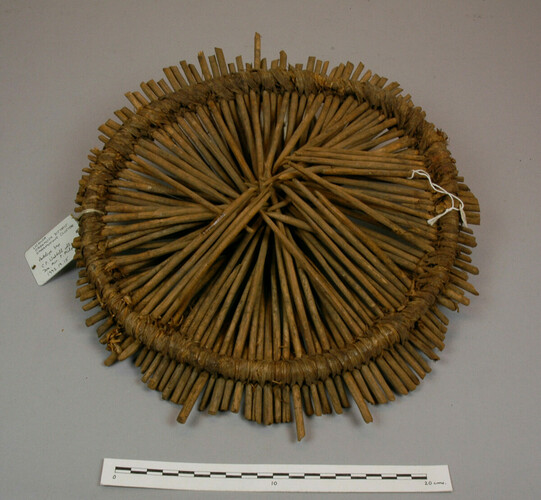 1992.19.15'Wheel' trap for antelope: a large number of sharpened sticks bound in a ring so that their points meet at the centre of the circle. [SM 27/11/2007]1992.19.15
 2017.255.1.3Arrow with wooden shaft and iron head. For associated quiver and arrows see [2017.255.1 .1 - .16]. [EH [OPS move] 30/10/2017]2017.255.1.3