
- Collection type
- Object
- Description
- Large notched end-blown flute carved from a waterbuck's horn, with added resin narrowing the embouchure and 3 finger-holes on the concave side [RTS 7/12/2004].
- Long description
- Large notched end-blown flute carved from a waterbuck horn, hollowed out inside. This has a broad notched embouchure through which the instrument is played, with concavely cut front and back edges; thick lumps of a dark resinous material has been applied inside the sides of this opening to narrow it, reducing the aperture to an hourglass-shaped hole. Below this, the body follows the natural shape of the horn, with obliquely ribbed body that curves convexely along its length before tapering to a narrow, sharp point at the other end, which is smooth and unribbed. Three circular finger-holes have been burnt into the concave upper surface of the lower part, and have irregularly blackened interior walls. In 2 cases, there is a small starter hole to one side of the actual hole, perhaps representing early attempts to fix the position of these holes, which were not carried through. The object is complete and intact, with some damage where the surface has been scraped down on one side near the embouchure; it is currently a dark brown colour (Pantone black 7C). It has a weight of 755.9 grams, and is 612 mm long. The embouchure has an external length of 61 mm and a width of 59 mm, and an internal diameter of 50 mm; the finger-holes have a diameter of 8 mm and the starter holes measure 2 mm across [RTS 7/12/2004].
- Cultural groups
- Lango
- Date / Period
- Date made: Before 1925
- Date collected
- By 1925
- Acquisition information
- Donated: 1925
- Materials and processes
- Material Antelope Horn Animal, Material Resin Plant, Process Carved, Process Hollowed, Process Perforated
- Dimensions
- Diameter: max 61 mm, Length 612 mm, Weight 755.9 g
- Object numbers
- Accession number: 1925.14.14
- Research and responses
Driberg 1923, The Lango, defines the term min (pl. megi or mege or mon) on p. 395 of his English-Lango dictionary as "Female that has given birth, mother; applied also to indicate size (used of animals, etc., not of persons, except in a few conventional insults)" and min bilo as "bass flute". He gives the more generic name for flute as otule - the accession book entry spells this 'atule'. Driberg states that bass flutes of this kind were made from adult waterbuck, cob, roan or tragelaphus, and that they have 3 stops which are made by burning with a heated spear butt. "The correctness with which they judge the intervals for boring the stops is remarkable. Indeed, it is unusual to see a flute which has had to be restopped, the original stops having been filled up with beeswax" (Driberg 1923, The Lango, p. 124).
For further discussion of these instruments and their use, including in consort with other flutes, see M. Trowell & K.P. Wachsmann, Tribal Crafts of Uganda, 1953, pp 345-7. This can also be described as a 'stopped' flute, as the body is not open ended at its base (compare this to examples such as 1934.8.87, which has a finger-hole at its distal end [RTS 26/1/2005].
'Finger-stops' however are not an accurate way of describing the finger-holes; stop is an archaic and confusing term for finger-hole that is no longer used [HLR 26/1/2005].
This object could not be examined by Peter Cooke during a research visit in April 2012, but after looking at the database entry he made the following comments: This instrument was not available but the description here matches well the description of the Lango cone flute in Tribal Crafts of Uganda p. 343, 345 and Pl. 81A. The playing style resembles that of other cone flute ensembles of northern Uganda and the enseegu music of the western kingdoms.
A copy of the report sent by Peter Cooke after his research visit has been placed in the Researcher's file. [El.B 09/05/2012]
Search terms: Music, Musical Instrument, Flute
Further items to explore
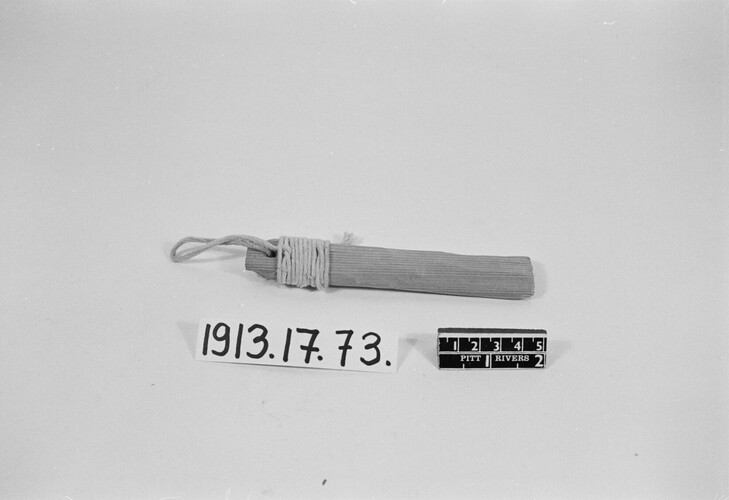 1913.17.73'Bullroarer'1913.17.73
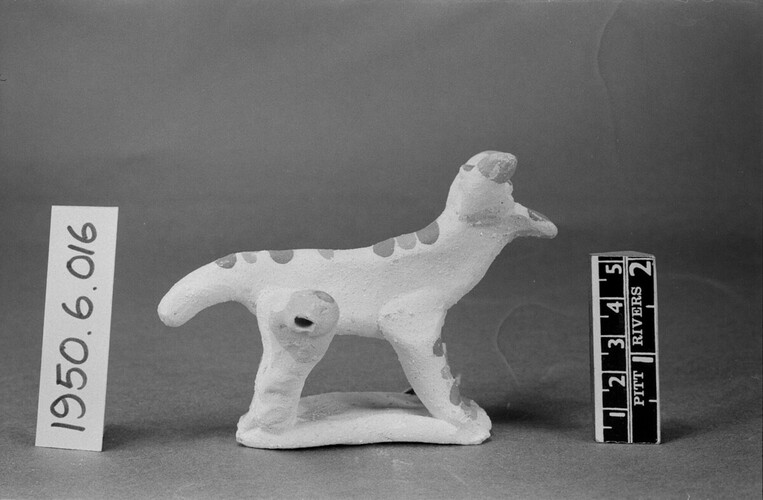 1950.6.016Whistle in the form of a bovine.1950.6.016
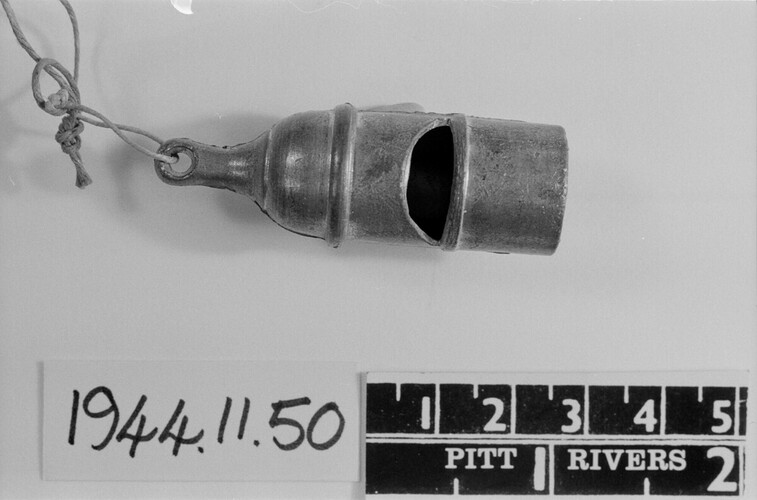 1944.11.50One-note flageolet type toy whistle.1944.11.50
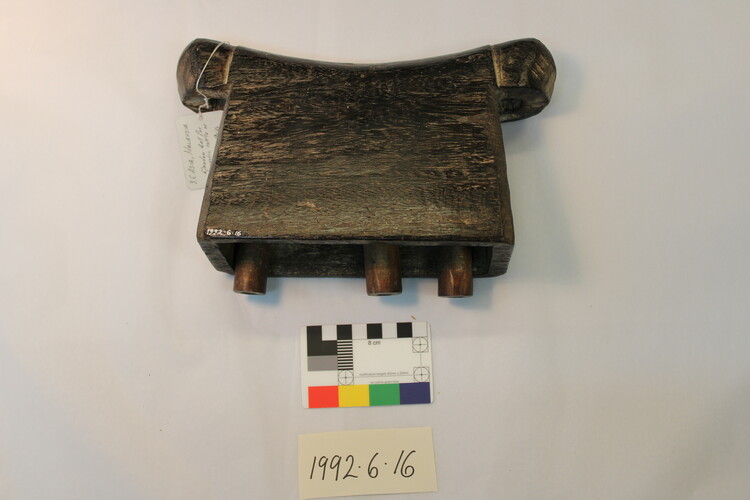 1992.6.16One of six wooden animal bells1992.6.16
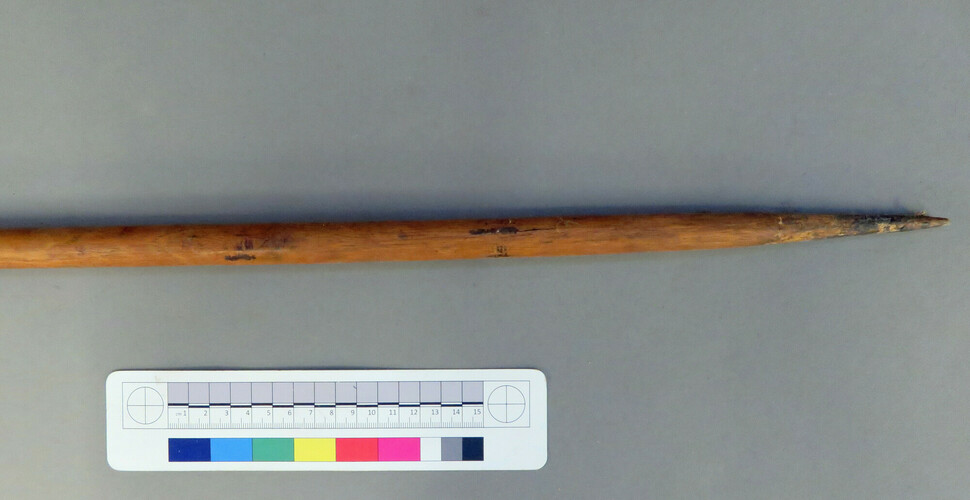 1992.19.49.1Wooden shaft of a spear carved to a point at both ends. For the blade see 1992.19.49 .3 and the butt 1992.19.49 .2 [PH [OPS move] 29/6/2018]1992.19.49.1
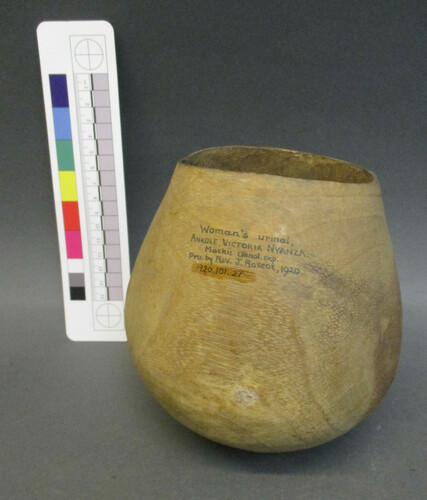 1920.101.27Globular wooden pot, with rounded bottom narrowing to the undecorated rim. [MOBB [OPS move] 10/10/2016]1920.101.27
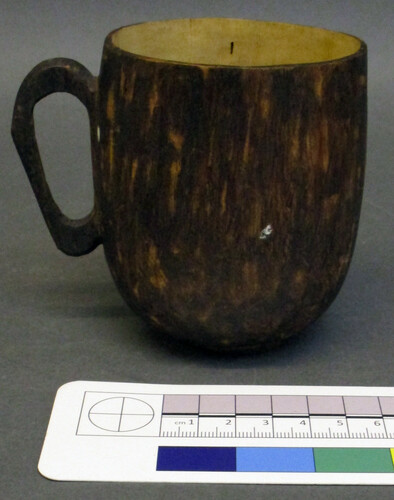 1992.7.23.1Stained dark wooden cup. Flat base and rim with a carved handle to one side. For the saucer see [1992.7.23 .2] [RM [OPS move] 6/10/2016]1992.7.23.1
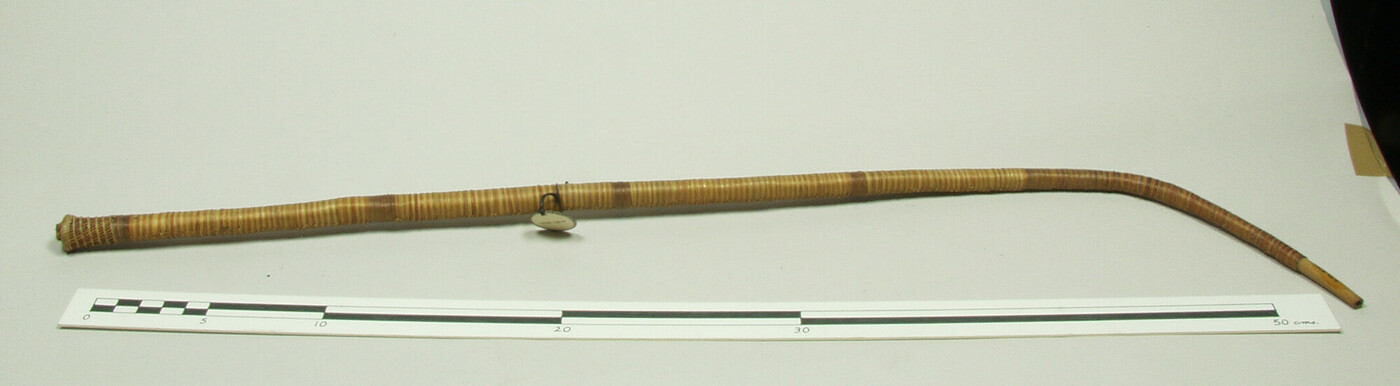 1909.45.4Beer-straining drinking tube, curved, with basketry top, bound with plant fibre in differently coloured stripes. [El.B 'DCF 2004-2006 What's Upstairs?' 7/4/2005]1909.45.4