
- Collection type
- Object
- Description
- Rectangular hide strip, edged with blue and white glass beads with iron beads at one end, worn hanging down from the back of an apron by married women [RTS 13/12/2004].
- Long description
- Married women's garment made from a rectangular strip of animal hide, folded over at both ends and sewn down with a simple tacking stitch using thin hide thongs. At one end, a narrow strip of hide with orange hair still present in patches has been passed through the loop created by this fold, leaving two long hide ends to serve as belt ties. One of these ends has been loosely knotted near its base. The opposite end has been decorated with a fringe made from 5 short strings of iron disc beads; each bead is made from a narrow rectangular iron piece bent into a loop. There are between 5 and 6 beads on each string; these are heavily encrusted with ochre and some a resinous surface residue and are not clearly distinguishable from one another. The belt body has been edged with a series of glass beads arranged in regular patterns that alternate between 13 groups of long opaque turquoise cylindrical beads, strung side by side with each group consisting of from 3 to 6 beads, and 13 groups of short white ring beads, strung in vertical columns of two beads each (in one case there are 3 beads), then arranged side by side with each group consisting of between 2 and 6 beads. All these beads are threaded onto plant fibre string which is then sewn onto the edges of the belt. The turquoise beads (Pantone 3125C) are made over an opaque white core, similar to beads found amongst the Lotuko (see 1946.8.101). The shorter ends of the belt are also decorated with these beads. The end with the beaded tassels has a row of 6 turquoise beads, arranged in 3 groups of 2 beads with spaces between; these are sewn to the folded over flap of hide at the base of the tassels. The opposite end is decorated with 4 rows of beads stitched on across the width of the belt, covering the fold. The two middle rows consist only of the turquoise beads; the outer two rows alternate 1 turquoise and 1 white bead. There are a further two turquoise beads running at right angles to these rows at the sides. The object is heavily encrusted with red ochre on belt body and partially over bead edging (Pantone 477C). It is nearly complete, but along one edge of this border there are several beads missing - a single blue bead, a group of 2 white beads strung together, and then a row of 3 turquoise beads. The object weighs 92.9 grams and has a total length of 763 mm, with the strip ties extended, while the hide part of the belt body is 510 mm long and 48 mm wide, including the glass bead edging. The ties are 10.5 mm wide and 1 mm thick. A typical blue glass bead is 5 mm long and has a diameter of 4 mm, while the white beads are 2 mm long and have diameters of 3.5 mm, and the iron beads are 3 to 4 mm long and 5 mm in diameter [RTS 28/7/2004].
- Cultural groups
- Lango
- Date / Period
- Date made: Before 1925
- Date collected
- By 1925
- Acquisition information
- Donated: 1925
- Materials and processes
- Material Animal Hide Skin, Material Iron Metal, Material Glass, Material Plant Fibre, Material Ochre, Process Beadwork, Process Stitched, Process Strung, Process Tied, Process Hammered, Process Bent, Process Twisted
- Dimensions
- Length: max 763 mm, Width 48 mm, Length 510 mm belt excluding ties and fringe, Weight 92.9 g
- Object numbers
- Accession number: 1925.14.4
- Research and responses
This type of garment is said to have been worn by women after the birth of a child, and is called a lau. It was worn at the back of the chip or cip, a fringed stringwork apron attached to a narrow hide belt; this would hang down from the del, a tail of hide strips that sticks out from the back of the chip, to below the knees (M. Trowell & K.P. Wachsmann, 1953, Tribal Crafts of Uganda, pl. 44.C.3, p. 188).
Driberg describes the use of this kind of garment: "In the case of a woman who has borne a child, a strip of leather (lau) about two or three inches in breath hangs down behind from the girdle to below the knees. It is given to her by the father of the child". He later defines Lau (plural: La'ni) as 'skin', lau nyar, as the skin apron worn by men and lau ngony as a woman's tail (J.H. Driberg, 1923, The Lango, p. 65; p. 391) [RTS 12/8/2004].
Hayley describes the lau as '.. a long strip of leather that is attached to a string around a married woman's waist and hangs behind almost touching the ground. It is put on the woman at the ceremony of tweyo lau... In The Lango Driberg referred to this strip of leather as a 'tail'. The Lango have translated this into ib (the tail of an animal), and they are furious that Driberg should have written in his book that the Lango have tails just like animals. The lau is not worn by the modern woman who wears clothes, except on certain ceremonial occasions (T.T.S Hayley, 1947, The Anatomy of Lango Religion and Groups, p. 194). He describes the ceremony of tweyo lau on p. 83, which is seen as a procedure that made a marriage official - usually triggered by the arrival of a child. The lau used in the ceremony is an old one brought by the mother-in-law, made of oribi skin (amyem); she also provides the chip to go with it. In his day, women only wore these items for the three or four days of the actual ceremony. They are believed to have magical properties (p. 83-87) [RTS 7/2/2005].
The iron beads on this garment are of the same type seen on 1925.14.5. The blue beads on this object look very similar to the type of bead found on 1946.8.101, which are attributed to the Lotuko and Bor Dinka, the accession book for that object commenting: 'LOTUKO-SPEAKING TRIBES ... known as gwen bor, which are very highly valued by the LOTUKO who stole them, according to DINKA tradition, from the BOR DINKA. They [insert] LOTUKO [end insert] say they went with OMURUK (their name for EMIN PASHA) to BOR & brought the beads back. Among the BOR DINKA they are even more highly prized & cattle can be bought with them. The BOR DINKA can readily distinguish the true gwen bor beads from imitations, the LOTUKO do not object to having others of the same colour mixed with the genuine ones as in these specimens'. The beads on this object share the same type of colouring; the cylindrical shape (although these are cut to longer lengths) and the opaque white glass core [RTS 16/6/2004].
Search terms: Clothing, Ornament, Bead, Status, Marriage, Apron, Waist Ornament, Status Object
Further items to explore
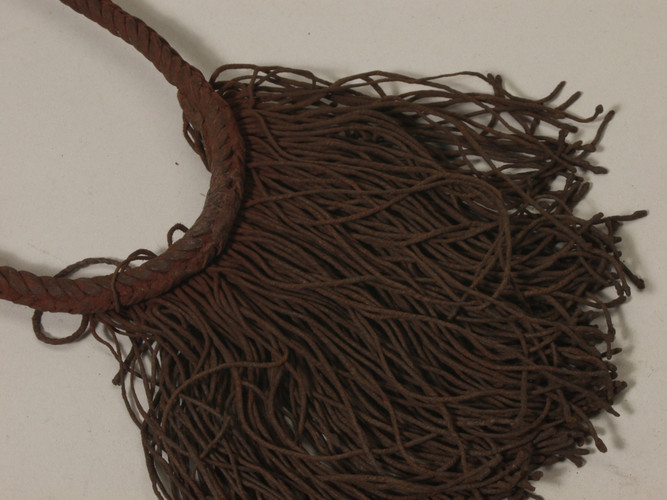 1925.14.6Plaited hide belt with stringwork apron in front and projecting 'tail' at back, worn by married women [RTS 24/5/2004].1925.14.6
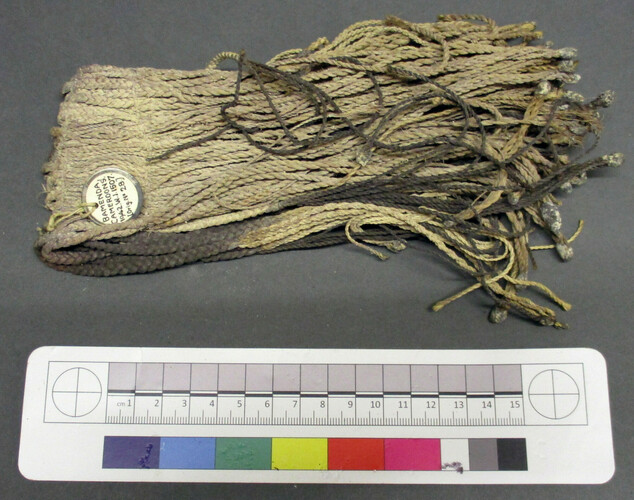 1942.13.1507Waist ornament, string apron. [ASh [OPS move] 13/12/2016]1942.13.1507
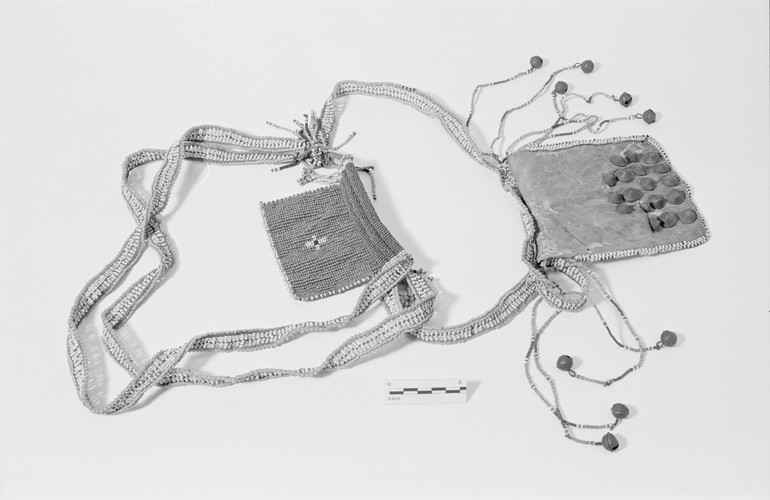 1997.19.17Beadwork waist ornament.1997.19.17
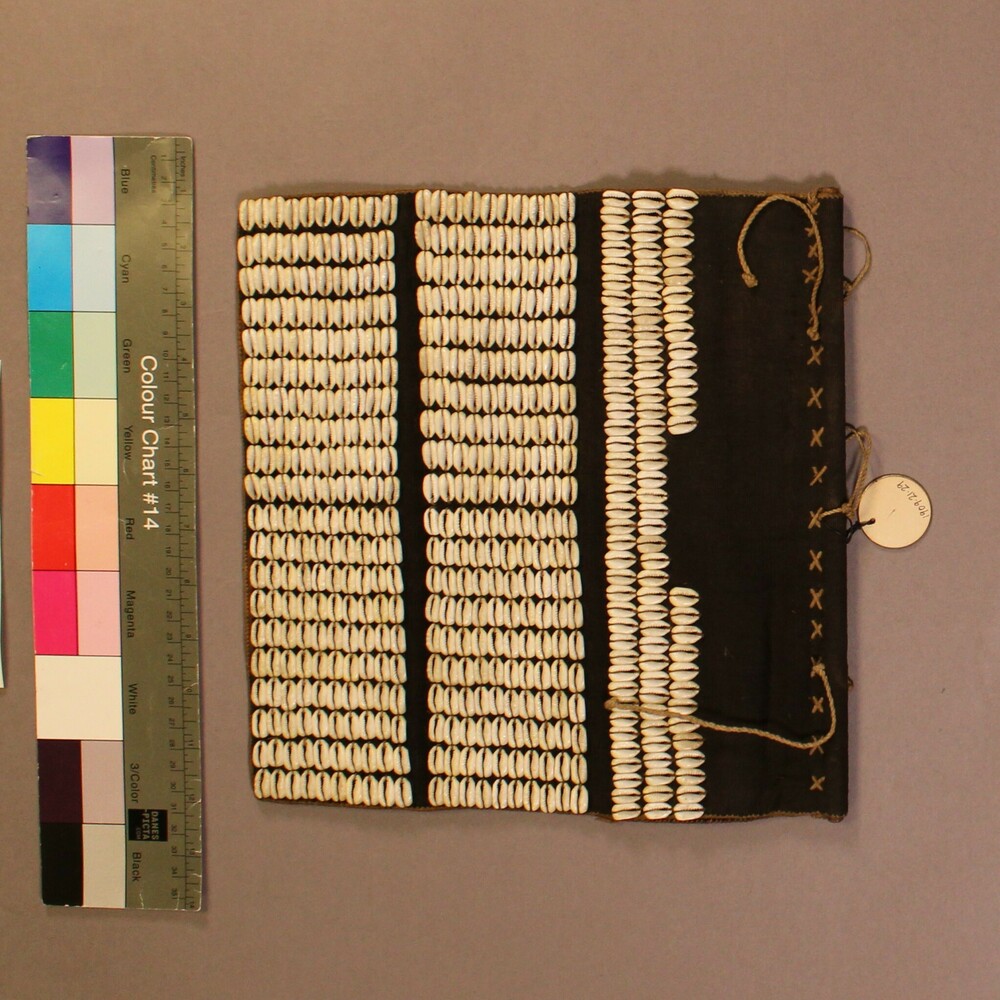 1909.21.29Partly defensive man’s apron1909.21.29
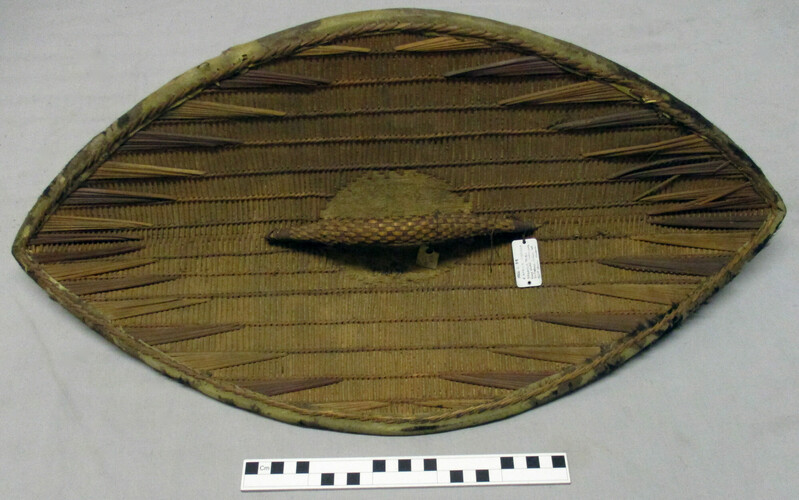 1966.1.39Oval shaped wooden shield with slating sides. The shield is covered with a wicker work pattern and edged with hide overstitched with cane plant. There is a raised wooden boss in the centre. On the reverse there is a woven wicker handle. [CW [OPS move] 17/8/2016]1966.1.39
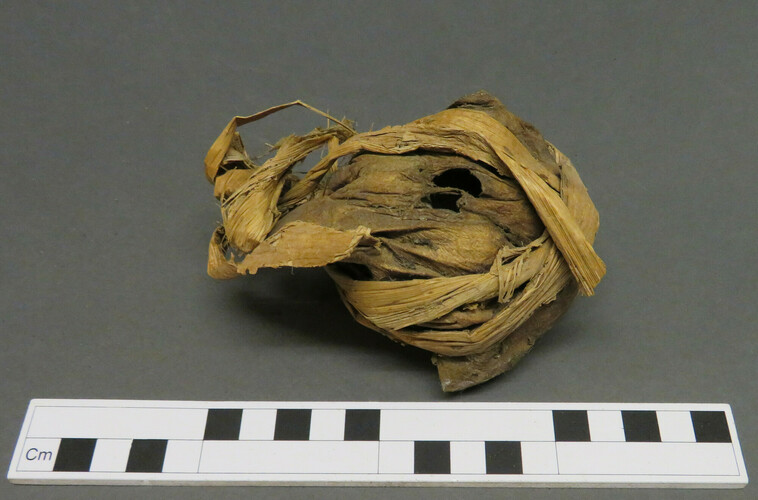 1921.9.172Medicine man's skin pouch. [ASh [OPS move] 10/5/2017]1921.9.172
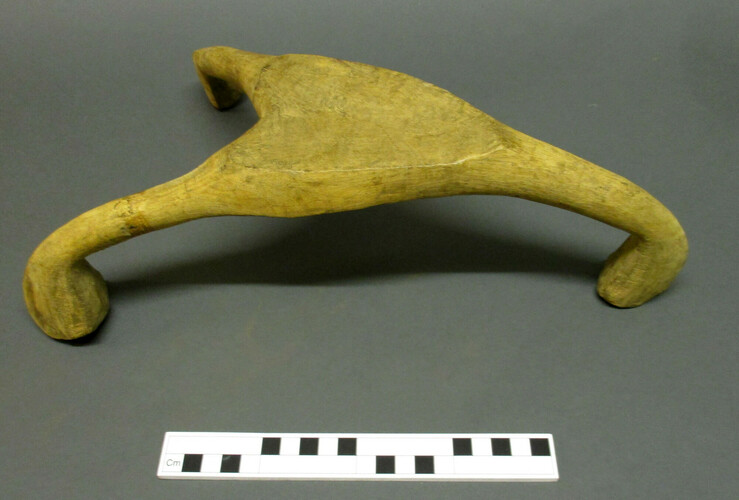 1970.13.24Carved wooden stool with three legs. The seat of the stool is heart-shaped and the each leg extends out from the seat and curves downwards towards a bulbous foot. [RH [OPS Move] 10/4/2017]1970.13.24
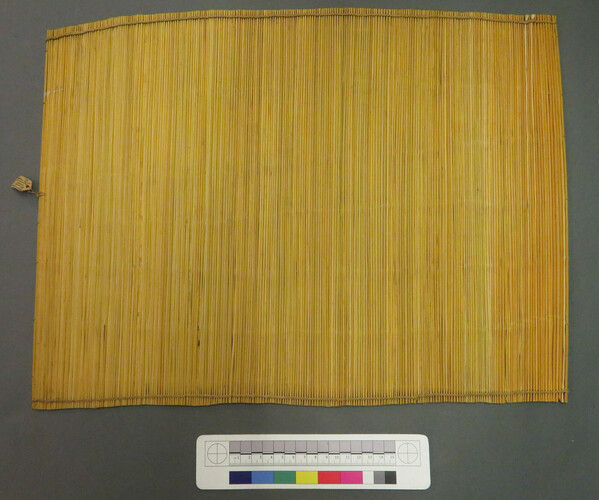 1921.9.81Royal milk mat. Rectangular, constructed from cylindrical strips of ?reed or ?cane plant fibre, stitched together with string along the long edges. [BS [OPS Move] 28/6/2017]1921.9.81