
- Collection type
- Object
- Description
- Artificial beard of plant fibre strands tied onto a plant fibre string.
- Geographical reference
- Cultural groups
- Kwanyama
- Person
- Field collector Antoinette Powell-Cotton
- Field collector Diana Powell-Cotton
- PRM source Antoinette Powell-Cotton
- Date / Period
- Date made: Before 1936
- Date collected
- 1936 - 1937
- Acquisition information
- Donated: 1940
- Materials and processes
- Material Plant Fibre, Process Tied, Process Twisted
- Dimensions
- Length: max 145 mm
- Object numbers
- Accession number: 1940.7.92 Other numbers: 37.2253
- Associated publications
- Featured in Out in Oxford: An LGBTQ+ Trail of the University of Oxford's Collections. Part of 'Celebrating Diversity' a project funded by Arts Council England via the Oxford University Museums Partnership and created with the LGBTQ+ community. [NC 16/02/2017] See booklet Out in Oxford: An : An LGBTQ+ Trail of the University of Oxford's Collections (published by University of Oxford) [in RDF]: Traditionally Kwanyama girls of marriageable age go through a five day initiation ceremony called the efundula. Towards the end of the ceremony the girls wear false beards and eyebrows to become ‘bridal boys’ who spend around 25 days living freely in the bush ‘as men’. During this period the girls assume ‘male’ gender attributes which are complemented by the ‘female’ behaviour of the men or future husbands. The false beard and eyebrows are part of the gender shifting of this ritual, with the girls’ dances mimicking the men, and the girls being well-armed and permitted to beat their future husbands. Any resulting pregnancies from this time are considered legitimate and result in marriage. The false beard is part of the elaborate costume that marks the culmination of her wanderings, the return to the village and the start of a new life in her husband’s home (by AKE). [NC 16/02/2017] See webpage [printout in RDF]: http://www.glam.ox.ac.uk/outinoxford-prm : False facial hair, such as this false beard, is traditionally worn by newly-wed brides in Angola. The Kwanyama people practise this tradition for young women around the time of their marriage. An initiation ceremony is held for the girls in the community called an efundula. After this ceremony, it is possible for the girls to get married. Once the marriage ceremony is over, a girl may not immediately go back to the home of her new husband. Instead, she may go into the wilderness and live there, freely, ‘as a man’. She may do this for about a month. Whilst there, she wears false facial hair, as part of the image of the ‘bridal boy’. This marriage ritual of adopting male characteristics is a traditional rite of passage, and marks the period of transition between girlhood and married life (by Rebecca Wood). [NC 17/02/2017]
Search terms: Ornament, Marriage, Clothing Headgear, Head Ornament, Wig
Further items to explore
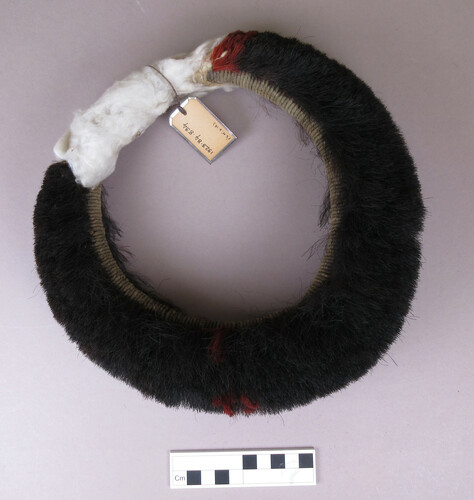 1923.84.834Avabo chaplet of hair plucked from the neck and shoulders of a bear, mounted on a cane ring, with a design in red hair representing a man and indicative of success in head hunting. Worn round the head by warriors. [DCF Court Team 22/2/2003]1923.84.834
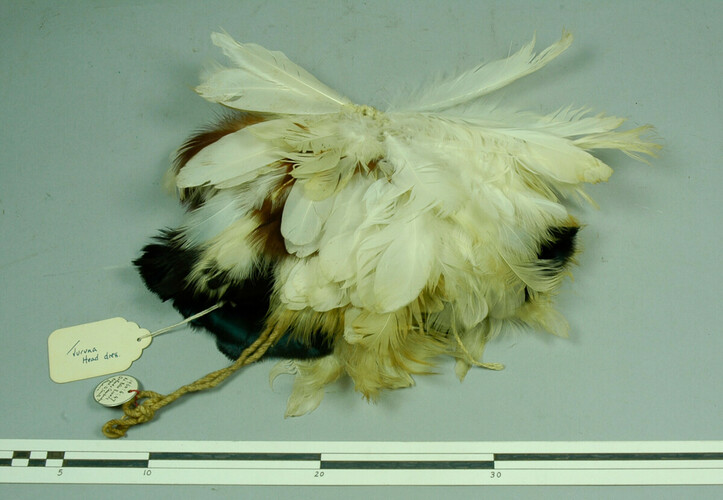 1960.6.47Headdress consisting of a woven cotton cap with white, brown and black feathers all over the outside surface. [El.B 16/12/2008]1960.6.47
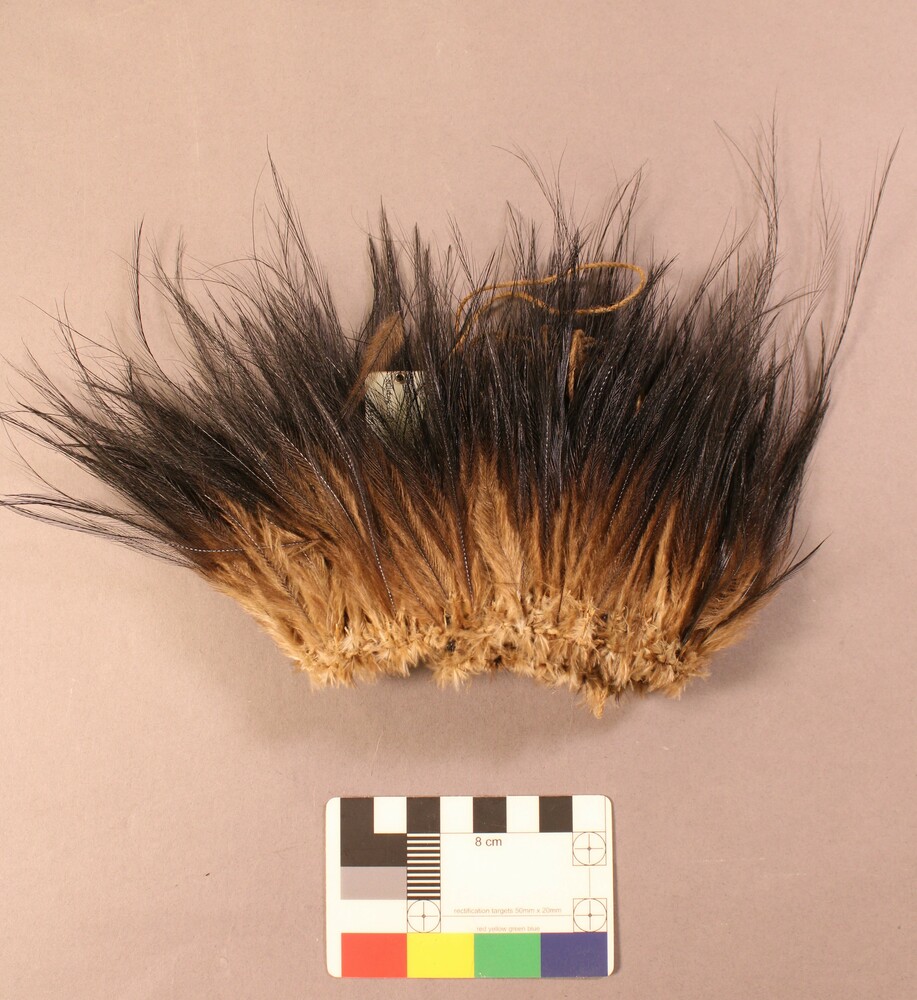 1979.21.15Cassowary feather fringe.1979.21.15
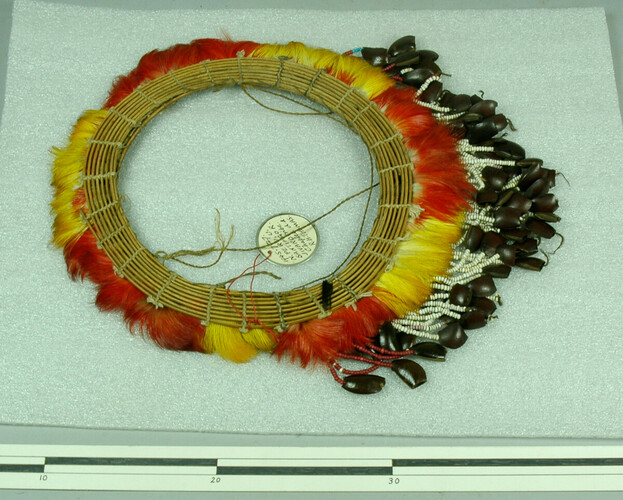 1945.7.27Feather and cane head ornament with seed and trade bead pendants.1945.7.27
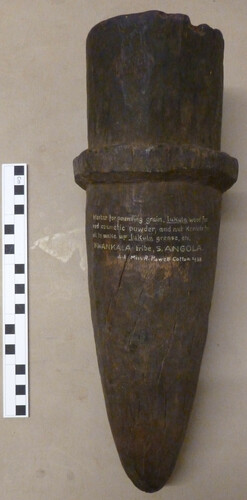 1938.22.3Mortar. Made from wood with a conical body and a ridge about a third of the way down from the mouth of the pounder. Used for pounding red cosmetic powder for greasing hair and body etc. Old and worn and stained with the grease from the wood. [ASh [OPS move] 26/10/2016]1938.22.3
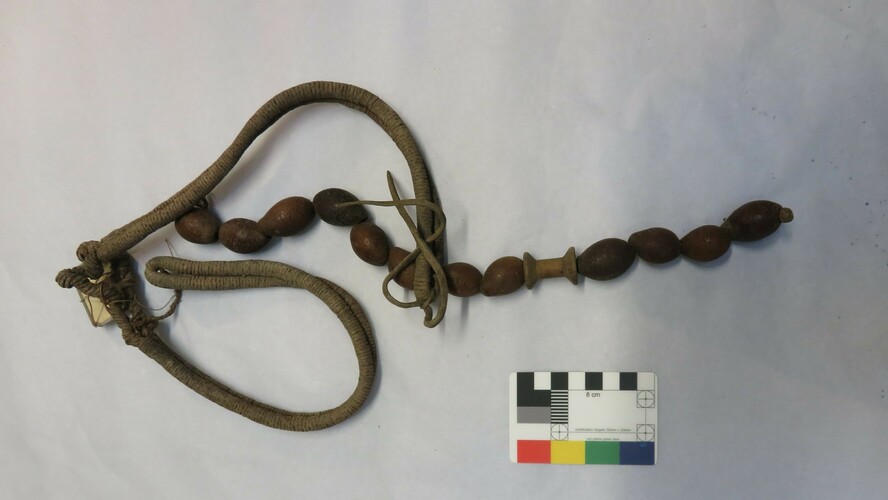 1941.12.156Gourd vessel rattle.1941.12.156
 1945.10.25.2One of four small pieces of crude iron ore as broken up ready for smelting. [El.B 26/11/2007]1945.10.25.2
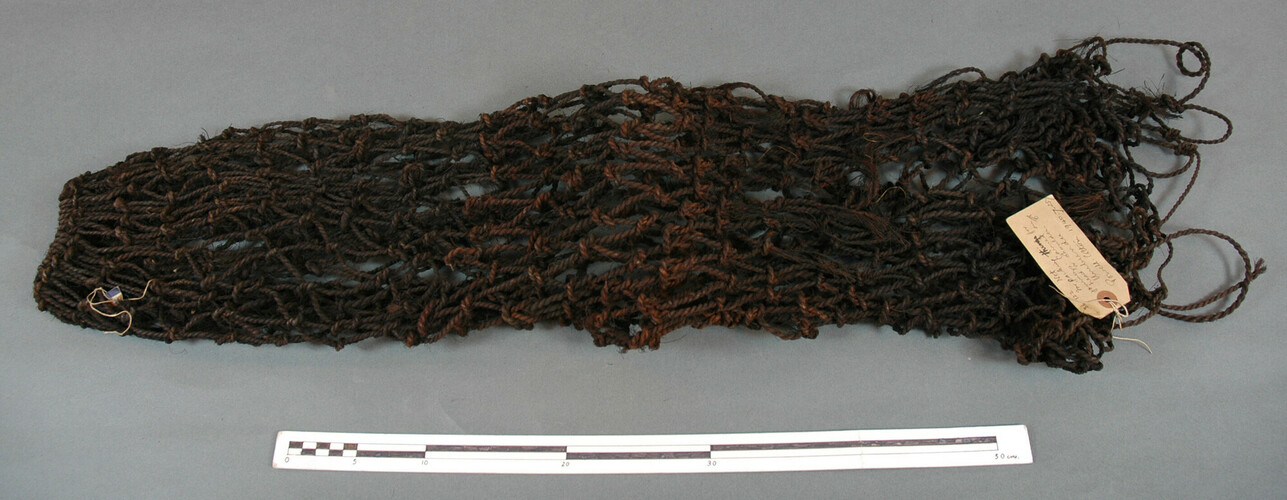 1940.7.257Carrying net of dark brown plant fibre. [MJD 12/12/2012]1940.7.257