
- Collection type
- Object
- Description
- Neck ornament of brass and iron beads in a single string [RTS 5/4/2004].
- Long description
- Plant fibre string, made of two twisted strands, on which 28 small iron disc beads, 114 brass convex sided ring beads, 1 thick brass disc bead, 15 brass convex sided ring beads and 25 iron disc beads have been strung. The string is tied and knotted twice at the top. Each bead appears to have a seam down one side. The necklace is in one piece, with all beads in place, and only minor corrosion around the edges of the brass ring beads. The iron is currently a metallic gray colour (Pantone 423C), the ring beads a dull metallic yellow (Pantone 873C), and the single brass disc bead a brighter metallic yellow (Pantone 871C). The string is 265 mm long, the smaller iron beads have a diameter of 3.2 mm, and the brass ring beads a diameter of 4.7 mm; the whole necklet weighs 43.7 grams [RTS 5/4/2004].
- Person
- Field collector Percy Horace Gordon Powell-Cotton
- Field collector Hannah Powell-Cotton
- PRM source Percy Horace Gordon Powell-Cotton
- Date / Period
- Date made: Before 1933
- Date collected
- 13th April 1933
- Acquisition information
- Donated: 1934
- Materials and processes
- Material Iron Metal, Material Brass Metal, Material Plant Fibre, Process Strung, Process Twisted, Process Hammered, Process Cast
- Dimensions
- Length 265 mm, Diameter: max 4.7 mm beads, Weight 43.7 g
- Object numbers
- Accession number: 1934.8.68 Other numbers: 667
- Research and responses
Schweinfurth discusses the role that early iron beads had to play in the Southern Sudan, amongst groups like the Jur Luo: 'iron beads or perforated little cylinders of iron… were earlier in use than glass beads… In the Soudan these string of beads were principally made at Wandala, and Barth has specially notied them at Marhi. Every tribe which I visited in proceeding inland from the Gazelle I found to retain the preference for beads made of iron (G. Schweinfurth, 1873, In the Heart of Africa Vol. I, 203-4."
According to “African ethnonyms: index to art-producing peoples of Africa” by Daniel P. Biebuyck, Susan Kelliher and Linda McRae (G.K. Hall & Co.: New York, 1996), the Latuka should be known as Lotuko [CW 23/3/2000]. Lotuko appears to be an alternative name for the Otuho, while the modern spelling of Laronyo is Loronyo. Powell-Cotton made ethnographic films during his 1932-3 shooting expedition to southern Sudan; footage included a Lotuko blacksmith and his forge and a female Lotuko potter at work (see the description in Mrs Powell Cotton, "Village Handicrafts in the Sudan", Man 34 (112), pp 90-91) [RTS 12/12/2003].
Search terms: Ornament, Bead, Neck Ornament
Further items to explore
 1921.93.514Perforated whale's tooth. [El.B 'DCF 2004-2006 What's Upstairs?' 9/12/2005]1921.93.514
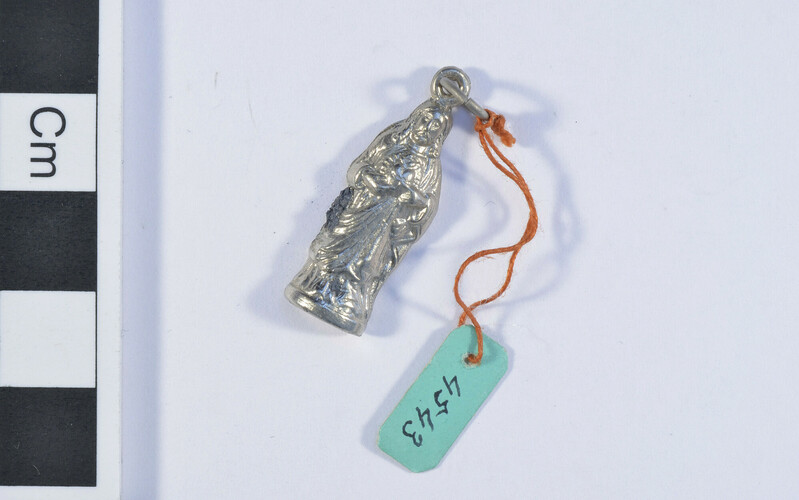 1985.52.2265Amulet, figure of Jesus depicted with a Sacred Heart on his chest, cast in white metal, with a loop for suspension. [RB 18/07/2012]1985.52.2265
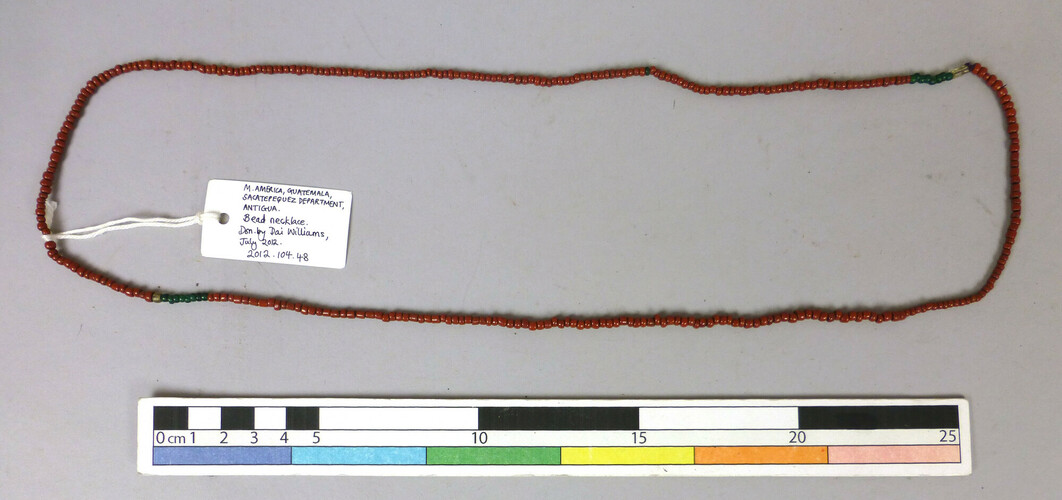 2012.104.48String of glass seed beads. Most of the beads are red with two sets of eight green beads and two clear white beads. [FB 01/04/2014]2012.104.48
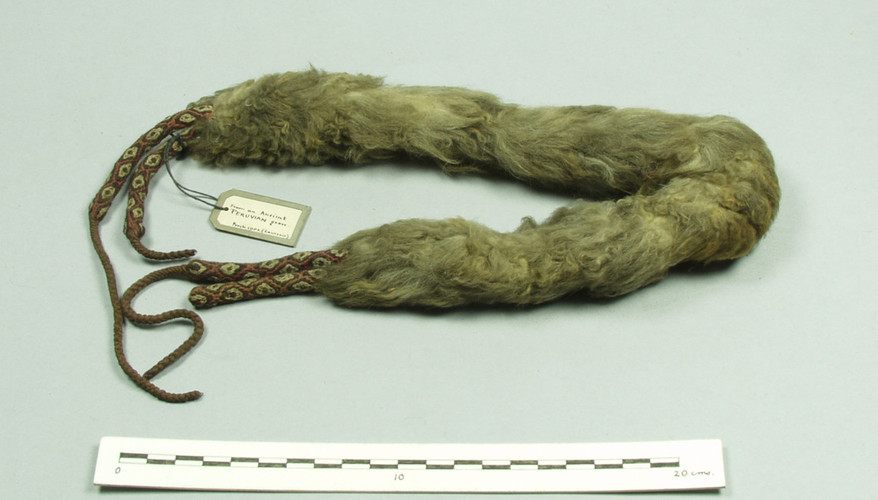 1902.69.7Grey fur (or wool?) neck ornament with black, white and red braids at each end and brown plaited ties [EC 'DCF 2004-2006 What's Upstairs?' 29/9/2005]1902.69.7
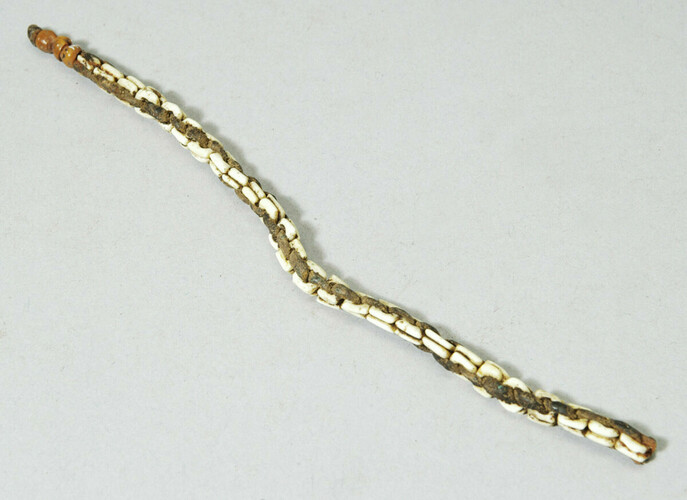 1940.7.075Decorative element from a girl's apron, made of square ostrich eggshell and brown spherical beads laced together with a strip of hide.1940.7.075
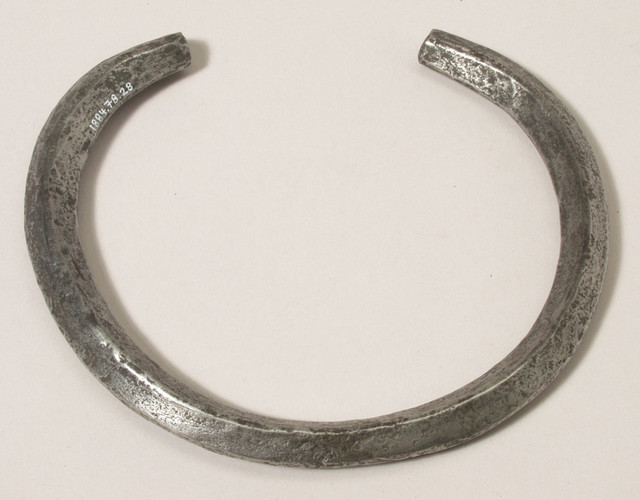 1884.78.28Heavy penannular iron torque with lozenge-shaped section [RTS 5/4/2004].1884.78.28
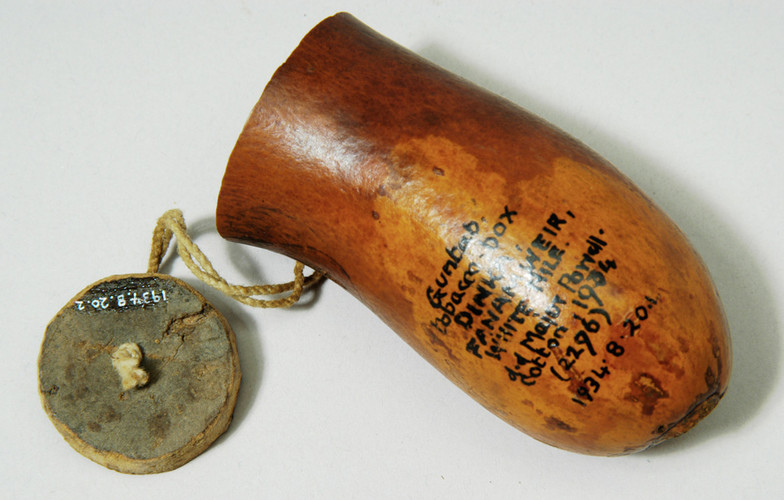 1934.8.20.1Tobacco-box made from the narrow end of a gourd [.1] with disc-shaped lid [.2] attached by string; contains some loose residue [RTS 22/9/2004].1934.8.20.1
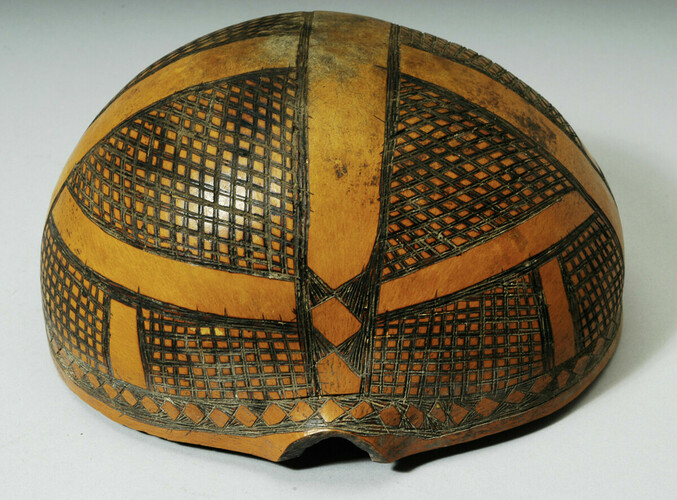 1979.20.50Hemispherical gourd bowl with short spout and pyroengraved decoration over exterior, probably used for eating [RTS 25/3/2005].1979.20.50