
- Collection type
- Object
- Description
- Hemispherical gourd bowl with short spout and pyroengraved decoration over exterior, probably used for eating [RTS 25/3/2005].
- Long description
- Hemispherical bowl made from a gourd, split longitudinally down the centre, with the pulpy interior removed and the shell dried out. It consists of a narrow flat topped rim, slightly indented on one side, and turning out from the rim opposite to form a short, broad spout; these areas represent the base and neck of the original gourd plant. The body is oval in plan view, and quite deep, with convex walls sloping down to a convex base. The interior is a matt yellow (Pantone 7508C), discoloured in the centre and over part of the walls. The exterior is a smooth orange colour (Pantone 7512C), with a few lighter yellow patches where the outer skin of the gourd was not completely scraped away (Pantone 7506C). The flat upper part of the rim and edge of the spout have been burnt black (Pantone black 7C), but the effect has worn away in places. The bowl exterior has been completely covered with a pyroengraved design, made by etching the surface with a thin metal tool and then burning in the patterns using a heated spear or knife. The design makes use of hatching to create textured bands, contrasted with the smooth, undecorated surface of the gourd left as reserve strips running both around the circumference and vertically down the sides. It consists of a narrow band just below the rim, filled with a row of hatched triangles pendant from the top line meeting a second row, pointing up from the base line - creating an hour-glass shaped motif. Below this, the bowl body has been divided into four quarters by vertical broad reserved strips, framed by straight lines. The strip that runs across the width of the body is further decorated with 2 pairs of hatched triangles at either end. Each of the quadrants has been divided into 2 horizontal registers by a narrow reserve strip. The upper register is filled with 2 rectangular areas of crosshatching; the lower register, which is triangular in shape, is completely filled with crosshatching. The bowl is complete, but has numerous insect bore holes in both interior and exterior walls. There is also a narrow cut mark along the inside edge of the rim in one area, left from removing the gourd interior. It has a weight of 167.3 grams, and is 273 mm long, 210 mm wide and 150 mm high, with walls that are 5 mm thick [RTS 30/3/2005].
- Geographical reference
- Northern Bahr el Ghazal Dhangrial
- Cultural groups
- Dinka Tuich
- Date / Period
- Date made: Before 1979
- Date collected
- 17 February 1979
- Acquisition information
- Purchased: 1979
- Materials and processes
- Material Gourd Plant, Process Hollowed, Process Dried, Process Decorated, Process Pyroengraved Pokerwork, Process Burnt
- Dimensions
- Height 150 mm, Length: max 273 mm, Width: max 210 mm, Thick 5 mm rim, Weight 167.3 g
- Object numbers
- Accession number: 1979.20.50 Other numbers: Langton Collection 100
- Research and responses
At the time this object was collected, the Bahr el Ghazal province was bordered by the Upper Nile Province to the east and Western Equatoria to the south; this area is now divided into the districts of Western Bahr el Ghazal, Northern Bahr el Ghazal, and parts of Warab and El Buheyrat. Dhangrial is located within Northern Bahr el Ghazal. For a map showing the distribution of Dinka Tuich groups, see J. Ryle, 1982, Warriors of the White Nile: The Dinka, p. 25.
Nebel gives the definition for Aduok, pl. aduk, as a large bowl, and Anyäl, pl. Anyel, as a calabash with drawings (A. Nebel 1979, Dinka-English Dictionary, p. 5, 10).
Although we are not specifically told this example was a food bowl, a similar vessel in Langton's list, 1979.20.91, comes with the comment: "Decorated gourds are used as plates for eating from by men or female guests".
Langton describes this method of decorating Dinka gourds in her entry for accession number 1979.20.91, with the pattern being marked out in charcoal, and then with a type of needle called a with (for this tool, which is made of iron, see 1979.20.59), which is then scored over using a heated spear or knife blade [RTS 3/12/2004].
Search terms: Vessel, Food and Drink, Bowl, Food Accessory
Further items to explore
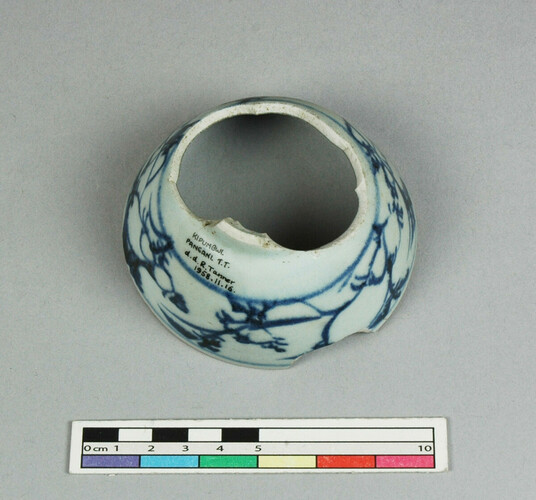 1958.11.16Portion of small bowl, with pale blue glaze and a band of dark blue floral design outside, circle at rim and lower down inside.1958.11.16
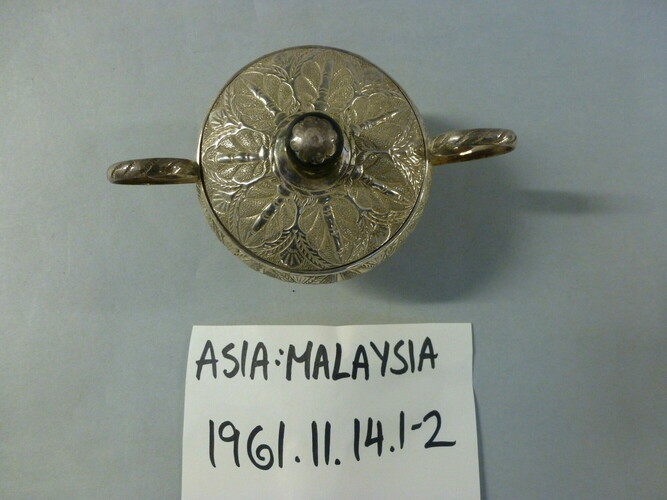 1961.11.14.1White metal vessel with scrolled handles. With a band of foliage design, and a plain base. For the lid please refer to [1961.11.14 .2] [BH [OPS move] 6/7/2016]1961.11.14.1
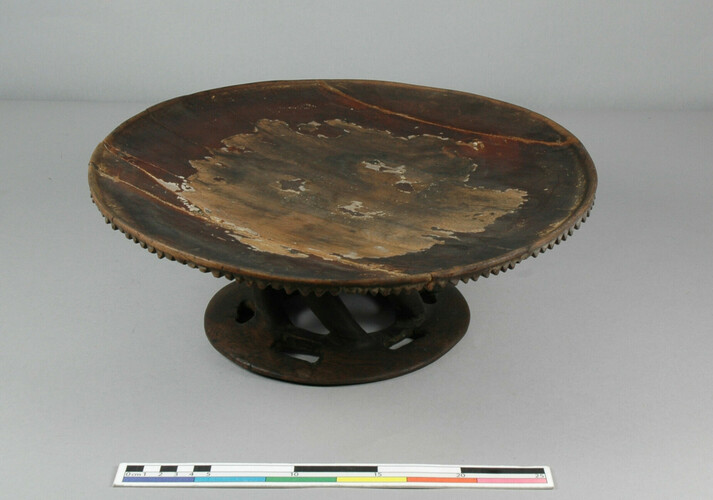 1884.6.20Wooden dish on a whirl of 6 open-work sloping legs on a round base; the edge of the bowl ornamented with a crenellated 'fringe'. The vessel is made of vesi wood. [El.B 01/11/2011]1884.6.20
 1931.52.1Long side-blown trumpet made of wood wound round with Monitor lizard skin, with cowries round bell1931.52.1
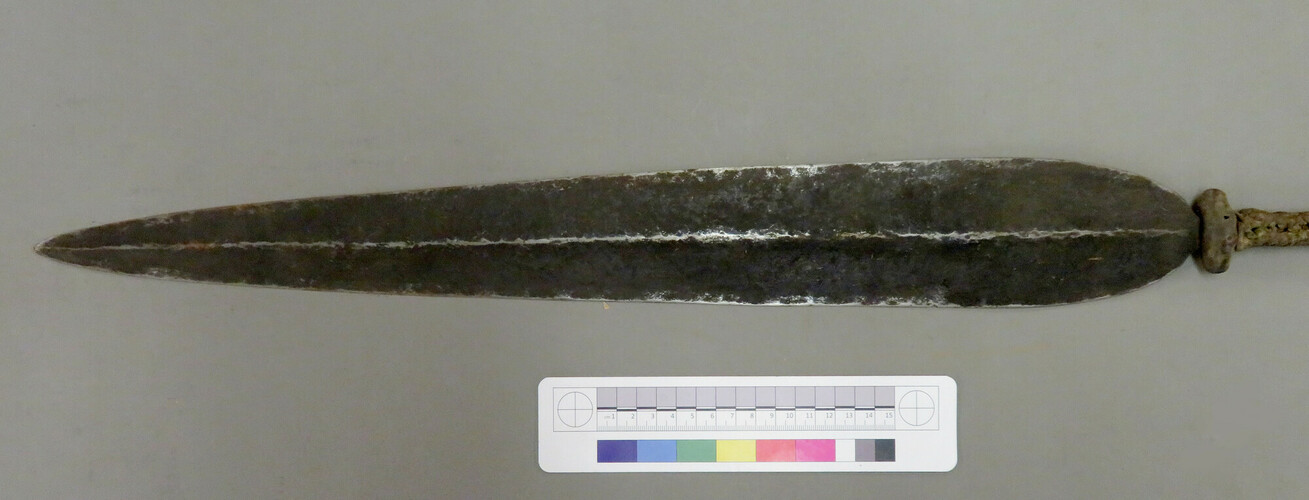 1940.7.077Iron stabbing spear with plaited hide bound handle and an iron ring at the end [RTS 25/7/2005].1940.7.077
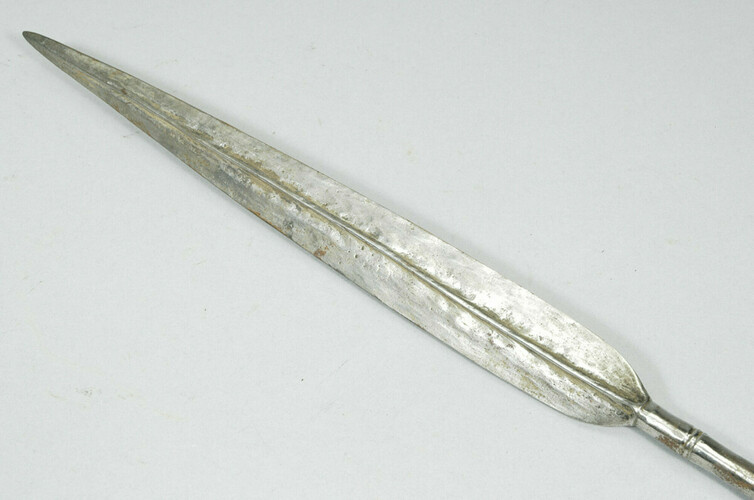 1979.20.76Spear with socketed iron point on a narrow wooden shaft, made by Baggara Arabs [RTS 12/1/2005].1979.20.76
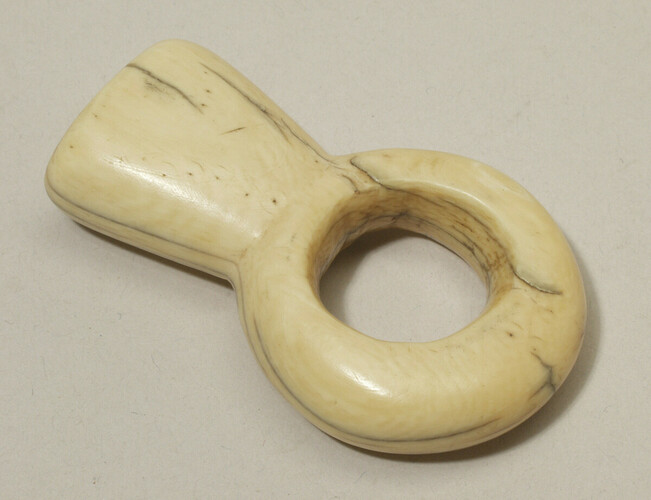 1979.20.124Ivory finger ring made from a recycled armlet, worn by men [RTS 8/7/2004].1979.20.124