
- Collection type
- Object
- Description
- Arrow with iron leaf-shaped blade and long tang set in a wooden shaft with nocked and bound end [RTS 28/9/2005].
- Long description
- Arrow consisting of an iron arrowhead with leaf-shaped blade, thickened at the centre with an angular ridge, and rounded shoulders, on a long narrow tang that is mostly round in section, although with some flattened areas. The base of the tang has been set into the top of a lightweight shaft carved from a single piece of yellow wood (Pantone 7508C). A narrow strip of plant fibre has been bound around the lower tang, with similar binding at the top of the shaft with one long section, a gap, then a shorter bound area. There is similar binding around the lower shaft, just above the nocked end which has 2 rectangular notches cut into opposite sides. The end of the butt has been blackened. All the binding has been stained a pinkish red colour, probably from use of a pigmented fixative (Pantone 4705C). The arrow is complete and intact. It has a weight of 64.9 grams, and a total length of 780 mm. The arrowhead has a length of 193 mm, down to its junction with the shaft; the blade is 80 mm long, 23.8 mm wide and 4 mm thick, while the tang has a width of 6 mm. The shaft is 586 mm long, 10 mm in diameter, and has a nock length of 11 mm; the upper binding is 17 mm long around the metal and 42 and then 8 mm long around the upper shaft, while the lower binding has a length of 29 mm [RTS 28/9/2005].
- Cultural groups
- Moru
- Person
- Field collector Percy Horace Gordon Powell-Cotton
- Field collector Hannah Powell-Cotton
- PRM source Percy Horace Gordon Powell-Cotton
- Date / Period
- Date made: Before 1933
- Date collected
- 26th April 1933
- Acquisition information
- Donated: 1934
- Materials and processes
- Material Iron Metal, Material Wood Plant, Material Plant Fibre, Material Pigment, Process Forged (Metal), Process Hammered, Process Carved, Process Bound, Process Notched
- Dimensions
- Length 193 mm arrowhead, Length 586 mm shaft, Width: max 23.8 mm blade, Length: max 780 mm, Length 80 mm blade, Weight 64.9 g
- Object numbers
- Accession number: 1934.8.33 Other numbers: 818
- Research and responses
Azumvuba is probably located somewhere around the town of Mongalla, either in the modern districts of Bahr el Jebel or Western Equatoria.
The Moru name for this type of object is atu. For a Moru bow, probably used with this type of arrow, see 1934.8.32; for an archer's hide ring, used to pull back the bow string, see 1934.8.34; all were collected by Powell-Cotton. A series of iron headed Moru arrows was also collected by Evans-Pritchard (see 1936.86.19.2-12, and 1936.86.18.2-15, and the quiver for holding them, 1936.86.18.1), and Patti Langton (1979.20.18-21). These share the use of pinkish stained fibre bindings around the base of the tang, top of the shaft and above the butt; the former was probably to prevent the arrow pushing too far into the shaft socket on impact, and the latter to prevent the wood splitting [RTS 28/9/2005].
A photograph in the museum's collection, probably taken by Powell-Cotton, shows a Moru man using a leather guard to draw back a bow; this was once on display with the actual object, but is now in the photographic archives (see photograph 1998.208.48.7) (information provided by Chris Morton).
Search terms: Archery Weapon, Hunting, Arrow, Arrow-head, Arrow Shaft, Weapon, Hunting accessory
Further items to explore
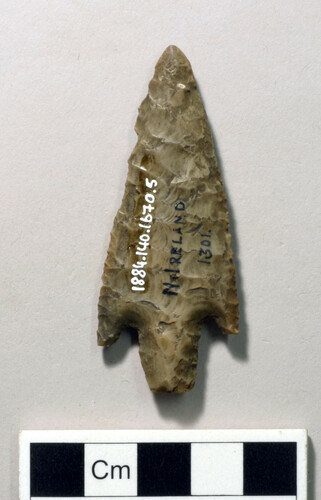 1884.140.1670.5Stone arrow-head1884.140.1670.5
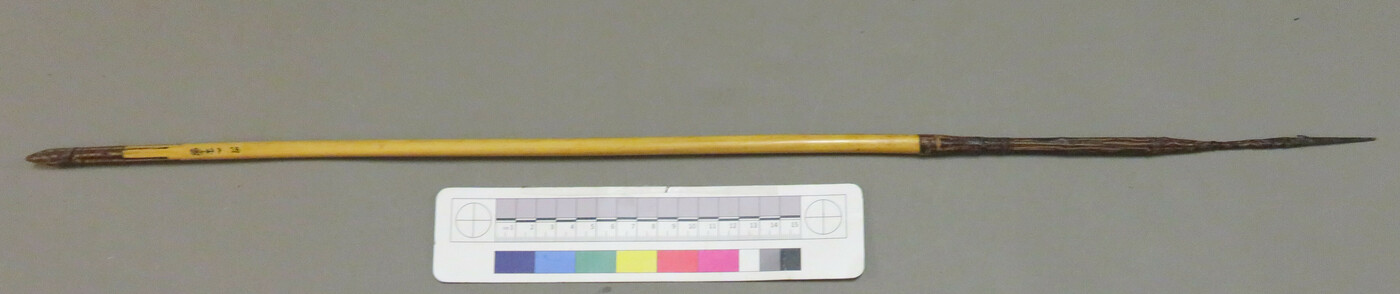 1884.17.7.28Arrow, made from a length of cane which is nocked at one end. The cane is bound with lengths of darker cane at each end. [ASh [OPS move] 18/10/2017]1884.17.7.28
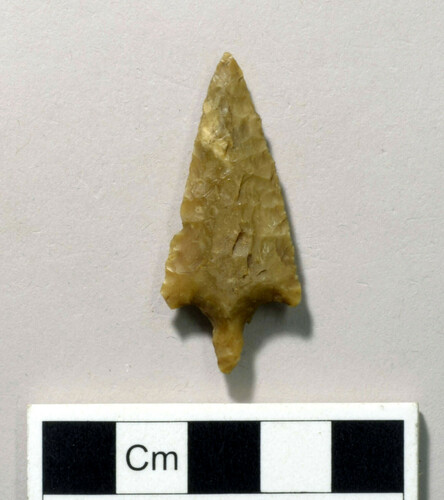 1884.140.1678.7Stone arrow-head1884.140.1678.7
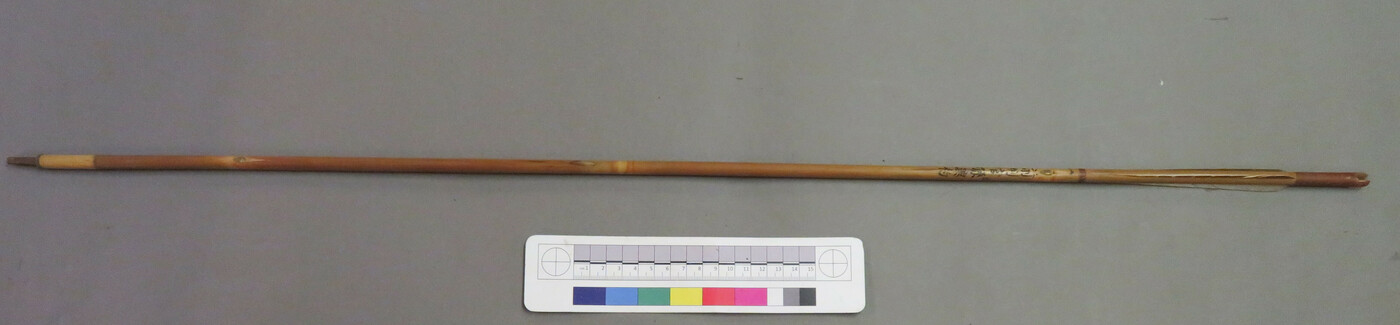 1906.79.6.2Arrow. For the associated quiver see [1906.79.6 .1] and arrows see [1906.79.6 .2 - .8] [BS [OPS move] 13/10/2017]1906.79.6.2
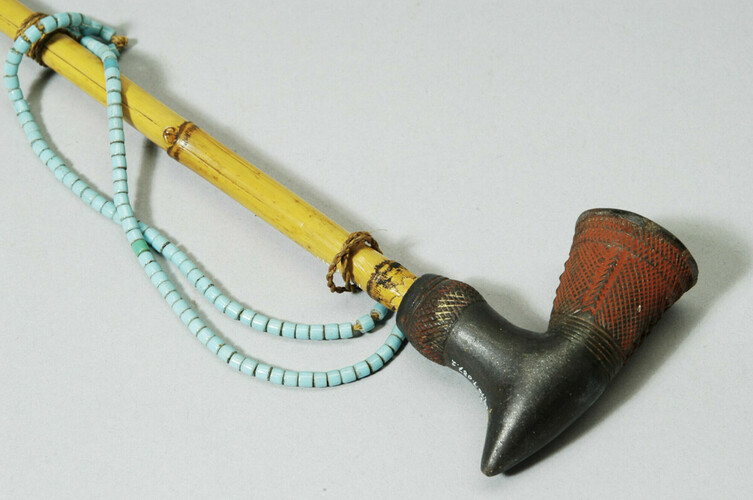 1940.7.087.1Tobacco pipe with cane stem and beaded carrying loop [.1] and a black pottery pipe bowl with ochre filled geometric decoration [.2] [RTS 7/3/2005].1940.7.087.1
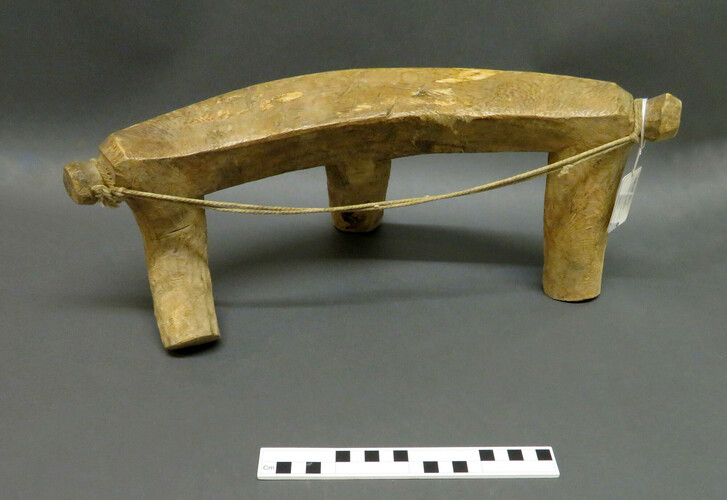 1979.20.87Wooden 3-legged headrest with twisted cord handle [RTS 22/3/2005].1979.20.87
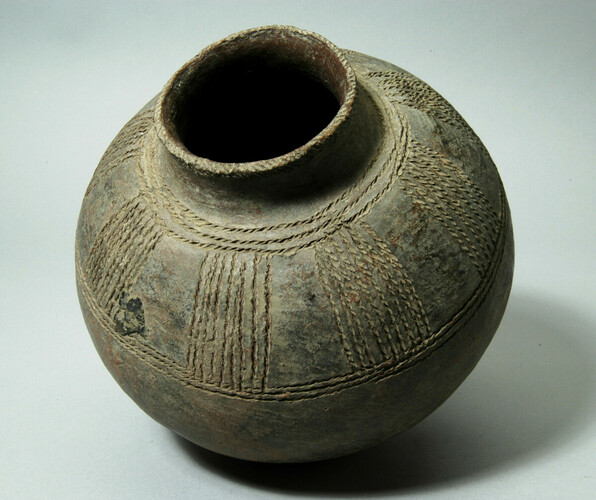 1979.20.135Reddish brown pottery jar with narrow neck, globular body and convex base, decorated with rouletted lines on upper body and rim [RTS 3/12/2004].1979.20.135
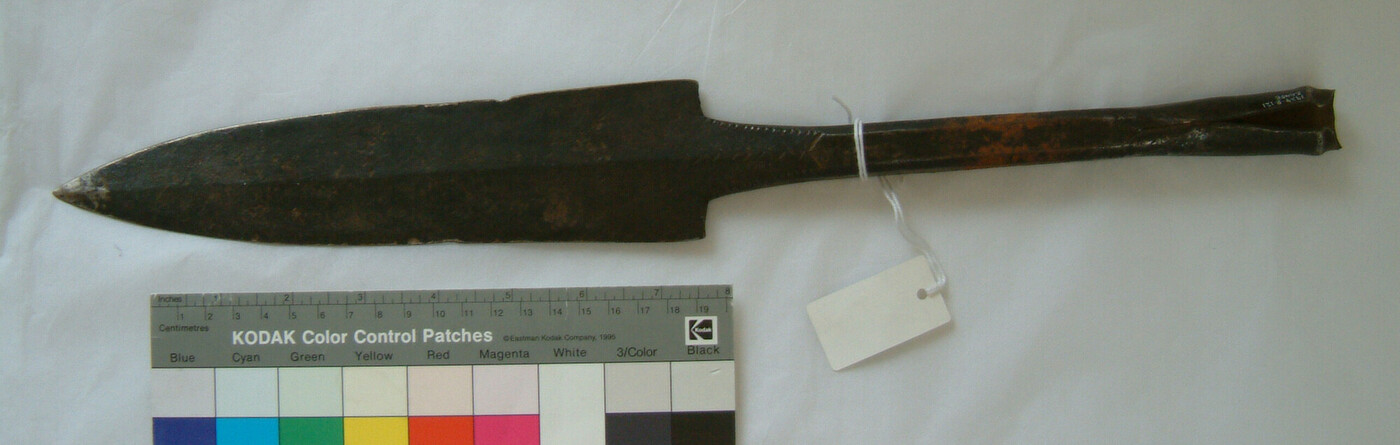 1934.8.121Iron spear-head with narrow triangular blade on a solid, decorated shank with socketed base [RTS 27/6/2005].1934.8.121